
Installation of a GREE All Match Slim Duct R32 ducted heat pump in Sainte-Rose, Laval: discreet comfort, custom ducts, and clean HVAC integration
AirGreen installs a GREE All Match Slim Duct R32 ducted heat pump in Sainte-Rose, Laval: discreet comfort, custom ducts, HVAC efficiency, and clean integration for uniform air distribution.
- City
- Region
- Equipment
- Brand
- Challenges
- Published
The job on one screen
The article, chapter by chapter
A ducted installation designed to disappear into the architecture while improving comfort
In Sainte-Rose, in the northern Laval area, our AirGreen team completed an HVAC installation that required much more than just installing a device: it was necessary to integrate a GREE ducted heat pump solution capable of distributing air evenly while maintaining a very discreet interior aesthetic. The choice of a Ducted – Slim Duct – Ductable – Ducted Systems system was obvious because it allows supplying multiple zones from a hidden indoor unit, with well-positioned air outlets and a duct network built according to the building's constraints.
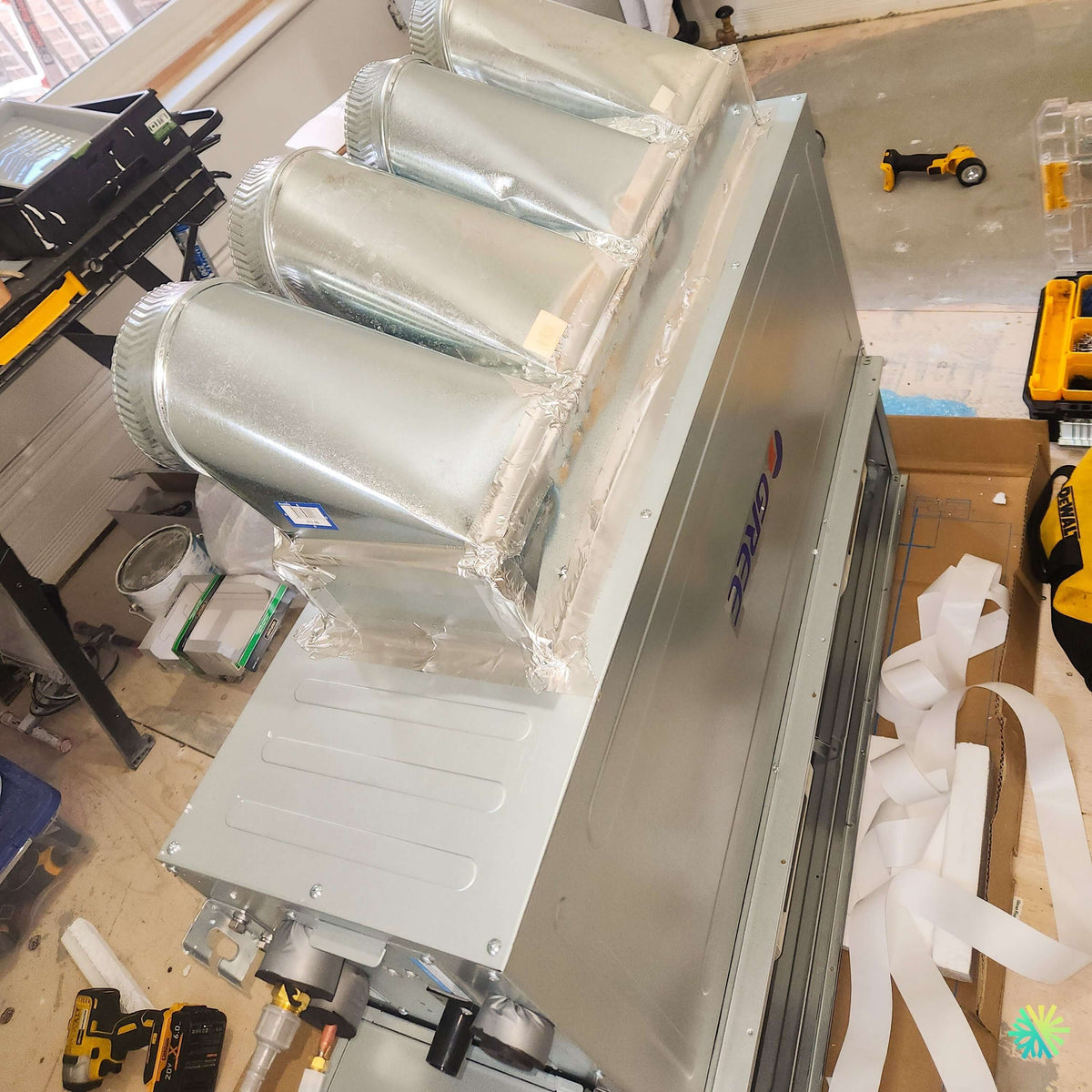
The photo of this project shows an essential part of the work: the GREE ducted unit equipped with several round sheet metal outlets, carefully connected, sealed, and insulated. This type of installation requires particular precision because the final performance depends not only on the brand or BTU capacity. It also depends on the quality of the duct network, the balancing of airflow, the available static pressure, the unit's location, accessibility for HVAC maintenance, and how the supply and return grilles are integrated into the rooms.
At AirGreen, we regularly install ducted systems in Montreal, Laval, Longueuil, on the North Shore and the South Shore, especially in renovated houses, high-end condos, open-concept apartments, and properties where clients want to avoid the visible appearance of a traditional wall unit. In Sainte-Rose, the project aimed precisely for this result: to achieve stable, quiet, and well-distributed comfort without multiplying visible units on the walls.
Why a GREE ducted system for this installation in Sainte-Rose
The installed system is part of the GREE ducted solutions family, including the All Match Slim Duct R32 options available in several capacities, notably 9,000, 12,000, 18,000, 24,000, 30,000, and 36,000 BTU depending on configurations. This flexibility allows designing a solution adapted to the building's actual thermal load, the number of rooms to serve, and the length of the duct network.
In this type of project, we never choose a capacity solely based on the area. We evaluate several concrete elements:
- the insulation of the house or condo;
- the sun exposure;
- the ceiling height;
- the number of windows;
- the heat losses and gains;
- the volume of air to be distributed;
- the possible duct lengths;
- the required static pressure;
- the available space for the indoor unit;
- the client's expectations regarding noise, comfort, and appearance.
The GREE All Match Slim Duct R32 is particularly interesting when you want a compact, discreet, and efficient installation. Its ducted format allows placing the unit in a technical space, a false ceiling, an open ceiling during renovation, an accessible attic, or a place designed for mechanical integration. The air is then distributed through ducts to different rooms, providing a more uniform comfort sensation than a single wall-mounted air outlet.
An installation where air distribution was the heart of the project
In this installation in Sainte-Rose, the visible work in the photo illustrates the importance of the distribution network. The round outlets installed on the plenum allow feeding several ducts, each intended for a specific zone or outlet. The challenge was not just to connect ducts: it was necessary to create a coherent, airtight, and balanced system.
Each fitting has been carefully prepared to limit air leaks, reduce pressure losses, and maintain a stable flow. The joints have been sealed, the transitions adjusted, and the outlets positioned to facilitate the rest of the installation. In a ducted system, a small oversight at the fittings can lead to reduced performance, a room that is less well air-conditioned or heated, or even unpleasant air noise. That is why we pay special attention to the details that are almost invisible once the ceiling is closed.
The client wanted a comfortable solution, but above all discreet. The ducted system meets this need very well, as the visible elements are generally limited to well-chosen grilles. The final result avoids the visual impact of a wall unit in living spaces, while benefiting from a high-performance heat pump for heating and cooling.
The technical steps that make the difference in a ducted installation
Building analysis and concept validation before installation
Before starting the work, we validated the location of the indoor unit, the duct route, structural constraints, and future access for service. This step is essential in a ducted HVAC installation, because once the ducts are integrated, adjustments become much more complex than with a wall-mounted heat pump.
We also studied how the air should circulate in the residence. A good ducted system is not just about blowing cold or hot air into several rooms. It must also allow for adequate air return. Without a well-designed air return, distribution becomes unbalanced, closed doors can hinder circulation, and some areas may become less comfortable.
For this installation in Sainte-Rose, the goal was to create a logical flow, with short ducts when possible, well-positioned outlets, and a configuration capable of ensuring good comfort in the served spaces.
Manufacturing and fitting the ducts
The duct network is one of the most important elements of this project. The round outlets visible in the photo were prepared to connect the ducts to the different zones. This type of work requires a good understanding of static pressure, airflow, and losses caused by elbows, duct lengths, and transitions.
A common mistake in ducted installations is underestimating the importance of duct diameter. A duct that is too small increases air velocity, which can create noise and limit airflow. A poorly sealed duct can reduce system efficiency and force the unit to work longer to reach the desired temperature. Poor balancing can cause one room to receive too much air while another receives too little.
At AirGreen, we treat every duct outlet as a critical part of the installation. Connections must be solid, joints must be airtight, and the network must remain as accessible as possible for inspection or HVAC maintenance.
Integration of the GREE unit and preparation of connections
The GREE ducted unit installed in Sainte-Rose was prepared for integration into the network. Refrigerant, electrical, drainage, and control connections must be precisely planned. In a ducted heat pump, condensate drainage requires special attention, especially if the unit is installed in a ceiling or space where a leak could cause damage.
We always check:
- the drainage slope;
- the possibility of using a condensate pump if necessary;
- access to the filter;
- access to the service panel;
- the space around the unit for future interventions;
- the mechanical stability of the installation;
- the quality of supports;
- the airtightness of air connections.
This attention to detail is especially important in homes in Laval and surrounding areas, where renovations can present unexpected constraints: low ceilings, existing joists, load-bearing walls, limited mechanical spaces, or duct passages already occupied by plumbing and electrical systems.
Performance, efficiency, and subsidy eligibility
The GREE ducted heat pumps offered by AirGreen include Energy Star models, some of which may be eligible for subsidy programs depending on the installed combination, applicable criteria, and requirements in effect at the time of the work. For customers in Montreal, Laval, Longueuil, the North Shore, and the South Shore, this aspect is often important, as a good HVAC solution must be evaluated based on its initial cost, seasonal performance, and long-term savings potential.
The refrigerant R32, used in the GREE All Match Slim Duct R32 series, also represents an advantage in recent installations. It allows for a modern design and meets current expectations for energy performance. For the client, this translates into a solution adapted to heating and cooling needs, with technology well aligned with current residential market standards.
However, it should be remembered that a machine that is efficient on paper does not automatically mean an efficient installation in the field. The actual performance depends on sizing, installation quality, duct tightness, airflow balancing, and overall configuration. This is precisely where the experience of a specialized HVAC contractor becomes crucial.
Acoustic comfort: an often underestimated aspect
Acoustic comfort was an important point in this project. Ducted systems can be very discreet, but only if they are well designed. Poor duct sizing, too high static pressure, or poorly chosen grilles can create air noise that becomes irritating daily.
To avoid this problem, we paid attention to the transition between the unit and the ducts, the diameters used, the quality of sealing, and the distribution to the different outlets. The goal was for the client to enjoy consistent comfort without perceiving the system as intrusive.
In many installations carried out by AirGreen in Montreal and Laval, we have found that clients who choose a ducted system often seek the same balance: performance, discretion, and silence. It’s a type of project where execution matters as much as the choice of the device.
Mistakes to avoid with a ducted heat pump
A ducted heat pump can deliver remarkable results, but only if it is installed correctly. Here are the most common mistakes we help our clients avoid:
Choosing a BTU capacity without actual calculation
A device that is too large can cause short cycles, reduce dehumidification, and harm comfort. A device that is too small may run too long and never reach the expected comfort level during very hot or very cold days.
Neglecting static pressure
Static pressure determines the fan’s ability to push air through the ducts. In a ducted project, it must be validated according to the actual network, not a general assumption.
Installing ducts that are too long or improperly sized
Every foot of duct, every elbow, and every transition affects airflow. A poorly designed network can turn a good device into a disappointing system.
Forgetting service access
An inaccessible filter or a blocked service panel can complicate maintenance. We always plan access to important components.
Underestimating drainage
Condensate must be properly drained. An inadequate slope or a poorly placed pump can cause costly problems.
The customer experience: a technical project, but clear from start to finish
For this project in Sainte-Rose, we took the time to explain the steps to the client, including the difference between a traditional wall solution and a ducted solution. Many homeowners like the idea of invisible comfort but don’t always realize that the duct network is a major part of the project. Our role is to make this technical part understandable and to propose a realistic solution.
We presented the advantages of the GREE system, installation requirements, possible constraints, and expected results. This transparency is an essential part of our approach. Before work begins, the client must understand what will be installed, why certain decisions are made, and how the installation will be completed.
The result is a clean, well-structured solution adapted to the space. The ducted unit allows for a discreet interior while providing heating and cooling distributed in targeted zones. This is exactly the type of project where AirGreen’s expertise in HVAC installation truly shines.
Why choose AirGreen for a ducted installation in Laval
Ducted installations require a team capable of working as refrigeration technicians, HVAC installers, and air distribution specialists. At AirGreen, we are used to managing this type of project in various environments: single-family homes, condos, multi-unit buildings, major renovations, and high-end residential projects.
Our concrete advantages for this type of installation:
- expertise with GREE ducted systems with low and high static pressure;
- knowledge of the specific constraints of buildings in Laval, Montreal, Longueuil, the North Shore, and the South Shore;
- installations carried out by professional refrigeration technicians;
- detailed quotes and transparent pricing;
- support for options eligible for subsidies;
- $5,000,000 liability insurance;
- structured after-sales service;
- access to original parts and best diagnostic practices.
This installation in Sainte-Rose clearly shows that a ducted system is not just a device. It is a complete project: machine selection, network design, duct installation, sealing, drainage, connections, startup, balancing, and usage advice.
Discreet comfort for Sainte-Rose, designed with precision
The GREE ducted system installed in this project meets an increasingly common demand: to achieve the comfort of a modern heat pump without changing the interior appearance of the rooms. For owners who prefer a clean finish, clear walls, and even distribution, the Slim Duct represents a very relevant solution.
In Sainte-Rose, this project allowed for the integration of a discreet and efficient HVAC solution in a space where every detail mattered. The ducts visible during installation demonstrate technical work that will be almost entirely hidden once the finishing is complete. This is often the mark of a good installation: a lot of precision behind the walls and ceilings, for a final result that is simple, comfortable, and elegant every day.
At AirGreen, we continue to recommend GREE ducted systems when the building is suitable and the client is looking for a well-integrated solution. For a house in Laval, a condo in Montreal, a project on the North Shore, or a renovation on the South Shore, ducted systems can offer an excellent balance between comfort, aesthetics, and energy efficiency, provided they are designed and installed by a team that truly masters this type of system.
The job tools
Two quick checks with real numbers: what heat costs, and what your current heaters add up to in BTU/h.
Conversion: 1 W = 3.412 BTU/h. An indication, not a load calculation: baseboards and furnaces are often stronger than the real need, and they can stay as backup. AirGreen confirms the capacity on site.
How the job unfolds
The main steps of this kind of job at AirGreen. Every house has its quirks: the estimate brings them out.
We look at the ducts, the current indoor module, the electrical panel and the planned spot for the outdoor unit.
The equipment combination, capacity and price, in writing. We check whether the combination qualifies for assistance programs.
Access protected, old unit disconnected and removed when it is being replaced.
Electric furnace or air handler, with its coil, connected to the supply and return ducts.
On a level base, raised above the snow, with free space all around.
Insulated, they enter through a sealed opening and run to the indoor coil.
Dedicated circuits, accessible disconnect, a thermostat that works with the heat pump and the backup heat.
Leak test, vacuum, start-up, airflow check and a test of both modes.
Filter, thermostat, backup heat in extreme cold: what to know before winter.
- The on-site estimateWe look at the ducts, the current indoor module, the electrical panel and the planned spot for the outdoor unit.
- The quoteThe equipment combination, capacity and price, in writing. We check whether the combination qualifies for assistance programs.
- Getting readyAccess protected, old unit disconnected and removed when it is being replaced.
- The indoor moduleElectric furnace or air handler, with its coil, connected to the supply and return ducts.
- The outdoor unitOn a level base, raised above the snow, with free space all around.
- The refrigerant linesInsulated, they enter through a sealed opening and run to the indoor coil.
- Electrical and thermostatDedicated circuits, accessible disconnect, a thermostat that works with the heat pump and the backup heat.
- Tests and start-upLeak test, vacuum, start-up, airflow check and a test of both modes.
- The walkthroughFilter, thermostat, backup heat in extreme cold: what to know before winter.
What we check on a job like this one
Each number is a point we check on site. Switch between summer and winter to watch air and heat move.
In summer, the outdoor unit rejects the house's heat outside.
Generic illustration of this type of installation, not a survey of this job site. Tap a number.
It captures or rejects heat outside. It sits on a level base, above the snow, with free space all around.
The insulated refrigerant lines enter the house through a sealed opening and run to the indoor coil.
A shut-off switch near the outdoor unit isolates it safely for service.
Sitting on the indoor module, it moves heat between the house air and the refrigerant.
Electric furnace or air handler: its fan pushes air through the ducts. The electric backup takes over in extreme cold.
Supply ducts bring air to the rooms; returns bring it back to the unit. Their condition matters as much as the unit's.
It protects the coil and the fan. A dirty filter cuts airflow, so it gets checked regularly.
It runs the heat pump and the backup heat. It must be compatible with the installed system.
Is your home ready?
Check what applies at your place. A "no" is not a refusal: it is what we sort out during the estimate.
Good habits, once the unit is in place
Six simple habits that keep the unit going. Your list stays on this device.
What to do, season by season
Three habits per season for this unit. They take a few minutes and prevent many calls.
- Check the indoor module's filter.
- Clear winter debris from the outdoor unit.
- Test cooling before the heat arrives.
- Check the filter more often in peak season.
- Keep registers and returns clear.
- Watch condensate drainage near the coil.
- Change or clean the filter.
- Test heating and backup heat before the cold.
- Book periodic maintenance.
- Clear snow around the outdoor unit.
- Store nothing in front of the indoor module.
- Note any unusual noise or smell and call us.
The right pages, at the right time
Four statements: true or false?
It all comes down to details you have just seen.
1. A central heat pump uses the house's ducts.
It connects to the existing ducts to heat and cool everywhere.
2. In extreme cold, electric backup heat can take over.
The indoor module (furnace or air handler) works with the heat pump and takes over in extreme cold.
3. The filter only gets changed when the unit breaks down.
A dirty filter cuts airflow. It gets checked regularly.
4. You can reuse the old unit's size without checking.
The house may have changed: insulation, windows, added rooms. Capacity is confirmed on site.
0 / 4 right answers
What people ask us about this kind of work
Can I keep my current ducts?
What happens in extreme cold?
Furnace, air handler, ducted: what is the difference?
Are there grants?
Do I need a permit?
How much can I save?
How is the LogisVert assistance calculated?
Will my current thermostat work?
Central or wall units: which one?
Does AirGreen hold the required licences?
Is the estimate free?
No question matches. Write to us: we answer.
More jobs to see, near you
By town, by equipment or by region: browse more than 4,700 published projects.
Each dot: a town where AirGreen has published projects. The glowing dot: this job.
An on-site estimate, the right capacity, the right equipment.
The on-site estimate is free and the quote follows within 24 hours.
Text and photo: a real AirGreen Climatisation & Chauffage job. The diagrams are generic illustrations of the type of installation, not a survey of this job site. Sources of the added figures: airgreen.ca product pages (NEEP / AHRI performance), Hydro-Québec (Heat pumps page, LogisVert, read on 13 October 2026), Régie de l’énergie (rate D as of 1 April 2026).