
Installation of a Hitachi airHome Multi dual-zone multi-zone heat pump in Chomedey, Laval
In Chomedey, AirGreen installs a Hitachi airHome Multi dual-zone heat pump on rooftop brackets, with protected lines, accessible power supply, and a layout designed for Laval’s climate.
In summer, the outdoor unit rejects the house's heat outside.
Generic illustration of this type of installation, not a survey of this job site. Tap a number.
Mounted level on a wall plate, high enough for the air to reach the whole room, with enough space around it to slide the filters out easily.
The refrigerant lines, the communication cable and the drain go through the wall in a single opening, sealed against water, cold air and insects.
Two insulated copper pipes connect the two units. Outside, a line cover can protect them from sun, knocks and weather.
A shut-off switch near the outdoor unit isolates it safely for service. It must stay accessible at all times.
The compressor and the fan. In heating mode it captures heat from the outdoor air, even in winter, and moves it inside.
On the ground or on the wall, it keeps the unit above accumulated snow. The unit stays clear and defrost water can drain away.
The fan needs to blow freely. Storage, a fence or a wall too close, and efficiency drops while noise goes up.
A flat-roof installation designed to free up ground space and protect the equipment
In Chomedey, Laval, we completed an installation of a Hitachi airHome Multi dual-zone multizone heat pump in a setting very different from a typical residential installation against an exterior wall. Here, the outdoor units had to be installed on a flat roof above the building, with a sufficiently neat, stable, and accessible refrigerant-line route to ensure the system's long-term reliability.
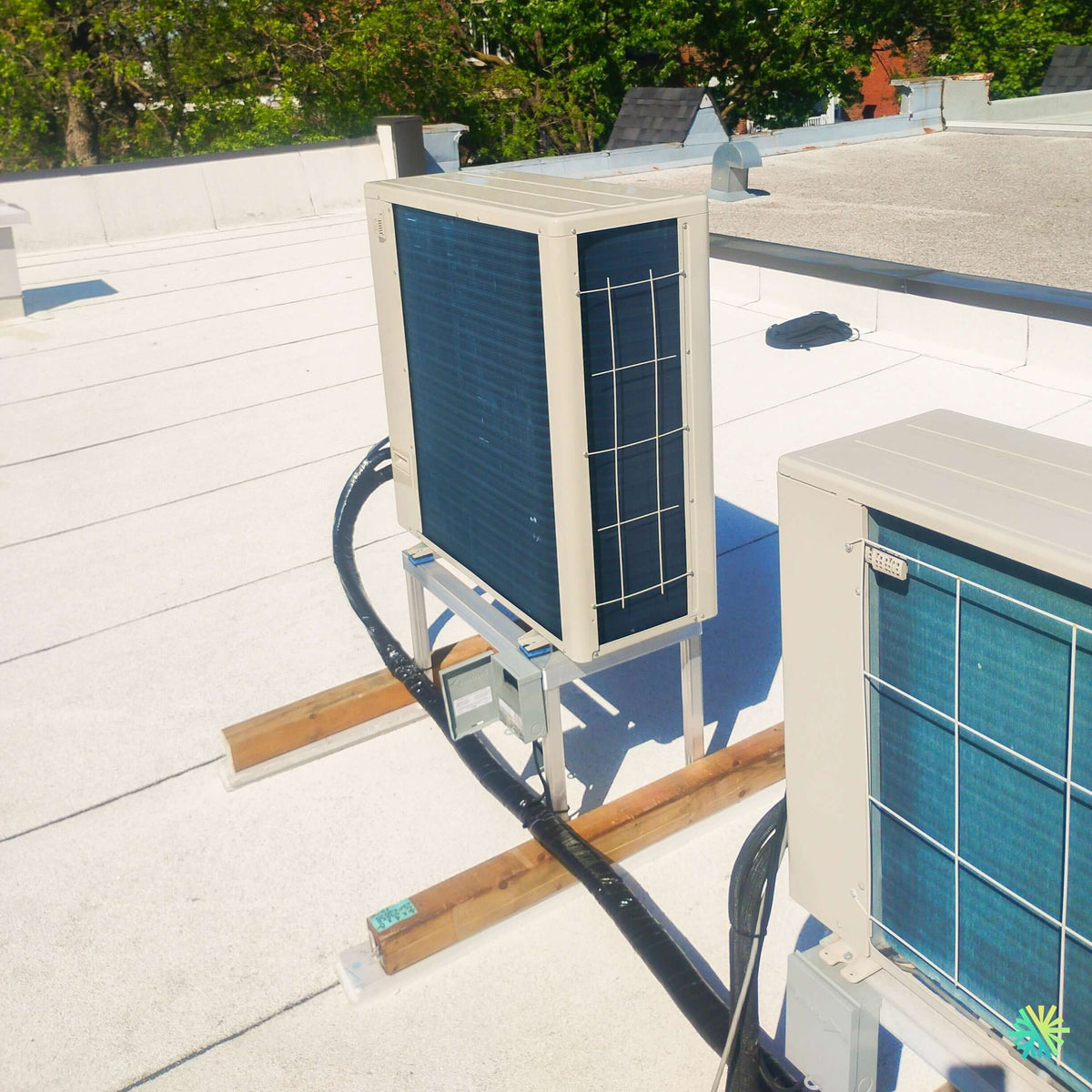
The project photograph immediately shows the main challenges of the worksite: a white roofing membrane, several HVAC units installed nearby, long refrigerant lines, outdoor electrical disconnects, and support structures that must not damage the building's roofing system.
A rooftop installation never consists simply of placing a heat pump on the membrane. Every detail must be planned to distribute the weight, limit wind-induced movement, facilitate maintenance, and prevent the lines from rubbing directly against the roof.
For this Chomedey residence, the Hitachi system was selected to supply two independent indoor zones from a single outdoor unit. This configuration provides better temperature control in two distinct sections of the building without unnecessarily multiplying the compressors associated with each room.
Why install a multizone heat pump on the roof?
In some Laval buildings, ground space is limited or unsuitable for accommodating an outdoor unit. Constraints may include:
- a narrow yard;
- a parking entrance;
- a shared passageway;
- a façade where the equipment would be too visible;
- condominium requirements;
- a high risk of snow accumulation;
- the presence of fences or obstacles;
- insufficient clearance from doors and windows.
A flat roof therefore becomes a logical solution, but only when its structure, membrane, and access points allow for a compliant and durable installation.
In this Chomedey project, placing the equipment on the roof offered several advantages. The units are away from traffic areas, take up no usable space around the building, and are located in a relatively open area where air can circulate around the heat exchangers.
This clearance remains essential. A heat pump absorbs or releases a significant amount of energy through its outdoor coil. If the warm or cold air expelled by one unit is immediately drawn in by another, performance may decrease. We must therefore consider the distance between the units, the orientation of the coils, prevailing winds, and the presence of parapets.
A raised base without unnecessary membrane perforation
The visible units are placed on raised metal supports. These supports themselves rest on long wooden pieces that distribute the load over a larger surface area.
This method prevents a narrow foot or a metal edge from exerting concentrated pressure directly on the membrane. It also reduces the risk of punctures caused by vibrations or seasonal movement.
The wooden pieces were arranged to create a stable base, while the aluminum supports keep the units above the roof. This elevation offers several benefits:
- it keeps the bottom of the units away from rainwater;
- it facilitates drainage during defrost cycles;
- it limits exposure to small snow accumulations;
- it improves access to the lines and valves;
- it prevents the lower panels from remaining in damp conditions;
- it makes it easier to inspect the membrane beneath and around the units.
On a flat roof in Laval, water must never be considered a secondary detail. Even a properly installed membrane may have areas where water temporarily accumulates after heavy rain or during snowmelt. A unit installed too low could then be exposed to persistent moisture.
The challenge of wind on an open roof
A ground-mounted outdoor unit is often partially protected by the house, a fence, or landscaping. On a roof, it can be much more exposed to the wind.
This exposure affects several factors:
- support stability;
- vibrations;
- forces applied to the lines;
- possible deformation of the panels;
- defrost cycles;
- the irregular accumulation of snow around the unit.
We must therefore ensure that the support structure is properly assembled and that the unit is securely fastened. The lines must retain some flexibility, without being left free to move in the wind.
In the photograph, the insulated lines follow a controlled route between the equipment and their entry point into the building. Their black outer covering protects the insulation and keeps the components more organized.
A dual-zone heat pump for two distinct comfort needs
The Hitachi airHome Multi system allows one outdoor unit to power multiple indoor units. In a dual-zone configuration, two indoor units are connected to the same compressor.
Each indoor unit can be adjusted separately. Occupants can choose:
- a temperature specific to each room;
- a different fan speed;
- a schedule adapted to how each space is used;
- turning off an unoccupied zone;
- more sustained operation in a sun-exposed room.
This independence significantly improves comfort compared with a single system that would attempt to condition the entire building from one location.
The Hitachi brochure states that an airHome Multi outdoor unit can serve up to five indoor units, depending on the model. Each zone has its own setpoint and settings, but the system as a whole operates in a compatible seasonal mode: cooling in summer or heating in winter.
An essential clarification about multizone operation
A multizone system generally cannot heat one room while cooling the other simultaneously. Both indoor units must operate in compatible modes.
In summer, the zones can usually be set to:
- cooling;
- dehumidification;
- ventilation.
In winter, they can operate in:
- heating;
- ventilation.
One unit can be turned off while the other remains active. This flexibility meets most residential needs, but it must be explained before installation, particularly when two spaces have very different conditions.
For example, a heavily sunlit room can become warm in spring while a shaded room remains cool. In this situation, a traditional multizone heat pump cannot provide cooling in one zone and heating in the other at the same time.
The technical details that determine the quality of a rooftop installation
The Hitachi RAM-G18N2HAA dual-zone model
Within the airHome Multi range, the outdoor model designed for two indoor connections is the Hitachi RAM-G18N2HAA. It offers a nominal capacity of 18,000 BTU/h in cooling and 22,000 BTU/h in heating.
The modulated capacity may vary depending on demand and the combination of connected indoor units. For a ductless configuration, the documentation indicates a cooling range of approximately 20,500 BTU/h and a heating range of up to approximately 24,000 BTU/h under certain conditions.
This modulation is made possible by Inverter technology. The compressor does not operate constantly at full power. It adjusts its speed to respond more precisely to the building’s thermal load.
This feature helps to:
- reduce temperature fluctuations;
- improve comfort;
- limit repeated starts;
- reduce consumption when demand is low;
- maintain more stable operation.
Efficiency of up to a TRÉS2 of 23.0
According to the ductless combination indicated by Hitachi, the dual-zone system can achieve a TRÉS2 of 23.0 and a region 5 CPSC2 of 7.85.
TRÉS2 represents seasonal cooling efficiency. The higher this value, the more cooling the system can produce with a given amount of electricity under the standardized conditions used for the assessment.
CPSC2 concerns seasonal heating efficiency. For a homeowner in Chomedey, this data is particularly important because the heat pump will be used during much of the fall, winter, and spring.
However, it is important to avoid comparing only the maximum figures listed in a brochure. Actual performance depends on several factors:
- the exact capacity of the indoor units;
- pipe length;
- building insulation;
- air tightness;
- temperature settings;
- outdoor conditions;
- maintenance;
- the quality of the commissioning.
Heating down to -20 °C: what it really means
The airHome Multi series can continue operating in heating mode down to an outdoor temperature of -20 °C. This value represents the stated operating limit, not the retention of the full rated capacity.
For the dual-zone model, the documentation indicates a maximum capacity of approximately:
- 14,300 BTU/h at -15 °C;
- 9,700 BTU/h at -20 °C.
This decrease is normal. The lower the outdoor temperature, the less readily recoverable heat the air contains, and the harder the system must work to transfer that energy indoors.
At AirGreen, we take this capacity curve into account when evaluating a project. A heat pump can cover a large portion of annual heating needs without necessarily replacing every form of supplemental heating on its own during the coldest periods.
In a Laval building, the appropriate strategy may be to use the heat pump as the primary heating source for most of the season, while retaining electric baseboard heaters or another source for periods of extreme cold.
Weather-protected refrigerant lines
The image of this installation in Chomedey shows a long set of lines covered with a black jacket. On a rooftop, this protection plays an essential role.
Refrigerant lines normally include:
- a liquid line;
- an insulated gas line;
- a communication cable;
- sometimes other conductors depending on the configuration.
The insulation must be protected from ultraviolet rays, water, birds, and mechanical damage. Insulation exposed directly to sunlight can deteriorate, crack, and gradually lose its effectiveness.
When the insulation is damaged, several problems may arise:
- condensation;
- loss of efficiency;
- moisture around the lines;
- accelerated deterioration;
- refrigerant temperature variations;
- neglected appearance.
We therefore ensure that the lines are grouped, protected, and supported. They must not rest freely on the membrane or form loops that could retain water.
The piping limits of the dual-zone system
For the RAM-G18N2HAA model, Hitachi specifies a maximum total piping length of 165 feet, or approximately 50 metres. The maximum length between the outdoor unit and an indoor unit can reach approximately 82 feet, subject to the manufacturer's requirements.
The maximum total height permitted is 66 feet, and a minimum length must also be observed.
These values make the range suitable for rooftop installation, as the indoor units may be several floors lower or a certain horizontal distance away. However, it is not enough to stay below the maximum limit.
Each run must also be checked for:
- pressure losses;
- the amount of additional refrigerant;
- the elevation difference;
- oil return;
- mechanical protection;
- the number of elbows;
- access to the connections.
Refrigerant connections and evacuation
The dual-zone model has two liquid connections 1/4 po and two gas connections 3/8 po.
The quality of the flared connections directly affects the system’s tightness. We use appropriate tools to achieve a uniform surface and proper tightening.
The procedure includes, among other things:
- preparing the tubing;
- flaring;
- tightening to the appropriate torque;
- pressure testing;
- leak detection;
- evacuating the system;
- checking that the vacuum is maintained;
- opening the valves;
- operational tests.
On a roof, a future leak would be particularly difficult to address, as access requires more time and preparation. Installation precision is therefore essential.
R32 refrigerant and associated precautions
The airHome Multi system uses R32 refrigerant. This refrigerant is commonly used in new generations of high-efficiency heat pumps.
Its use requires trained personnel, compatible tools, and strict adherence to the prescribed procedures. The compatible indoor units also include a refrigerant leak sensor. Depending on the type of unit, a visual or audible alarm may be provided directly or through an accessory.
However, safety features do not replace a watertight installation. They provide additional protection.
Accessible disconnect switches near the units
The photograph shows electrical boxes installed near the outdoor units. These disconnect switches allow the power supply to be shut off locally during maintenance or technical work.
The dual-zone model operates at 208-230 V, single-phase, 60 Hz. Its documentation specifies a minimum circuit ampacity of 16 A and maximum overcurrent protection of 25 A.
The final values must always be confirmed on the nameplate of the delivered equipment. The circuit breaker must never be selected solely according to the BTU capacity.
A proper electrical installation includes:
- a dedicated circuit;
- properly sized wiring;
- appropriate protection;
- an accessible disconnect switch;
- weatherproof connections;
- proper grounding;
- mechanical protection for exposed conductors.
Several types of compatible indoor units
The Hitachi airHome Multi system can be combined with several indoor unit formats, including:
- airHome 400 wall-mounted unit;
- airHome 650 wall-mounted unit;
- airHome Floor floor console;
- mini cassette;
- ducted unit.
In a dual-zone project in Chomedey, it is therefore possible to select two different formats according to the characteristics of the rooms.
A wall-mounted unit can be installed in an open area, while a ducted unit can serve an area where you want to reduce the visual impact. A floor console can be useful when there is not enough wall space at a higher level.
This flexibility must not turn into an improvised selection. Each indoor unit has its own capacity, dimensions, airflow, and piping requirements.
Comfort and air quality features
Some indoor units compatible with airHome Multi offer FrostWash technology. This function uses a freeze-and-thaw cycle to help clean the indoor coil.
Mold Guard mode extends ventilation after certain cooling or dehumidification operations to dry the internal components for approximately 60 minutes. This action is intended to reduce conditions that promote odors and mold.
Depending on the selected unit, the system may also include:
- a PM2.5 activated carbon filter;
- a ViroSense S filter;
- a motion detector;
- Smart Eco mode;
- automatic shutoff;
- the optional airCloud Go interface.
The airCloud Go app lets you manage certain functions remotely, schedule operation, and monitor system usage.
Mistakes to avoid when installing on a flat roof
Placing equipment directly on the membrane
Weight and vibration can damage the roof. A suitable base must distribute the load and keep metal components away from the membrane.
Leaving pipes on the ground without support
Pipes can move in the wind, rub against the roof, or retain water. They must be protected and securely fastened in a controlled manner.
Neglecting clearance between units
Two units placed too close together can recirculate the discharged air and reduce their efficiency. The required clearance depends on their design and orientation.
Forgetting about future access
Valves, disconnect switches, electrical panels, and coils must remain accessible. A compact installation must not become impossible to service.
Underestimating defrost water
In heating mode, the heat pump must periodically defrost its coil. The water produced must be able to drain away without creating a significant sheet of ice beneath the equipment.
Using unprotected exterior insulation
Sun and exposure to the elements can quickly damage insulation. UV-resistant protection is essential on a roof.
An installation suited to the building rather than a standardized solution
This Hitachi heat pump installation in Chomedey demonstrates why every HVAC installation must be adapted to the building.
On a typical home, we can often install the compressor on a wall bracket or on a base near the ground. On this flat roof in Laval, we had to approach things differently:
- distribute the weight;
- protect the membrane;
- elevate the units;
- secure the lines;
- organize the electrical connections;
- maintain clearances;
- plan for future service work.
The result is a well-structured installation where the equipment remains accessible and the technical routes are clearly identifiable.
A Suitable Solution for Chomedey, Laval, and Greater Montreal
Multi-zone heat pumps are particularly well suited to duplexes, multistory homes, condos, and buildings with rooms located far from one another.
We carry out this type of HVAC installation in Montreal, Laval, Longueuil, the North Shore, and the South Shore. The constraints vary depending on the building: brick wall, flat roof, balcony, alley, condominium, or narrow side passage.
In all cases, our objective remains the same: to design an installation that aligns with the architecture, comfort needs, and technical requirements of the equipment.
Warranty and Maintenance of the Hitachi airHome Multi System
Hitachi documentation indicates a standard seven-year warranty on the compressor and five years on parts. For an eligible residential installation, online registration may provide extended coverage of ten years on the compressor and ten years on parts.
An enhanced warranty may also be available, subject to the applicable terms, registration, and selected options.
The owner must retain:
- the installation invoice;
- the model numbers;
- the serial numbers;
- the commissioning date;
- proof of registration;
- the warranty documents.
For a rooftop installation, HVAC maintenance must include a visual inspection of the supports, lines, outdoor protection, and disconnect switches. The membrane around the equipment must also remain free of debris.
Indoor filters must be cleaned regularly. Coils, fans, drains, and electrical connections must be checked periodically to maintain stable operation.
This installation in Chomedey therefore represents much more than adding a heat pump. It combines a dual-zone configuration, a flat-roof installation, and execution adapted to Laval’s climate.
How it goes, from the first call to the end
The main steps of this kind of job at AirGreen. Every house has its quirks: the estimate brings them out.
We look at the room, the outside wall, the line route and where the outdoor unit will go. That is where the capacity gets chosen.
Model, capacity and price, in writing. We also check whether the model qualifies for assistance programs.
Floors and furniture protected, wall plate position marked level, wall opening located.
A single opening, with the slope the drain needs to flow outside.
Set on a stand raised above the snow, with the clearances the manufacturer requires.
Connected, insulated and protected. The opening is then sealed against water, cold air and insects.
A dedicated circuit and an accessible disconnect near the outdoor unit.
Leak test, vacuum, then start-up and a check of heating and cooling.
Remote, modes, filters: we show you the essentials before we leave.
- The on-site estimateWe look at the room, the outside wall, the line route and where the outdoor unit will go. That is where the capacity gets chosen.
- The quoteModel, capacity and price, in writing. We also check whether the model qualifies for assistance programs.
- Getting readyFloors and furniture protected, wall plate position marked level, wall opening located.
- The wall openingA single opening, with the slope the drain needs to flow outside.
- The outdoor unitSet on a stand raised above the snow, with the clearances the manufacturer requires.
- Lines, cable and drainConnected, insulated and protected. The opening is then sealed against water, cold air and insects.
- The electrical workA dedicated circuit and an accessible disconnect near the outdoor unit.
- Tests and start-upLeak test, vacuum, then start-up and a check of heating and cooling.
- The walkthroughRemote, modes, filters: we show you the essentials before we leave.
And at your place?
Two quick checks with real numbers: what heat costs, and what your current heaters add up to in BTU/h.
Conversion: 1 W = 3.412 BTU/h. An indication, not a load calculation: baseboards and furnaces are often stronger than the real need, and they can stay as backup. AirGreen confirms the capacity on site.
What to do, season by season
Three habits per season for this unit. They take a few minutes and prevent many calls.
- Clean the indoor unit's filters.
- Clear leaves and debris left on the outdoor unit by winter.
- Test cooling before the first hot days.
- Clean the filters more often when the unit runs a lot.
- Keep plants away from the outdoor unit.
- Check that no water drips from the indoor unit.
- Rake the leaves around the outdoor unit.
- Test heating before the first cold days.
- Book periodic maintenance before winter.
- Keep snow away from the stand and the front of the unit.
- Let the unit defrost: it is normal.
- Never hit the ice on the fins; call us if the unit stays iced up.
Which type of equipment for your project?
Pick what looks like your need.
Four mistakes we do not make
Flip each card to see what we do instead.
What people ask us about this kind of work
Does a wall-mounted heat pump heat in winter?
Wall-mounted or multi-zone: how do I choose?
Where does the outdoor unit go?
Are there grants?
Do I need a permit?
How cold can it heat?
How much can I save?
How is the LogisVert assistance calculated?
Is it noisy?
The outdoor unit is covered in ice: is that normal?
Does AirGreen hold the required licences?
Is the estimate free?
No question matches. Write to us: we answer.
Useful pages for what comes next
More jobs to see, near you
By town, by equipment or by region: browse more than 4,700 published projects.
Each dot: a town where AirGreen has published projects. The glowing dot: this job.
Tell us about your house. We come and see it for free.
The on-site estimate is free and the quote follows within 24 hours.
Text and photo: a real AirGreen Climatisation & Chauffage job. The diagrams are generic illustrations of the type of installation, not a survey of this job site. Sources of the added figures: airgreen.ca product pages (NEEP / AHRI performance), Hydro-Québec (Heat pumps page, LogisVert, read on 13 October 2026), Régie de l’énergie (rate D as of 1 April 2026).