
Installation of a HITACHI airHome Multi triple-zone multi-zone heat pump in Montréal-Est
In Montréal-Est, AirGreen installs a HITACHI airHome Multi triple-zone heat pump on a pad and elevated supports, with organized lines, winter protection, and independent control of three zones.
Take a tour of the installation
Each number is a point we check on site. Switch between summer and winter to watch air and heat move.
In summer, the outdoor unit rejects the house's heat outside.
Generic illustration of this type of installation, not a survey of this job site. Tap a number.
Mounted level on a wall plate, high enough for the air to reach the whole room, with enough space around it to slide the filters out easily.
The refrigerant lines, the communication cable and the drain go through the wall in a single opening, sealed against water, cold air and insects.
Two insulated copper pipes connect the two units. Outside, a line cover can protect them from sun, knocks and weather.
A shut-off switch near the outdoor unit isolates it safely for service. It must stay accessible at all times.
The compressor and the fan. In heating mode it captures heat from the outdoor air, even in winter, and moves it inside.
On the ground or on the wall, it keeps the unit above accumulated snow. The unit stays clear and defrost water can drain away.
The fan needs to blow freely. Storage, a fence or a wall too close, and efficiency drops while noise goes up.
Three comfort zones, two HITACHI outdoor units, and a carefully organized mechanical installation
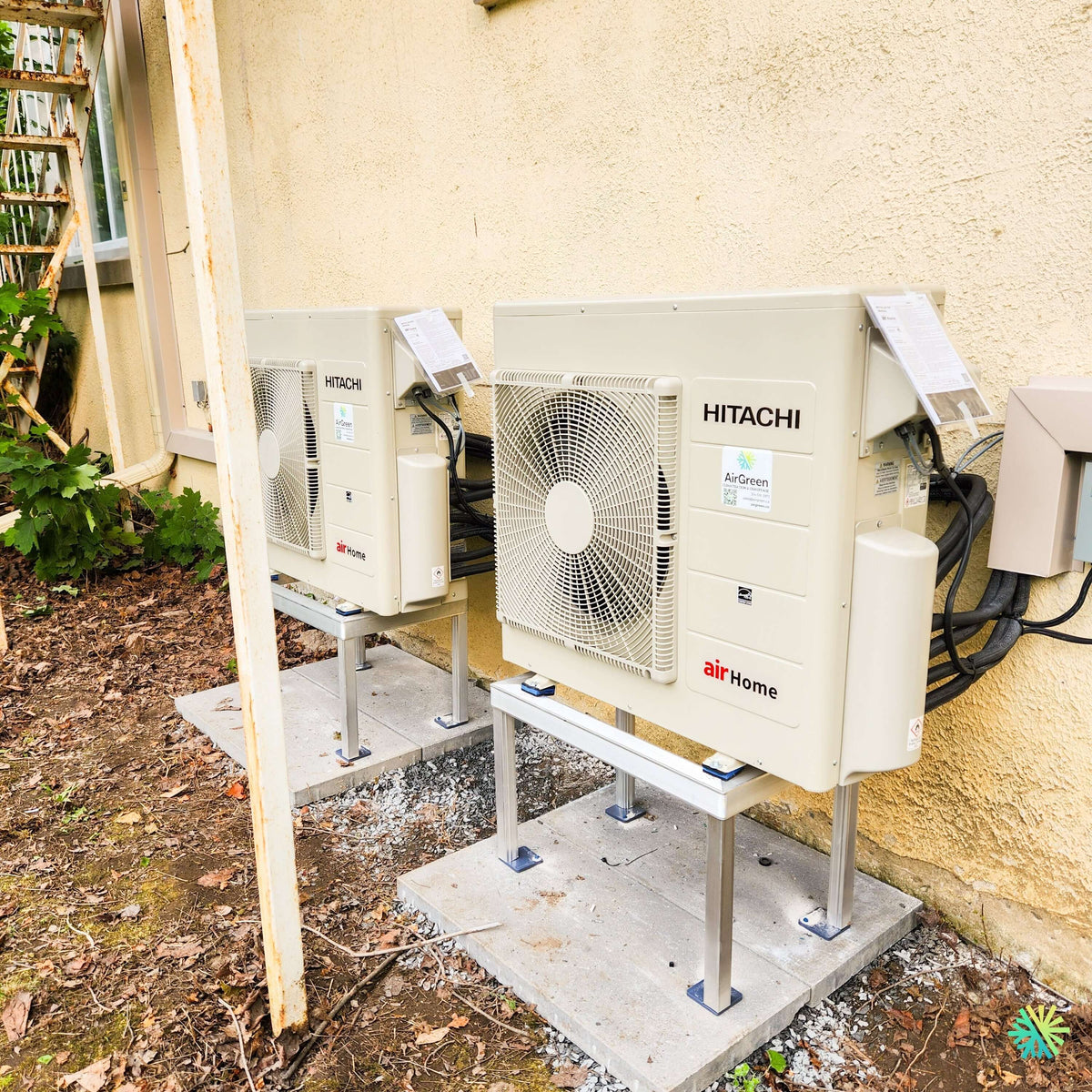
This multi-zone heat pump installation in Montréal-Est perfectly illustrates the constraints encountered when a building must be air-conditioned and heated by zones while having limited outdoor space. The project includes two HITACHI airHome outdoor units installed side by side along a stucco wall, each on an independent, elevated base.
The project presented here mainly concerns a HITACHI airHome Multi triple-zone heat pump, designed to power three indoor units from a single outdoor unit. The second HITACHI unit visible in the photo serves another part of the building or a separate circuit. The simultaneous presence of two units made installation planning particularly important: the units had to remain accessible, stable, and sufficiently clear without obstructing passage or complicating future service work.
The result shows several characteristic elements of a professional HVAC installation:
- two independent concrete slabs;
- elevated metal supports;
- anti-vibration pads beneath the equipment;
- front clearance for air discharge;
- refrigerant lines grouped behind the units;
- accessible electrical connections;
- an installation parallel to the building;
- a space kept clear near the existing exterior staircase.
In the older areas of Montréal-Est, we frequently work with narrow side yards, metal staircases, uneven walls, and existing equipment. Each new system must therefore be integrated with the existing setup rather than simply placed in the easiest location.
Why was a triple-zone heat pump suitable for this building?
A triple-zone configuration makes it possible to connect three indoor units to a single outdoor unit. It is suitable for buildings where needs differ significantly from one room, floor, or dwelling to another.
This solution is often chosen to address, for example:
- a living area on the ground floor;
- a bedroom or an upstairs area;
- an office, a basement, or a separate dwelling;
- three enclosed rooms that cannot be served effectively by a single wall-mounted unit;
- zones with different solar exposures and insulation levels.
Each indoor unit has its own control. Occupants can individually adjust the set temperature, fan speed, and airflow direction. A zone can also be turned off when the room is not in use, while the other two continue operating.
However, it is important to understand how a multi-zone heat pump works: the three indoor units share the same outdoor unit and must therefore use compatible modes. In summer, the system operates in cooling, dehumidification, or fan mode. In winter, the units are used for heating or fan mode. It is normally not possible to heat one zone while another simultaneously calls for cooling.
This detail sometimes influences the choice between a triple-zone system and several single-zone heat pumps. In this project, the multi-zone system made it possible to limit the number of outdoor units required to serve three spaces while maintaining independent indoor control.
An outdoor layout that respects the existing equipment
The construction-site photo shows that the space was not completely unobstructed. On the left, an exterior metal staircase runs down along the building. Its structure shows signs of wear and corrosion, making it all the more important to maintain a safe space between this element and the new heat pumps.
We also had to contend with:
- vegetation near the wall;
- a narrow passage;
- several conduit runs;
- electrical enclosures installed nearby;
- the need to maintain access to the units’ side panels;
- two units whose airflow needed to be kept from interfering with each other.
The heat pumps were aligned in the same direction, with their fans facing the open space. This arrangement promotes the discharge of expelled air and limits recirculation between the two units.
Placing two units facing each other or too close together can cause undesirable air exchange. In cooling mode, one unit could re-aspirate the hot air discharged by the other. In heating mode, it could draw in colder, more humid air, thereby increasing strain on the system and the frequency of defrost cycles.
Separate concrete slabs for a durable foundation
Each heat pump rests on its own concrete slab. This choice creates a stable base and facilitates the alignment of the metal supports.
The slabs protect the equipment in particular against:
- the settling of unstable soil;
- movement caused by freezing and thawing;
- direct contact with the soil;
- splashing;
- the accumulation of leaves and mud;
- weeds that could reach the coil.
The area around the slabs was also covered with crushed stone in certain places. This layer helps with drainage and limits direct contact between the damp soil and the bases.
However, a concrete slab must not become a place where defrost water remains trapped. It must be positioned to allow water to drain around the support. In winter, a heat pump regularly produces water when it defrosts its outdoor coil. Excessive accumulation can form a mass of ice beneath the unit if the height and drainage are insufficient.
Raised supports suited to the winters of Montréal-Est
The HITACHI units are placed on sturdy metal supports. This elevation provides significant clearance between the undersides of the units and the slabs.
It serves several purposes:
- keep the heat pumps above common snow accumulation;
- allow defrost water to drain away;
- reduce exposure to leaves, soil, and debris;
- make cleaning beneath the units easier;
- provide more convenient access to the connections;
- keep the equipment bases away from persistent moisture.
The supports have four feet anchored to each slab. Under the units, we can also see vibration-isolating elements. These help reduce the transmission of compressor vibrations to the metal structure and the ground.
In an urban environment, noise control is important. A slight vibration can become noticeable if it is transmitted to a slab, wall, or metal staircase. The actual sound level therefore depends as much on the equipment as on the quality of its installation.
Numerous lines, but methodically grouped
A triple-zone heat pump requires three sets of refrigerant lines, three communication circuits, and several condensate drains, depending on the arrangement of the indoor units.
In the photo, the insulated lines are grouped behind the units before being routed to the building. Their position limits visual clutter in front of the heat pumps and preserves access to the fans.
In a multi-zone installation, organizing these lines is essential. Each indoor unit must be connected to the correct outdoor port. The communication wiring must follow exactly the same circuit as the corresponding refrigerant piping.
A mix-up between two zones can create several problems:
- inconsistent controls;
- heat exchange in the wrong unit;
- error codes;
- unstable operation;
- more complex diagnosis;
- the risk of having to redo part of the connections.
We therefore identify the circuits during installation and verify that they correspond during commissioning.
The performance and specifications of the HITACHI airHome Multi three-zone system
According to HITACHI documentation, the outdoor model intended for three connections is the RAM-G24N3HAA. It offers a nominal capacity of 24,000 BTU/h in cooling and 24,000 BTU/h in heating. The published modulation range can reach 28,000 BTU/h in cooling and 26,200 BTU/h in heating in a ductless configuration.
The exact selection of the indoor units remains essential. Three wall-mounted heads should not be selected solely by adding their nominal capacities. The manufacturer requires compatible combinations to preserve modulation, oil return, and refrigeration-circuit operation.
Seasonal efficiency of up to 22.0 in TRÉS2
For the three-zone ductless model, the documentation lists, among other specifications:
- a TRÉ2 of 12.5;
- a TRÉS2 of up to 22.0;
- a Region 5 CPSC2 of 7.8;
- a COP of 3.5 at 8 °C;
- a heating capacity of 18,500 BTU/h at -15 °C;
- a heating capacity of 13,000 BTU/h at -20 °C.
These data provide a better assessment of seasonal performance, but they must always be considered in relation to the building’s heat losses.
In Montréal-Est, heating needs can vary considerably between two buildings of the same size. An older building with poorly insulated walls, original windows, and multiple air leaks may require much more heating than a renovated property.
We analyze, among other factors:
- the year of construction;
- the area of each zone;
- ceiling height;
- insulation;
- the number of exterior walls;
- the windows;
- solar orientation;
- the presence of a basement;
- the available supplemental heating.
Heating operation down to -20 °C
The airHome Multi range is designed to operate in heating mode down to -20 °C. For the triple-zone model, the maximum published capacity at this temperature is 13,000 BTU/h.
This value shows why nominal capacity alone is not sufficient for sizing a heat pump. The model has a nominal heating capacity of 24,000 BTU/h, but its available capacity decreases when the outdoor temperature becomes very low.
The system can nevertheless provide a substantial portion of the seasonal heating. Electric baseboards, a furnace, or another auxiliary heating system can take over when heat losses exceed the heat pump’s capacity.
A good heating strategy does not necessarily seek to eliminate all supplemental heating. Rather, it aims to use the heat pump efficiently for as many hours as possible while maintaining a backup solution for cold snaps.
Inverter technology and management of three different demands
The Inverter compressor adjusts its speed according to the combined demand of the three indoor units.
Consider a common example:
- the first zone has reached its temperature;
- the second continues to require a small amount of heating;
- the third has just been turned on and requires more capacity.
The system analyzes demand and modulates its operation. It does not necessarily provide the same capacity to each indoor unit. This management helps maintain more stable temperatures and avoid a constant succession of starts and stops.
Inverter technology provides several benefits:
- capacity modulation;
- better temperature stability;
- smoother operation;
- adaptation to partial loads;
- reduced abrupt fluctuations;
- better use of energy.
Sizing remains important, however. When the three indoor units are very small compared with the outdoor unit, the compressor’s minimum capacity may exceed the actual demand during mild periods. The system may then undergo shorter cycles.
Three separate refrigerant connections
For the RAM-G24N3HAA model, HITACHI specifies three liquid connections of 1/4 po and three gas connections of 3/8 po on the outdoor unit side.
The specified piping limits include:
- a maximum total length of 200 ft;
- a maximum length of 82 ft per indoor unit;
- a maximum total height of 66 ft;
- a published minimum length of 16 ft;
- a maximum elevation difference of 16 ft between indoor units.
These limits provide some flexibility in multistory buildings. However, they do not mean that a long route is preferable. We always seek a logical path that limits:
- unnecessary lengths;
- changes in direction;
- fittings;
- pressure losses;
- hard-to-access areas;
- outdoor exposure of the insulation.
Electrical power supply and circuit protection
The triple-zone model operates at a nominal voltage of 208–230 V, single-phase, 60 Hz. The brochure indicates a minimum circuit ampacity of 19 A and a maximum overcurrent protection of 35 A.
These data are used for planning, but the electrician must always refer to the nameplate of the unit actually installed.
On the job site, electrical boxes are positioned near the equipment. This arrangement facilitates disconnecting the power during maintenance or repairs. They must remain accessible and must not be hidden behind the units or piping.
Several types of compatible indoor units
The airHome Multi series allows different indoor unit formats to be combined:
- airHome 400 wall-mounted units;
- airHome 650 wall-mounted units;
- airHome Floor consoles;
- ducted units;
- four-way mini-cassettes.
This flexibility is useful in a triple-zone configuration. A living area can receive a wall-mounted unit, while a room with limited ceiling height can be served by a floor console. A renovated area can also incorporate a more discreet ducted unit.
Published indoor capacities generally range from 7,000 to 24,000 BTU/h, depending on the family. The selection must comply with approved combinations and the actual load of each room.
FrostWash, Mold Guard, and filtration
Some compatible indoor units integrate FrostWash technology, which uses a freeze-and-thaw process to help clean the coil. The Mold Guard function continues drying the interior after cooling or dehumidification to reduce residual moisture.
Depending on the type of unit, different filters may be available:
- PM2.5 activated carbon filter;
- ViroSense S filter;
- washable prefilter;
- stainless steel prefilter.
These functions support air quality and unit cleanliness, but heat pump maintenance is still necessary. Dirty filters reduce airflow, increase noise, and may limit performance.
The optional airCloud Go interface
The range can be equipped with an optional Wi-Fi interface compatible with airCloud Go. This app can be used to schedule operation and control the units remotely.
In a triple-zone installation, remote control can be useful for:
- reduce the temperature in an unused zone;
- start a room before occupants arrive;
- check the settings;
- create different schedules;
- prevent a unit from running unnecessarily.
Depending on the selected units, an airPoint Room H700 wall-mounted thermostat may also be used. The documentation also mentions a possible five-wire connection with certain third-party thermostats, although advanced functions may then be limited.
The main mistakes to avoid in a triple-zone installation
Placing the outdoor units too close to each other
Two heat pumps must maintain the required clearances for air intake and discharge. Their proximity must not cause recirculation.
Installing the units too low
An insufficiently elevated base exposes the heat pumps to snow, ice, and debris.
Neglecting low-temperature capacity
The rated capacity is not the available capacity at -15 °C or -20 °C. These figures must be incorporated into the calculation.
Mixing up the refrigeration and electrical circuits
Each port must correspond to the correct indoor unit and the correct communication cable.
Blocking access to the service panels
The positioning must allow the panels to be removed and provide access to the valves, electronic boards, and connections.
Omitting vibration-damping pads
Vibrations can be transmitted to the structure and become more noticeable in an environment containing metal, concrete, or a rigid wall.
Allowing vegetation to reach the coils
Plants, leaves, and branches must be kept away from the units. They can restrict airflow and retain moisture.
An installation designed to remain accessible over time
This installation in Montréal-Est is about more than the aligned appearance of the two HITACHI units. The slabs, elevated supports, clearances, vibration-damping pads, and piping layout were designed as a unified system.
The triple-zone heat pump can serve three spaces with a single outdoor unit, while the other visible unit meets additional building needs. The parallel layout maintains a clear maintenance logic and facilitates circuit identification.
At AirGreen, we apply the same rigor to our heat pump installations in Montreal, Laval, Longueuil, the North Shore, and the South Shore. Every building presents its own constraints: an exterior staircase, uneven ground, limited access, multiple dwellings, or existing equipment. Our job is to turn these constraints into a stable, maintainable, and coherent installation.
The HITACHI airHome Multi system offers an attractive solution when several zones need to be controlled independently without unnecessarily multiplying the number of outdoor units. Its effectiveness nevertheless depends on three inseparable factors: correctly selected capacities, precise installation, and complete commissioning.
The big day, step by step
The main steps of this kind of job at AirGreen. Every house has its quirks: the estimate brings them out.
We look at the room, the outside wall, the line route and where the outdoor unit will go. That is where the capacity gets chosen.
Model, capacity and price, in writing. We also check whether the model qualifies for assistance programs.
Floors and furniture protected, wall plate position marked level, wall opening located.
A single opening, with the slope the drain needs to flow outside.
Set on a stand raised above the snow, with the clearances the manufacturer requires.
Connected, insulated and protected. The opening is then sealed against water, cold air and insects.
A dedicated circuit and an accessible disconnect near the outdoor unit.
Leak test, vacuum, then start-up and a check of heating and cooling.
Remote, modes, filters: we show you the essentials before we leave.
- The on-site estimateWe look at the room, the outside wall, the line route and where the outdoor unit will go. That is where the capacity gets chosen.
- The quoteModel, capacity and price, in writing. We also check whether the model qualifies for assistance programs.
- Getting readyFloors and furniture protected, wall plate position marked level, wall opening located.
- The wall openingA single opening, with the slope the drain needs to flow outside.
- The outdoor unitSet on a stand raised above the snow, with the clearances the manufacturer requires.
- Lines, cable and drainConnected, insulated and protected. The opening is then sealed against water, cold air and insects.
- The electrical workA dedicated circuit and an accessible disconnect near the outdoor unit.
- Tests and start-upLeak test, vacuum, then start-up and a check of heating and cooling.
- The walkthroughRemote, modes, filters: we show you the essentials before we leave.
What would it look like at your place?
Two quick checks with real numbers: what heat costs, and what your current heaters add up to in BTU/h.
Conversion: 1 W = 3.412 BTU/h. An indication, not a load calculation: baseboards and furnaces are often stronger than the real need, and they can stay as backup. AirGreen confirms the capacity on site.
Four mistakes we do not make
Flip each card to see what we do instead.
Your own project, step by step
What to do, season by season
Three habits per season for this unit. They take a few minutes and prevent many calls.
- Clean the indoor unit's filters.
- Clear leaves and debris left on the outdoor unit by winter.
- Test cooling before the first hot days.
- Clean the filters more often when the unit runs a lot.
- Keep plants away from the outdoor unit.
- Check that no water drips from the indoor unit.
- Rake the leaves around the outdoor unit.
- Test heating before the first cold days.
- Book periodic maintenance before winter.
- Keep snow away from the stand and the front of the unit.
- Let the unit defrost: it is normal.
- Never hit the ice on the fins; call us if the unit stays iced up.
Is your home ready?
Check what applies at your place. A "no" is not a refusal: it is what we sort out during the estimate.
Four statements: true or false?
It all comes down to details you have just seen.
1. In heating mode, the outdoor unit can produce water.
During defrost cycles. That water must drain away without forming ice.
2. You pick the capacity with a simple square-footage rule.
Windows, insulation, orientation and how the room is used all count. Capacity is chosen on site.
3. A multi-zone connects several indoor heads to a single condenser.
One head per room, all on the same condenser. Each room keeps its own temperature.
4. The disconnect can sit behind the patio furniture.
It must stay accessible: it is what shuts the unit off for service.
0 / 4 right answers
What people ask us about this kind of work
Does a wall-mounted heat pump heat in winter?
Wall-mounted or multi-zone: how do I choose?
Where does the outdoor unit go?
Are there grants?
Do I need a permit?
How cold can it heat?
How much can I save?
How is the LogisVert assistance calculated?
Is it noisy?
The outdoor unit is covered in ice: is that normal?
Does AirGreen hold the required licences?
Is the estimate free?
No question matches. Write to us: we answer.
More jobs to see, near you
By town, by equipment or by region: browse more than 4,700 published projects.
Each dot: a town where AirGreen has published projects. The glowing dot: this job.
Every house has its constraints. We see them before we install.
The on-site estimate is free and the quote follows within 24 hours.
Text and photo: a real AirGreen Climatisation & Chauffage job. The diagrams are generic illustrations of the type of installation, not a survey of this job site. Sources of the added figures: airgreen.ca product pages (NEEP / AHRI performance), Hydro-Québec (Heat pumps page, LogisVert, read on 13 October 2026), Régie de l’énergie (rate D as of 1 April 2026).