
Installation of a Hitachi airHome Multi dual-zone multi-zone heat pump in La Prairie
In La Prairie, AirGreen installs a Hitachi airHome Multi dual-zone heat pump on an elevated bracket: independent comfort, inverter technology, and installation adapted to South Shore winters.
- City
- Region
- Equipment
- Brand
- Challenges
- Published
The job on one screen
The article, chapter by chapter
A dual-zone installation designed to improve comfort without multiplying the number of outdoor units
In La Prairie, on Montreal’s South Shore, we installed a Hitachi airHome Multi multi-zone heat pump designed to cool and heat two distinct areas of the home. The project addressed a common need in Quebec homes: achieving a more stable temperature in several rooms without installing two separate outdoor compressors.
A dual-zone configuration connects two indoor units to a single outdoor unit. Each zone can then be controlled individually according to its occupancy, sun exposure, and the occupants’ preferences. This approach is particularly well suited to homes where an upstairs bedroom and a ground-floor living area have very different needs.
The Hitachi airHome Multi system uses Inverter technology that gradually adjusts the compressor’s output. Unlike a unit that operates solely through on-off cycles, the heat pump modulates its operation to maintain the requested temperature with fewer abrupt fluctuations.
For this installation in La Prairie, our work therefore involved more than simply mounting an outdoor unit and connecting two wall-mounted units. We also had to plan for:
- compressor positioning;
- the routing of the refrigerant lines;
- proper condensate drainage;
- electrical connection;
- support stability;
- future accessibility for maintenance;
- air circulation around the outdoor unit;
- the system’s visual integration with the property.
Why choose a dual-zone heat pump instead of two independent systems?
The main advantage is using a single outdoor unit. On a property where available space is limited, particularly near a side passage, balcony, or entrance, reducing the number of compressors can make a significant difference.
A multi-zone heat pump also offers more logical comfort management. Each indoor unit has its own temperature setting, fan speed, and control functions. One unit can be turned off while the other continues to operate.
However, it is important to understand one key feature: the units connected to the same multi-zone system must operate in a compatible mode. In summer, the zones can be used for cooling, dehumidification, or ventilation. In winter, they can operate in heating or ventilation mode. One zone cannot normally heat while another is cooling at the same time.
This distinction must be explained before installation so that the homeowner can choose their system with full knowledge of the facts.
What we observe in the outdoor installation
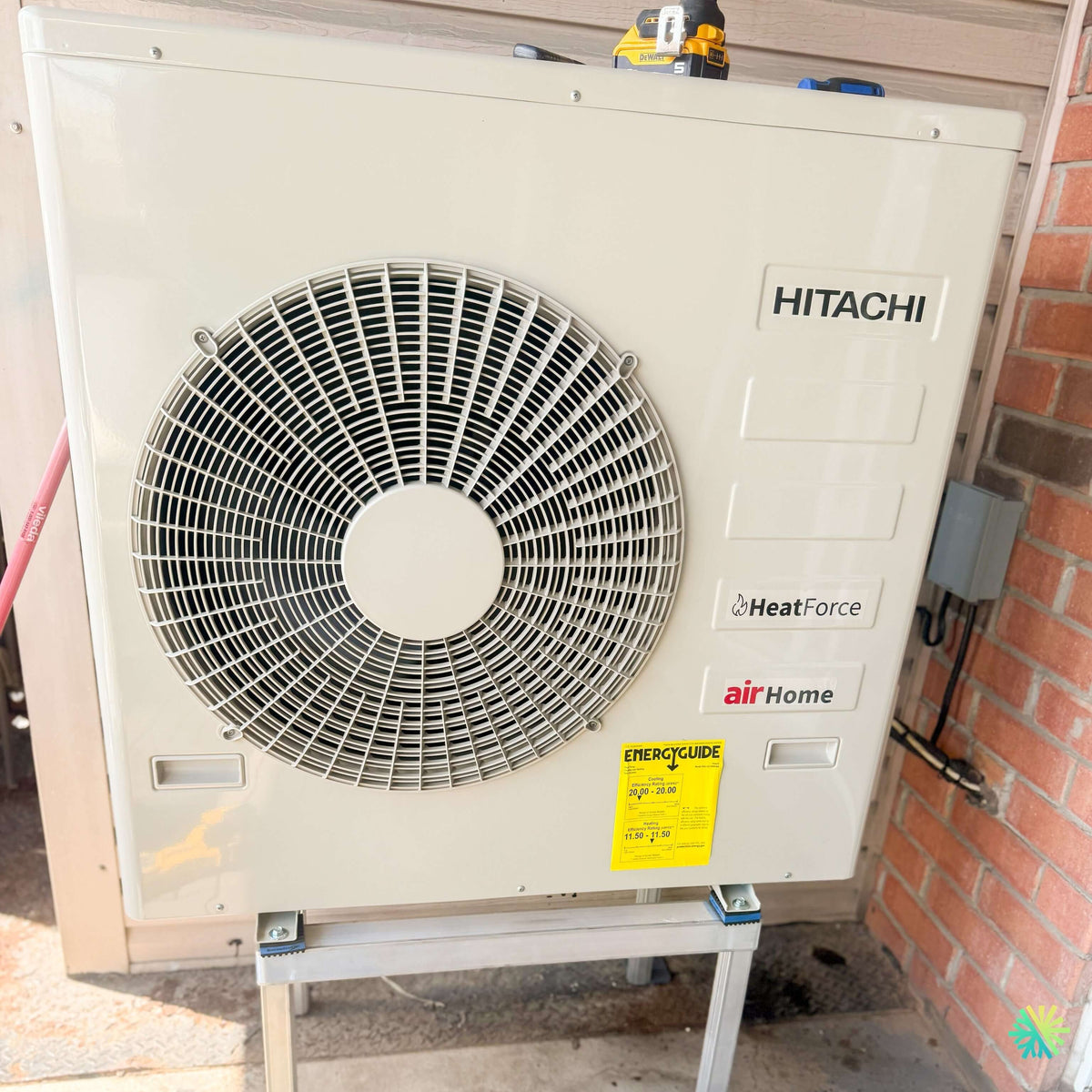
The project photograph shows an outdoor Hitachi airHome unit installed on a raised aluminum structure. This type of support is particularly relevant in Quebec.
The appliance is not placed directly on a ground-level slab. It is held above the surface to reduce the risks associated with:
- snow accumulation;
- ice;
- leaves and debris;
- splashing;
- standing moisture;
- obstruction of drainage during defrost cycles.
The visible support is fitted with adjustable feet and support points beneath the unit. This configuration helps stabilize the compressor while maintaining clearance beneath the cabinet.
The outdoor unit was placed beneath a covered section of the property, near a brick wall. A sheltered location can limit direct snow accumulation on top of the appliance, but it requires careful clearance checks. A heat pump must be able to draw in and discharge air freely. The front fan must not blow against an obstacle that is too close, while the sides and rear must remain sufficiently accessible.
We must also prevent a shelter, balcony, or overhead structure from trapping the discharged air. Recirculation of this air can reduce system performance, particularly during periods of high demand.
A clean installation around a restricted space
Positioning the unit between the exterior wall, the house structure, and the passageway required careful planning. The proximity of the brick wall made it essential to carefully control the pipe outlet and access to the service panel.
The installation notably includes:
- a level-mounted unit;
- a rigid outdoor support;
- a nearby power supply;
- a lower space allowing defrost water to drain;
- a completely unobstructed front of the fan;
- a compact placement that limits encroachment on usable space.
These details matter. A heat pump may appear to be properly installed at first glance, but a support that is too low, an inadequately protected line, or insufficient clearance for servicing can cause problems several years later.
At AirGreen, we evaluate the installation as a whole. System performance depends on the equipment, but also on the quality of the connections, drainage, electrical work, and location selection.
Technical specifications of the Hitachi airHome Multi system installed in La Prairie
The Hitachi airHome Multi product line includes multizone systems ranging from 18,000 to 42,000 BTU/h that can power up to five indoor units. The dual-zone model presented in the manufacturer's documentation is the RAM-G18N2HAA, designed to accommodate two indoor connections.
For this equipment category, the stated rated capacity is 18,000 BTU/h for cooling and 22,000 BTU/h for heating. However, the actual capacity delivered to each room depends on the combination of indoor units, line-set length, outdoor temperatures, and simultaneous demand from both zones.
Energy efficiency of the airHome Multi
According to the ductless configuration presented in the Hitachi brochure, the dual-zone model can achieve:
- a TRÉS2 rating of up to 23.0;
- a regional CPSC2 rating of up to 7.85;
- a coefficient of performance that can exceed 3 in moderate conditions;
- a cooling range of up to 46 °C outdoors;
- a heating range extending down to -20 °C.
These figures show that the system was designed to deliver high seasonal efficiency. However, they do not mean that it will maintain its full rated capacity at all temperatures.
At -15 °C, the dual-zone model documentation indicates a maximum heating capacity of approximately 14,300 BTU/h. At -20 °C, it is around 9,700 BTU/h. The drop in capacity in very cold weather is normal for a heat pump and must be taken into account when sizing the system.
In some homes, the airHome Multi can cover a large portion of annual heating needs. In others, a supplementary heat source remains necessary during the coldest days. Our role is to set realistic expectations rather than consider only the capacity advertised at moderate temperatures.
An electrical supply suitable for the system
The dual-zone outdoor model operates on a 208 to 230 volts, single-phase, 60 Hz power supply. The documentation specifies a minimum circuit ampacity of 16 A and maximum overcurrent protection of 25 A for the RAM-G18N2HAA.
The selection of the circuit breaker, wiring, and disconnecting device must always be based on the nameplate of the actual appliance delivered. We never select electrical protection solely based on an estimated tonnage or another similar installation.
A proper electrical installation helps protect:
- the compressor;
- the electronic control boards;
- the fan motor;
- the occupants;
- the integrity of the building.
Having an accessible disconnect near the outdoor unit also facilitates future servicing.
Refrigerant lines dedicated to each zone
In the 18,000 BTU/h dual-zone configuration, the documentation indicates two liquid connections of 1/4 po and two gas connections of 3/8 po on the outdoor unit.
The maximum permitted total length can reach 165 feet, while each individual branch can measure up to 82 feet, subject to the limits and adjustments specified by the manufacturer. A minimum total length must also be observed.
This data is essential because a multi-zone system cannot be installed like two simple units assembled at random. Each refrigerant branch must be sized, flared, tightened, and tested according to the manufacturer's requirements.
During our installations, we pay particular attention to the following steps:
- Clean cutting of copper tubing.
- Deburring without internal contamination.
- Precise fabrication of flared connections.
- Tightening to the appropriate torque.
- Leak test.
- Complete evacuation.
- Checking vacuum stability.
- Opening the service valves.
- Operational testing in the different modes.
Vacuuming for too short a time or using unsuitable tools can leave moisture in the circuit. This moisture can then react with the refrigerant and compressor oil, increasing the risk of premature problems.
R32 refrigerant
The airHome Multi range uses R32 refrigerant. This refrigerant has different characteristics from those of the older refrigerants used in several residential appliances.
Installing an R32 system requires, among other things:
- compatible tools;
- suitable procedures;
- rigorous leak-tightness testing;
- proper management of connections;
- compliance with requirements regarding room volume;
- an understanding of Hitachi’s planned leak detection functions.
The brochure states that compatible indoor units include a refrigerant leak sensor. Depending on the unit type, the warning may be transmitted through an indicator light, an audible signal, or an optional receiving accessory.
Two zones, but several indoor unit options
One of the advantages of the airHome Multi series is its flexibility. A single compressor can be connected to different styles of compatible indoor units.
Hitachi offers, among others:
- airHome 400 wall-mounted units;
- airHome 650 wall-mounted units;
- floor consoles;
- mini-cassettes;
- concealed ducted units.
For a residential two-zone installation in La Prairie, a common combination may include a wall-mounted unit in the open area and a second one in a bedroom or upstairs. Another option is to use a wall-mounted unit in one zone and a small concealed ducted unit in a space where aesthetics are a priority.
The choice should not depend solely on BTU capacity. We also consider:
- the shape of the room;
- ceiling height;
- the location of the doors;
- sun exposure;
- natural air circulation;
- the desired sound level;
- drain accessibility;
- the ability to conceal the lines.
Air quality and maintenance functions
Depending on the selected indoor unit, airHome Multi may integrate FrostWash technology, Mold Guard mode, and various filtration systems.
The FrostWash function uses a freeze-and-thaw cycle to clean the heat exchanger coil. The process helps remove certain accumulated contaminants and maintain better airflow.
Mold Guard mode runs the fan after certain periods of cooling or dehumidification to dry the internal components. This step helps reduce conditions conducive to odors and mold growth.
Some wall-mounted units also use a PM2.5 activated carbon filter. The mini-cassettes can accommodate a ViroSense S filter. The filtration level therefore depends on the selected indoor unit model and must not be automatically attributed to all configurations.
These functions do not replace maintenance. Filters must always be cleaned regularly, and the fan and coil must be inspected when visible buildup appears.
Phone control and individual room management
The airCloud Go interface can be added to compatible units. It allows users to control the system remotely, schedule operating times, and view certain usage-related information.
In a dual-zone installation, each indoor unit remains controlled separately. This allows the homeowner to lower the temperature in an unoccupied bedroom or cool a room exposed to the sun more.
This flexibility does not mean that extreme differences should be imposed between the two zones. An indoor unit that is heavily used while the other is almost idle can change how the compressor distributes its capacity. Moderate, consistent settings generally provide more stable comfort.
Mistakes to avoid with a multi-zone heat pump
A multi-zone installation requires more planning than a single-zone system. Among the mistakes we aim to prevent are:
Oversizing the outdoor unit
An oversized heat pump may run in shorter cycles, dehumidify less effectively, and create temperature differences. The number of zones alone does not determine the required capacity.
Simply adding up the wall-mounted units' capacities
Two 12,000 BTU/h indoor units do not automatically mean that the outdoor unit must continuously provide 24,000 BTU/h. Approved combinations and connection ratios must be checked in the manufacturer's tables.
Neglecting drainage
Each indoor unit produces water in cooling mode. An insufficient slope, a crushed drain, or an improperly positioned outlet can cause backflow and water damage.
Installing the compressor too close to the ground
On the South Shore, snow and ice can quickly obstruct an unit that is too low. The raised support used for this installation in La Prairie reduces this risk.
Hiding the unit with an enclosure that is too closed
Homeowners sometimes want to hide the compressor. However, a poorly designed decorative screen can block airflow and cause recirculation. Any added structure must maintain the required clearances.
Forgetting about service access
Electrical panels, valves, and fittings must remain accessible. An installation too close to a wall or fence makes diagnostics more difficult and increases the time required for repairs.
Why installation quality has such an impact on performance
Even a heat pump offering an excellent TRÉS2 will not deliver the expected results if it is improperly installed.
Actual performance depends, among other things, on:
- load calculation;
- the selection of indoor capacities;
- insulation quality;
- the positioning of the wall-mounted units;
- line length;
- refrigerant charge;
- drainage;
- airflow;
- the settings used by the owner.
Our HVAC installation approach therefore aims to bring these elements together rather than treating the heat pump as an isolated appliance.
A suitable solution for La Prairie and the Greater Montreal area
This Hitachi multi-zone heat pump installation in La Prairie illustrates a solution particularly well suited to homes with multiple levels or rooms with different needs.
We install this type of system in Montreal, Laval, Longueuil, the North Shore, and the South Shore. However, every project requires an analysis specific to the building. The appropriate capacity for a home in La Prairie may differ from that of a duplex in Montreal or a residence in Laval, even when the floor area appears comparable.
A dual-zone configuration is well suited when you want to:
- condition two floors;
- improve the comfort of a remote bedroom;
- air-condition an extension;
- replace several window air conditioners;
- reduce the number of outdoor units;
- to control two spaces independently.
The final result depends on a well-matched equipment selection and a thorough installation. In this project, the raised stand, compact positioning, and protection of the outdoor unit help prepare the system for the conditions encountered on the South Shore.
Warranty and recommended maintenance
Hitachi documentation indicates a standard seven-year warranty on the compressor and a five-year warranty on parts. Online registration allows certain eligible residential installations to receive an extended ten-year warranty on the compressor and ten-year warranty on parts. Enhanced coverage may also be available subject to the applicable terms.
Registration must be completed within the specified time frame. The owner must retain:
- the invoice;
- the model number;
- the serial number;
- the installation date;
- the installer’s information.
To keep the system operating properly, we recommend cleaning the filters regularly, keeping the outdoor unit clear, and monitoring drain flow. Periodic professional inspection also helps check the coils, electrical connections, fan, and any signs of dirt buildup.
The job tools
Two quick checks with real numbers: what heat costs, and what your current heaters add up to in BTU/h.
Conversion: 1 W = 3.412 BTU/h. An indication, not a load calculation: baseboards and furnaces are often stronger than the real need, and they can stay as backup. AirGreen confirms the capacity on site.
How the job unfolds
The main steps of this kind of job at AirGreen. Every house has its quirks: the estimate brings them out.
We look at the room, the outside wall, the line route and where the outdoor unit will go. That is where the capacity gets chosen.
Model, capacity and price, in writing. We also check whether the model qualifies for assistance programs.
Floors and furniture protected, wall plate position marked level, wall opening located.
A single opening, with the slope the drain needs to flow outside.
Set on a stand raised above the snow, with the clearances the manufacturer requires.
Connected, insulated and protected. The opening is then sealed against water, cold air and insects.
A dedicated circuit and an accessible disconnect near the outdoor unit.
Leak test, vacuum, then start-up and a check of heating and cooling.
Remote, modes, filters: we show you the essentials before we leave.
- The on-site estimateWe look at the room, the outside wall, the line route and where the outdoor unit will go. That is where the capacity gets chosen.
- The quoteModel, capacity and price, in writing. We also check whether the model qualifies for assistance programs.
- Getting readyFloors and furniture protected, wall plate position marked level, wall opening located.
- The wall openingA single opening, with the slope the drain needs to flow outside.
- The outdoor unitSet on a stand raised above the snow, with the clearances the manufacturer requires.
- Lines, cable and drainConnected, insulated and protected. The opening is then sealed against water, cold air and insects.
- The electrical workA dedicated circuit and an accessible disconnect near the outdoor unit.
- Tests and start-upLeak test, vacuum, then start-up and a check of heating and cooling.
- The walkthroughRemote, modes, filters: we show you the essentials before we leave.
What we check on a job like this one
Each number is a point we check on site. Switch between summer and winter to watch air and heat move.
In summer, the outdoor unit rejects the house's heat outside.
Generic illustration of this type of installation, not a survey of this job site. Tap a number.
Mounted level on a wall plate, high enough for the air to reach the whole room, with enough space around it to slide the filters out easily.
The refrigerant lines, the communication cable and the drain go through the wall in a single opening, sealed against water, cold air and insects.
Two insulated copper pipes connect the two units. Outside, a line cover can protect them from sun, knocks and weather.
A shut-off switch near the outdoor unit isolates it safely for service. It must stay accessible at all times.
The compressor and the fan. In heating mode it captures heat from the outdoor air, even in winter, and moves it inside.
On the ground or on the wall, it keeps the unit above accumulated snow. The unit stays clear and defrost water can drain away.
The fan needs to blow freely. Storage, a fence or a wall too close, and efficiency drops while noise goes up.
Is your home ready?
Check what applies at your place. A "no" is not a refusal: it is what we sort out during the estimate.
Good habits, once the unit is in place
Six simple habits that keep the unit going. Your list stays on this device.
What to do, season by season
Three habits per season for this unit. They take a few minutes and prevent many calls.
- Clean the indoor unit's filters.
- Clear leaves and debris left on the outdoor unit by winter.
- Test cooling before the first hot days.
- Clean the filters more often when the unit runs a lot.
- Keep plants away from the outdoor unit.
- Check that no water drips from the indoor unit.
- Rake the leaves around the outdoor unit.
- Test heating before the first cold days.
- Book periodic maintenance before winter.
- Keep snow away from the stand and the front of the unit.
- Let the unit defrost: it is normal.
- Never hit the ice on the fins; call us if the unit stays iced up.
The right pages, at the right time
Four statements: true or false?
It all comes down to details you have just seen.
1. In heating mode, the outdoor unit can produce water.
During defrost cycles. That water must drain away without forming ice.
2. You pick the capacity with a simple square-footage rule.
Windows, insulation, orientation and how the room is used all count. Capacity is chosen on site.
3. A multi-zone connects several indoor heads to a single condenser.
One head per room, all on the same condenser. Each room keeps its own temperature.
4. The disconnect can sit behind the patio furniture.
It must stay accessible: it is what shuts the unit off for service.
0 / 4 right answers
What people ask us about this kind of work
Does a wall-mounted heat pump heat in winter?
Wall-mounted or multi-zone: how do I choose?
Where does the outdoor unit go?
Are there grants?
Do I need a permit?
How cold can it heat?
How much can I save?
How is the LogisVert assistance calculated?
Is it noisy?
The outdoor unit is covered in ice: is that normal?
Does AirGreen hold the required licences?
Is the estimate free?
No question matches. Write to us: we answer.
More jobs to see, near you
By town, by equipment or by region: browse more than 4,700 published projects.
Each dot: a town where AirGreen has published projects. The glowing dot: this job.
An on-site estimate, the right capacity, the right equipment.
The on-site estimate is free and the quote follows within 24 hours.
Text and photo: a real AirGreen Climatisation & Chauffage job. The diagrams are generic illustrations of the type of installation, not a survey of this job site. Sources of the added figures: airgreen.ca product pages (NEEP / AHRI performance), Hydro-Québec (Heat pumps page, LogisVert, read on 13 October 2026), Régie de l’énergie (rate D as of 1 April 2026).