
Installation of a vänEE AI V160H75RT Series Air Exchanger (HRV with Virtuo Air Technology) in Huntingdon
A 30-inch cabinet, four top-mounted burners, and a vänEE AI Series V160H75RT HRV with ECM motors: here’s how we ventilated a renovated home in Huntingdon, with measured and documented airflow rates.
Take a tour of the installation
Each number is a point we check on site. Switch between summer and winter to watch air and heat move.
Generic illustration of this type of installation, not a survey of this job site. Tap a number.
It removes stale air and brings in fresh air. The two airflows cross in the core without mixing.
It recovers part of the heat from the outgoing air to temper the incoming air. Depending on the model, it also manages humidity.
An outdoor hood, kept away from the exhaust so the house does not pull back the air it just removed.
Humid, stale air leaves through its own hood, fitted with a damper.
The ducts that connect to the outside are insulated to prevent condensation inside the house.
Stale air is drawn from humid rooms and fresh air is sent to living areas. The airflows are balanced.
It sets the mode and speed. You use it more when the house is humid or full of people.
Depending on the model and the season, the core produces condensation, removed through a drain with its loop.
A 30-inch storage closet, four outlets on top, and an HRV that calibrates its own airflow
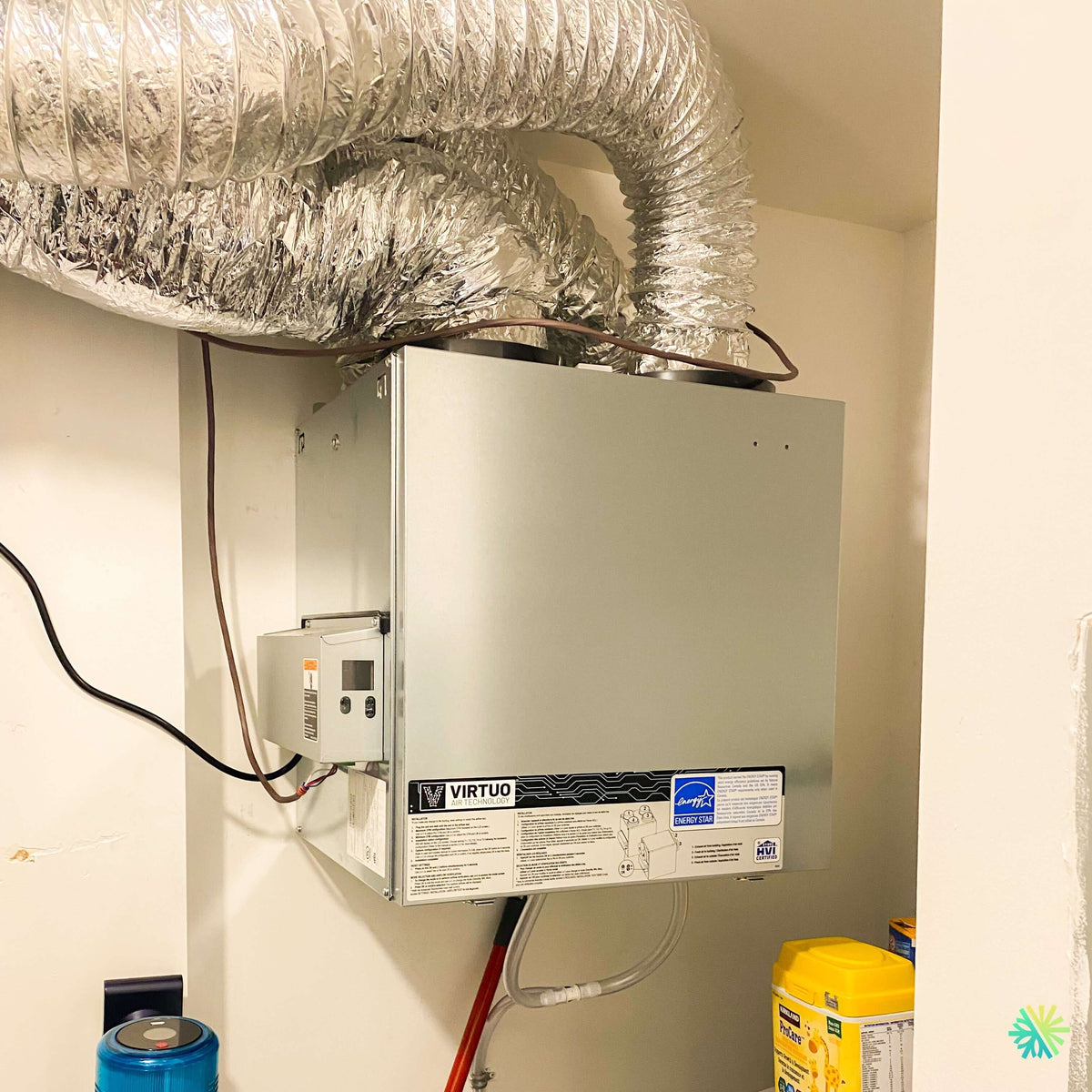
In Huntingdon, the constraint was not technical. It was geographic, in the narrowest sense of the term: the available space measured approximately 30 inches wide between two walls, in a utility closet that also serves as a secondary pantry. No open basement, no accessible joists, no centralized mechanical room. One wall, one power outlet, and the requirement to fit a complete air exchanger in there.
That is exactly the type of configuration for which the vänEE AI Series was designed, and it guided our recommendation.
The assignment: ventilate a renovated home with no mechanical space
The owner had completed a major renovation: upgraded insulation, new windows, and a continuous air barrier. The predictable and well-documented result—a tightly sealed home without adequate mechanical ventilation accumulates moisture, CO₂, and volatile organic compounds released by new materials.
The reported symptoms were consistent: persistent condensation on the bedroom windows, heavy air upon waking, and a new-home smell that had not gone away six months after the work was completed. The portable dehumidifier in the basement treated the symptom, never the cause.
Why the AI Series instead of an entry-level HRV
Three reasons influenced the decision, and none of them was the price.
Electronically commutated PMSM motors
The V160H75RT is equipped with two electronically commutated permanent magnet synchronous motors (PMSMs). In practical terms, consumption varies from 36 to 100 watts depending on the requested airflow, rather than remaining fixed at a high level as with traditional motors.
On a unit that runs almost continuously from November to April, the difference shows up on the Hydro-Québec bill, not just on a spec sheet.
Automatic airflow calibration
The unit integrates an LCD screen and a control system that performs 120 readings per minute to maintain the programmed airflow, even when the interior filters begin to load or the system pressure changes.
Here is the nuance we want to clarify, because it is often misrepresented: this function maintains the airflows measured at the unit's outlets. It does not replace adjusting the grilles and dampers throughout the home. A perfectly calibrated unit can still send 80% of the fresh air into a single bedroom if the distribution has not been adjusted. We do both.
A size that fits where others do not
Actual dimensions: 21.5 in. high × 21 in. wide × 16.3 in. deep, weighing approximately 35 lb. Suspended from the wall on its bracket, the unit completely frees up the closet floor.
The V160H75RT figures
- Airflow range: 35 to 159 ft³/min at 0.2 in. w.g. — 35 to 150 ft³/min at 0.4 in. w.g.
- Sensible recovery efficiency (SRE): 75% at 0 °C (at 64 ft³/min) and 65% at -25 °C
- High-airflow SRE: 66% at 0 °C (at 131 ft³/min)
- Power consumption: 36 to 100 W
- Outlets: 6-inch round, top-mounted
- Core: expanded polystyrene, UL 94 HF-1 certified
- Interior filters: MERV 8 (part SV66133)
- Defrosting: HomeShield system with variable cycles based on outdoor temperature and programmed airflow
- Certifications: HVI, UL, and cUL, ENERGY STAR (in Canada)
The most significant point for a home in the Haut-Saint-Laurent area is the 65% SRE at -25 °C. That is the value that really matters in January in Huntingdon, not the one measured at 0 °C that most specifications highlight.
The installation process
Wall bracket and service clearance
The bracket is secured to two studs, never to the drywall alone. We then imposed a non-negotiable rule on the owner: the access door must be able to open fully. On the AI Series, the core and interior filters are removed from the front. A unit blocked by shelves or boxes is a unit that will never be serviced.
Top-mounted outlets: the advantage and the trap
The top-mounted outlets configuration allows the four ducts to run toward the ceiling without lateral clearance. That is what made this closet viable.
The immediate trap is the temptation to bend the duct 90 degrees as soon as it leaves the collar. A bend that is too tight at this exact point chokes the airflow and increases static pressure, which the unit then compensates for by increasing its speed and energy consumption. We keep a straight section before every change in direction and support the insulated flexible duct to keep it from collapsing accordion-style.
The drain
An HRV produces condensate as soon as warm stale air crosses cold outdoor air in the core. The supplied drain hose was connected with a continuous slope and a trap. Without a trap, the unit draws air from the drain.
Exterior penetrations
Both hoods were installed with a minimum separation of 1.8 m (6 ft) between the fresh-air intake and exhaust, at a height that clears the typical snow accumulation in the area, and with rodent-proof grilles. In agricultural areas, this last point is not merely decorative.
Programming and commissioning
Airflows were programmed on the LCD screen, then checked at the grilles with an instrument. Intermittent mode was configured for periods of vacancy, and the humidity override was enabled. The final values are recorded on a label affixed to the inside of the door, along with the date.
The compromises we accept on this project
We prefer rigid galvanized ducting wherever possible: less pressure loss, easier to clean, and more durable. In this closet, the geometry did not allow it for the first few feet. We used quality insulated flexible ducting, taut and supported, while limiting its length and avoiding bends.
An installer who claims to use only rigid ducting everywhere has never worked in a 30-inch closet. What matters is that the flexible duct is taut, insulated, short, and never crushed.
Five mistakes to avoid with a modern HRV with ECM motors
- Rely solely on the unit's display. It shows what the unit is producing, not what is reaching the rooms.
- Replace the MERV 8 filter with a denser filter purchased elsewhere. Static pressure increases, the motors compensate, and energy consumption rises.
- Plug the unit into an outlet controlled by a switch. An air exchanger that is unplugged half the year ventilates nothing.
- Store items against the unit. The clearance in front determines all future maintenance.
- Connect the exhaust duct to the range hood or clothes dryer. Grease and lint destroy the core.
Maintenance: key points to remember
- MERV 8 interior filters: inspect every 3 months and replace as needed. In rural areas, more frequently during harvest season.
- Core: remove and wash annually, preferably in the fall.
- Exterior exhaust hoods: two inspections per year, in spring and fall.
- Drain: visual inspection of the hose and trap during every maintenance visit.
Compliance and assistance programs: the facts
The Quebec Construction Code requires mechanical ventilation in new dwellings, with airflow rates calculated according to the number and type of rooms. In Novoclimat-certified new construction, a heat recovery ventilation system meeting the program's criteria is mandatory.
For existing homes, let us be direct: there is no Quebec subsidy specifically targeting air exchangers. The equipment's ENERGY STAR certification does not qualify you for a cheque. Ventilation affects the overall result of a Rénoclimat assessment: the more you air-seal a home, the more mechanical ventilation becomes necessary to maintain indoor air quality. The two must be planned together, never separately.
Huntingdon, Ormstown, Valleyfield: rural ventilation does not follow the same rules as downtown
A home in Haut-Saint-Laurent faces constraints that are not found in a Plateau condo: operating combustion appliances, more frequent power outages, seasonal agricultural dust, long runs of ductwork through unheated spaces, and wildlife that finds exterior exhaust hoods very welcoming.
Each of these factors affects the layout, choice of materials, filter rating, and final adjustments. Identical equipment installed in Laval and Huntingdon cannot be configured the same way.
Our method, wherever we install
Complete on-site assessment, room-by-room airflow calculations, equipment selection based on floor area and heating system, careful installation, documented adjustments, and delivery of the file to the client. We follow the same approach in Montreal, Laval, Longueuil, on the North Shore, on the South Shore, and throughout Montérégie.
If the air in your home feels heavy in the morning, your windows run with condensation in January, or your air exchanger has never been adjusted since it was commissioned, we come to your home, take measurements, and provide you with a detailed assessment before making any recommendations.
AirGreen — Heating, ventilation and air conditioning. RBQ 5645-9605-01. (514) 316-2973 | sales@airgreen.ca
The big day, step by step
The main steps of this kind of job at AirGreen. Every house has its quirks: the estimate brings them out.
We locate the wall for the two outdoor hoods, the unit's spot, service access and the drain.
The unit, its location and the price, in writing.
Hung or set level, with clear access to the filters and the core.
Fresh air intake and exhaust, kept apart and sealed.
The ones connected to the outside are insulated to prevent condensation inside the house.
Connected with its loop, when the unit needs one.
Installed where you will see it and use it.
Incoming and outgoing airflows are adjusted so the house is neither pressurized nor depressurized.
Speeds, filters, core: how to use it through the seasons.
- The on-site estimateWe locate the wall for the two outdoor hoods, the unit's spot, service access and the drain.
- The quoteThe unit, its location and the price, in writing.
- The unitHung or set level, with clear access to the filters and the core.
- The outdoor hoodsFresh air intake and exhaust, kept apart and sealed.
- The ductsThe ones connected to the outside are insulated to prevent condensation inside the house.
- The drainConnected with its loop, when the unit needs one.
- The wall controlInstalled where you will see it and use it.
- BalancingIncoming and outgoing airflows are adjusted so the house is neither pressurized nor depressurized.
- The walkthroughSpeeds, filters, core: how to use it through the seasons.
Four mistakes we do not make
Flip each card to see what we do instead.
Your own project, step by step
What to do, season by season
Three habits per season for this unit. They take a few minutes and prevent many calls.
- Clean the filters and core as the manufacturer specifies.
- Check the outdoor hoods: nests, debris, dampers.
- Lower the speed if the outdoor air gets humid.
- Adjust the speed to the humidity in the house.
- Check that the drain flows.
- Keep the outdoor hoods clear.
- Clean the filters before the closed-house season.
- Check the exhaust damper.
- Book a full cleaning if the unit has not had one in a long time.
- Clear snow from both outdoor hoods.
- Raise the speed if condensation appears on windows.
- Let the unit run: with the house closed, humidity builds up.
Is your home ready?
Check what applies at your place. A "no" is not a refusal: it is what we sort out during the estimate.
Four statements: true or false?
It all comes down to details you have just seen.
1. In an air exchanger, fresh air and stale air mix.
The two airflows cross in the core without mixing.
2. The two outdoor hoods must be kept apart.
Otherwise the exchanger pulls back the air it just removed.
3. An air exchanger can help with condensation on windows.
It renews the air and helps keep humidity in the right range.
4. An exchanger never needs maintenance.
Filters and core get dirty and need regular cleaning.
0 / 4 right answers
What people ask us about this kind of work
What does an air exchanger do?
Does fresh air cool the house in winter?
What speed should it run at?
Does an exchanger need cleaning?
What are the signs of poor ventilation?
HRV or ERV: what is the difference?
Should it run in winter?
Does AirGreen hold the required licences?
Is the estimate free?
No question matches. Write to us: we answer.
More jobs to see, near you
By town, by equipment or by region: browse more than 4,700 published projects.
Each dot: a town where AirGreen has published projects. The glowing dot: this job.
Every house has its constraints. We see them before we install.
The on-site estimate is free and the quote follows within 24 hours.
Text and photo: a real AirGreen Climatisation & Chauffage job. The diagrams are generic illustrations of the type of installation, not a survey of this job site. Sources of the added figures: airgreen.ca product pages (NEEP / AHRI performance), Hydro-Québec (Heat pumps page, LogisVert, read on 13 October 2026), Régie de l’énergie (rate D as of 1 April 2026).