
Installation of a Fujitsu AIRSTAGE wall-mounted heat pump in Saint-Césaire: precise integration above a window
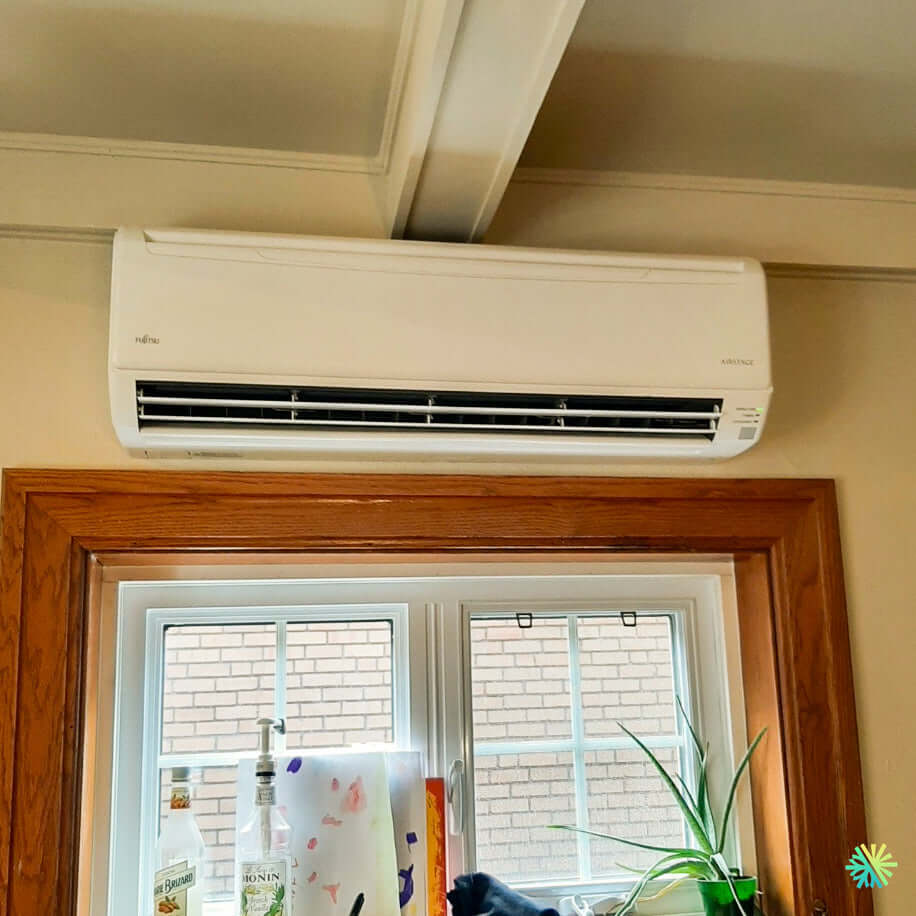
Installation of a Fujitsu AIRSTAGE wall-mounted heat pump in Saint-Césaire, precisely integrated above a window to optimize space, comfort, air distribution, and accessibility for maintenance.
Take a tour of the installation
Each number is a point we check on site. Switch between summer and winter to watch air and heat move.
In summer, the outdoor unit rejects the house's heat outside.
Generic illustration of this type of installation, not a survey of this job site. Tap a number.
Mounted level on a wall plate, high enough for the air to reach the whole room, with enough space around it to slide the filters out easily.
The refrigerant lines, the communication cable and the drain go through the wall in a single opening, sealed against water, cold air and insects.
Two insulated copper pipes connect the two units. Outside, a line cover can protect them from sun, knocks and weather.
A shut-off switch near the outdoor unit isolates it safely for service. It must stay accessible at all times.
The compressor and the fan. In heating mode it captures heat from the outdoor air, even in winter, and moves it inside.
On the ground or on the wall, it keeps the unit above accumulated snow. The unit stays clear and defrost water can drain away.
The fan needs to blow freely. Storage, a fence or a wall too close, and efficiency drops while noise goes up.
A Fujitsu installation in Saint-Césaire where every available inch mattered
In this residence in Saint-Césaire, the objective was clear: to integrate a Fujitsu AIRSTAGE wall-mounted heat pump efficiently into a room where the architectural layout offered relatively few suitable options for positioning the indoor unit. In the photograph of this installation carried out by AirGreen, one detail immediately stands out: the wall-mounted evaporator is installed directly above a window, between the existing trim and a dropped ceiling.
This type of configuration looks simple once the work is complete. Yet, for a team of HVAC technicians, properly positioning a heat pump in such a precisely defined space requires several checks before even drilling the first hole.
We must consider the available height, the required clearance around the unit, airflow direction, the route of the refrigerant lines, condensate drainage, and the ability to carry out future HVAC maintenance without dismantling the room’s architectural elements.
The result achieved in Saint-Césaire shows exactly what we look for in a residential installation: a well-centered, accessible, discreet unit positioned to distribute air efficiently throughout the space.
A Fujitsu AIRSTAGE wall-mounted heat pump suited to a residential installation
The Fujitsu AIRSTAGE range is well known in the heating and air conditioning sector in Quebec. Fujitsu offers several generations and capacities of wall-mounted heat pumps, and the AIRSTAGE designation covers different series.
In this specific installation, the Fujitsu brand and the AIRSTAGE designation are clearly visible on the indoor unit. However, the complete model number and the rated capacity in BTUs are not legible in the photograph. We therefore prefer not to arbitrarily assign the unit a capacity of 9,000, 12,000, 15,000, or 18,000 BTUs.
This is an important distinction when we talk about heat pump sizing.
Two units that look very similar on the outside may have:
- different capacity;
- different energy efficiency;
- different heating performance at low temperatures;
- slightly different dimensions;
- different electrical requirements;
- different refrigerant pipe diameters;
- different eligibility for subsidy programs.
To determine the exact characteristics of an existing Fujitsu heat pump, we instead check the nameplate on the indoor unit, and especially the one on the outdoor unit.
Why install the indoor unit above a window?
Wall selection is a decisive step in a wall-mounted heat pump installation.
In the project presented here, the space directly above the window offered a logical solution. The unit is installed in a section of wall that would otherwise be difficult to use, preserving the side surfaces for furniture and other room elements.
This positioning can also provide excellent air distribution when properly planned.
A wall-mounted heat pump operates by circulating a significant volume of air throughout the room. In cooling mode, cooler air is directed forward and downward. In heating mode, adjusting the louvers can help send warm air farther into the occupied area.
Our goal is therefore not simply to find a place where the unit “fits.” We look for a location that allows the appliance to actually heat and cool the room evenly.
A significant constraint: the proximity of the ceiling
The photo also highlights an interesting feature of this installation in Saint-Césaire: the space available between the top of the window and the ceiling structure is limited.
A wall-mounted unit primarily draws room air through its upper section. Adequate clearance must therefore be maintained to avoid unnecessarily restricting airflow.
An installation too close to a ceiling can cause several problems:
Insufficient airflow
If the air intake is obstructed, the indoor fan must operate under less favorable conditions. The heat pump’s actual performance may then be affected.
More difficult maintenance
The filters of a wall-mounted unit are generally accessible through the front panel. Sufficient space must be maintained to open the housing and remove the filters easily.
Evaporator cleaning
After several years of use, a deep cleaning of a wall-mounted heat pump may become necessary. Access to the cross-flow fan, evaporator, and drain pan must be considered during installation.
That is why our technicians always assess the unit’s physical dimensions before determining its final position.
An installation that respects the existing architecture
In some homes in Saint-Césaire, as elsewhere on the South Shore, we work in buildings where moldings, window trim, beams, ceilings, and decorative elements impose very real limitations.
Here, the imposing wooden trim around the window had to remain intact.
We therefore used the space available directly above it without unnecessarily compromising the room’s appearance.
The heat pump visually follows the window’s horizontal axis. This attention to positioning contributes significantly to the final result. A unit installed just a few centimeters too far to the left or right would have been immediately noticeable because of the symmetry of the trim.
In our HVAC installation projects in Montreal, Laval, Longueuil, the North Shore, and the South Shore, these details often distinguish a purely functional installation from work that is truly well integrated.
What this Saint-Césaire installation teaches us about choosing and positioning a wall-mounted heat pump
The best location is not necessarily the wall that is easiest to drill through.
When planning an installation, many homeowners naturally think first of the most accessible exterior wall.
For us, this is only one criterion among several.
We assess, among other things:
- the room’s geometry;
- the location of doors and windows;
- occupied areas;
- air circulation between rooms;
- the wall structure;
- the possible route for the lines;
- the outdoor unit’s location;
- drainage options;
- electrical access;
- the installation’s final appearance.
In some situations, the shortest route for the piping results in poor air distribution. In others, the best indoor location would require an unnecessarily complex outdoor route.
The role of an HVAC contractor is to find a sound technical compromise among these various factors.
An installation above a window requires the drainage to be checked.
When a heat pump operates in cooling or dehumidification mode, water forms on the indoor evaporator. This water is collected in a pan and then discharged through a drain.
When conditions allow, we favor gravity drainage.
For it to function properly, the drain must maintain a sufficient slope along its entire route. An inadequate slope can lead to water buildup and potentially cause:
- gurgling sounds;
- an odor coming from the drain;
- an overflowing drain pan;
- water infiltration;
- marks on the wall or around the window.
In an installation like this, planning the wall opening must therefore take the refrigerant lines and drainage into account simultaneously.
The BTU requirement should be determined before choosing the unit’s physical size
A common mistake is to select a heat pump solely based on the space available on the wall.
The process should be exactly the opposite.
We first determine the required capacity in BTUs, then verify whether the corresponding unit can be properly installed in the available space.
Sizing depends in part on the floor area, but not exclusively. We also consider:
- insulation;
- the number of windows;
- sun exposure;
- ceiling height;
- the number of floors;
- air leaks;
- the layout of the rooms;
- the desired heating temperature;
- the existence of another heating system.
An oversized heat pump is not automatically better. In cooling mode, excessive capacity can shorten operating cycles and reduce the unit’s ability to remove humidity effectively.
Conversely, a heat pump that is too small may struggle to maintain the temperature during periods of extreme cold or heat.
Fujitsu and heating during the Quebec winter
The term Fujitsu AIRSTAGE encompasses several series, some of which are specifically designed for cold climates. However, performance can vary considerably from one model to another.
For a homeowner comparing a new Fujitsu heat pump, we recommend looking beyond the rated capacity shown in the brochure.
Important data includes the heating capacity maintained as the outdoor temperature drops, the minimum operating temperature, the coefficient of performance, SEER2, HSPF2, and ENERGY STAR certification when applicable.
These factors become especially important in areas such as Saint-Césaire, Saint-Hyacinthe, Chambly, Saint-Jean-sur-Richelieu, Brossard, Longueuil, and the entire South Shore, where a heat pump must cope with genuine winter conditions.
Watch out for rebates: the brand name alone is not enough
When a homeowner owns or is considering a Fujitsu heat pump, it can be tempting to assume that all models from the same brand qualify for the same financial incentives.
That is not the case.
Eligibility for a subsidy must be verified using the exact combination of indoor and outdoor units and, when applicable, the AHRI reference number or the program's specific criteria.
We therefore recommend never choosing a unit solely because an advertisement mentions a subsidy.
At AirGreen, when financial assistance is available for a new installation, we verify the exact equipment being proposed to avoid an unpleasant surprise after the work is completed.
The mistakes we aim to avoid in a wall-mounted installation
Our experience with installations in Montreal, Laval, Longueuil, the North Shore, and the South Shore has shown us that several problems identified a few years after installation could have been avoided from day one.
Among the most common are choosing an inadequate capacity, placing an indoor unit too close to the ceiling, an improper drain slope, inadequately protected outdoor piping, an outdoor unit location that is difficult to service, and a layout that directs air straight at the occupants.
We also pay particular attention to aesthetics.
A heat pump remains visible every day for many years. The ducts, cables, line-hide covers, and brackets must therefore be installed with the same care as the equipment itself.
Maintenance access must be planned from day one
The Fujitsu heat pump visible in this installation is located above a window, but its front panel remains accessible.
This is essential.
Filters must be maintained regularly to maintain adequate airflow. Over time, dust can also accumulate on the evaporator and the indoor fan.
When the fan becomes very dirty, reduced airflow, increased noise, or particles accumulated in the unit being blown out may occur.
A well-planned installation allows our technicians to perform heat pump maintenance without having to remove trim, move a structure, or dismantle part of the ceiling.
Our approach at AirGreen for a heat pump installation in Saint-Césaire
For us, a successful installation begins well before the heat pump arrives at the job site.
We assess the space, heating and cooling needs, building constraints, and the technical routing required. When several locations are possible, we explain the differences to the homeowner so they can choose a logical long-term solution.
The Fujitsu AIRSTAGE wall-mounted heat pump project in Saint-Césaire presented here is a good example: the space above the window was used precisely, while maintaining access to the unit and a clean appearance.
This is also representative of our daily work. Every home has its own particularities. An installation in a Saint-Césaire bungalow is not necessarily planned the same way as an installation in a Montreal duplex, a Laval condo, a Longueuil two-story home or a property on the North Shore.
Our job is precisely to adapt the HVAC system to the building rather than forcing the building to adapt to a standardized installation.
Replacing an old Fujitsu heat pump?
An existing wall-mounted heat pump can also offer some interesting possibilities when it is replaced.
Before reusing an existing installation, however, we must check several elements: the dimensions of the refrigerant lines, their condition, the type of refrigerant used by the old system, the length of the run, the electrical wiring, the drain and compatibility with the new manufacturer.
Automatically reusing old lines simply to save time is not always a good decision.
Requirements can vary between two generations of systems, even when both units bear the Fujitsu brand.
An HVAC installation designed to last
This installation in Saint-Césaire illustrates a simple principle that we apply to our projects: the quality of a heat pump and the quality of its installation must go hand in hand.
An excellent unit installed in the wrong location can provide a disappointing experience. Conversely, a properly sized, well-positioned heat pump installed with care can provide particularly stable comfort while remaining relatively discreet in the home.
At AirGreen, we carry out wall-mounted heat pump, multi-zone heat pump, central system and other HVAC projects in Saint-Césaire and throughout Greater Montreal, including Montreal, Laval, Longueuil, the North Shore and the South Shore.
This Fujitsu AIRSTAGE installed above the window clearly shows that architectural constraints are not necessarily an obstacle. When properly analyzed, they can lead to a compact, clean installation that integrates perfectly with the available space.
The big day, step by step
The main steps of this kind of job at AirGreen. Every house has its quirks: the estimate brings them out.
We look at the room, the outside wall, the line route and where the outdoor unit will go. That is where the capacity gets chosen.
Model, capacity and price, in writing. We also check whether the model qualifies for assistance programs.
Floors and furniture protected, wall plate position marked level, wall opening located.
A single opening, with the slope the drain needs to flow outside.
Set on a stand raised above the snow, with the clearances the manufacturer requires.
Connected, insulated and protected. The opening is then sealed against water, cold air and insects.
A dedicated circuit and an accessible disconnect near the outdoor unit.
Leak test, vacuum, then start-up and a check of heating and cooling.
Remote, modes, filters: we show you the essentials before we leave.
- The on-site estimateWe look at the room, the outside wall, the line route and where the outdoor unit will go. That is where the capacity gets chosen.
- The quoteModel, capacity and price, in writing. We also check whether the model qualifies for assistance programs.
- Getting readyFloors and furniture protected, wall plate position marked level, wall opening located.
- The wall openingA single opening, with the slope the drain needs to flow outside.
- The outdoor unitSet on a stand raised above the snow, with the clearances the manufacturer requires.
- Lines, cable and drainConnected, insulated and protected. The opening is then sealed against water, cold air and insects.
- The electrical workA dedicated circuit and an accessible disconnect near the outdoor unit.
- Tests and start-upLeak test, vacuum, then start-up and a check of heating and cooling.
- The walkthroughRemote, modes, filters: we show you the essentials before we leave.
What would it look like at your place?
Two quick checks with real numbers: what heat costs, and what your current heaters add up to in BTU/h.
Conversion: 1 W = 3.412 BTU/h. An indication, not a load calculation: baseboards and furnaces are often stronger than the real need, and they can stay as backup. AirGreen confirms the capacity on site.
Four mistakes we do not make
Flip each card to see what we do instead.
Your own project, step by step
What to do, season by season
Three habits per season for this unit. They take a few minutes and prevent many calls.
- Clean the indoor unit's filters.
- Clear leaves and debris left on the outdoor unit by winter.
- Test cooling before the first hot days.
- Clean the filters more often when the unit runs a lot.
- Keep plants away from the outdoor unit.
- Check that no water drips from the indoor unit.
- Rake the leaves around the outdoor unit.
- Test heating before the first cold days.
- Book periodic maintenance before winter.
- Keep snow away from the stand and the front of the unit.
- Let the unit defrost: it is normal.
- Never hit the ice on the fins; call us if the unit stays iced up.
Is your home ready?
Check what applies at your place. A "no" is not a refusal: it is what we sort out during the estimate.
Four statements: true or false?
It all comes down to details you have just seen.
1. In heating mode, the outdoor unit can produce water.
During defrost cycles. That water must drain away without forming ice.
2. You pick the capacity with a simple square-footage rule.
Windows, insulation, orientation and how the room is used all count. Capacity is chosen on site.
3. A multi-zone connects several indoor heads to a single condenser.
One head per room, all on the same condenser. Each room keeps its own temperature.
4. The disconnect can sit behind the patio furniture.
It must stay accessible: it is what shuts the unit off for service.
0 / 4 right answers
What people ask us about this kind of work
Does a wall-mounted heat pump heat in winter?
Wall-mounted or multi-zone: how do I choose?
Where does the outdoor unit go?
Are there grants?
Do I need a permit?
How cold can it heat?
How much can I save?
How is the LogisVert assistance calculated?
Is it noisy?
The outdoor unit is covered in ice: is that normal?
Does AirGreen hold the required licences?
Is the estimate free?
No question matches. Write to us: we answer.
More jobs to see, near you
By town, by equipment or by region: browse more than 4,700 published projects.
Each dot: a town where AirGreen has published projects. The glowing dot: this job.
Every house has its constraints. We see them before we install.
The on-site estimate is free and the quote follows within 24 hours.
Text and photo: a real AirGreen Climatisation & Chauffage job. The diagrams are generic illustrations of the type of installation, not a survey of this job site. Sources of the added figures: airgreen.ca product pages (NEEP / AHRI performance), Hydro-Québec (Heat pumps page, LogisVert, read on 13 October 2026), Régie de l’énergie (rate D as of 1 April 2026).