
Installation of a Fujitsu AIRSTAGE Altair 500 wall-mounted heat pump in Sainte-Julie: a compact indoor installation near the ceiling, designed for comfort
In Sainte-Julie, AirGreen installs a Fujitsu AIRSTAGE Altair 500 high up in a confined space, with positioning designed for airflow, accessibility, comfort, and discreet indoor integration.
In summer, the outdoor unit rejects the house's heat outside.
Generic illustration of this type of installation, not a survey of this job site. Tap a number.
Mounted level on a wall plate, high enough for the air to reach the whole room, with enough space around it to slide the filters out easily.
The refrigerant lines, the communication cable and the drain go through the wall in a single opening, sealed against water, cold air and insects.
Two insulated copper pipes connect the two units. Outside, a line cover can protect them from sun, knocks and weather.
A shut-off switch near the outdoor unit isolates it safely for service. It must stay accessible at all times.
The compressor and the fan. In heating mode it captures heat from the outdoor air, even in winter, and moves it inside.
On the ground or on the wall, it keeps the unit above accumulated snow. The unit stays clear and defrost water can drain away.
The fan needs to blow freely. Storage, a fence or a wall too close, and efficiency drops while noise goes up.
A precise installation in a restricted space where every centimeter counted
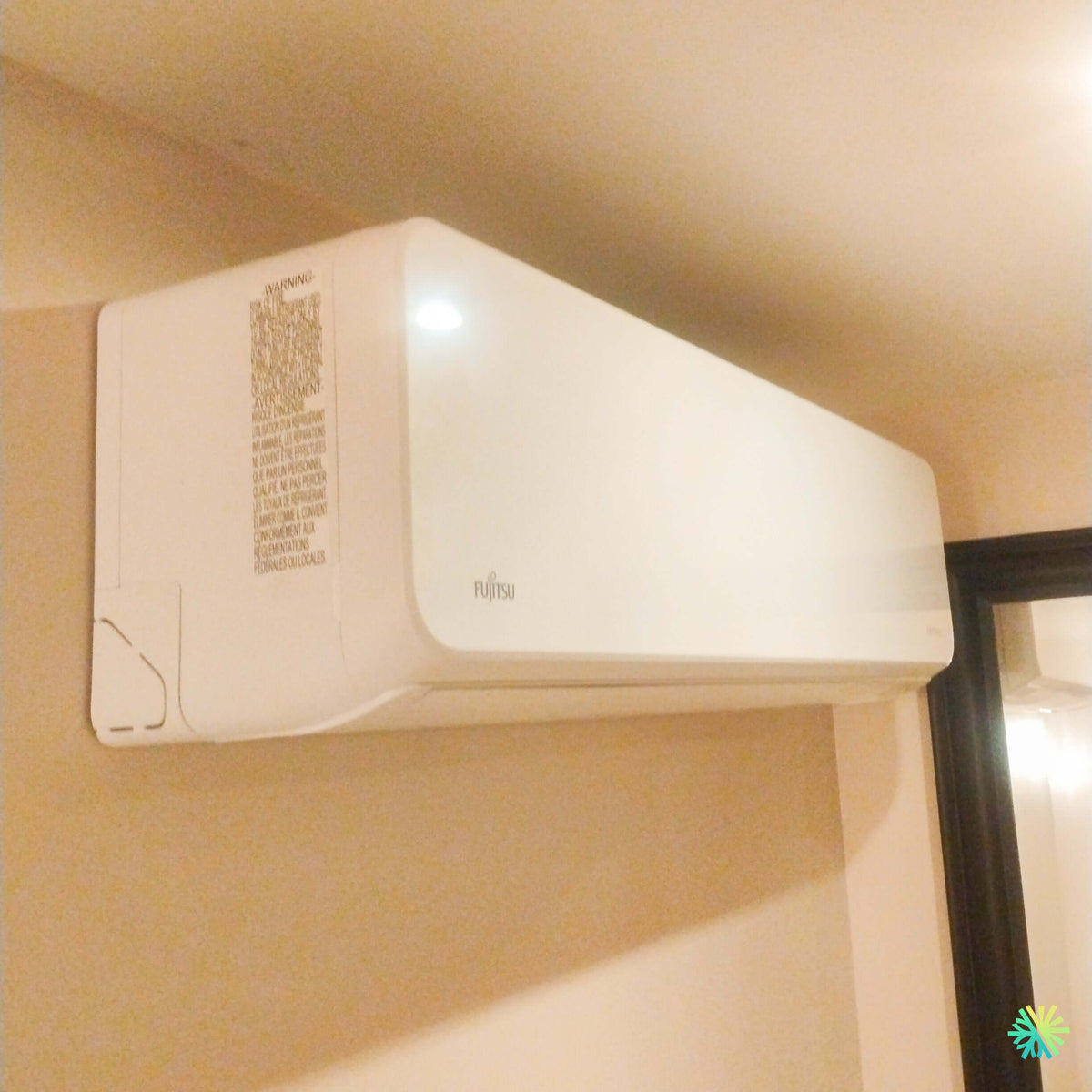
At Sainte-Julie, we installed a Fujitsu AIRSTAGE Altair 500 wall-mounted heat pump in a room where the architectural layout required very precise positioning. The project photo shows the indoor unit installed high up, very close to the ceiling and immediately beside a dark door frame. This type of installation requires more than simple aesthetic alignment: airflow must be preserved, the necessary clearances must be respected, future access for HVAC maintenance must be ensured, and the heat pump must be integrated naturally into the existing space.
The result is a compact and discreet installation. The white unit blends into the light-colored wall and remains high enough not to encroach on the living space. Its position also allows treated air to be projected into the room rather than creating a draft directly at occupant height.
The Fujitsu AIRSTAGE Altair 500 is part of the H single-zone series. According to the manufacturer’s documentation, this family includes models 09KPAS1, 12KPAS1, 18KPAS1, 24KPAS1, 30KPAS1 and 36KPAS1 and uses R-32 refrigerant.
A wall-mounted unit installed very high: why this choice can be appropriate
The installation height of a wall-mounted heat pump directly influences how air is distributed throughout a room.
In this Sainte-Julie installation, the indoor unit is positioned very close to the ceiling. This placement frees up the wall below while promoting air distribution over a greater distance.
In cooling mode, the cool air projected upward gradually descends into the room. In heating mode, the unit’s louvers direct the airflow downward and forward to distribute heat throughout the occupied area.
The challenge is always to find a balance between several factors:
- the necessary clearance above the unit for air intake;
- airflow direction;
- proximity to walls, doors, or structures;
- access to the filters;
- the piping route;
- the final appearance of the installation.
A wall-mounted unit should therefore never be positioned solely according to where it seems least visible.
An installation near a door frame
The photo clearly shows that the heat pump is installed a few centimetres from a dark door frame or vertical structure.
This constraint is useful because it requires us to plan the available width precisely.
A wall-mounted unit must retain enough space to allow for:
- opening the front panel;
- removing the filters;
- access to the unit’s technical side;
- good airflow around the unit;
- the possibility of carrying out professional cleaning.
An installation that is too tightly wedged between two obstacles can make future servicing considerably more difficult.
At AirGreen, we therefore always look beyond the installation day. An attractive finish is only useful if the heat pump also remains accessible several years later.
Altair 500: several capacities in one range
The Fujitsu Altair 500 series covers several capacities.
According to the technical specifications:
- the 09KPAS1 offers 9,000 BTU/h in cooling mode;
- the 12KPAS1, 12,000 BTU/h;
- the 18KPAS1, 18,000 BTU/h;
- the 24KPAS1, 22,000 BTU/h;
- the 30KPAS1, 30,000 BTU/h;
- the 36KPAS1, 33,000 BTU/h.
In heating mode, the respective rated capacities are 10,000, 14,000, 18,000, 24,000, 30,000 and 34,000 BTU/h.
The photo does not make it possible to determine with certainty which of these capacities was installed in Sainte-Julie. We prefer not to assign a BTU rating based solely on the apparent width of the indoor unit.
Precise identification must always be based on the model number.
Proper sizing: a factor more important than the number of BTUs displayed
An oversized heat pump is not necessarily more comfortable.
An oversized machine can reach the desired temperature very quickly and reduce its operating cycles, which can hinder dehumidification in summer. Conversely, an undersized unit may run continuously during the most demanding periods.
For our heat pump projects in Sainte-Julie, Montréal, Laval, Longueuil, the North Shore and the South Shore, we consider, among other factors:
- the area of the space;
- ceiling height;
- the insulation level;
- the number and size of windows;
- solar exposure;
- the room layout;
- the building’s heat losses.
The capacity selected should therefore reflect the actual building rather than an approximate estimate.
Inverter technology to adapt output to demand
The Altair 500 series uses an Inverter compressor.
This technology allows the system to modulate its operation rather than operating exclusively at full power or being switched off.
In practice, this means that the heat pump can reduce its output when the indoor temperature approaches the setpoint.
This modulation helps to:
- maintain a more stable temperature;
- reduce comfort fluctuations;
- improve operation at partial load;
- limit abrupt starts;
- offer quieter operation.
Fujitsu also indicates that the outdoor unit can provide up to 16% more heat than the labeled nominal capacity, depending on operating conditions.
Heating down to -15 °C according to the technical specifications
Fujitsu documentation indicates a heating operating range of -15 °C to 24 °C for the various capacities in the Altair 500 series.
This range allows the heat pump to be used during much of the cold season.
However, it is important to distinguish between the minimum operating temperature and the capacity actually available at low temperatures.
A very well-insulated home in Sainte-Julie will not have the same needs as an older residence with greater heat loss.
The choice of a heat pump should therefore always be part of an overall heating strategy.
Very quiet indoor operation
The indoor unit installed in a living space must remain discreet.
The Altair 500 technical specifications indicate an indoor sound level as low as 19 dB(A) in quiet mode for the 9,000 and 12,000 BTU models. The other capacities show values ranging from 26 to 32 dB(A) in quiet mode.
This feature can be particularly useful in:
- a living room;
- a bedroom;
- an office;
- a reading area;
- an open-concept area.
The series also offers six fan speeds plus automatic mode, allowing the airflow to be adjusted according to demand.
The technical details that make this Sainte-Julie installation particularly interesting
The visible side panel highlights the importance of service access.
In the photo, the left side of the indoor unit and its warning label are clearly visible.
This detail is interesting because it shows that the unit is not completely recessed against a structure.
Leaving reasonable access to the sides of a unit makes future servicing easier.
A technician may need access to the internal components, drainage system, electronic board, or certain connections.
An excessively tight installation can turn a simple service call into a much more complex job.
Condensate drainage: invisible but essential
In cooling mode, the indoor unit removes moisture from the air.
This water must be discharged through a condensate drain.
Drainage is one of the least visible elements once installation is complete, but it is among the most important.
An incorrect slope, a crushed pipe, or a poorly designed drainage system can cause:
- water leaks;
- stains on the walls;
- odors;
- moisture accumulation;
- operating shutdowns.
At AirGreen, we therefore pay particular attention to the drain path, even when it disappears completely behind the finish.
Dehumidification and summer comfort
The Altair 500 series also offers variable dehumidification capacity depending on its output.
According to the technical data sheet, moisture removal ranges from 1.12 L/h for the 9,000 BTU model to 4.9 L/h for the 36,000 BTU model.
This function plays an important role during hot and humid days on the South Shore.
Indoor comfort depends as much on relative humidity as on temperature.
A room at 23°C may feel stuffy if its humidity level remains too high.
A properly sized heat pump therefore helps maintain a more comfortable environment by simultaneously reducing the temperature and some of the air’s humidity.
SEER2 rating of up to 26.0, depending on the model
Energy performance varies across the Altair 500 series.
The technical data sheet indicates a SEER2 of 26.0 for the 9,000 BTU model, 24.0 for the 12,000 BTU model, 22.0 for the 18,000 BTU model, 21.5 for the 24,000 BTU model, 22.0 for the 30,000 BTU model, and 21.0 for the 36,000 BTU model.
This confirms an important rule when comparing heat pumps: the exact model must be analyzed, not just the series name.
Two Altair 500 units with different capacities may have different energy and electrical specifications.
R-32: the refrigerant used throughout the series
The Altair 500 series operates with R-32.
Fujitsu indicates a global warming potential of 675 for R-32, compared with 2,088 for R-410A, representing an announced reduction of 68% in GWP.
For us, using R-32 primarily means that installation and service procedures must be adapted to this refrigerant.
It is not simply a difference on the label.
The technician must use methods, equipment, and practices suited to the actual system.
ProCore coils and Hydro Fin heat exchanger
Fujitsu documentation presents the indoor unit with highly corrosion-resistant copper ProCore coils, as well as a heat exchanger equipped with Hydro Fin fins designed to improve durability and corrosion resistance.
These components are invisible once the unit is installed, but they are part of the system’s overall design.
The technical specifications also indicate the presence of a washable filter.
Cleaning this filter is essential.
A clogged filter restricts airflow, reduces performance, and can increase dust buildup inside the unit.
A wall-mounted heat pump that remains easy to maintain
An installation near the ceiling may seem more difficult to maintain, but it must still allow for regular access.
The owner must be able to:
- open the front panel;
- remove the filters;
- check the unit’s overall condition;
- clean the filters;
- observe whether abnormal drainage occurs.
For professional HVAC maintenance, we must also be able to access the coil, tangential fan, and drain pan.
We therefore avoid installations where the unit would be completely enclosed or where a cabinet would prevent the panel from being opened.
Piping diameters vary according to capacity
The Altair 500 series does not use the same refrigerant lines for all capacities.
According to Fujitsu:
- 9,000 and 12,000 BTU: 1/4 in. liquid and 3/8 in. gas;
- 18,000 and 24,000 BTU: 1/4 in. liquid and 1/2 in. gas;
- 30,000 and 36,000 BTU: 3/8 in. liquid and 5/8 in. gas.
This information is particularly important when replacing an older heat pump.
Existing piping must always be inspected before being reused.
Maximum piping lengths make installations easier when the indoor location is the priority
Fujitsu specifies maximum piping lengths of up to 66 ft for the 9,000 and 12,000 BTU models, 98 ft for the 18,000 and 24,000 BTU models, and 164 ft for the 30,000 and 36,000 BTU models.
This flexibility is useful in projects where the ideal location for the indoor unit does not directly correspond to the most practical place to install the outdoor unit.
In a home in Sainte-Julie, it can sometimes be preferable to run a few extra feet of piping to achieve better air distribution throughout the room.
The electrical power supply also varies
Altair 500 units operate at 208 to 230 V, 60 Hz, single-phase, but the electrical protection varies by model.
The technical specifications state:
- 15 A for the 9,000, 12,000, and 18,000 BTU models;
- 20 A for the 24,000 BTU model;
- 30 A for the 30,000 and 36,000 BTU models.
This must be verified before installation.
An existing circuit must never be assumed to be compatible solely because an old heat pump previously occupied the same area.
Wi-Fi and optional controls
The Altair 500 series can be paired with various control options.
Fujitsu documentation specifically mentions a Wi-Fi adapter compatible with AIRSTAGE Mobile, as well as various wired controllers and BACnet or Modbus interfaces.
For a residential owner, the main benefit of Wi-Fi is generally the ability to manage the temperature remotely.
More advanced interfaces can be useful in buildings equipped with a building management system.
Mistakes we avoid on an installation like this
Mounting the unit against the ceiling without checking the air intake
Air must be able to enter properly through the top of the unit.
Installing the unit too close to a door or molding
Access to the panel and components must be maintained.
Neglecting drainage because it is invisible
An improper drain can cause significant damage.
Choosing capacity based on the unit’s width
Capacity must be calculated according to the building’s needs.
Automatically reusing the old lines
Dimensions vary depending on the Altair 500 model.
Forgetting about future maintenance
The unit must remain accessible after finishing.
A discreet installation that respects the room’s architecture
This Fujitsu AIRSTAGE Altair 500 wall-mounted heat pump installation in Sainte-Julie illustrates a common situation in our projects: the ideal space for comfort is not always a large, empty wall.
Here, we had to work around a low ceiling, a door frame, and a relatively limited wall area.
The result shows that a wall-mounted unit can be integrated cleanly even in a constrained space, provided the project is planned precisely.
At AirGreen, we take the same approach when installing heat pumps in Sainte-Julie, Montreal, Laval, Longueuil, the North Shore, and the South Shore: checking sizing, airflow, drainage, electrical requirements, piping, and accessibility before finalizing the location.
A good HVAC installation must work properly on day one, but above all, continue to be practical, efficient, and easy to maintain for years to come.
How it goes, from the first call to the end
The main steps of this kind of job at AirGreen. Every house has its quirks: the estimate brings them out.
We look at the room, the outside wall, the line route and where the outdoor unit will go. That is where the capacity gets chosen.
Model, capacity and price, in writing. We also check whether the model qualifies for assistance programs.
Floors and furniture protected, wall plate position marked level, wall opening located.
A single opening, with the slope the drain needs to flow outside.
Set on a stand raised above the snow, with the clearances the manufacturer requires.
Connected, insulated and protected. The opening is then sealed against water, cold air and insects.
A dedicated circuit and an accessible disconnect near the outdoor unit.
Leak test, vacuum, then start-up and a check of heating and cooling.
Remote, modes, filters: we show you the essentials before we leave.
- The on-site estimateWe look at the room, the outside wall, the line route and where the outdoor unit will go. That is where the capacity gets chosen.
- The quoteModel, capacity and price, in writing. We also check whether the model qualifies for assistance programs.
- Getting readyFloors and furniture protected, wall plate position marked level, wall opening located.
- The wall openingA single opening, with the slope the drain needs to flow outside.
- The outdoor unitSet on a stand raised above the snow, with the clearances the manufacturer requires.
- Lines, cable and drainConnected, insulated and protected. The opening is then sealed against water, cold air and insects.
- The electrical workA dedicated circuit and an accessible disconnect near the outdoor unit.
- Tests and start-upLeak test, vacuum, then start-up and a check of heating and cooling.
- The walkthroughRemote, modes, filters: we show you the essentials before we leave.
And at your place?
Two quick checks with real numbers: what heat costs, and what your current heaters add up to in BTU/h.
Conversion: 1 W = 3.412 BTU/h. An indication, not a load calculation: baseboards and furnaces are often stronger than the real need, and they can stay as backup. AirGreen confirms the capacity on site.
What to do, season by season
Three habits per season for this unit. They take a few minutes and prevent many calls.
- Clean the indoor unit's filters.
- Clear leaves and debris left on the outdoor unit by winter.
- Test cooling before the first hot days.
- Clean the filters more often when the unit runs a lot.
- Keep plants away from the outdoor unit.
- Check that no water drips from the indoor unit.
- Rake the leaves around the outdoor unit.
- Test heating before the first cold days.
- Book periodic maintenance before winter.
- Keep snow away from the stand and the front of the unit.
- Let the unit defrost: it is normal.
- Never hit the ice on the fins; call us if the unit stays iced up.
Which type of equipment for your project?
Pick what looks like your need.
Four mistakes we do not make
Flip each card to see what we do instead.
What people ask us about this kind of work
Does a wall-mounted heat pump heat in winter?
Wall-mounted or multi-zone: how do I choose?
Where does the outdoor unit go?
Are there grants?
Do I need a permit?
How cold can it heat?
How much can I save?
How is the LogisVert assistance calculated?
Is it noisy?
The outdoor unit is covered in ice: is that normal?
Does AirGreen hold the required licences?
Is the estimate free?
No question matches. Write to us: we answer.
Useful pages for what comes next
More jobs to see, near you
By town, by equipment or by region: browse more than 4,700 published projects.
Each dot: a town where AirGreen has published projects. The glowing dot: this job.
Tell us about your house. We come and see it for free.
The on-site estimate is free and the quote follows within 24 hours.
Text and photo: a real AirGreen Climatisation & Chauffage job. The diagrams are generic illustrations of the type of installation, not a survey of this job site. Sources of the added figures: airgreen.ca product pages (NEEP / AHRI performance), Hydro-Québec (Heat pumps page, LogisVert, read on 13 October 2026), Régie de l’énergie (rate D as of 1 April 2026).