
Installation of a MIDEA 28 triple-zone heat pump by MIDEA in Saint-Blaise-sur-Richelieu, in Montérégie
Installation of a MIDEA 28 triple-zone heat pump in Saint-Blaise-sur-Richelieu: three comfort zones, Inverter technology, neat wall-mounted installation, and technical details explained by AirGreen.
Take a tour of the installation
Each number is a point we check on site. Switch between summer and winter to watch air and heat move.
In summer, the outdoor unit rejects the house's heat outside.
Generic illustration of this type of installation, not a survey of this job site. Tap a number.
Mounted level on a wall plate, high enough for the air to reach the whole room, with enough space around it to slide the filters out easily.
The refrigerant lines, the communication cable and the drain go through the wall in a single opening, sealed against water, cold air and insects.
Two insulated copper pipes connect the two units. Outside, a line cover can protect them from sun, knocks and weather.
A shut-off switch near the outdoor unit isolates it safely for service. It must stay accessible at all times.
The compressor and the fan. In heating mode it captures heat from the outdoor air, even in winter, and moves it inside.
On the ground or on the wall, it keeps the unit above accumulated snow. The unit stays clear and defrost water can drain away.
The fan needs to blow freely. Storage, a fence or a wall too close, and efficiency drops while noise goes up.
A triple-zone installation designed to distribute comfort rather than simply multiply wall-mounted units
At Saint-Blaise-sur-Richelieu, the installation of a MIDEA 28 triple-zone heat pump addresses a very different need from that of a simple wall-mounted air conditioner installed in a single room. With three indoor zones connected to the same outdoor system, the challenge is no longer simply to produce heating or cooling: the available capacity must be distributed properly, the location of each unit must be chosen carefully, and a clean installation must be maintained in each room served.
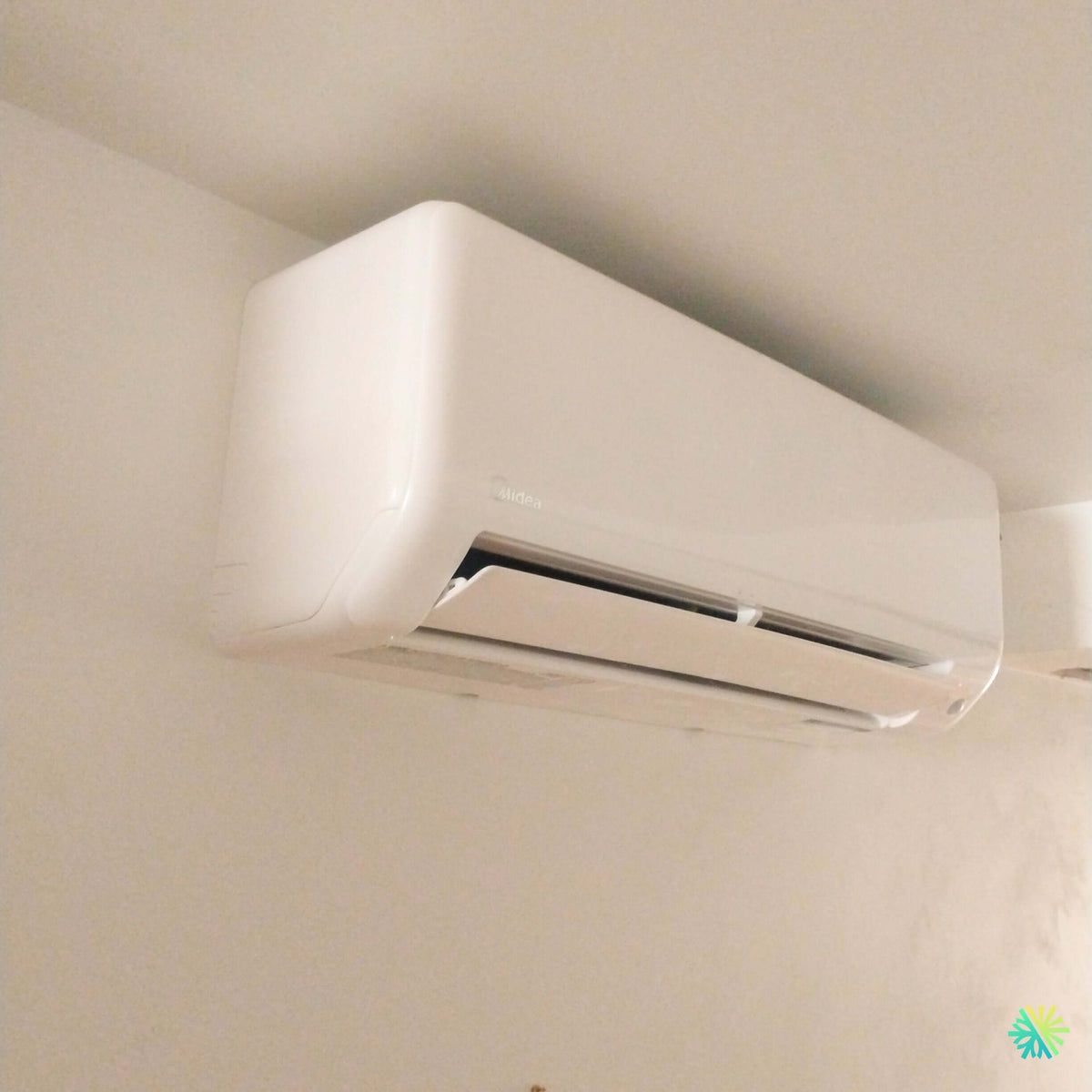
In the photo of this project, one of the details we attach great importance to at AirGreen is immediately noticeable: the visual integration of the MIDEA wall-mounted unit. The white indoor head is installed very high on the wall, near the ceiling, with clean alignment. In the visible framing, no piping or wiring runs clutter the wall surface around the unit. The result is discreet, which is particularly appealing in a residence where three indoor units must coexist with the existing layout.
A multi-zone heat pump operates with a single outdoor unit that supplies multiple indoor units. MIDEA indicates that each of these units can be controlled individually, with its own setpoint temperature, making it possible to heat or cool spaces according to how they are used rather than systematically treating the entire home the same way.
For a home in Saint-Blaise-sur-Richelieu, this approach is particularly relevant when the needs differ between, for example, a main living area, a bedroom, and another room used more occasionally.
Why three zones completely change the installation design
An installation triple-zone does not consist of installing three independent units. The three units must operate as branches of the same refrigeration system.
In particular, we must take into account:
- the capacity actually required in each room;
- the total capacity that can be connected to the condenser;
- the length and routing of each refrigerant line;
- condensate drainage;
- the position of the three wall-mounted units;
- natural air circulation;
- accessibility for theHVAC maintenance;
- the outdoor unit’s power supply;
- the balance between comfort, efficiency, and noise level.
This is precisely one of the important technical points in MIDEA’s documentation: when the combined nominal capacity of the indoor units exceeds that of the outdoor unit, the power actually available to each zone may decrease when several units place heavy demands on the system, particularly in heating mode.
In other words, adding together the BTUs listed on three indoor units is not a sufficient sizing method.
The location of the wall-mounted unit visible in this installation
The photo from the job site Saint-Blaise-sur-Richelieu shows an indoor unit positioned near the ceiling. This choice allows the treated air to be projected into the room rather than being immediately blocked by furniture or other obstacles.
However, the installation height must remain compatible with the clearances required by the manufacturer and allow access to the appliance for filter cleaning and future servicing.
A good location should also minimize several problems we encounter in less carefully planned installations:
- airflow directed straight toward a bed or sofa;
- unit too close to a wall corner;
- insufficient space above the appliance;
- difficult condensate drainage;
- long indoor run for the line-set cover;
- an appliance placed solely for aesthetic reasons, without considering airflow.
In this project, the MIDEA unit blends discreetly into the upper part of the wall. This may seem like a simple detail, but in an installation with three indoor units, repeating this level of finish in each zone makes a significant difference.
MIDEA 28: an especially flexible multi-zone architecture
The range presented by MIDEA is not limited to wall-mounted units. The manufacturer offers an architecture that can combine several types of indoor units: wall-mounted models, consoles, cassettes, ducted units, and air-handling units.
This flexibility is particularly useful for an HVAC installation because a residence is not always made up of three rooms with exactly the same constraints.
A bedroom may be perfectly suited to a wall-mounted unit, while another space may require a different solution. The multi-zone platform therefore makes it possible to design the system around the building rather than trying to adapt every room to the same type of equipment.
A single outdoor unit for multiple spaces
MIDEA also highlights two direct advantages of the multi-zone concept: several indoor units can share a single outdoor unit, reducing the space occupied outdoors, and each zone can be adjusted independently.
For a property with limited outdoor space, or when the owner wants to avoid installing three separate condensers, this configuration is particularly appealing.
It also simplifies the exterior appearance of the residence: a single condenser can provide heating and cooling for several rooms.
An Inverter heat pump that modulates its capacity
MIDEA documentation specifies that Inverter technology modulates compressor and fan motor capacity as temperature or demand changes. When all rooms do not simultaneously require full capacity, the system can operate at partial load to reduce consumption.
This modulation is particularly well suited to a triple-zone installation.
Consider a typical scenario: the living room may require more cooling in the afternoon while a bedroom remains at its setpoint. Later, the demand may reverse. The system is therefore not constantly faced with three identical loads.
That is precisely why the sizing of a multi-zone heat pump must account for the building's actual behavior, not just its total area.
The technical details that matter before choosing a MIDEA 28 triple-zone system
The MIDEA 28 system's technical brochure shows why it is essential to verify the exact combination of the condenser and indoor units. A single product line includes several capacities and possible configurations.
In the Extreme Heat category, for example, MIDEA documents a three-zone configuration using three 6,000 BTU All Easy Pro units with the condenser MO3HX-H18B-2A, under reference number AHRI 215471457.
For this specific combination documented by the manufacturer, the table indicates, among other things:
- power supply: 208/230 V, single-phase, 60 Hz;
- specified capacity: 19,000 BTU/h in cooling and 20,000 BTU/h in heating;
- SEER2: 25;
- EER2: 15;
- specified heating performance rating: 10,4;
- specified maximum outdoor airflow: 2,131 CFM;
- specified outdoor sound level: 62 dB(A).
However, these data do not mean that every MIDEA 28 triple-zone installation automatically uses this combination. The final choice depends on the indoor unit capacities actually installed and the condenser selected. That is why we always verify the full model numbers and the AHRI combination, rather than limiting ourselves to the product line's commercial name.
SEER2 of 25: what it means in practical terms
A rating SEER2 of 25 for the documented three-zone combination, represents high seasonal cooling efficiency. However, this value should not be interpreted as fixed consumption.
Actual consumption depends in particular on:
- outdoor temperature;
- indoor temperature setting;
- number of zones in operation;
- insulation level;
- solar exposure;
- how often the doors are opened;
- the sizing of each zone;
- filter and heat exchanger maintenance.
The best efficiency on paper can never compensate for an improperly sized installation or a poorly positioned indoor unit.
Why the capacity of each room must be assessed separately
In a three-zone system, a common mistake is to choose three units with the same capacity simply because there are three rooms.
A small bedroom does not have the same needs as a living room with large windows. A south-facing room may experience significantly greater solar gains than a shaded bedroom. A kitchen and an open-plan area present yet another thermal dynamic.
At AirGreen, we therefore seek to match each zone to its actual load while respecting the manufacturer's combination rules.
This approach helps avoid:
- unnecessarily short operating cycles;
- a draft-like sensation;
- excessive temperature variations;
- less effective indoor humidity control in summer;
- insufficient capacity in the most demanding zone;
- an improper distribution of capacity when several units operate simultaneously.
An interesting technology for simplifying multi-zone connections
MIDEA also presents its SynchroConnect. According to the manufacturer's documentation, the system can diagnose the connections between the refrigerant lines and cables, then synchronize certain pairings when the connections do not correspond to the same ports.
In an installation with multiple zones, this type of function can facilitate commissioning, but it obviously does not replace methodical connection work.
We always check the circuits, connections, drainage, operating parameters, and the behavior of each unit individually before considering an installation complete.
What we check when commissioning a three-zone heat pump
Once the physical installation is complete, startup is an essential step.
We specifically check:
- the operation of each of the three units;
- control response;
- air circulation;
- condensate drainage;
- refrigerant connections;
- the behavior of the outdoor unit;
- the absence of abnormal vibrations;
- operating temperatures;
- communication between the indoor units and the condenser.
In a multi-zone installation, it is also important to test several scenarios to ensure that the different zones respond correctly as demand varies.
A major mistake: treating three zones as three completely independent systems
Each indoor unit has its own temperature setting, but all three units share the same outdoor heat pump.
This distinction is important for the user.
Zoning allows comfort to be adjusted room by room, but all zones remain integrated into the same refrigeration system. The MIDEA brochure specifically emphasizes the benefit of individual control for heating or cooling occupied spaces rather than the entire residence indiscriminately.
Smart use therefore means maintaining reasonable temperatures in the different zones rather than creating extreme differences between neighboring rooms.
LogisVert grant: the complete combination must be verified, not just the brand
In Quebec, the eligibility of a MIDEA heat pump eligibility for financial assistance cannot be determined solely because the unit bears the name MIDEA 28 or because it is a multi-zone heat pump.
For heat pumps installed since November 26, 2025, Hydro-Québec notably requires the complete system to be ENERGY STAR certified to qualify for the LogisVert Heat Pump measure. In the case of a multi-zone wall-mounted heat pump, the system may include several indoor units connected to an outdoor unit, and the outdoor unit must, among other requirements, have a minimum rated cooling capacity of 12,000 BTU/h.
The applicable list and amount must be verified based on the installation date and exact combination of equipment, with Hydro-Québec specifying that eligible models and amounts may change.
This is where the AHRI number becomes important. For the three-zone Extreme Heat All Easy Pro configuration described above, 6,000 + 6,000 + 6,000 BTU, MIDEA indicates the reference AHRI 215471457.
We therefore always recommend confirming the installed combination and its eligibility at the time of the project rather than promising an amount based solely on the product name.
Special case for multi-unit buildings
Hydro-Québec has also offered, since June 15, 2026, an enhancement that can increase the incentive to $220 per 1,000 BTU/h at -8°C for certain ENERGY STAR cold-climate wall-mounted heat pumps installed in multi-unit buildings meeting specific criteria, particularly those related to the building and its location.
This enhancement should not be assumed automatically for an installation in Saint-Blaise-sur-Richelieu: the building type and all eligibility requirements must be validated.
What this installation in Saint-Blaise-sur-Richelieu clearly illustrates
The photo of this MIDEA heat pump installation well summarizes our approach to a multi-zone project: technical performance must go hand in hand with quality workmanship.
An indoor unit may have excellent energy characteristics, but its location directly affects:
- air distribution;
- perceived comfort;
- the room’s aesthetics;
- perceived noise level;
- ease of maintenance;
- the routing required for the lines.
Here, the wall-mounted unit blends discreetly into the upper part of the room, with a white casing that blends into the surrounding surfaces. In a triple-zone installation, this type of result must be replicated in every space without compromising technical requirements.
Three points to check before having a multi-zone heat pump installed
1. Request the exact capacities of the three indoor units
The term “triple-zone” provides no information about sizing. You need to know the BTUs of each unit and the condenser’s exact model.
2. Check the AHRI combination before relying on a subsidy
Two systems carrying the same brand name may have different AHRI reference numbers depending on the indoor units selected.
3. Confirm the locations before installation day
The best refrigerant-line route is not always the best location for comfort. Planning must strike a balance among aesthetics, drainage, air distribution, maintenance access and line length.
AirGreen for a MIDEA installation in Saint-Blaise-sur-Richelieu and Greater Montreal
A MIDEA 28 triple-zone heat pump is especially worthwhile when designed as a complete system. The condenser, the three indoor units, the sizing, the line-set routing, the electrical work, the drainage and the settings must all work together.
This is the approach we take at AirGreen for our multi-zone heat pumps, whether the installation is carried out in Saint-Blaise-sur-Richelieu, in Montreal, Laval, Longueuil, in South Shore or on the North Shore.
This project also shows that a high-performance installation does not need to visually dominate a room. The photographed MIDEA wall-mounted head blends discreetly near the ceiling while being part of a system capable of conditioning several areas of the home from a single outdoor unit.
For a homeowner comparing a single-zone heat pump with a triple-zone heat pumpso the real question is not only the number of indoor units. You need to examine the available capacity, how it will be distributed, the energy characteristics of the exact combination, eligibility for financial assistance programs and, above all, the quality of the installation that will allow the system to deliver its expected performance for many years.
The big day, step by step
The main steps of this kind of job at AirGreen. Every house has its quirks: the estimate brings them out.
We look at the room, the outside wall, the line route and where the outdoor unit will go. That is where the capacity gets chosen.
Model, capacity and price, in writing. We also check whether the model qualifies for assistance programs.
Floors and furniture protected, wall plate position marked level, wall opening located.
A single opening, with the slope the drain needs to flow outside.
Set on a stand raised above the snow, with the clearances the manufacturer requires.
Connected, insulated and protected. The opening is then sealed against water, cold air and insects.
A dedicated circuit and an accessible disconnect near the outdoor unit.
Leak test, vacuum, then start-up and a check of heating and cooling.
Remote, modes, filters: we show you the essentials before we leave.
- The on-site estimateWe look at the room, the outside wall, the line route and where the outdoor unit will go. That is where the capacity gets chosen.
- The quoteModel, capacity and price, in writing. We also check whether the model qualifies for assistance programs.
- Getting readyFloors and furniture protected, wall plate position marked level, wall opening located.
- The wall openingA single opening, with the slope the drain needs to flow outside.
- The outdoor unitSet on a stand raised above the snow, with the clearances the manufacturer requires.
- Lines, cable and drainConnected, insulated and protected. The opening is then sealed against water, cold air and insects.
- The electrical workA dedicated circuit and an accessible disconnect near the outdoor unit.
- Tests and start-upLeak test, vacuum, then start-up and a check of heating and cooling.
- The walkthroughRemote, modes, filters: we show you the essentials before we leave.
What would it look like at your place?
Two quick checks with real numbers: what heat costs, and what your current heaters add up to in BTU/h.
Conversion: 1 W = 3.412 BTU/h. An indication, not a load calculation: baseboards and furnaces are often stronger than the real need, and they can stay as backup. AirGreen confirms the capacity on site.
Four mistakes we do not make
Flip each card to see what we do instead.
Your own project, step by step
What to do, season by season
Three habits per season for this unit. They take a few minutes and prevent many calls.
- Clean the indoor unit's filters.
- Clear leaves and debris left on the outdoor unit by winter.
- Test cooling before the first hot days.
- Clean the filters more often when the unit runs a lot.
- Keep plants away from the outdoor unit.
- Check that no water drips from the indoor unit.
- Rake the leaves around the outdoor unit.
- Test heating before the first cold days.
- Book periodic maintenance before winter.
- Keep snow away from the stand and the front of the unit.
- Let the unit defrost: it is normal.
- Never hit the ice on the fins; call us if the unit stays iced up.
Is your home ready?
Check what applies at your place. A "no" is not a refusal: it is what we sort out during the estimate.
Four statements: true or false?
It all comes down to details you have just seen.
1. In heating mode, the outdoor unit can produce water.
During defrost cycles. That water must drain away without forming ice.
2. You pick the capacity with a simple square-footage rule.
Windows, insulation, orientation and how the room is used all count. Capacity is chosen on site.
3. A multi-zone connects several indoor heads to a single condenser.
One head per room, all on the same condenser. Each room keeps its own temperature.
4. The disconnect can sit behind the patio furniture.
It must stay accessible: it is what shuts the unit off for service.
0 / 4 right answers
What people ask us about this kind of work
Does a wall-mounted heat pump heat in winter?
Wall-mounted or multi-zone: how do I choose?
Where does the outdoor unit go?
Are there grants?
Do I need a permit?
How cold can it heat?
How much can I save?
How is the LogisVert assistance calculated?
Is it noisy?
The outdoor unit is covered in ice: is that normal?
Does AirGreen hold the required licences?
Is the estimate free?
No question matches. Write to us: we answer.
More jobs to see, near you
By town, by equipment or by region: browse more than 4,700 published projects.
Each dot: a town where AirGreen has published projects. The glowing dot: this job.
Every house has its constraints. We see them before we install.
The on-site estimate is free and the quote follows within 24 hours.
Text and photo: a real AirGreen Climatisation & Chauffage job. The diagrams are generic illustrations of the type of installation, not a survey of this job site. Sources of the added figures: airgreen.ca product pages (NEEP / AHRI performance), Hydro-Québec (Heat pumps page, LogisVert, read on 13 October 2026), Régie de l’énergie (rate D as of 1 April 2026).