
Installation of a Fujitsu AIRSTAGE Altair 700 Wall-Mounted Heat Pump in Très-Saint-Sacrement: Precise Integration Beneath an Indoor Glass Roof
At Très-Saint-Sacrement, AirGreen installs a Fujitsu AIRSTAGE Altair 700 beneath an interior glass roof: a quiet, compact R-32 Inverter wall-mounted heat pump installed with a clean, precise line-set routing.
In summer, the outdoor unit rejects the house's heat outside.
Generic illustration of this type of installation, not a survey of this job site. Tap a number.
Mounted level on a wall plate, high enough for the air to reach the whole room, with enough space around it to slide the filters out easily.
The refrigerant lines, the communication cable and the drain go through the wall in a single opening, sealed against water, cold air and insects.
Two insulated copper pipes connect the two units. Outside, a line cover can protect them from sun, knocks and weather.
A shut-off switch near the outdoor unit isolates it safely for service. It must stay accessible at all times.
The compressor and the fan. In heating mode it captures heat from the outdoor air, even in winter, and moves it inside.
On the ground or on the wall, it keeps the unit above accumulated snow. The unit stays clear and defrost water can drain away.
The fan needs to blow freely. Storage, a fence or a wall too close, and efficiency drops while noise goes up.
In Très-Saint-Sacrement, an installation where the positioning of the indoor unit made all the difference
This installation of a Fujitsu AIRSTAGE Altair 700 wall-mounted heat pump in Très-Saint-Sacrement illustrates a type of project we often encounter at AirGreen: the equipment may be relatively compact, but the available space requires careful consideration before installation.
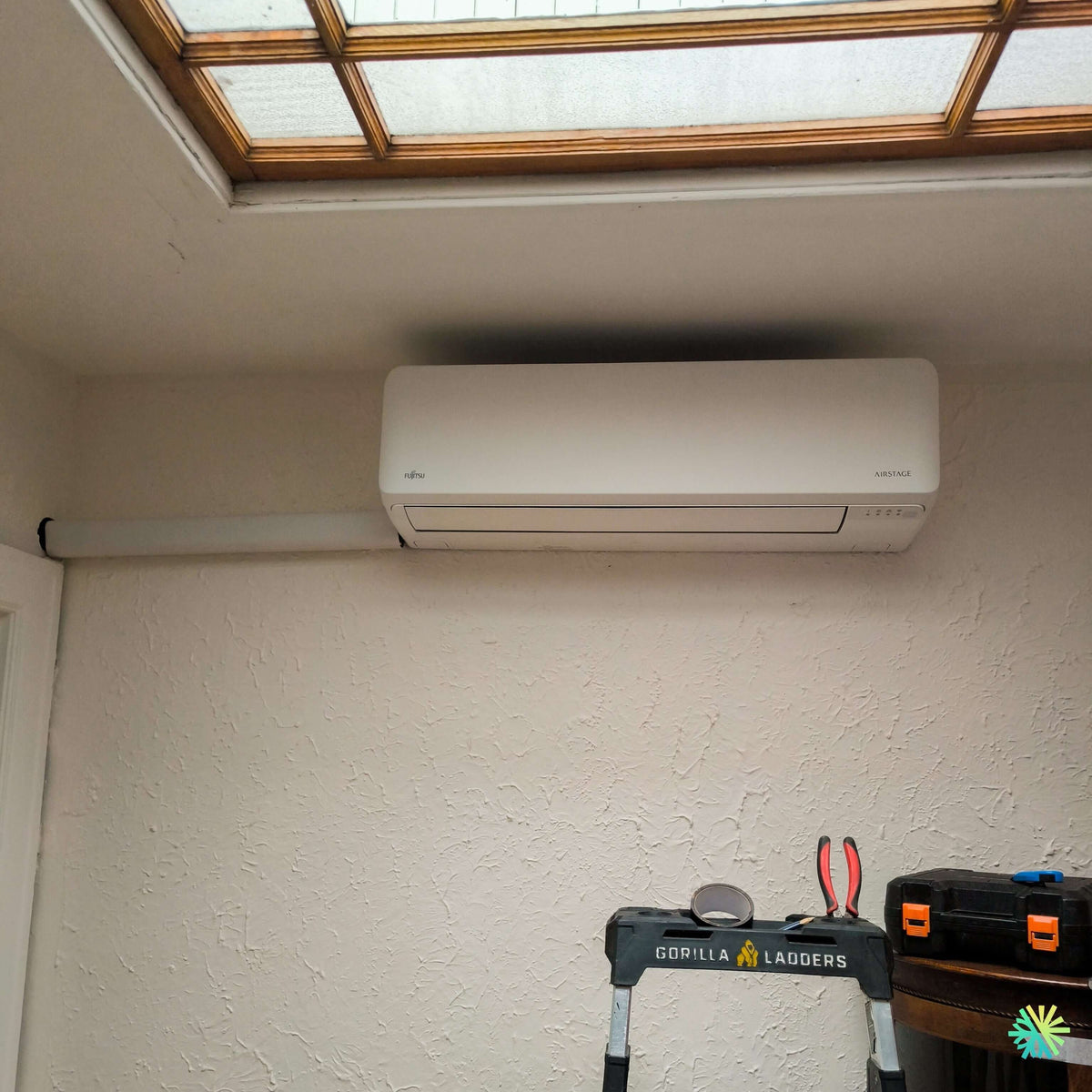
In the photo, the indoor unit is installed very high on a textured wall, immediately beneath a large interior glass opening framed in wood. To the left of the unit, the lines were routed horizontally inside a white cover, with a clean exit through the wall. This detail is important because it shows that the installation was adapted to the existing configuration rather than forcing a more complex route through the structure.
The objective was clear: to achieve a clean, functional, and accessible HVAC installation, while maintaining unobstructed airflow into the room.
A wall-mounted heat pump placed directly beneath a glass structure
The selected location offers several advantages.
The unit is positioned in the upper part of the wall, which generally promotes air distribution throughout the room. In cooling mode, cool air can be directed toward the occupied space without blowing directly at occupant height. In heating mode, airflow modulation helps distribute heat more evenly.
But this installation also had an obvious constraint: the glass partition located immediately above the heat pump.
In a situation like this, we must ensure that the unit:
- maintains the clearances required to draw in air;
- can open its front panel properly;
- remains accessible for filter cleaning;
- does not blow air directly against an obstacle;
- can be serviced without unnecessary removal of architectural elements.
The visible result in the photo is very compact. The unit makes use of the available wall space without encroaching on the wooden frame of the glass partition.
A deliberate yet well-integrated side piping route
To the left of the indoor unit, the connections are visible inside a white cover.
On certain projects, it is possible to run the lines directly behind the unit. On others, the building structure, the location of the outdoor unit, or the presence of interior finishes makes a side route more logical.
Here, choosing an outlet on the left makes it possible to achieve a short, direct route.
For us, a professional wall-mounted heat pump installation does not necessarily mean that all the mechanical components must be hidden. Above all, it means that the routing must be clean, logical, watertight, and compliant with the manufacturer's requirements.
This installation in Très-Saint-Sacrement is a good example: the technical routing remains visible, but it is discreet, straight, and consistent with the existing wall.
Fujitsu AIRSTAGE Altair 700: two capacities for single-zone applications
Fujitsu's technical documentation for the Altair 700 series presents two single-zone wall-mounted configurations:
- 09KMAS1, with a rated cooling capacity of 9,000 BTU/h;
- 12KMAS1, with a rated cooling capacity of 12,000 BTU/h.
For the 09KMAS1 model, the cooling range is 3,100 to 12,100 BTU/h, while the rated heating capacity is 12,000 BTU/h, with a range extending up to 14,500 BTU/h.
For the 12KMAS1, the cooling range reaches 13,800 BTU/h, with a rated heating capacity of 14,000 BTU/h and a maximum of 15,000 BTU/h.
The photo of the indoor installation does not allow us to read the nameplate or confirm whether the installed system is the 9,000 or 12,000 BTU version. We therefore do not want to attribute a specific capacity without visual proof.
This caution is important when comparing heat pumps: two indoor units may look identical while being associated with different capacities.
What the Fujitsu Altair 700 brings to a residential installation in practical terms
Very high energy efficiency
The Altair 700 series stands out in particular for its efficiency.
According to the Fujitsu technical specifications:
- the 09KMAS1 has a SEER2 rating of 30.0;
- the 12KMAS1 has a SEER2 rating of 27.5.
Both models are also listed with ENERGY STAR ratings in the technical documentation.
For a homeowner comparing a wall-mounted heat pump in Très-Saint-Sacrement, Montreal, Laval, Longueuil, on the North Shore, or the South Shore, this level of efficiency can be an important consideration.
However, we always emphasize that a good efficiency rating is not enough on its own. The actual quality of an installation also depends on sizing, line length, vacuum evacuation, unit placement, drainage, and commissioning.
Inverter technology designed for everyday comfort
The Fujitsu Altair 700 uses an inverter compressor.
Instead of operating only at full capacity and then stopping, the system adjusts its output according to the actual demand.
This provides several benefits:
- more stable temperature;
- fewer abrupt fluctuations;
- generally quieter operation;
- energy consumption better matched to the load;
- fewer on-off cycles.
In a room like the one in this installation in Très-Saint-Sacrement, where the unit is mounted high on the wall, this modulation helps maintain comfort without having to operate continuously at full speed.
R-32 refrigerant: an important change from R-410A
The Altair 700 series uses R-32.
Fujitsu indicates a global warming potential of 675 for R-32, compared with 2,088 for R-410A, representing an announced reduction of 68%. The manufacturer also states that R-32 systems require less refrigerant while maintaining good heating performance.
For the homeowner, day-to-day operation remains simple.
For the installer, however, this change means following the procedures and practices appropriate for the new refrigerant.
This is another reason why installation should be entrusted to an HVAC company equipped to work with current generations of heat pumps.
Heating down to -15 °C
The Fujitsu Altair 700’s heating operating range extends down to -15 °C.
This information must be understood correctly.
In Très-Saint-Sacrement and several areas of Montérégie, winter temperatures can drop lower. The property’s overall heating strategy must therefore be taken into account.
In some buildings, this heat pump can meet a substantial portion of the heating needs during the fall, mild winter, and spring, while another source takes over during colder periods.
For a customer seeking a heat pump designed to maintain high performance at significantly lower temperatures, we can compare other Fujitsu ranges specifically designed for more severe conditions.
Indoor operation as low as 19 dB(A)
Sound level is often an important consideration for a wall-mounted heat pump.
Fujitsu’s documentation indicates that the indoor sound level can drop to 19 dB(A) in quiet mode.
At high speed, the level is 40 dB(A) in cooling mode and 42 dB(A) in heating mode.
This makes the Altair 700 series appealing for rooms where avoiding dominant mechanical noise is a priority, including:
- a bedroom;
- an office;
- a living room;
- a reading room;
- an open living space.
The advertised outdoor sound levels are also relatively moderate: 44/47 dB(A) for the 9,000 BTU model and 48/50 dB(A) for the 12,000 BTU model in cooling/heating mode.
A compact indoor unit
The Altair 700 indoor unit measures approximately:
32 13/16 in. wide
10 5/8 in. high
8 3/4 in. deep
It weighs approximately 22 lb.
These dimensions partly explain why it can be installed in tight configurations like the one shown in the photo.
Between the top of the wall, the glass roof, and the side clearances, a much larger indoor unit could have reduced the available positioning options.
Standard 1/4 in. and 3/8 in. piping
For the 09KMAS1 and 12KMAS1 models, Fujitsu specifies:
liquid line: 1/4 in.
gas line: 3/8 in.
The minimum piping length is 10 ft, and the maximum length is 66 ft.
The maximum permitted vertical difference is 49 ft.
These figures play a direct role in the installation design.
At Très-Saint-Sacrement, the visible side passage to the left of the indoor unit clearly illustrates the importance of choosing a realistic piping route from the outset.
A shorter, simpler route generally makes installation easier and limits unnecessary work on the walls.
A 208–230 V power supply with a 15 A breaker
Both Altair 700 models listed in the specification sheet operate at 208 to 230 V, single-phase, 60 Hz, with a 15 A breaker.
For the 09KMAS1, the specified maximum current is 6.4 A in cooling mode and 9.4 A in heating mode.
For the 12KMAS1, it is 6.9 A in cooling mode and 9.4 A in heating mode.
This relatively light electrical requirement can be advantageous in some residential projects.
However, the existing electrical panel must always be checked.
The presence of available space in the panel alone does not guarantee that the connection is suitable. The panel capacity, breaker type, wiring gauge, and installation conditions must all be verified.
Integrated Wi-Fi and remote control
The Altair 700 also offers integrated Wi-Fi connectivity.
This allows users to take advantage of the compatible control features in the AIRSTAGE ecosystem.
For some homeowners, this feature quickly becomes practical in everyday use: adjusting the temperature, managing periods of absence, or checking the system remotely.
The documentation also mentions several advanced controller and interface options, including wired solutions as well as compatibility with certain building management protocols.
ProCore coils and internal construction
Fujitsu indicates that the indoor unit uses ProCore copper coils with high corrosion resistance.
The documentation also mentions several features:
- economy mode;
- energy-saving mode;
- automatic defrost;
- automatic restart;
- minimum-heat mode;
- wireless remote control;
- low-noise outdoor operating mode.
These are elements that are not visible in an installation photo but have a direct impact on long-term operation.
The importance of drainage in such a high installation
An indoor unit installed near the ceiling also requires properly prepared drainage.
In cooling mode, the indoor coil produces condensation.
Fujitsu specifies a moisture-removal capacity of 1.38 L/h for the 9,000 BTU model and 1.73 L/h for the 12,000 BTU model.
This water must be discharged continuously.
A drain that is poorly positioned or lacks sufficient slope can lead to drainage, odor, or leakage problems.
In a project like this, we must therefore consider the following from the outset:
- the available slope;
- the drain outlet;
- the height of the unit;
- the possibility of cleaning the drain later;
- the refrigeration lines routed beside the drain.
It is an invisible detail once the installation is complete, but essential to its reliability.
What the photo shows about the quality of a real installation
The photo taken during the work is particularly interesting because it is not a catalog image.
The ladder, tools, and toolbox used by the team are still visible.
This makes it possible to see the installation in its actual context.
The unit is well centered on the available wall area. The mechanical routing remains compact. The front of the heat pump is unobstructed. The appliance is positioned beneath the skylight without entering the wooden frame.
These are precisely the details that distinguish a location chosen quickly from one carefully considered before installation.
The mistakes we aim to avoid on this type of project
A wall-mounted heat pump installation in Très-Saint-Sacrement may seem simple, but several mistakes are common.
Installing the unit too close to the ceiling
A unit installed too high may not have enough space to draw in air properly and can become difficult to service.
Routing the piping along an unnecessarily long path
More length means more work, more finishing, and sometimes additional refrigeration adjustments.
Ignoring the location of doors and openings
In this photo, the duct runs above a door on the left. The route therefore had to be positioned carefully to avoid any interference.
Underestimating future access
The filters must be removable, and the unit must remain accessible for HVAC maintenance or thorough cleaning.
Choosing BTUs based solely on floor area
Sizing also depends on insulation, exposure, the number of windows, room layout, and heat loss.
Subsidies: verify the exact combination before announcing an amount
Fujitsu documentation indicates different ENERGY STAR classifications for the Altair 700 series.
This can make certain combinations attractive in the context of financial assistance programs.
However, we avoid announcing a subsidy amount based solely on the series name.
The following must be verified:
- the exact indoor model;
- the exact outdoor model;
- the corresponding AHRI number;
- the criteria applicable at the time of the project;
- the selected capacity;
- the type of building.
This verification prevents unrealistic expectations from being created before installation.
An approach we also apply in Montreal, Laval, Longueuil, the North Shore, and the South Shore
Although this installation is located in Très-Saint-Sacrement, the principle remains the same everywhere we work.
In Montreal, we often work with older buildings where existing walls and passageways impose constraints.
In Laval, we frequently encounter homes with additions or finished basements.
In Longueuil and on the South Shore, projects may require working around more open spaces or renovations that have already been completed.
On the North Shore, we also install systems on properties where the outdoor unit’s location must be optimized for snow and defrosting.
In every case, the same principle applies: we adapt the heat pump to the building rather than forcing the building to accept a poor location.
A discreet installation that makes intelligent use of space
This Fujitsu AIRSTAGE Altair 700 installation in Très-Saint-Sacrement is interesting precisely because it is not spectacular.
It is compact, tidy, and logical.
The indoor unit uses the space beneath the sunroom, the side passage remains unobstructed, and air distribution into the room is clear.
With its R-32 refrigerant, Inverter technology, high efficiency, built-in Wi-Fi, quiet operation, and compact design, the Altair 700 is well suited to this type of residential project.
But as always, the machine’s specifications represent only part of the outcome.
At AirGreen, the difference also comes down to the choice of wall, the routing of the lines, drainage preparation, the quality of the connections, compliance with clearance requirements, and the ability to service the equipment easily in the years to come.
How it goes, from the first call to the end
The main steps of this kind of job at AirGreen. Every house has its quirks: the estimate brings them out.
We look at the room, the outside wall, the line route and where the outdoor unit will go. That is where the capacity gets chosen.
Model, capacity and price, in writing. We also check whether the model qualifies for assistance programs.
Floors and furniture protected, wall plate position marked level, wall opening located.
A single opening, with the slope the drain needs to flow outside.
Set on a stand raised above the snow, with the clearances the manufacturer requires.
Connected, insulated and protected. The opening is then sealed against water, cold air and insects.
A dedicated circuit and an accessible disconnect near the outdoor unit.
Leak test, vacuum, then start-up and a check of heating and cooling.
Remote, modes, filters: we show you the essentials before we leave.
- The on-site estimateWe look at the room, the outside wall, the line route and where the outdoor unit will go. That is where the capacity gets chosen.
- The quoteModel, capacity and price, in writing. We also check whether the model qualifies for assistance programs.
- Getting readyFloors and furniture protected, wall plate position marked level, wall opening located.
- The wall openingA single opening, with the slope the drain needs to flow outside.
- The outdoor unitSet on a stand raised above the snow, with the clearances the manufacturer requires.
- Lines, cable and drainConnected, insulated and protected. The opening is then sealed against water, cold air and insects.
- The electrical workA dedicated circuit and an accessible disconnect near the outdoor unit.
- Tests and start-upLeak test, vacuum, then start-up and a check of heating and cooling.
- The walkthroughRemote, modes, filters: we show you the essentials before we leave.
And at your place?
Two quick checks with real numbers: what heat costs, and what your current heaters add up to in BTU/h.
Conversion: 1 W = 3.412 BTU/h. An indication, not a load calculation: baseboards and furnaces are often stronger than the real need, and they can stay as backup. AirGreen confirms the capacity on site.
What to do, season by season
Three habits per season for this unit. They take a few minutes and prevent many calls.
- Clean the indoor unit's filters.
- Clear leaves and debris left on the outdoor unit by winter.
- Test cooling before the first hot days.
- Clean the filters more often when the unit runs a lot.
- Keep plants away from the outdoor unit.
- Check that no water drips from the indoor unit.
- Rake the leaves around the outdoor unit.
- Test heating before the first cold days.
- Book periodic maintenance before winter.
- Keep snow away from the stand and the front of the unit.
- Let the unit defrost: it is normal.
- Never hit the ice on the fins; call us if the unit stays iced up.
Which type of equipment for your project?
Pick what looks like your need.
Four mistakes we do not make
Flip each card to see what we do instead.
What people ask us about this kind of work
Does a wall-mounted heat pump heat in winter?
Wall-mounted or multi-zone: how do I choose?
Where does the outdoor unit go?
Are there grants?
Do I need a permit?
How cold can it heat?
How much can I save?
How is the LogisVert assistance calculated?
Is it noisy?
The outdoor unit is covered in ice: is that normal?
Does AirGreen hold the required licences?
Is the estimate free?
No question matches. Write to us: we answer.
Useful pages for what comes next
More jobs to see, near you
By town, by equipment or by region: browse more than 4,700 published projects.
Each dot: a town where AirGreen has published projects. The glowing dot: this job.
Tell us about your house. We come and see it for free.
The on-site estimate is free and the quote follows within 24 hours.
Text and photo: a real AirGreen Climatisation & Chauffage job. The diagrams are generic illustrations of the type of installation, not a survey of this job site. Sources of the added figures: airgreen.ca product pages (NEEP / AHRI performance), Hydro-Québec (Heat pumps page, LogisVert, read on 13 October 2026), Régie de l’énergie (rate D as of 1 April 2026).