
Installation of a Fujitsu AIRSTAGE Altair 700 wall-mounted heat pump on a rooftop in Notre-Dame-de-l'Île-Perrot
In Notre-Dame-de-l'Île-Perrot, AirGreen installs a Fujitsu Altair 700 R-32 rooftop unit on an elevated support, with a layout designed around clearances, nearby equipment, maintenance, and durability.
Take a tour of the installation
Each number is a point we check on site. Switch between summer and winter to watch air and heat move.
In summer, the outdoor unit rejects the house's heat outside.
Generic illustration of this type of installation, not a survey of this job site. Tap a number.
Mounted level on a wall plate, high enough for the air to reach the whole room, with enough space around it to slide the filters out easily.
The refrigerant lines, the communication cable and the drain go through the wall in a single opening, sealed against water, cold air and insects.
Two insulated copper pipes connect the two units. Outside, a line cover can protect them from sun, knocks and weather.
A shut-off switch near the outdoor unit isolates it safely for service. It must stay accessible at all times.
The compressor and the fan. In heating mode it captures heat from the outdoor air, even in winter, and moves it inside.
On the ground or on the wall, it keeps the unit above accumulated snow. The unit stays clear and defrost water can drain away.
The fan needs to blow freely. Storage, a fence or a wall too close, and efficiency drops while noise goes up.
In Notre-Dame-de-l'Île-Perrot, a rooftop installation where structure, clearance, and future maintenance become just as important as the heat pump
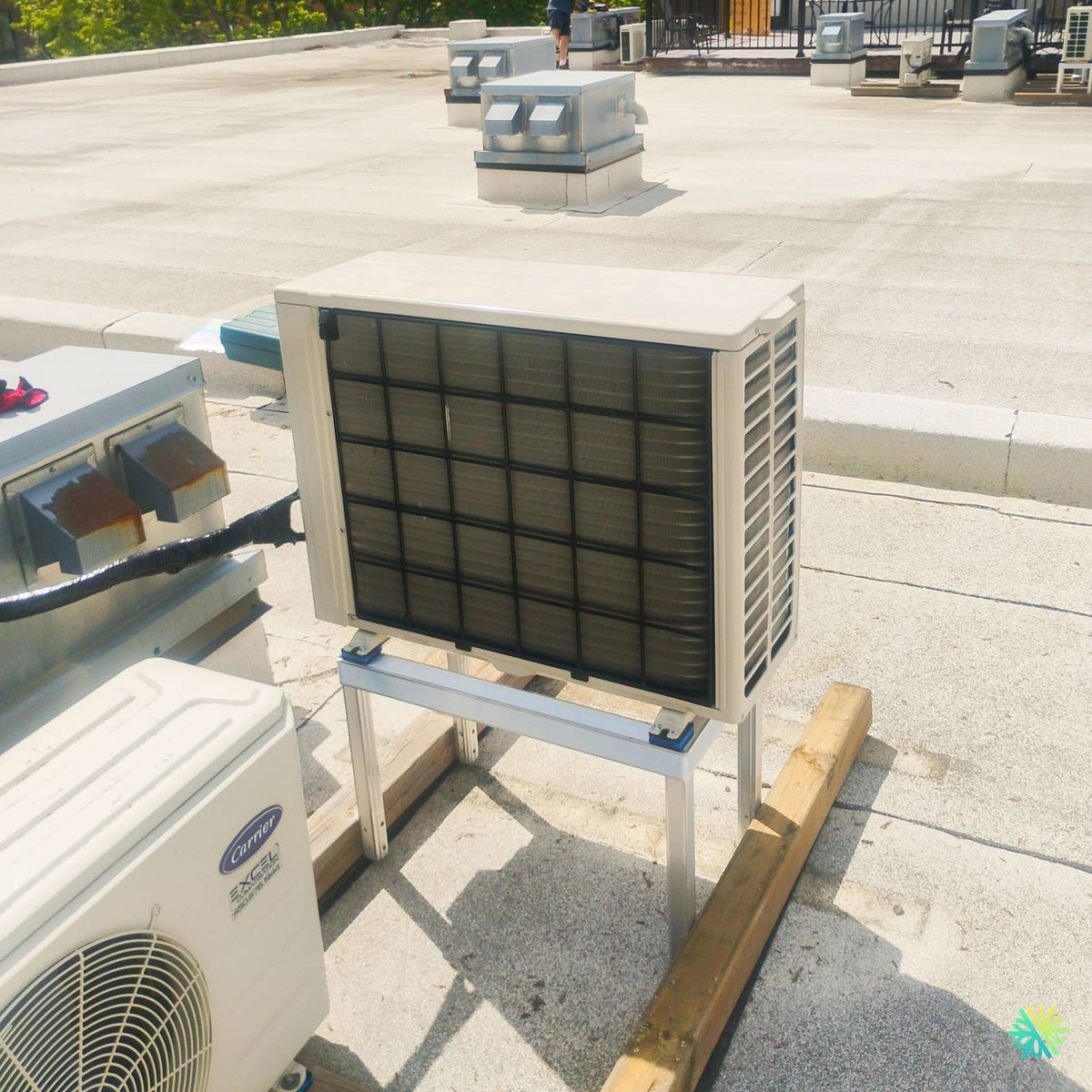
This installation carried out by our AirGreen team in Notre-Dame-de-l'Île-Perrot presents a configuration very different from a wall-mounted heat pump installed at ground level or on a balcony. Here, the outdoor unit of the Fujitsu AIRSTAGE Altair 700 was positioned directly on a flat roof, among several other mechanical systems already in place.
The job-site photograph immediately reveals the project’s main constraints: a shared mechanical area, another nearby air-conditioning unit, rooftop ventilation equipment, a roof membrane that must be protected, and the need to keep the unit above the surface. We therefore installed the Fujitsu on a raised metal support, with supports beneath the unit to ensure a stable installation suited to this environment.
A rooftop installation is never simply a matter of transporting the condenser to the roof and placing it in the available space. We must consider airflow, roof load capacity, service access, vibrations, drainage, winter conditions, refrigerant line routing, and the space required for future HVAC maintenance simultaneously.
This is what makes this project particularly representative of our work in Greater Montreal: the same wall-mounted heat pump may require a completely different strategy depending on the building in which it is installed.
A single-zone Fujitsu AIRSTAGE Altair 700 using R-32
The Fujitsu Altair 700 lineup used for this type of installation belongs to Fujitsu’s single-zone H series. The technical documentation provided covers two combinations:
- ASUH09KMAS + AOUH09KMAS1, with a nominal cooling capacity of 9,000 BTU/h;
- ASUH12KMAS + AOUH12KMAS1, with a nominal cooling capacity of 12,000 BTU/h.
The roof photograph allows us to identify the Fujitsu AIRSTAGE family, but it does not allow us to read the nameplate clearly enough to confidently attribute the 9,000 or 12,000 BTU/h version to this specific installation. We therefore retain both documented configurations rather than presenting an assumed capacity as a job-site fact. The Fujitsu documentation also confirms the use of R-32 refrigerant, Inverter technology, and the main performance values of both models.
Why install the unit on a metal support above the roof?
One of the most important details visible in the photo is the support.
The outdoor unit is not placed directly on the roof membrane. It rests on a metal structure that holds it at a certain height.
This decision addresses several needs.
Protecting the roof
An outdoor unit exerts a permanent load on its supporting surface. It also vibrates slightly during operation.
We therefore seek to avoid an improvised installation that would unnecessarily concentrate stress on the membrane or create a permanent friction point against it.
On an existing roof, we must work with what is already there and avoid damaging the building's waterproofing.
Keeping the unit above water and accumulations
A flat roof must drain rainwater and water from melting snow. The outdoor unit must not become an obstacle placed directly in an area where water may flow.
Raising the unit also helps keep its base away from the surface when winter accumulations form.
Facilitating defrosting in heating mode
A heat pump does more than provide cooling. When operating in heating mode during cold weather, the outdoor coil can accumulate frost.
The unit then automatically runs a defrost cycle. The resulting water must then be able to drain away.
Leaving space beneath the machine therefore makes perfect sense on a Quebec roof.
An already occupied mechanical roof: the project's real challenge
The photograph taken in Notre-Dame-de-l'Île-Perrot clearly shows that the Fujitsu is not alone.
A Carrier unit is located immediately nearby. Farther away, we can make out several ventilation components and various pieces of equipment installed on the roof.
This creates a constraint that an owner does not always see before the team arrives: the equipment cannot be positioned independently of one another.
We must take the behavior of each machine into account.
An outdoor unit draws air through its heat exchanger and then discharges a substantial volume of air. If several units are installed too close together or with an unsuitable orientation, undesirable interactions between their airflow patterns may occur.
We therefore seek to maintain:
- sufficient space around the heat exchanger;
- a clear air-discharge area;
- access to the service panels;
- reasonable separation from nearby equipment;
- a safe route for technicians;
- a layout compatible with the other equipment on the roof.
This is an essential part of a rooftop HVAC installation.
A compact outdoor unit that helps when space is limited
The Altair 700’s compact format is an advantage in this context.
For the two documented configurations, the outdoor unit measures approximately:
- 799 mm wide, or 31 7/16 in;
- 542 mm high, or 21 5/16 in;
- 290 mm deep, or 11 7/16 in;
- 32 kg, or approximately 71 lb.
These dimensions are listed in the Fujitsu technical sheet for the series.
A depth of only 290 mm obviously makes integration into an already crowded mechanical environment easier.
This does not mean that we can arbitrarily reduce the required operating clearances. The compact format simply gives us more flexibility to find a logical position.
Performance of up to 30.0 SEER2
The Altair 700 offers two efficiency profiles depending on capacity.
For the 09KMAS1 configuration, Fujitsu indicates:
- SEER2: 30.0;
- HSPF2 Region V: 9.9;
- EER2: 16.4;
- COP2: 4.64.
For the 12KMAS1 configuration:
- SEER2: 27.5;
- HSPF2 Region V: 8.5;
- EER2: 13.5;
- COP2: 4.32.
The documentation also lists ENERGY STAR ratings, including the designations presented for cold climates and ENERGY STAR Most Efficient.
These values are useful when comparing several wall-mounted heat pumps. They make it possible to look beyond the simple BTU rating and better understand a unit’s seasonal efficiency.
Inverter modulation: particularly useful during the shoulder seasons
Inverter technology allows the unit to adjust its capacity according to demand.
The 9,000 BTU/h model can modulate between approximately 3,100 and 12,100 BTU/h in cooling and between 2,800 and 14,500 BTU/h in heating.
For the 12,000 BTU/h version, the stated range reaches 3,100 to 13,800 BTU/h in cooling and 2,800 to 15,000 BTU/h in heating.
This modulation is important in Quebec’s climate.
On a mild day in October or April, the residence may require relatively little heating. A machine capable of reducing its capacity can then maintain the setpoint more continuously.
In summer, the same principle makes it possible to adapt to periods when the cooling load remains moderate.
Heating down to -15 °C according to the Fujitsu specifications
For the Altair 700 described in the documentation provided, the official heating operating range is -15 °C to 24 °C.
In cooling mode, Fujitsu specifies a range of -10 °C to 50 °C.
We place a great deal of importance on this information because commercial expressions such as “cold-climate heat pump” must always be accompanied by the manufacturer’s exact specifications.
In Notre-Dame-de-l'Île-Perrot, temperatures can obviously drop below -15 °C during the winter. The building’s heating must therefore be planned with the heat pump’s actual operating range and the presence of an appropriate backup system in mind.
What Installing a Fujitsu Altair 700 on a Roof Really Requires from Our AirGreen Team
Transporting it to the roof is part of the job
A heat pump installed on a roof adds an important logistical step.
We must transport the outdoor unit to its location without damaging:
- the condenser;
- its fins;
- the connections;
- the roof;
- the equipment already present.
An outdoor unit from this series weighs approximately 32 kg, which remains relatively compact for HVAC equipment, but its size obviously means it cannot be handled like a simple box.
Once on the roof, the positioning must be carried out precisely so that the feet rest properly on their support.
Vibrations are even more significant on a roof
In the photo, we can see supports between the unit’s feet and the metal structure.
This contact area deserves a great deal of attention.
On a roof, poorly controlled vibration can be transmitted directly to the building’s structure. A relatively discreet noise outside can then become noticeable indoors as vibration or humming.
We are therefore looking to create an installation that is:
- rigid;
- level;
- properly supported;
- without unnecessary contact between the unit and the roof;
- accessible for future adjustments and service work.
The outdoor heat exchanger must remain unobstructed
The photo provides a particularly interesting view of the back of the Fujitsu unit.
We can clearly see the large heat exchanger protected by its grille.
This area must be able to receive sufficient airflow. It plays an essential role in both cooling and heating.
Poor placement that blocks the heat exchanger with a wall, nearby equipment, or an obstacle can reduce the machine's performance.
That is why the position of a rooftop unit is decided in three dimensions: we do not look only at the available ground area.
Noise: another advantage of this series
Fujitsu specifies approximately 44 dB(A) in cooling and 47 dB(A) in heating for the 09KMAS1 outdoor unit.
For the 12KMAS1 model, the stated values are 48 dB(A) and 50 dB(A), respectively.
The indoor unit can reach as low as 19 dB(A) in quiet cooling mode and 21 dB(A) in heating mode.
This acoustic performance is particularly valuable in installations where the outdoor unit is located on the roof directly above occupied spaces.
However, a good acoustic rating from the manufacturer does not eliminate the importance of installation. A quiet machine installed on an unstable support can transmit more vibration than a properly mounted machine.
1/4 in. and 3/8 in. refrigerant lines
For the two Altair 700 configurations presented in the Fujitsu data sheet, the refrigerant connections use:
- 1/4 in. for liquid;
- 3/8 in. for gas.
The specified minimum piping length is 3 m, or 10 ft, while the maximum length is 20 m, or 66 ft.
The maximum permitted vertical difference is 14.9 m, or 49 ft.
This last characteristic is particularly relevant on a project like this one.
When the outdoor unit is installed on the roof and the indoor unit is located lower in the building, the height difference between the two components becomes a central project consideration.
We must therefore measure the route before starting, rather than after choosing the final location of the outdoor unit.
A 208–230 V power supply with a 15 A circuit breaker
Fujitsu's technical data sheet indicates for both models:
- 208 to 230 V;
- 60 Hz;
- single-phase power supply;
- 15 A circuit breaker.
The 9,000 BTU/h version has a maximum current of 6.4 A in cooling mode and 9.4 A in heating mode. For the 12,000 BTU/h version, these values reach 6.9 A and 9.4 A, respectively.
On a rooftop project, the electrical connection must also be carefully planned. The route, circuit protection, and location of the necessary components must be determined without improvising once the machine has already been secured.
R-32 and commissioning: work that cannot be seen in the photo
The Altair 700 operates with R-32.
Fujitsu documentation lists a global warming potential of 675 for R-32, compared with 2,088 for R-410A, representing an announced reduction of 68% in GWP.
But the most important part for us remains commissioning.
A beautiful installation on a perfectly aligned support can never compensate for:
- an improper refrigerant connection;
- a leak;
- improper vacuuming;
- a crushed line;
- an electrical error;
- an installation that does not comply with the manufacturer’s technical specifications.
The work visible in the photo therefore represents only part of the actual installation.
Built-in Wi-Fi and AIRSTAGE control
The Altair 700 series also includes built-in Wi-Fi connectivity for remote monitoring through the AIRSTAGE mobile app, according to Fujitsu documentation.
For the owner, this makes daily system management easier.
It becomes possible, in particular, to adjust the temperature without being physically in front of the remote control, which is useful when the heat pump serves a space occupied according to variable schedules.
The product line also offers several integration and control options, including wired controllers and interfaces that can support certain protocols such as BACnet and Modbus.
Three mistakes we particularly seek to avoid on a rooftop
Placing two condensers too close to each other
At the photographed job site, the presence of a nearby Carrier unit shows why airflow must be analyzed before choosing the location.
The available space should never be the sole criterion.
Placing the equipment directly on the membrane
A rooftop installation deserves suitable support. Stability, water, vibrations, and surface protection must all be considered together.
Forgetting that a technician will need to return
Today, the unit is new.
In several years, it may be necessary to access its connections, clean the coil, check a sensor, or replace a component.
A good HVAC installation leaves this possibility open.
A wall-mounted heat pump can very well have its outdoor unit on the roof
Some property owners automatically associate a wall-mounted heat pump with a condenser mounted on the exterior wall of a house or installed on a support near the ground.
This project in Notre-Dame-de-l'Île-Perrot shows another possibility.
When the building, line length, and technical requirements allow it, the roof can be a suitable location, particularly when:
- ground-level space is limited;
- several units or pieces of equipment share the building;
- the façades need to remain more unobstructed;
- the existing mechanical configuration favors grouping the equipment on the roof.
The key, therefore, is not to systematically choose the roof or the ground. It is to choose the location that truly works for the building.
Our AirGreen approach in Notre-Dame-de-l'Île-Perrot and Greater Montreal
This project illustrates a principle we apply in our installations in Notre-Dame-de-l'Île-Perrot, Montreal, Laval, Longueuil, on the North Shore and the South Shore: we adapt the installation to the actual environment rather than applying exactly the same method everywhere.
In this project, the main challenge was not simply connecting a Fujitsu Altair 700.
A new outdoor unit had to be integrated into a roof where several pieces of equipment were already present, while maintaining mechanical access, positioning the coil correctly, creating a stable elevated base, and planning the lines for an installation located at height.
The Fujitsu AIRSTAGE Altair 700 is particularly well suited to this type of project thanks to its compact outdoor format, Inverter technology, R-32 refrigerant, 1/4 in. and 3/8 in. lines, advertised maximum piping length of 66 ft, and efficiency of up to 30.0 SEER2, depending on the configuration.
The result is an installation that appears relatively simple once completed, but behind it are several essential technical decisions. It is precisely this preparation that turns a properly selected heat pump into a durable, accessible HVAC installation that is consistent with the building.
The big day, step by step
The main steps of this kind of job at AirGreen. Every house has its quirks: the estimate brings them out.
We look at the room, the outside wall, the line route and where the outdoor unit will go. That is where the capacity gets chosen.
Model, capacity and price, in writing. We also check whether the model qualifies for assistance programs.
Floors and furniture protected, wall plate position marked level, wall opening located.
A single opening, with the slope the drain needs to flow outside.
Set on a stand raised above the snow, with the clearances the manufacturer requires.
Connected, insulated and protected. The opening is then sealed against water, cold air and insects.
A dedicated circuit and an accessible disconnect near the outdoor unit.
Leak test, vacuum, then start-up and a check of heating and cooling.
Remote, modes, filters: we show you the essentials before we leave.
- The on-site estimateWe look at the room, the outside wall, the line route and where the outdoor unit will go. That is where the capacity gets chosen.
- The quoteModel, capacity and price, in writing. We also check whether the model qualifies for assistance programs.
- Getting readyFloors and furniture protected, wall plate position marked level, wall opening located.
- The wall openingA single opening, with the slope the drain needs to flow outside.
- The outdoor unitSet on a stand raised above the snow, with the clearances the manufacturer requires.
- Lines, cable and drainConnected, insulated and protected. The opening is then sealed against water, cold air and insects.
- The electrical workA dedicated circuit and an accessible disconnect near the outdoor unit.
- Tests and start-upLeak test, vacuum, then start-up and a check of heating and cooling.
- The walkthroughRemote, modes, filters: we show you the essentials before we leave.
What would it look like at your place?
Two quick checks with real numbers: what heat costs, and what your current heaters add up to in BTU/h.
Conversion: 1 W = 3.412 BTU/h. An indication, not a load calculation: baseboards and furnaces are often stronger than the real need, and they can stay as backup. AirGreen confirms the capacity on site.
Four mistakes we do not make
Flip each card to see what we do instead.
Your own project, step by step
What to do, season by season
Three habits per season for this unit. They take a few minutes and prevent many calls.
- Clean the indoor unit's filters.
- Clear leaves and debris left on the outdoor unit by winter.
- Test cooling before the first hot days.
- Clean the filters more often when the unit runs a lot.
- Keep plants away from the outdoor unit.
- Check that no water drips from the indoor unit.
- Rake the leaves around the outdoor unit.
- Test heating before the first cold days.
- Book periodic maintenance before winter.
- Keep snow away from the stand and the front of the unit.
- Let the unit defrost: it is normal.
- Never hit the ice on the fins; call us if the unit stays iced up.
Is your home ready?
Check what applies at your place. A "no" is not a refusal: it is what we sort out during the estimate.
Four statements: true or false?
It all comes down to details you have just seen.
1. In heating mode, the outdoor unit can produce water.
During defrost cycles. That water must drain away without forming ice.
2. You pick the capacity with a simple square-footage rule.
Windows, insulation, orientation and how the room is used all count. Capacity is chosen on site.
3. A multi-zone connects several indoor heads to a single condenser.
One head per room, all on the same condenser. Each room keeps its own temperature.
4. The disconnect can sit behind the patio furniture.
It must stay accessible: it is what shuts the unit off for service.
0 / 4 right answers
What people ask us about this kind of work
Does a wall-mounted heat pump heat in winter?
Wall-mounted or multi-zone: how do I choose?
Where does the outdoor unit go?
Are there grants?
Do I need a permit?
How cold can it heat?
How much can I save?
How is the LogisVert assistance calculated?
Is it noisy?
The outdoor unit is covered in ice: is that normal?
Does AirGreen hold the required licences?
Is the estimate free?
No question matches. Write to us: we answer.
More jobs to see, near you
By town, by equipment or by region: browse more than 4,700 published projects.
Each dot: a town where AirGreen has published projects. The glowing dot: this job.
Every house has its constraints. We see them before we install.
The on-site estimate is free and the quote follows within 24 hours.
Text and photo: a real AirGreen Climatisation & Chauffage job. The diagrams are generic illustrations of the type of installation, not a survey of this job site. Sources of the added figures: airgreen.ca product pages (NEEP / AHRI performance), Hydro-Québec (Heat pumps page, LogisVert, read on 13 October 2026), Régie de l’énergie (rate D as of 1 April 2026).