
Installation of a Fujitsu AIRSTAGE Orion XLTH wall-mounted heat pump in Côte Saint-Luc: R-32 system on an elevated stand for cold-climate heating
In Côte Saint-Luc, AirGreen installs a Fujitsu Orion XLTH R-32 wall-mounted heat pump on an elevated bracket: a configuration designed for defrosting, snow, heating down to -26 °C, and reliable operation in Quebec’s climate.
Take a tour of the installation
Each number is a point we check on site. Switch between summer and winter to watch air and heat move.
In summer, the outdoor unit rejects the house's heat outside.
Generic illustration of this type of installation, not a survey of this job site. Tap a number.
Mounted level on a wall plate, high enough for the air to reach the whole room, with enough space around it to slide the filters out easily.
The refrigerant lines, the communication cable and the drain go through the wall in a single opening, sealed against water, cold air and insects.
Two insulated copper pipes connect the two units. Outside, a line cover can protect them from sun, knocks and weather.
A shut-off switch near the outdoor unit isolates it safely for service. It must stay accessible at all times.
The compressor and the fan. In heating mode it captures heat from the outdoor air, even in winter, and moves it inside.
On the ground or on the wall, it keeps the unit above accumulated snow. The unit stays clear and defrost water can drain away.
The fan needs to blow freely. Storage, a fence or a wall too close, and efficiency drops while noise goes up.
An installation in Côte Saint-Luc where the outdoor unit’s location required precise planning
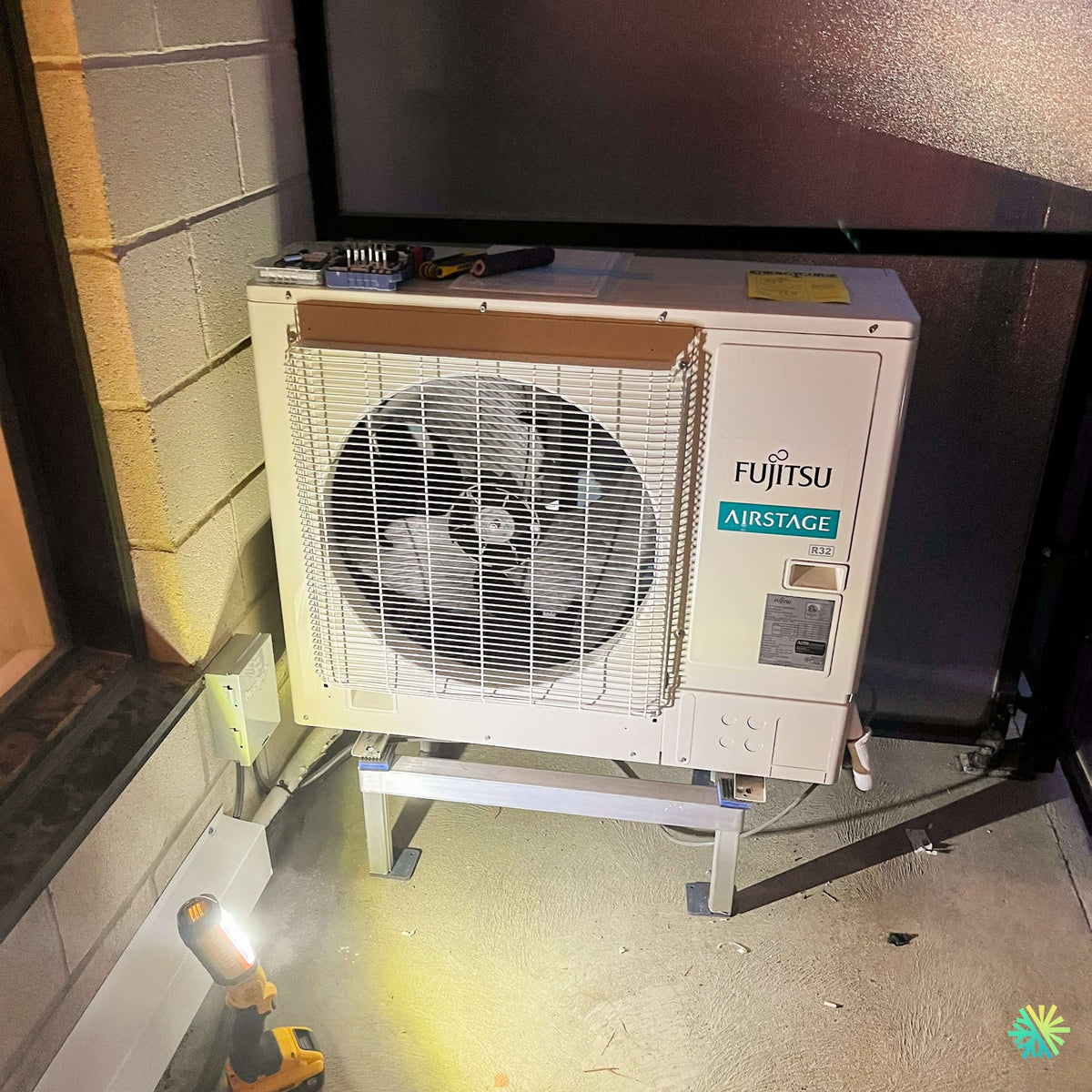
In Côte Saint-Luc, we completed this installation of a Fujitsu AIRSTAGE Orion XLTH wall-mounted heat pump in a particularly interesting outdoor configuration. The photo taken during the work shows the Fujitsu outdoor unit installed in a relatively confined space, between a concrete block wall and an adjacent structure, with a concrete surface beneath the equipment.
The detail that immediately catches our attention is the elevated metal bracket used to install the outdoor unit. In Quebec, this choice is never purely aesthetic. A heat pump intended to provide heating during the winter must be positioned with snow, ice, defrost cycles, and water drainage beneath the machine in mind.
For this Côte Saint-Luc installation, we therefore did not want to simply place the equipment near ground level. We had to create a stable, accessible configuration suited to the winter operation of a heat pump designed specifically for a cold climate.
The photo also shows the marking R32 directly on the outdoor cabinet, confirming the use of R-32 refrigerant in this Fujitsu generation. The tools still temporarily placed on top of the unit indicate that the photograph was taken during the installation or project-completion phase, before the work area was fully cleaned.
The Fujitsu Orion XLTH: a wall-mounted heat pump designed for Quebec winters
The Fujitsu AIRSTAGE Orion XLTH, presented by the manufacturer under the Orion CTEB series, is a single-zone wall-mounted system designed to provide both cooling and heating.
One particularly relevant aspect for an installation in Côte Saint-Luc is its winter operating range. Fujitsu documentation indicates heating operation down to -26 °C, for the various capacities in the lineup. The indicated cooling operating range, meanwhile, extends from -10 °C to 50 °C.
This data significantly changes the way we evaluate a heat pump.
For a Greater Montreal homeowner, a heat pump is no longer merely an appliance intended to cool the house for a few weeks in summer. It can become an important component of the heating system during a large part of the cold season.
A range offered in several capacities
Fujitsu technical documentation presents five Orion XLTH configurations:
- 09KZAH1 : 9,000 BTU/h nominal cooling capacity;
- 12KZAH1 : 12,000 BTU/h;
- 15KZAH1 : 14,500 BTU/h;
- 18KZAH1 : 18,000 BTU/h;
- 24KZAH1 : 22,000 BTU/h.
The nominal heating capacities are respectively 12,000, 16,000, 18,000, 21,600, and 25,200 BTU/h.
The rating plate visible in the Côte Saint-Luc photograph is too small to reliably confirm the exact capacity installed. We therefore prefer not to arbitrarily assign a BTU rating to this installation.
This caution is important in the HVAC field. Two outdoor units from the same product line may look very similar while having different technical specifications.
Why sizing remains more important than the simple BTU count
At AirGreen, we do not select a wall-mounted heat pump solely by looking at a property’s square footage.
At AirGreen, we take the following into account:
- the building’s insulation;
- the fenestration;
- sun exposure;
- the number of floors;
- the layout of the rooms;
- the possible location of the indoor unit;
- heat losses;
- the homeowner’s heating objectives;
- available electrical capacity;
- the possibility of properly positioning the outdoor unit.
A heat pump that is too small may be overworked when demand becomes high. Conversely, simply installing a larger machine “to be sure” is not a sizing strategy.
The right unit is the one that genuinely matches the building and its intended use.
An elevated stand that truly makes sense in winter
In the photograph of this Côte Saint-Luc installation, the outdoor unit is installed on a freestanding metal stand secured to the ground.
This arrangement leaves significant space beneath the heat pump.
This is particularly relevant for a machine designed to operate at low temperatures. When a heat pump heats a home in winter, the outdoor coil can accumulate frost. The unit then periodically runs a defrost cycle.
The ice melts and produces water beneath the outdoor unit.
If the machine is installed too close to the ground and this water repeatedly freezes beneath its cabinet, ice buildup can gradually become problematic. The presence of snow must also be taken into consideration.
The integrated base pan heater in the Orion XLTH design
Fujitsu documentation indicates that the outdoor unit is equipped with a base pan heater designed for extremely cold climate regions. It also mentions an automatic defrost function.
The base-pan heater helps manage the conditions around the base of the unit during winter operation, but it does not replace proper physical installation.
We must always consider where the defrost water will go and what will happen around the equipment when temperatures drop well below zero for several days.
A tight outdoor space: airflow and service must be planned from the outset
The photo shows another important element: the outdoor unit is not installed in the middle of a large open yard.
The block wall is very close to the left side, and another vertical surface is behind and near the machine. An installation in this type of environment must comply with the specified clearances and maintain adequate airflow.
The outdoor fan must be able to move a significant volume of air.
Poor placement can hinder heat transfer and make maintenance more complicated.
We therefore always examine:
- the space around the air intake;
- the fan discharge area;
- access to the service panels;
- the possibility of removing or replacing certain components;
- the piping route;
- the location of the electrical disconnect;
- the stability of the support;
- the physical constraints around the unit.
On this installation, the outdoor electrical disconnect is also visible on the wall near the heat pump, allowing for a compact and organized configuration of the system components.
R-32: clearly identifiable on the unit installed in Côte Saint-Luc
The small logo R32 is visible on the front panel of the photographed Fujitsu unit.
This product line does indeed use R-32 refrigerant.
In its documentation, Fujitsu compares its global warming potential with that of R-410A. The stated values are 675 for R-32 versus 2,088 for R-410A, representing a claimed 68% reduction in GWP.
For an HVAC installation company, changing the refrigerant primarily means working from the actual specifications of the installed machine.
We never assume that a newer heat pump uses the same refrigerant, pressures, or line dimensions as the equipment it replaces.
The piping varies considerably depending on the Orion XLTH capacity
Here is a particularly useful technical detail for homeowners replacing an older heat pump.
Depending on the Orion XLTH version, Fujitsu requires different refrigerant line diameters:
9,000 and 12,000 BTU
- liquid: 1/4 po;
- gas: 3/8 po.
15,000 BTU
- liquid: 1/4 po;
- gas: 1/2 po.
18,000 and 24,000 BTU
- liquid: 3/8 po;
- gas: 5/8 po.
The maximum permitted lengths also vary: the specifications indicate up to 25 m for the 9K and 12K models, 30 m for the 15K, then up to 50 m for the 18K and 24K configurations.
This variation is an excellent illustration of a mistake we regularly avoid: reusing old piping simply because it is already in place.
Before any reuse, the diameters, condition of the lines, refrigerant compatibility, and manufacturer-imposed limits must be confirmed.
Performance, efficiency, and details that make the Orion XLTH a serious option in Côte Saint-Luc
High efficiency ratings depending on capacity
The Orion XLTH series delivers seasonal efficiency ratings that vary depending on the unit size.
The Fujitsu data sheet lists the following TRÈS2 values:
- 9K : 33,1;
- 12K : 30,5;
- 15K : 27,5;
- 18K : 25,5;
- 24K : 24,0.
All five configurations listed in this documentation also carry ENERGY STAR certifications, including designations associated with cold climates.
For a homeowner comparing several heat pumps in Côte Saint-Luc or Montreal, efficiency must nevertheless be analyzed alongside capacity.
Choosing the smallest unit solely because its efficiency rating is higher would obviously make no sense if it does not meet the building’s heating needs.
Heating performance that remains impressive as temperatures drop
The technical data sheet also provides particularly interesting low-temperature data.
At -26 °C, Fujitsu indicates the following maximum capacity percentage relative to the rated capacity:
- 127% for the 09K;
- 102% for the 12K;
- 109% for the 15K;
- 106% for the 18K;
- 80% for the 24K.
These figures demonstrate why an analysis of a heat pump for Quebec should not stop at its rated cooling capacity.
Operation at -15 °C, -21 °C, or -26 °C may be much more relevant for a homeowner who wants to use their equipment seriously throughout the winter.
Inverter technology: less on-off operation, more modulation
The Fujitsu Orion XLTH uses an Inverter compressor.
This technology allows the system to gradually adjust its output according to demand rather than being limited to simple full-power cycles followed by a shutdown.
In practice, this modulation is intended to maintain a more consistent indoor temperature and adapt energy consumption to the actual load.
The specification sheet also shows very wide capacity ranges. For example, depending on the configuration, maximum heating output can reach 23,000 to 36,800 BTU/h.
A compact outdoor unit, but not one to be treated like a small accessory
The Côte Saint-Luc photo clearly shows that the outdoor unit is relatively compact.
But “compact” does not mean that the installation location can be improvised.
The Fujitsu specifications indicate that the outdoor units in this series are approximately 31 7/16 in. wide and 24 7/8 in. high. Their weight varies by version: approximately 86 lb for the smaller models and up to 117 lb for some higher-capacity models.
An outdoor support must therefore be selected and installed accordingly.
We must also account for vibrations, substrate quality, leveling, and the mechanical stresses associated with the unit’s operation.
A nighttime installation that also shows the reality of our fieldwork
There is something about this photo that we particularly appreciate: it does not look like a catalog image.
You can still see our technicians’ tools on the unit, the work light placed on the floor, the freshly installed support, and the work area before its final cleanup.
This is precisely the reality of a HVAC installation in Côte Saint-Luc.
Before a heat pump can operate quietly for years, the team must measure, drill, connect, support, wire, check the lines, perform the required refrigeration procedures, test the system, and verify its operation.
The final finish matters, but all the invisible work behind the machine matters even more.
Electrical requirements: 15 A or 20 A depending on the version
All configurations in the series shown use a 208 to 230 V, 60 Hz, single-phase power supply.
However, the technical data sheet lists two breaker configurations:
- 15 A for the 9K and 12K models;
- 20 A for the 15K, 18K, and 24K models.
This variation once again shows why you must start with the exact model number before preparing the electrical supply.
An existing circuit should never be deemed compatible simply because it previously powered a heat pump.
Particularly quiet indoor operation
Although the photo of this project mainly shows the outdoor unit, the indoor unit’s acoustic comfort is a notable feature of the series.
Depending on the selected capacity, the heat pump can operate at an indoor sound level as low as 23 dB(A) in quiet mode.
The units offer several speeds:
- automatic;
- high;
- medium-high;
- medium;
- medium-low;
- low;
- quiet operation.
For bedrooms, offices, living rooms, and other spaces occupied for long periods, this ability to reduce the noise level can be just as important as heating capacity.
Built-in Wi-Fi and more advanced controls
Fujitsu documentation also mentions built-in Wi-Fi connectivity with remote monitoring through the AIRSTAGE mobile app.
The range offers various control and integration options, including certain wired controllers and interfaces that enable more advanced integration.
For a typical residential installation, the main advantage nevertheless remains simple: the homeowner can manage their comfort and settings more easily, including remotely.
The mistakes we avoid on an outdoor installation like the one in Côte Saint-Luc
The configuration shown in the photo highlights several best practices that may be useful to anyone planning a wall-mounted heat pump installation in Montreal.
Installing the unit too low
With snow and defrost water, a few inches of height can make a considerable difference.
Placing the machine against obstacles
A restricted outdoor space does not justify sacrificing the required clearances and airflow.
Choosing the support based solely on price
The support must be sufficiently sturdy and suited to the weight of the unit and the type of surface.
Forgetting service access
A technician will eventually need to be able to access the connections, electrical panels, and internal components.
Assuming the existing piping will be suitable
Within the same Orion XLTH family, the lines can range from 1/4-3/8 in. to 3/8-5/8 in.
Neglecting winter management
A heat pump capable of operating down to -26 °C must be installed with the actual conditions of a Montreal winter in mind.
An installation adapted to Côte Saint-Luc, and an approach applicable throughout Greater Montreal
This Fujitsu AIRSTAGE Orion XLTH heat pump installation in Côte Saint-Luc clearly demonstrates our approach at AirGreen.
We look at the equipment, but also at everything around it.
The support, height, available space, airflow, electrical system, lines, winter drainage, and future access to the machine are all part of the same installation.
The Orion XLTH heat pump, for its part, offers several features that are particularly relevant to our climate: heating operation down to -26 °C, an Inverter compressor, R-32 refrigerant, a base pan heater, ENERGY STAR ratings, and high seasonal efficiencies depending on capacity.
For our clients in Côte Saint-Luc, Montreal, Laval, Longueuil, the North Shore, and the South Shore, our goal remains the same: to provide an HVAC installation in which the choice of heat pump and the quality of the on-site work truly complement each other.
A good machine installed in the wrong place remains a poor installation. A properly selected, correctly positioned, and properly connected heat pump can instead provide much more consistent comfort during both hot summers and cold periods in Quebec.
The big day, step by step
The main steps of this kind of job at AirGreen. Every house has its quirks: the estimate brings them out.
We look at the room, the outside wall, the line route and where the outdoor unit will go. That is where the capacity gets chosen.
Model, capacity and price, in writing. We also check whether the model qualifies for assistance programs.
Floors and furniture protected, wall plate position marked level, wall opening located.
A single opening, with the slope the drain needs to flow outside.
Set on a stand raised above the snow, with the clearances the manufacturer requires.
Connected, insulated and protected. The opening is then sealed against water, cold air and insects.
A dedicated circuit and an accessible disconnect near the outdoor unit.
Leak test, vacuum, then start-up and a check of heating and cooling.
Remote, modes, filters: we show you the essentials before we leave.
- The on-site estimateWe look at the room, the outside wall, the line route and where the outdoor unit will go. That is where the capacity gets chosen.
- The quoteModel, capacity and price, in writing. We also check whether the model qualifies for assistance programs.
- Getting readyFloors and furniture protected, wall plate position marked level, wall opening located.
- The wall openingA single opening, with the slope the drain needs to flow outside.
- The outdoor unitSet on a stand raised above the snow, with the clearances the manufacturer requires.
- Lines, cable and drainConnected, insulated and protected. The opening is then sealed against water, cold air and insects.
- The electrical workA dedicated circuit and an accessible disconnect near the outdoor unit.
- Tests and start-upLeak test, vacuum, then start-up and a check of heating and cooling.
- The walkthroughRemote, modes, filters: we show you the essentials before we leave.
What would it look like at your place?
Two quick checks with real numbers: what heat costs, and what your current heaters add up to in BTU/h.
Conversion: 1 W = 3.412 BTU/h. An indication, not a load calculation: baseboards and furnaces are often stronger than the real need, and they can stay as backup. AirGreen confirms the capacity on site.
Four mistakes we do not make
Flip each card to see what we do instead.
Your own project, step by step
What to do, season by season
Three habits per season for this unit. They take a few minutes and prevent many calls.
- Clean the indoor unit's filters.
- Clear leaves and debris left on the outdoor unit by winter.
- Test cooling before the first hot days.
- Clean the filters more often when the unit runs a lot.
- Keep plants away from the outdoor unit.
- Check that no water drips from the indoor unit.
- Rake the leaves around the outdoor unit.
- Test heating before the first cold days.
- Book periodic maintenance before winter.
- Keep snow away from the stand and the front of the unit.
- Let the unit defrost: it is normal.
- Never hit the ice on the fins; call us if the unit stays iced up.
Is your home ready?
Check what applies at your place. A "no" is not a refusal: it is what we sort out during the estimate.
Four statements: true or false?
It all comes down to details you have just seen.
1. In heating mode, the outdoor unit can produce water.
During defrost cycles. That water must drain away without forming ice.
2. You pick the capacity with a simple square-footage rule.
Windows, insulation, orientation and how the room is used all count. Capacity is chosen on site.
3. A multi-zone connects several indoor heads to a single condenser.
One head per room, all on the same condenser. Each room keeps its own temperature.
4. The disconnect can sit behind the patio furniture.
It must stay accessible: it is what shuts the unit off for service.
0 / 4 right answers
What people ask us about this kind of work
Does a wall-mounted heat pump heat in winter?
Wall-mounted or multi-zone: how do I choose?
Where does the outdoor unit go?
Are there grants?
Do I need a permit?
How cold can it heat?
How much can I save?
How is the LogisVert assistance calculated?
Is it noisy?
The outdoor unit is covered in ice: is that normal?
Does AirGreen hold the required licences?
Is the estimate free?
No question matches. Write to us: we answer.
More jobs to see, near you
By town, by equipment or by region: browse more than 4,700 published projects.
Each dot: a town where AirGreen has published projects. The glowing dot: this job.
Every house has its constraints. We see them before we install.
The on-site estimate is free and the quote follows within 24 hours.
Text and photo: a real AirGreen Climatisation & Chauffage job. The diagrams are generic illustrations of the type of installation, not a survey of this job site. Sources of the added figures: airgreen.ca product pages (NEEP / AHRI performance), Hydro-Québec (Heat pumps page, LogisVert, read on 13 October 2026), Régie de l’énergie (rate D as of 1 April 2026).