
Installation of a Fujitsu AIRSTAGE Orion XLTH wall-mounted heat pump in Dollard-des-Ormeaux, in the West Island of Montreal
In Dollard-des-Ormeaux, AirGreen installs a Fujitsu AIRSTAGE Orion XLTH R32 heat pump on an elevated balcony stand, with protected piping and a design adapted for winter heating down to -26 °C.
Take a tour of the installation
Each number is a point we check on site. Switch between summer and winter to watch air and heat move.
In summer, the outdoor unit rejects the house's heat outside.
Generic illustration of this type of installation, not a survey of this job site. Tap a number.
Mounted level on a wall plate, high enough for the air to reach the whole room, with enough space around it to slide the filters out easily.
The refrigerant lines, the communication cable and the drain go through the wall in a single opening, sealed against water, cold air and insects.
Two insulated copper pipes connect the two units. Outside, a line cover can protect them from sun, knocks and weather.
A shut-off switch near the outdoor unit isolates it safely for service. It must stay accessible at all times.
The compressor and the fan. In heating mode it captures heat from the outdoor air, even in winter, and moves it inside.
On the ground or on the wall, it keeps the unit above accumulated snow. The unit stays clear and defrost water can drain away.
The fan needs to blow freely. Storage, a fence or a wall too close, and efficiency drops while noise goes up.
A balcony installation where clearances, vibrations, and the exterior finish had to be planned with precision
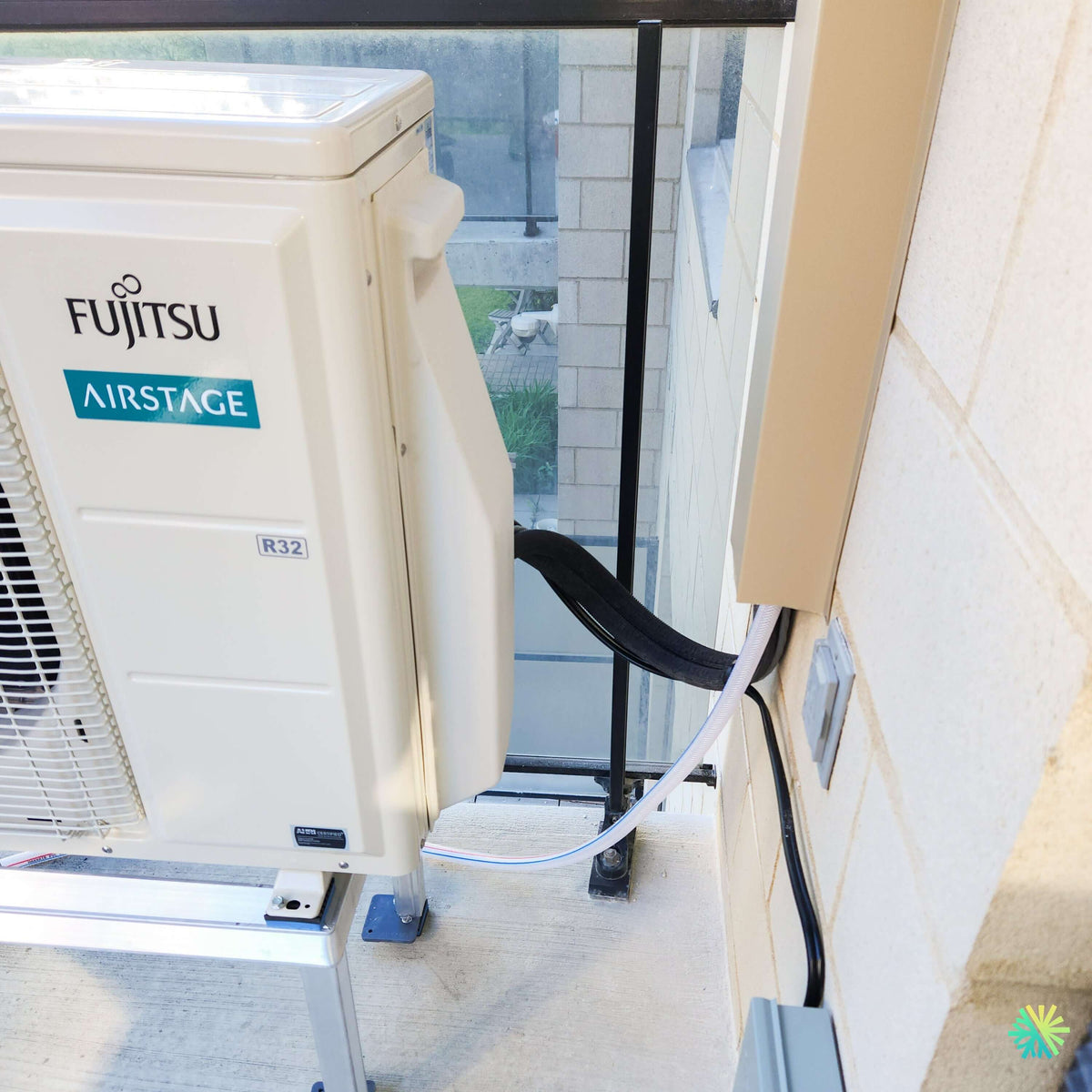
In Dollard-des-Ormeaux, we completed an installation of a Fujitsu AIRSTAGE Orion XLTH wall-mounted heat pump in an outdoor configuration that deserves special attention: the condensing unit was installed on a balcony, near a glass guardrail and a masonry wall.
The project photograph clearly shows the constraints we must work with in this type of environment. The space available around an outdoor unit is much more limited than beside a single-family home with a large lot. The heat pump must therefore be positioned to ensure proper operation while avoiding interference with balcony access, building access, and the architectural finish.
For this installation, we used a raised metal structure so that the Fujitsu unit would not rest directly on the concrete slab. This configuration helps keep the unit at a practical height and is particularly relevant in Quebec’s climate, where snow accumulation, defrost water, and ice formation must be considered from the planning stage.
The FUJITSU AIRSTAGE logo and the R32 identification on the outdoor unit panel are also clearly visible in the photo. This is an important feature of this new generation of Orion XLTH heat pumps: the series documented by Fujitsu uses R-32 refrigerant and is designed for heating in cold climates down to -26 °C.
Installing a heat pump on a balcony requires a different approach
A heat pump installation on a balcony in Dollard-des-Ormeaux is not handled the same way as a ground-level installation in a backyard.
We must assess several constraints simultaneously:
- the available space in front of and behind the outdoor unit;
- air circulation around the heat exchanger;
- the presence of the guardrail;
- access to the service panels;
- the transmission of vibrations to the slab or structure;
- the drainage of water produced during defrost cycles;
- the route of the refrigerant lines;
- the wiring route;
- the protection and appearance of the connections;
- future access for HVAC maintenance.
The photo notably shows the refrigerant lines coming from the wall through a vertical exterior finish before connecting directly to the unit. This approach makes it possible to group and protect the connections rather than leaving several components exposed on the facade.
We can also see the electrical wiring descending toward a box mounted on the wall. In a professional installation, the refrigerant and electrical components must be organized together from the outset. The final result must be functional, accessible, and visually cohesive.
An elevated outdoor unit rather than one placed directly on the concrete
One of the most interesting elements of this installation is the metal bracket visible beneath the Fujitsu heat pump.
On a Quebec balcony, this elevation is not simply an aesthetic decision. During winter, a heat pump in heating mode extracts energy from the outdoor air and must periodically perform a defrost cycle. Water is then produced at the outdoor unit.
If the unit is too low or located in an area where water cannot drain properly, ice buildup around the base can become problematic.
The Fujitsu Orion XLTH brochure also states that the outdoor unit features a base pan heater designed for extremely cold climate regions.
However, this does not relieve the installer of the need to consider the physical management of snow and defrosting. Equipment design and installation quality work together.
The glass railing: an architectural detail that influences positioning
The presence of a glass railing is clearly visible behind the outdoor unit.
In this situation, we must avoid treating the balcony as a simple empty space. The glass, adjacent walls, and structural elements can all influence airflow.
A heat pump must be able to exhaust and draw in air without being enclosed in an area that would encourage excessive recirculation.
The technician’s workspace also matters. During a future diagnostic, cleaning, or component replacement, it must be possible to properly access the unit’s important parts.
It’s a principle we apply just as much in Dollard-des-Ormeaux as to our heat pump installations in Montreal, Laval, Longueuil, the North Shore, and the South Shore: we don’t plan only for the day of installation, but also for the years of use that follow.
Fujitsu Orion XLTH: a series designed for low-temperature heating
In Montreal’s West Island, a wall-mounted heat pump is no longer simply considered an air conditioner that provides a little heating during the fall.
Homeowners are increasingly looking for units capable of handling a significant portion of their heating needs during the winter.
The Fujitsu AIRSTAGE Orion XLTH documented in the supplied technical specification sheet has a heating operating range from -26 °C to 24 °C. The series includes five different capacities: 09K, 12K, 15K, 18K, and 24K.
The advertised nominal capacities are:
| Series | Nominal cooling | Nominal heating |
|---|---|---|
| 09K | 9,000 BTU/h | 12,000 BTU/h |
| 12K | 12,000 BTU/h | 16,000 BTU/h |
| 15K | 14,500 BTU/h | 18,000 BTU/h |
| 18K | 18,000 BTU/h | 21,600 BTU/h |
| 24K | 22,000 BTU/h | 25,200 BTU/h |
The outdoor photograph identifies the Fujitsu AIRSTAGE R32 range, but it does not allow the complete model number to be read with sufficient certainty. We therefore do not provide a precise BTU capacity for this particular installation without confirmation from the nameplate.
This is an important distinction: the physical size of an outdoor unit must never be used to determine its capacity.
Performance at -21 °C and -26 °C matters more than the simple minimum temperature
Two heat pumps that can theoretically operate down to the same temperature will not necessarily provide the same amount of heat when the mercury drops.
The Fujitsu specification sheet provides particularly interesting data on the maximum capacity available in very cold weather.
At -21 °C, the models in the series are listed at 154%, 124%, 126%, 127%, and 95%, respectively, of their reference nominal capacity. Even at -26 °C, the specification sheet still shows 127%, 102%, 109%, 106%, and 80%, depending on capacity.
These values illustrate why, at AirGreen, we examine low-temperature performance when choosing a heat pump for Montreal.
A unit may have excellent seasonal efficiency, but the owner must also know how it performs during the coldest days of January and February.
R-32 piping: the technical details that determine the quality of an Orion XLTH installation
R-32 is clearly identifiable on the unit installed in Dollard-des-Ormeaux
In the photograph, the small identification label R32 appears directly on the heat pump’s outdoor panel.
Fujitsu documentation compares the global warming potential of R-32 with that of R-410A. It indicates a value of 675 for R-32 versus 2,088 for R-410A, representing an announced 68% reduction in GWP.
This refrigerant change also entails specific handling, installation, and commissioning requirements.
When we replace an old wall-mounted heat pump, we therefore never assume that the existing lines can automatically be kept.
We must verify:
- the actual diameter of the lines;
- their length;
- their condition;
- their compatibility with the new system;
- their location;
- the possibility of complying with the manufacturer’s requirements.
Piping dimensions vary according to the capacity of the Fujitsu Orion XLTH
The technical data sheet is particularly useful on this point.
The 09K and 12K configurations use:
- 1/4 in. for the liquid line;
- 3/8 in. for the gas line.
The 15K uses:
- 1/4 in. liquid;
- 1/2 in. gas.
The 18K and 24K versions use:
- 3/8 in. liquid;
- 5/8 in. gas.
This difference is enough to show why replacing a system “unit for unit” without technical verification can be a poor decision.
At our Dollard-des-Ormeaux installation, the lines are visible as they reach the outdoor unit and are wrapped in black insulation before connecting to the system. The vertical finish secured to the wall organizes their route between the inside of the building and the balcony.
Up to 164 feet of piping on certain capacities
The Orion XLTH also offers good flexibility for buildings where the indoor and outdoor units cannot be installed directly on opposite sides of the same wall.
The maximum lengths listed are:
- 82 ft for the 09K and 12K versions;
- 98 ft for the 15K;
- 164 ft for the 18K and 24K.
The maximum allowable elevation difference also varies from 66 to 98 feet, depending on capacity.
In a condo or multistory building, these characteristics can enable installation solutions that would otherwise be difficult.
However, we always seek to create a rational route. A long refrigerant line is not an advantage in itself; it is simply a technical possibility when the architecture requires it.
A power supply that must be confirmed before the work begins
The range shown operates at 208 to 230 V, 60 Hz, single-phase.
The data sheet specifies a breaker of:
- 15 A for the 09K and 12K;
- 20 A for the 15K, 18K, and 24K.
In the photo, we can see part of the outdoor electrical installation and its route to the system.
This step should not be improvised after the technicians arrive. The panel capacity, available circuit, and requirements of the selected model must be verified during project preparation.
Energy efficiency: up to 33.1 VERY2, depending on capacity
The series’ seasonal performance also stands out.
Fujitsu lists the following VERY2 values:
- 09K : 33,1
- 12K : 30,5
- 15K : 27,5
- 18K : 25,5
- 24K : 24,0
The technical data sheet also classifies the models shown in the ENERGY STAR, ENERGY STAR Cold Climate, and ENERGY STAR Most Efficient categories.
However, high efficiency never eliminates the need for proper sizing.
A heat pump chosen solely according to the number of BTUs advertised in a promotion may not match the building’s needs. Insulation, window area, exposure, the volume to be conditioned, the interior layout, and heat loss must all be considered.
Inverter technology designed to modulate rather than operate only at full capacity
The Inverter technology of the Orion XLTH allows the compressor to vary its operation according to demand.
In practical terms, the needs of a residence in Dollard-des-Ormeaux constantly change. A slightly cool day in October does not require the same heat output as a night at -20 °C.
Modulation allows the system to adjust instead of operating the same way all the time.
This feature contributes to comfort and energy-use management, but it performs optimally when the unit has first been properly sized and installed.
Outdoor sound level matters especially on a balcony
On a balcony, noise deserves additional attention because the unit may be relatively close to a patio door, window, or neighboring residence.
Depending on the model, Fujitsu lists outdoor sound levels ranging from approximately 46 to 50 dB(A) in the series’ technical data sheet.
The physical installation also influences how vibrations are perceived.
This is another reason why the support base and contact points visible in this installation are important. An outdoor unit should not simply be placed wherever it fits. Its support must be stable, suitable for the site, and designed with the actual operating conditions in mind.
A compact heat pump, but with essential access for servicing
Fujitsu presents the Orion XLTH as a range of compact outdoor units.
In a restricted space like the one shown in the photo, this feature certainly makes the work easier. However, “compact” does not mean “able to be enclosed anywhere.”
We must preserve enough space for:
- air circulation;
- removing the panels;
- diagnostics;
- cleaning the heat exchanger;
- checking the connections;
- future refrigeration work.
The goal is not simply to get a great-looking photo once the work is complete. We want a technician to still be able to service the system properly several years later.
Rebates: the exact installed combination must be verified
The Fujitsu product sheet shows that the models in this series have appealing energy ratings. For a homeowner looking for a heat pump rebate in Dollard-des-Ormeaux, this is a relevant starting point.
Actual eligibility for a program should not, however, be determined solely from the commercial name “Orion XLTH”.
The exact combination of the indoor unit and outdoor unit must be verified, along with the program criteria applicable at the time of purchase and installation.
At AirGreen, we pay particular attention to this validation because a few characters in a model number can make the difference between two administratively distinct configurations.
Mistakes this installation helps avoid
An outdoor balcony installation can quickly become problematic when certain details are overlooked.
Among the mistakes to avoid:
- installing the unit directly in an area likely to accumulate significant amounts of snow or ice;
- placing the outdoor unit too close to an obstacle that prevents proper airflow;
- ignoring vibrations transmitted to the balcony;
- leaving the piping and wiring exposed without an appropriate finish;
- choosing the capacity before evaluating the building;
- automatically reusing old piping;
- forgetting the space required for servicing;
- neglecting winter drainage;
- selecting the equipment before checking the electrical supply.
It is often these details, much more than the logo on the machine, that distinguish a professional HVAC installation from a project completed with minimal preparation.
An AirGreen installation adapted to the constraints of the West Island
This Fujitsu AIRSTAGE Orion XLTH installation in Dollard-des-Ormeaux is a good example of a type of project we regularly encounter in Greater Montreal: high-performance equipment must be integrated into a limited outdoor space without sacrificing operation, accessibility, or finish quality.
The photograph provides a concrete view of several aspects of our work: an elevated outdoor unit, organized line routing along the wall, insulated refrigerant lines, an exterior electrical connection, and positioning that takes the balcony’s specific configuration into account.
Complete technical documentation covers what an image cannot show: heating down to -26 °C, R-32 refrigerant, Inverter technology, base pan heater, ENERGY STAR classifications, multiple capacities, and different piping options depending on the model.
At AirGreen, we install wall-mounted heat pumps in Dollard-des-Ormeaux, the West Island, Montreal, Laval, Longueuil, the North Shore, and the South Shore, adapting each project to the actual building.
A heat pump can be excellent on paper. Our job is to ensure that its installation lives up to its technical specifications.
The big day, step by step
The main steps of this kind of job at AirGreen. Every house has its quirks: the estimate brings them out.
We look at the room, the outside wall, the line route and where the outdoor unit will go. That is where the capacity gets chosen.
Model, capacity and price, in writing. We also check whether the model qualifies for assistance programs.
Floors and furniture protected, wall plate position marked level, wall opening located.
A single opening, with the slope the drain needs to flow outside.
Set on a stand raised above the snow, with the clearances the manufacturer requires.
Connected, insulated and protected. The opening is then sealed against water, cold air and insects.
A dedicated circuit and an accessible disconnect near the outdoor unit.
Leak test, vacuum, then start-up and a check of heating and cooling.
Remote, modes, filters: we show you the essentials before we leave.
- The on-site estimateWe look at the room, the outside wall, the line route and where the outdoor unit will go. That is where the capacity gets chosen.
- The quoteModel, capacity and price, in writing. We also check whether the model qualifies for assistance programs.
- Getting readyFloors and furniture protected, wall plate position marked level, wall opening located.
- The wall openingA single opening, with the slope the drain needs to flow outside.
- The outdoor unitSet on a stand raised above the snow, with the clearances the manufacturer requires.
- Lines, cable and drainConnected, insulated and protected. The opening is then sealed against water, cold air and insects.
- The electrical workA dedicated circuit and an accessible disconnect near the outdoor unit.
- Tests and start-upLeak test, vacuum, then start-up and a check of heating and cooling.
- The walkthroughRemote, modes, filters: we show you the essentials before we leave.
What would it look like at your place?
Two quick checks with real numbers: what heat costs, and what your current heaters add up to in BTU/h.
Conversion: 1 W = 3.412 BTU/h. An indication, not a load calculation: baseboards and furnaces are often stronger than the real need, and they can stay as backup. AirGreen confirms the capacity on site.
Four mistakes we do not make
Flip each card to see what we do instead.
Your own project, step by step
What to do, season by season
Three habits per season for this unit. They take a few minutes and prevent many calls.
- Clean the indoor unit's filters.
- Clear leaves and debris left on the outdoor unit by winter.
- Test cooling before the first hot days.
- Clean the filters more often when the unit runs a lot.
- Keep plants away from the outdoor unit.
- Check that no water drips from the indoor unit.
- Rake the leaves around the outdoor unit.
- Test heating before the first cold days.
- Book periodic maintenance before winter.
- Keep snow away from the stand and the front of the unit.
- Let the unit defrost: it is normal.
- Never hit the ice on the fins; call us if the unit stays iced up.
Is your home ready?
Check what applies at your place. A "no" is not a refusal: it is what we sort out during the estimate.
Four statements: true or false?
It all comes down to details you have just seen.
1. In heating mode, the outdoor unit can produce water.
During defrost cycles. That water must drain away without forming ice.
2. You pick the capacity with a simple square-footage rule.
Windows, insulation, orientation and how the room is used all count. Capacity is chosen on site.
3. A multi-zone connects several indoor heads to a single condenser.
One head per room, all on the same condenser. Each room keeps its own temperature.
4. The disconnect can sit behind the patio furniture.
It must stay accessible: it is what shuts the unit off for service.
0 / 4 right answers
What people ask us about this kind of work
Does a wall-mounted heat pump heat in winter?
Wall-mounted or multi-zone: how do I choose?
Where does the outdoor unit go?
Are there grants?
Do I need a permit?
How cold can it heat?
How much can I save?
How is the LogisVert assistance calculated?
Is it noisy?
The outdoor unit is covered in ice: is that normal?
Does AirGreen hold the required licences?
Is the estimate free?
No question matches. Write to us: we answer.
More jobs to see, near you
By town, by equipment or by region: browse more than 4,700 published projects.
Each dot: a town where AirGreen has published projects. The glowing dot: this job.
Every house has its constraints. We see them before we install.
The on-site estimate is free and the quote follows within 24 hours.
Text and photo: a real AirGreen Climatisation & Chauffage job. The diagrams are generic illustrations of the type of installation, not a survey of this job site. Sources of the added figures: airgreen.ca product pages (NEEP / AHRI performance), Hydro-Québec (Heat pumps page, LogisVert, read on 13 October 2026), Régie de l’énergie (rate D as of 1 April 2026).