
Installation of a FUJITSU AIRSTAGE ORION XLTH wall-mounted heat pump in Très-Saint-Rédempteur, Montérégie
At Très-Saint-Rédempteur, AirGreen installs a FUJITSU AIRSTAGE ORION XLTH wall-mounted heat pump above a large window: precise installation, clean finish, cold-climate heating down to -26 °C, and Inverter technology.
- City
- Region
- Equipment
- Brand
- Challenges
- Published
The job on one screen
The article, chapter by chapter
An installation above a large window area where every centimetre counted
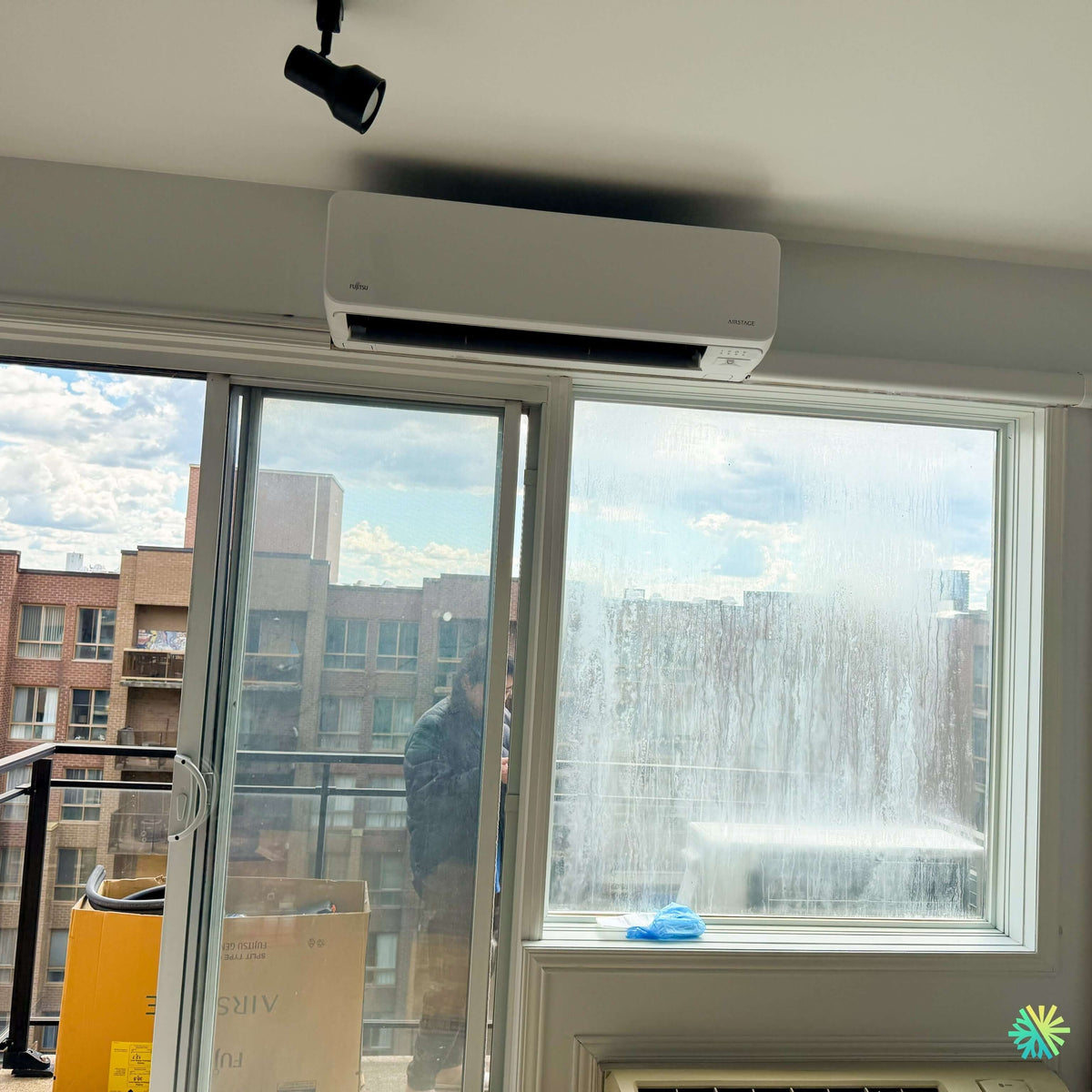
At Très-Saint-Rédempteur, we completed an installation that perfectly represents the type of challenge regularly encountered in homes and apartments where available wall space is limited: installing a FUJITSU AIRSTAGE ORION XLTH wall-mounted heat pump above a large glazed surface, very close to the ceiling, without compromising either the aesthetics or air circulation.
The project photograph makes the constraint immediately apparent. A large sliding patio door and a window occupy almost the entire width of the exterior wall. Above them, the remaining space is relatively narrow. A track light is also mounted on the ceiling, directly in front of the installation area. On the right, the lines are enclosed in a white line set cover that runs neatly along the top of the wall before descending at the end of the windows.
In this type of configuration, we do not choose the indoor unit’s location simply because “there is space left.” We must check the clearances, future access for maintenance, the ability to open the panel and filters properly, the airflow path, as well as the routing of the refrigerant lines and drain.
The result achieved in Très-Saint-Rédempteur clearly demonstrates the value of carefully planned installation: the FUJITSU ORION XLTH heat pump occupies the unused space above the windows and leaves the room’s main walls entirely available for furnishing.
A strategic position above the patio door
Installing a heat pump above a door or window can be an excellent solution when technically feasible.
Here, the large amount of glazing severely limits the other possible locations. Placing the unit above it makes use of an area that could not accommodate a tall cabinet, a significant piece of artwork, or storage anyway.
This position is also beneficial for air distribution. The unit is installed very high, allowing it to project treated air toward the interior of the room. In cooling mode, the cool air can then gradually descend into the living space. In heating mode, the louver’s orientation becomes particularly important to direct the warm air toward the occupied area rather than letting it accumulate unnecessarily near the ceiling.
For us, a good HVAC installation therefore means considering how the equipment will actually be used after we leave.
A visible constraint in the photo: the limited space between the unit and the ceiling
The photograph shows that the indoor unit is installed in a relatively tight area below the ceiling.
This is precisely the kind of situation where the model selection and measurements must be completed before installation. The FUJITSU technical specifications indicate that the indoor units for the 9K, 12K, and 15K models in this series measure approximately 980 mm wide, 280 mm high, and 240 mm deep, while the 18K and 24K models are larger, at approximately 1,150 mm wide and 340 mm high.
These physical differences become important when a unit must fit between a window frame and a ceiling.
In the photo, the unit fits precisely into this narrow strip of wall. The equipment selection must therefore always be coordinated with the actual dimensions available on site.
A white line set cover that blends into the interior architecture
Another interesting detail of this installation in Très-Saint-Rédempteur is the visible path of the line set cover.
Rather than leaving the lines exposed, we use a protective cover that groups together and conceals the technical elements. In this room, the white line set cover runs horizontally along the top of the window toward the right. Since the trim, ceiling, and surrounding walls already use pale tones, it remains discreet.
In a residential installation, this type of finish makes a real difference.
A heat pump is not equipment installed in an enclosed mechanical room. The indoor unit remains part of the décor for many years. We therefore aim to integrate the lines, drain, and accessories required for installation as neatly as the building allows.
An installation in an environment where fenestration strongly influences comfort
The large glazed surface visible in the photo is also important from a thermal perspective.
Windows and patio doors can account for a significant portion of heat gain in summer and heat loss in winter. Sun exposure, building orientation, glazing type, frame quality, and airtightness all influence actual heating and cooling needs.
This explains why we do not size a wall-mounted heat pump using only an approximate square-feet-per-BTU rule.
Two rooms of the same size may require completely different strategies when one has a small north-facing window and the other has a huge patio door facing the sun.
FUJITSU AIRSTAGE ORION XLTH: a range designed for heating in cold climates
Heating down to -26 °C according to FUJITSU documentation
One of the main advantages of the FUJITSU AIRSTAGE ORION XLTH for the Quebec market is its ability to provide heating when the outdoor temperature drops significantly.
The series’ official documentation indicates a heating operating range down to -26 °C (-15 °F) for the models presented in the ORION XLTH range.
For a property in Très-Saint-Rédempteur, this point is much more relevant than a simple nominal capacity measured under temperate conditions.
When a homeowner is shopping for a heat pump in Montréal, Laval, Longueuil, the North Shore, or the South Shore, it is useful to check not only the lowest temperature at which the unit can operate, but also how much heating capacity it retains as the temperature drops.
Detailed heating performance at -15 °C, -21 °C, and -26 °C
The FUJITSU technical data sheet goes further by indicating the maximum percentage of heating available at several outdoor temperatures.
Depending on the selected capacity, the series delivers different results. At -21 °C, for example, some models can still provide a maximum capacity exceeding their reference nominal capacity. At -26 °C, the 9K, 12K, 15K, and 18K models listed in the documentation retain maximum levels of 127%, 102%, 109%, and 106%, respectively, of their reference nominal capacity, while the top model in the range displays a different value.
This type of data is particularly useful in our field.
A figure like “12,000 BTU” indicates a general category, but it does not tell the whole story. What matters on a cold January night is the actual amount of heat the system can still transfer indoors.
Several capacities are available in the range: the exact model must be selected according to the building
The ORION XLTH series presented in the documentation includes several nominal cooling capacities:
- 9,000 BTU/h;
- 12,000 BTU/h;
- 14,500 BTU/h for the 15K model;
- 18,000 BTU/h;
- 22,000 BTU/h for the 24K model.
The corresponding nominal heating capacities range from 12,000 to 25,200 BTU/h.
The installation photo in Très-Saint-Rédempteur clearly identifies the FUJITSU AIRSTAGE family, but it does not allow us to read the rating plate and therefore confirm with certainty the exact capacity installed.
We prefer not to infer a BTU rating solely from the appearance of the cabinet.
To select the correct capacity, we consider, among other factors:
- the area to be heated;
- whether the rooms are open or closed;
- ceiling height;
- insulation;
- glazing;
- solar exposure;
- heat losses;
- the level of airtightness;
- the other existing heating sources.
Inverter technology that modulates according to demand
The ORION XLTH series uses Inverter technology.
The principle differs from that of a unit that would operate constantly according to a full-capacity on-off logic. The Inverter allows the compressor to adapt its operation more closely to the thermal demand.
Once the desired temperature has been approached, the heat pump can reduce its output rather than systematically shutting off. This modulation helps maintain a more consistent indoor temperature.
In a room like the one shown in the photo, where extensive glazing can cause the thermal load to change rapidly depending on sunlight exposure, this adaptability is particularly valuable.
An R-32 heat pump
The range presented in the FUJITSU documentation uses R-32 refrigerant.
FUJITSU indicates a global warming potential of 675 for R-32, compared with 2,088 for R-410A, representing a stated reduction of 68% in GWP. The brochure also specifies that systems using this refrigerant require a smaller amount of fluid while being designed to maintain good heating performance.
For homeowners replacing an older heat pump, however, the refrigerant type should never be considered independently of the rest of the installation.
Replacement may require reviewing:
- the line sizes;
- their condition;
- their length;
- the existing routing;
- the requirements of the new system.
Pipe diameters vary by model
The ORION XLTH technical sheet illustrates this point precisely.
The specified sizes vary depending on capacity:
9K and 12K models
The line sizes are:
1/4 in. liquid and 3/8 in. gas.
15K model
The documentation indicates:
1/4 in. liquid and 1/2 in. gas.
18K and 24K models
The sizes are:
3/8 in. liquid and 5/8 in. gas.
That is why old piping should never automatically be reused simply because it “looks fine.”
We always verify compatibility between the piping and the exact combination of units selected.
Piping distances that provide good installation flexibility
For projects where the outdoor unit cannot be located directly behind the indoor unit, the maximum permitted piping length becomes important.
The FUJITSU specifications indicate up to:
- 25 m (82 ft) for the 9K and 12K configurations;
- 30 m (98 ft) for the 15K;
- 50 m (164 ft) for the 18K and 24K configurations.
The maximum permitted vertical difference also varies from 20 to 30 metres, depending on the model.
In a property with numerous architectural constraints, this flexibility can allow us to place the indoor unit in the most logical location for comfort while installing the outdoor condenser in a more suitable area.
Very quiet indoor operation depending on the selected capacity
Noise is sometimes an underestimated factor when making a purchase.
FUJITSU documentation states that indoor sound levels can be as low as 23 dB(A) in quiet mode on the range’s smaller capacities. The other models also offer several fan speeds, including automatic, high, medium-high, medium, medium-low, low, and quiet.
In a living room, dining room, or open living space, the ability to operate at low speed is especially appreciated.
The goal is not only to reach the programmed temperature, but to do so without the system becoming the primary source of noise in the room.
Built-in Wi-Fi and remote control
The ORION XLTH series also offers built-in Wi-Fi connectivity, enabling remote monitoring and control through FUJITSU’s AIRSTAGE mobile ecosystem.
For many homeowners, this type of feature quickly becomes practical.
Depending on the configuration and application used, it is possible to adjust the temperature without being in front of the unit’s remote control. This can be useful for lowering the setpoint when no one is home or preparing the house before the occupants return.
An outdoor unit prepared for winter conditions
The page dedicated to the ORION XLTH features also mentions a base pan heater designed for regions with very cold climates, as well as a mode that reduces the outdoor unit’s noise level.
For us, however, this never replaces an outdoor installation adapted to Quebec winters.
Even an excellent cold-climate heat pump must be positioned correctly.
We pay particular attention to:
- the height above the ground;
- accumulated snow;
- the flow of defrost water;
- air circulation around the unit;
- the proximity of the windows;
- the risk of vibration;
- future access for servicing.
ENERGY STAR and ENERGY STAR Cold Climate
The product line's technical sheet displays ENERGY STAR classifications, including the cold-climate category applicable to the models presented.
This feature may be relevant when a homeowner wants to verify whether their installation qualifies for financial assistance, such as an energy-efficiency program.
However, we always verify eligibility based on the exact combination of the indoor and outdoor models, the applicable reference, and the rules in effect at the time of the project.
The mere fact that a product line is certified does not automatically make it possible to assign a specific subsidy amount to any installation.
This project shows why positioning should never be improvised
The Très-Saint-Rédempteur installation is an excellent example of a project where the available space dictates a significant part of the strategy.
We had to work around:
- a large glazed area;
- limited wall height;
- a ceiling very close to the installation area;
- a nearby track light;
- a piping route that had to remain clear;
- the need to maintain effective air distribution.
The result makes it possible to use an area that would otherwise be difficult to utilize while preserving access to the patio door and windows.
Beware of installations too close to ceilings or obstacles
A wall-mounted heat pump generally draws a significant portion of its air through the top of its cabinet.
That is why the space above the unit must be assessed in accordance with the manufacturer's installation instructions.
Installing a unit simply because it physically fits into an opening is not enough.
It is also important to ensure that:
- the airflow is not restricted;
- the unit remains accessible;
- the panel can be handled;
- the filters can be removed;
- the wall provides the necessary support;
- the drain can maintain the proper slope.
At AirGreen, it is precisely these details that distinguish a functional installation from an improvised one.
Maintenance remains simple when the installation is planned from the outset
A wall-mounted heat pump requires periodic maintenance.
The homeowner must be able to remove and clean the filters. Over time, the evaporator, tangential fan, and drain pan may also require more thorough HVAC maintenance.
When a unit is installed very high up, as it is here, we must therefore anticipate future accessibility.
An installation that looks clean on the day of the project but becomes impossible to maintain a few years later is not a good installation.
AirGreen in Très-Saint-Rédempteur and throughout Greater Montreal
At AirGreen, we install FUJITSU wall-mounted heat pumps, along with other heating and cooling systems, throughout Greater Montreal and several surrounding municipalities.
We work throughout Montreal, Laval, Longueuil, the North Shore, and the South Shore, as well as in more distant areas of Montérégie such as Très-Saint-Rédempteur.
Every project is different.
Some homes have a completely unobstructed exterior wall. Others, like this installation, have windows occupying almost all the available surface. In some buildings, the main challenge is routing the lines; in others, it is positioning the outdoor unit, the electrical panel, or access to the upper floor.
Our role is to adapt the HVAC installation to the building rather than asking the building to adapt to a standardized installation.
What we take away from this FUJITSU ORION XLTH installation
This installation in Très-Saint-Rédempteur highlights three main elements.
The first is the intelligent use of space: the unit occupies the section of wall above the patio door and window.
The second is the quality of the technical routing finish, with a white line set cover that follows the existing architecture neatly.
The third is the choice of a FUJITSU AIRSTAGE ORION XLTH heat pump designed for cold climates, using R-32, Inverter technology, and a range of capacities that allows the system to be adapted to the building’s actual needs.
For a homeowner considering a new heat pump, this installation highlights an important rule: even the best machine will reach its full potential only if its sizing, placement, and installation are done correctly.
At AirGreen, it is precisely this combination of equipment, design, and installation quality that we focus our work on.
The job tools
Two quick checks with real numbers: what heat costs, and what your current heaters add up to in BTU/h.
Conversion: 1 W = 3.412 BTU/h. An indication, not a load calculation: baseboards and furnaces are often stronger than the real need, and they can stay as backup. AirGreen confirms the capacity on site.
How the job unfolds
The main steps of this kind of job at AirGreen. Every house has its quirks: the estimate brings them out.
We look at the room, the outside wall, the line route and where the outdoor unit will go. That is where the capacity gets chosen.
Model, capacity and price, in writing. We also check whether the model qualifies for assistance programs.
Floors and furniture protected, wall plate position marked level, wall opening located.
A single opening, with the slope the drain needs to flow outside.
Set on a stand raised above the snow, with the clearances the manufacturer requires.
Connected, insulated and protected. The opening is then sealed against water, cold air and insects.
A dedicated circuit and an accessible disconnect near the outdoor unit.
Leak test, vacuum, then start-up and a check of heating and cooling.
Remote, modes, filters: we show you the essentials before we leave.
- The on-site estimateWe look at the room, the outside wall, the line route and where the outdoor unit will go. That is where the capacity gets chosen.
- The quoteModel, capacity and price, in writing. We also check whether the model qualifies for assistance programs.
- Getting readyFloors and furniture protected, wall plate position marked level, wall opening located.
- The wall openingA single opening, with the slope the drain needs to flow outside.
- The outdoor unitSet on a stand raised above the snow, with the clearances the manufacturer requires.
- Lines, cable and drainConnected, insulated and protected. The opening is then sealed against water, cold air and insects.
- The electrical workA dedicated circuit and an accessible disconnect near the outdoor unit.
- Tests and start-upLeak test, vacuum, then start-up and a check of heating and cooling.
- The walkthroughRemote, modes, filters: we show you the essentials before we leave.
What we check on a job like this one
Each number is a point we check on site. Switch between summer and winter to watch air and heat move.
In summer, the outdoor unit rejects the house's heat outside.
Generic illustration of this type of installation, not a survey of this job site. Tap a number.
Mounted level on a wall plate, high enough for the air to reach the whole room, with enough space around it to slide the filters out easily.
The refrigerant lines, the communication cable and the drain go through the wall in a single opening, sealed against water, cold air and insects.
Two insulated copper pipes connect the two units. Outside, a line cover can protect them from sun, knocks and weather.
A shut-off switch near the outdoor unit isolates it safely for service. It must stay accessible at all times.
The compressor and the fan. In heating mode it captures heat from the outdoor air, even in winter, and moves it inside.
On the ground or on the wall, it keeps the unit above accumulated snow. The unit stays clear and defrost water can drain away.
The fan needs to blow freely. Storage, a fence or a wall too close, and efficiency drops while noise goes up.
Is your home ready?
Check what applies at your place. A "no" is not a refusal: it is what we sort out during the estimate.
Good habits, once the unit is in place
Six simple habits that keep the unit going. Your list stays on this device.
What to do, season by season
Three habits per season for this unit. They take a few minutes and prevent many calls.
- Clean the indoor unit's filters.
- Clear leaves and debris left on the outdoor unit by winter.
- Test cooling before the first hot days.
- Clean the filters more often when the unit runs a lot.
- Keep plants away from the outdoor unit.
- Check that no water drips from the indoor unit.
- Rake the leaves around the outdoor unit.
- Test heating before the first cold days.
- Book periodic maintenance before winter.
- Keep snow away from the stand and the front of the unit.
- Let the unit defrost: it is normal.
- Never hit the ice on the fins; call us if the unit stays iced up.
The right pages, at the right time
Four statements: true or false?
It all comes down to details you have just seen.
1. In heating mode, the outdoor unit can produce water.
During defrost cycles. That water must drain away without forming ice.
2. You pick the capacity with a simple square-footage rule.
Windows, insulation, orientation and how the room is used all count. Capacity is chosen on site.
3. A multi-zone connects several indoor heads to a single condenser.
One head per room, all on the same condenser. Each room keeps its own temperature.
4. The disconnect can sit behind the patio furniture.
It must stay accessible: it is what shuts the unit off for service.
0 / 4 right answers
What people ask us about this kind of work
Does a wall-mounted heat pump heat in winter?
Wall-mounted or multi-zone: how do I choose?
Where does the outdoor unit go?
Are there grants?
Do I need a permit?
How cold can it heat?
How much can I save?
How is the LogisVert assistance calculated?
Is it noisy?
The outdoor unit is covered in ice: is that normal?
Does AirGreen hold the required licences?
Is the estimate free?
No question matches. Write to us: we answer.
More jobs to see, near you
By town, by equipment or by region: browse more than 4,700 published projects.
Each dot: a town where AirGreen has published projects. The glowing dot: this job.
An on-site estimate, the right capacity, the right equipment.
The on-site estimate is free and the quote follows within 24 hours.
Text and photo: a real AirGreen Climatisation & Chauffage job. The diagrams are generic illustrations of the type of installation, not a survey of this job site. Sources of the added figures: airgreen.ca product pages (NEEP / AHRI performance), Hydro-Québec (Heat pumps page, LogisVert, read on 13 October 2026), Régie de l’énergie (rate D as of 1 April 2026).