
Installation of a GREE CHARMO R32 wall-mounted heat pump in Côte-des-Neiges–Notre-Dame-de-Grâce, Montreal: a compact and efficient HVAC solution in a renovated residential space
AirGreen installs a GREE CHARMO R32 wall-mounted heat pump in Côte-des-Neiges–Notre-Dame-de-Grâce, a clean, efficient mini-split solution suited for Montreal housing renovations.
- City
- Region
- Equipment
- Brand
- Challenges
- Published
The job on one screen
The article, chapter by chapter
A strategic wall-mounted installation in the heart of a Montreal home undergoing transformation
In the Côte-des-Neiges–Notre-Dame-de-Grâce sector of Montreal, wall-mounted heat pump projects often require more than just installing a unit on a wall. Homes in this area present a wide variety of configurations: old duplexes, renovated condos, apartments with decorative moldings, modified partitions, limited outdoor access, walls partially opened during renovation, ceilings with delicate finishes, and interior spaces where every inch counts. This installation of a GREE CHARMO R32 perfectly illustrates this type of intervention where AirGreen's field experience makes all the difference.
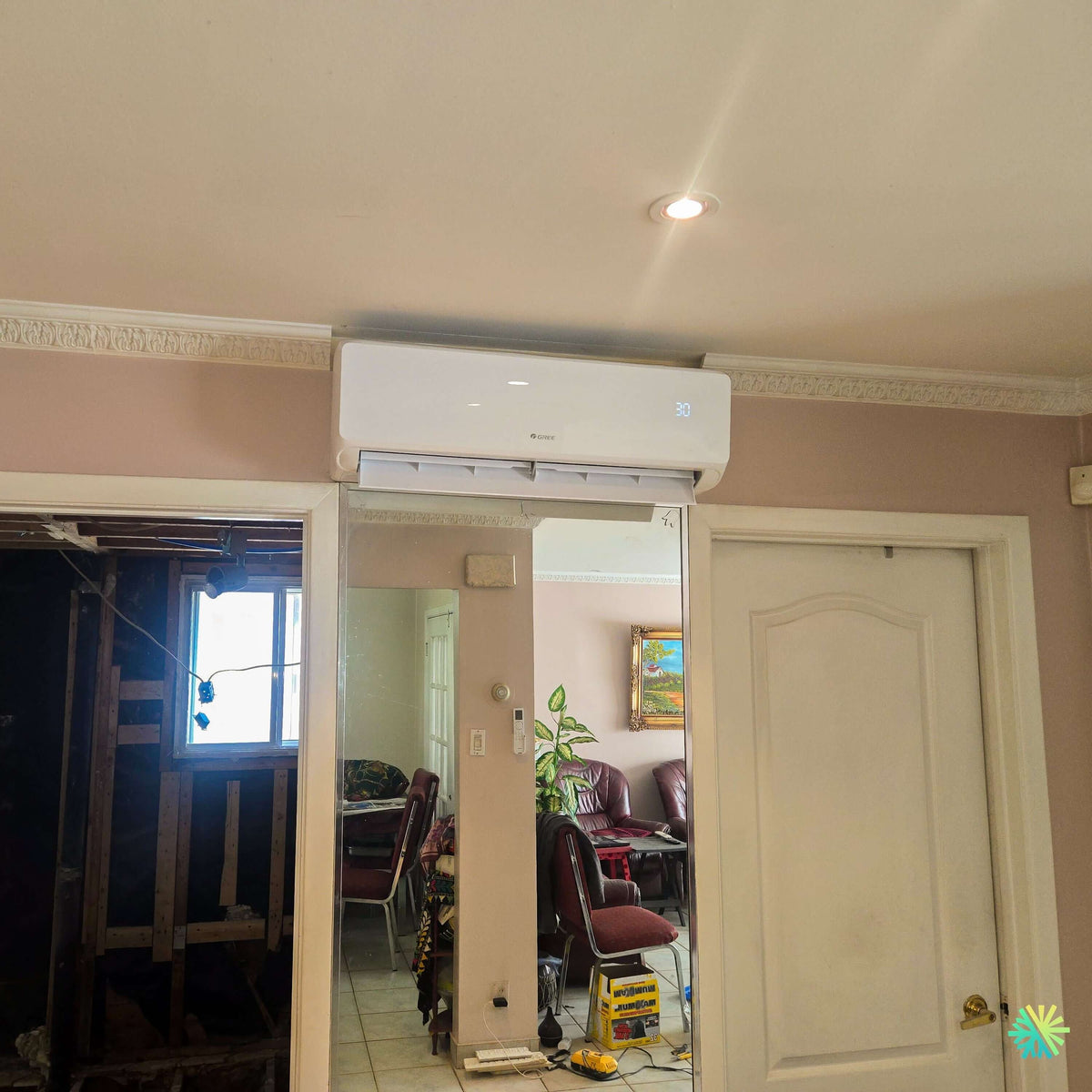
The client wanted to quickly improve the comfort of a main living space, while taking into account ongoing work in an adjacent room. The installation photo clearly shows a residential environment under renovation: a wall opening leading to a work area, exposed studs, temporary wires, an already occupied neighboring room, and a wall-mounted unit installed very close to the ceiling, between two interior openings. This context required precise planning to position the mini-split wall air conditioner without hindering air circulation, damaging existing finishes, or compromising future renovation steps.
The GREE CHARMO R32 was chosen for its discreet size, its performance adapted to residential needs, and its efficient operation for both air conditioning and supplementary heating. In a neighborhood like Côte-des-Neiges–Notre-Dame-de-Grâce, where many homes combine older architecture with recent renovations, this type of wall-mounted mini-split represents a practical solution for achieving stable comfort without undertaking major transformations to the central heating system.
A complex, yet perfectly utilized location
The positioning of the indoor unit was one of the most important aspects of this HVAC installation in Montreal. The unit was installed above a large interior opening, between two wall sections, with decorative ceiling molding and a door immediately to the right. This type of location requires particular attention for several reasons.
Firstly, it's crucial to ensure that the air blown by the wall-mounted heat pump can circulate freely into the main living area. A unit placed too low, too close to a door, or in a confined corner can create uncomfortable zones: too cold near the unit, too hot at the back of the room, or an unpleasant draft. Here, the unit is installed high enough to promote good air projection, while respecting the necessary clearances around the unit.
Secondly, the presence of decorative moldings necessitates precise work. In many Montreal homes, particularly in established sectors like NDG, Outremont, Villeray, Rosemont, or the Plateau-Mont-Royal, ceilings and frames often have decorative elements that owners wish to preserve. Our technicians must therefore measure, align, drill, and fix the unit without damaging visible finishes. A clean installation is not limited to the unit's operation: it must also integrate visually into the room.
Finally, the adjacent wall undergoing renovation required additional coordination. When an area is open or under construction, it can be tempting to run lines without complete planning. At AirGreen, we avoid this mistake. We always analyze the path of refrigerant lines, condensate drain, and electrical supply to prevent conflicts with future work. A good heat pump installation must be designed not only for the day of installation but also for the years of use that follow.
Why the GREE CHARMO R32 was a good fit for this project
The GREE CHARMO R32 is a wall-mounted solution designed for homeowners seeking a modern, efficient unit well-suited to the needs of urban dwellings. The R32 refrigerant is particularly interesting because it is used in several recent systems to improve energy efficiency and reduce environmental impact compared to older generations of refrigerants.
In this project in Côte-des-Neiges–Notre-Dame-de-Grâce, the choice of the GREE CHARMO R32 met several concrete objectives:
- improve comfort in a main living area;
- provide rapid air conditioning during hot and humid Montreal days;
- offer efficient supplementary heating during cooler periods;
- limit interior work thanks to a compact wall-mounted solution;
- preserve the aesthetics of an already furnished residential space;
- integrate the unit into a renovation context without slowing down other work.
The GREE brand is well-known in the residential HVAC sector, particularly for its wall-mounted and multi-zone systems. The CHARMO R32 model stands out for its sleek design, discreet front display, and its ability to adapt to spaces where the appearance of the indoor unit matters as much as its performance. In the photo, the unit blends well with the light wall and existing frame, without giving the impression of an improvised addition.
A clean installation despite an active construction site
What makes this installation interesting is the contrast between the clean finish of the GREE wall-mounted heat pump and the visible construction site context on the left. Part of the wall is open, structural elements are exposed, and the space appears to be in transition. Yet, the indoor unit is installed neatly, aligned, and functionally.
In this type of project, our teams often have to work with very concrete constraints: renovation dust, partial access to certain areas, presence of furniture, tools on the floor, finished ceilings on one side and open walls on the other. The goal is to proceed efficiently without adding complications to the site.
Our technicians paid particular attention to three elements.
Protection of existing surfaces
Even when some areas are under construction, there are often finished surfaces to protect: painted walls, doors, frames, moldings, floors, mirrors, or furniture. In this installation, the proximity of the door, wall mirror, and moldings required careful handling of the indoor unit. A scratch on a frame or a mark on a finished wall can turn a successful installation into a source of frustration for the client.
Respect for level and alignment
A wall-mounted air conditioner must be installed with a slight technical logic related to drainage, but it must also appear visually straight. In a room with several visible horizontal lines — molding, door frame, top of mirror, ceiling — the slightest misalignment becomes immediately noticeable. The wall plate was therefore installed with precision to achieve a clean and professional result.
Drainage management
The condensate drain is an element often underestimated by homeowners. Yet, it is one of the most important points for a durable installation. Insufficient slope, a poorly positioned drain, or too complex a path can lead to leaks, odors, blockages, or wall damage. At AirGreen, we always validate the drain path before finalizing the indoor unit installation, especially in Montreal homes where walls, ceilings, and outdoor access can be irregular.
What this installation teaches homeowners in Montreal, Laval, Longueuil, North Shore, and South Shore
This installation in Côte-des-Neiges–Notre-Dame-de-Grâce highlights several important aspects for anyone considering the purchase of a wall-mounted heat pump, whether in Montreal, Laval, Longueuil, on the North Shore or on the South Shore. The choice of appliance matters, but the quality of the installation is just as crucial.
Do not choose the location based solely on appearance
Many clients first tell us where they would like to see the indoor unit, often for aesthetic reasons. This is normal. A wall-mounted heat pump is visible daily and must integrate into the room. However, the best location is not always the one that seems the most discreet.
You also need to consider air circulation, ceiling height, door locations, traffic areas, furniture, heat sources, access to the exterior wall, the path of conduits, and drainage. In the case of this installation, the unit was placed to take advantage of a high and central position, while avoiding immediate obstacles.
A common mistake is to install the unit too close to a corner or a tall piece of furniture. The result can be disappointing, even with an excellent appliance: air mixes poorly, temperature becomes uneven, and the system works harder to reach the set point. A good on-site evaluation helps avoid these problems.
Consider ongoing renovations
When a client renovates a room, it can be wise to integrate the HVAC installation into the overall planning. In some cases, an open wall can facilitate the passage of conduits. In others, it can create new constraints, especially if divisions, ceilings, or outdoor exits are not yet finalized.
For this GREE CHARMO R32 installation in Montreal, the renovation context allowed us to carefully assess the available space and anticipate the next steps. The objective was to install the unit in the right place, without blocking further work and without creating unnecessary dependence between the interior renovation and the system's operation.
This is an approach we regularly apply in HVAC projects in Laval, Longueuil, Brossard, Terrebonne, Repentigny, Saint-Eustache, Blainville, Boucherville, and several neighborhoods in Montreal. A well-coordinated installation avoids costly reworks.
Understanding the role of BTU and sizing
Even if the client mainly sees the wall unit, final comfort largely depends on sizing. A heat pump that is too small will run constantly without achieving the desired comfort. A unit that is too large risks short cycling, poor humidity control, and premature wear of certain components.
The right capacity choice depends on several factors:
- area to be treated;
- ceiling height;
- insulation quality;
- window orientation;
- sun exposure level;
- number of occupants;
- room layout;
- presence of open walls or communicating areas;
- intended use: air conditioning only or supplementary heating.
In older neighborhoods of Montreal, the calculation often needs to be more nuanced, as two homes of the same size can have very different needs. A poorly insulated ground floor, an upper-floor condo, or an apartment with large windows will not react in the same way.
The importance of a professional finish
In an installation photo, visual details often speak for themselves. A straight, well-centered unit, without poorly integrated conduits or imprecise cuts, inspires confidence. Conversely, a neglected installation can reduce the perceived value of the home and cause technical problems.
At AirGreen, we place great importance on finishing because it reflects the quality of all the invisible work: fastening, drilling, condensate drainage, refrigerant connections, sealing, commissioning, and functional verification. A beautiful visual result does not replace technical rigor, but it is often a sign of it.
In this installation in Côte-des-Neiges–Notre-Dame-de-Grâce, the interior finish was particularly important due to the unit's visibility in the main room. The unit is located above an opening, near a door, in a frequently used space. Therefore, a clean, discreet, and durable result was essential.
Subsidies and eligibility: a point to validate before purchase
Many homeowners contact us to find out if their wall-mounted heat pump is eligible for a subsidy. Available programs can vary according to current criteria, appliance performance, eligibility lists, and updates from relevant organizations. For customers in Montreal, Laval, Longueuil, the North Shore and the South Shore, we always recommend validating the eligibility of the specific model before making a final decision.
For an appliance like the GREE CHARMO R32, it is necessary to check the exact model data, its capacity, its performance, and its potential registration in applicable programs at the time of purchase. AirGreen assists its clients in this verification to avoid unpleasant surprises. A potential subsidy can make a project more advantageous, but it should never be assumed without validation.
Mistakes to avoid when undertaking a mini-split wall project
This installation also serves as a reminder of some common mistakes we see in the field.
Choosing an appliance based solely on price
A low price may seem attractive, but the entire project should be compared: appliance quality, warranty, installation, compliance, after-sales service, parts availability, and contractor experience. A poorly installed wall system can cost much more to correct than a professional installation done correctly from the start.
Neglecting access for maintenance
A wall-mounted heat pump needs to be cleaned and maintained. Filters must remain accessible, the unit must be able to be opened correctly, and the space around the appliance should not hinder future interventions. In this installation, the unit remains easily accessible despite its high position, which will facilitate HVAC maintenance.
Installing without planning the outdoor exit
The path between the indoor unit and the outdoor unit influences the efficiency, appearance, and durability of the installation. Factors to consider include pipe length, protection, outdoor compressor positioning, noise, snow, clearance, and service access. In dense areas of Montreal, this step often requires more in-depth consideration.
Entrusting refrigeration work to an unqualified person
Refrigerant handling and refrigeration connections must be performed by qualified professionals. Improper vacuuming, a poorly tightened connection, or a refrigerant leak can reduce system performance and lead to costly repairs. At AirGreen, installations are carried out according to the rules of the art, with appropriate tools and necessary checks during commissioning.
Immediate Comfort for a More Pleasant Living Space
Once the unit was installed and started up, the client quickly noticed the difference. The display on the facade shows a clear set temperature, and the adjustable louvers allow air to be directed to the desired zone. In a residential space where rooms communicate with each other, this modulation capability is essential to achieve comfortable conditions without overcooling a single area.
The main advantage of a GREE CHARMO R32 in this type of environment is its ability to provide targeted comfort without requiring central ducts. For many homes in Côte-des-Neiges–Notre-Dame-de-Grâce, this is a particularly relevant solution: it improves the quality of life quickly, while adapting to existing architectural constraints.
The AirGreen Approach: Analysis, Precision, and After-Installation Service
Every AirGreen project begins with a thorough understanding of the building. We don't just sell an appliance. We analyze the configuration, client needs, housing constraints, outdoor access, necessary power, desired aesthetics, and possibilities for future maintenance.
This approach is particularly important in Greater Montreal, where installations vary enormously from one building to another. An HVAC installation in Montreal is not always like an installation in Laval, Longueuil, on the North Shore, or on the South Shore. Wall types, access, condominium regulations, piping distances, and client expectations change depending on the area.
For this GREE CHARMO R32 wall-mounted heat pump installation, our goal was clear: to offer an efficient, clean, and adapted solution for a home undergoing transformation, while ensuring a neat interior finish. The result demonstrates that a well-executed HVAC project can integrate harmoniously even in an active renovation context.
A project representative of current air conditioning needs in Montreal
Montreal summers are increasingly demanding for homes that were not originally designed with central air conditioning. Homeowners are looking for reliable, efficient, and relatively discreet solutions. The wall-mounted heat pump responds well to this demand, provided it is well chosen and properly installed.
In a neighborhood like Côte-des-Neiges–Notre-Dame-de-Grâce, where there are old houses, renovated homes, income properties, and condos, the wall-mounted mini-split offers great flexibility. It can be used to air-condition a main room, improve the comfort of a floor, reduce reliance on certain auxiliary heating systems, or simply make the living space more pleasant during hot periods.
The installation of this GREE CHARMO R32 shows that it is possible to achieve a professional result even when the dwelling has constraints: ongoing renovation, limited wall space, decorative moldings, adjacent openings, and the need to preserve the interior appearance.
A lasting investment in residential comfort
A well-installed GREE CHARMO R32 wall-mounted heat pump represents more than an air conditioning unit. It is an investment in daily comfort, the functional value of the home, and energy efficiency. The choice of the right contractor is therefore essential.
At AirGreen, we install heating, ventilation, and air conditioning systems throughout Greater Montreal, including Montreal, Laval, Longueuil, the North Shore, and the South Shore. Our teams are familiar with local realities: old buildings, condominiums, access constraints, need for discretion, technical requirements, and high client expectations.
This installation in Côte-des-Neiges–Notre-Dame-de-Grâce perfectly summarizes our working method: serious analysis, clean execution, attention to detail, and a solution adapted to the actual building, not just a technical sheet. For homeowners considering a wall-mounted air conditioner installation, a mini-split heat pump, or a system replacement, this project demonstrates the importance of a professional approach from the very first visit.
The job tools
Two quick checks with real numbers: what heat costs, and what your current heaters add up to in BTU/h.
Conversion: 1 W = 3.412 BTU/h. An indication, not a load calculation: baseboards and furnaces are often stronger than the real need, and they can stay as backup. AirGreen confirms the capacity on site.
How the job unfolds
The main steps of this kind of job at AirGreen. Every house has its quirks: the estimate brings them out.
We look at the room, the outside wall, the line route and where the outdoor unit will go. That is where the capacity gets chosen.
Model, capacity and price, in writing. We also check whether the model qualifies for assistance programs.
Floors and furniture protected, wall plate position marked level, wall opening located.
A single opening, with the slope the drain needs to flow outside.
Set on a stand raised above the snow, with the clearances the manufacturer requires.
Connected, insulated and protected. The opening is then sealed against water, cold air and insects.
A dedicated circuit and an accessible disconnect near the outdoor unit.
Leak test, vacuum, then start-up and a check of heating and cooling.
Remote, modes, filters: we show you the essentials before we leave.
- The on-site estimateWe look at the room, the outside wall, the line route and where the outdoor unit will go. That is where the capacity gets chosen.
- The quoteModel, capacity and price, in writing. We also check whether the model qualifies for assistance programs.
- Getting readyFloors and furniture protected, wall plate position marked level, wall opening located.
- The wall openingA single opening, with the slope the drain needs to flow outside.
- The outdoor unitSet on a stand raised above the snow, with the clearances the manufacturer requires.
- Lines, cable and drainConnected, insulated and protected. The opening is then sealed against water, cold air and insects.
- The electrical workA dedicated circuit and an accessible disconnect near the outdoor unit.
- Tests and start-upLeak test, vacuum, then start-up and a check of heating and cooling.
- The walkthroughRemote, modes, filters: we show you the essentials before we leave.
What we check on a job like this one
Each number is a point we check on site. Switch between summer and winter to watch air and heat move.
In summer, the outdoor unit rejects the house's heat outside.
Generic illustration of this type of installation, not a survey of this job site. Tap a number.
Mounted level on a wall plate, high enough for the air to reach the whole room, with enough space around it to slide the filters out easily.
The refrigerant lines, the communication cable and the drain go through the wall in a single opening, sealed against water, cold air and insects.
Two insulated copper pipes connect the two units. Outside, a line cover can protect them from sun, knocks and weather.
A shut-off switch near the outdoor unit isolates it safely for service. It must stay accessible at all times.
The compressor and the fan. In heating mode it captures heat from the outdoor air, even in winter, and moves it inside.
On the ground or on the wall, it keeps the unit above accumulated snow. The unit stays clear and defrost water can drain away.
The fan needs to blow freely. Storage, a fence or a wall too close, and efficiency drops while noise goes up.
Is your home ready?
Check what applies at your place. A "no" is not a refusal: it is what we sort out during the estimate.
Good habits, once the unit is in place
Six simple habits that keep the unit going. Your list stays on this device.
What to do, season by season
Three habits per season for this unit. They take a few minutes and prevent many calls.
- Clean the indoor unit's filters.
- Clear leaves and debris left on the outdoor unit by winter.
- Test cooling before the first hot days.
- Clean the filters more often when the unit runs a lot.
- Keep plants away from the outdoor unit.
- Check that no water drips from the indoor unit.
- Rake the leaves around the outdoor unit.
- Test heating before the first cold days.
- Book periodic maintenance before winter.
- Keep snow away from the stand and the front of the unit.
- Let the unit defrost: it is normal.
- Never hit the ice on the fins; call us if the unit stays iced up.
The right pages, at the right time
Four statements: true or false?
It all comes down to details you have just seen.
1. In heating mode, the outdoor unit can produce water.
During defrost cycles. That water must drain away without forming ice.
2. You pick the capacity with a simple square-footage rule.
Windows, insulation, orientation and how the room is used all count. Capacity is chosen on site.
3. A multi-zone connects several indoor heads to a single condenser.
One head per room, all on the same condenser. Each room keeps its own temperature.
4. The disconnect can sit behind the patio furniture.
It must stay accessible: it is what shuts the unit off for service.
0 / 4 right answers
What people ask us about this kind of work
Does a wall-mounted heat pump heat in winter?
Wall-mounted or multi-zone: how do I choose?
Where does the outdoor unit go?
Are there grants?
Do I need a permit?
How cold can it heat?
How much can I save?
How is the LogisVert assistance calculated?
Is it noisy?
The outdoor unit is covered in ice: is that normal?
Does AirGreen hold the required licences?
Is the estimate free?
No question matches. Write to us: we answer.
More jobs to see, near you
By town, by equipment or by region: browse more than 4,700 published projects.
Each dot: a town where AirGreen has published projects. The glowing dot: this job.
An on-site estimate, the right capacity, the right equipment.
The on-site estimate is free and the quote follows within 24 hours.
Text and photo: a real AirGreen Climatisation & Chauffage job. The diagrams are generic illustrations of the type of installation, not a survey of this job site. Sources of the added figures: airgreen.ca product pages (NEEP / AHRI performance), Hydro-Québec (Heat pumps page, LogisVert, read on 13 October 2026), Régie de l’énergie (rate D as of 1 April 2026).