
Installation of a GREE CHARMO R32 Mini Split wall-mounted heat pump in Montreal's West Island
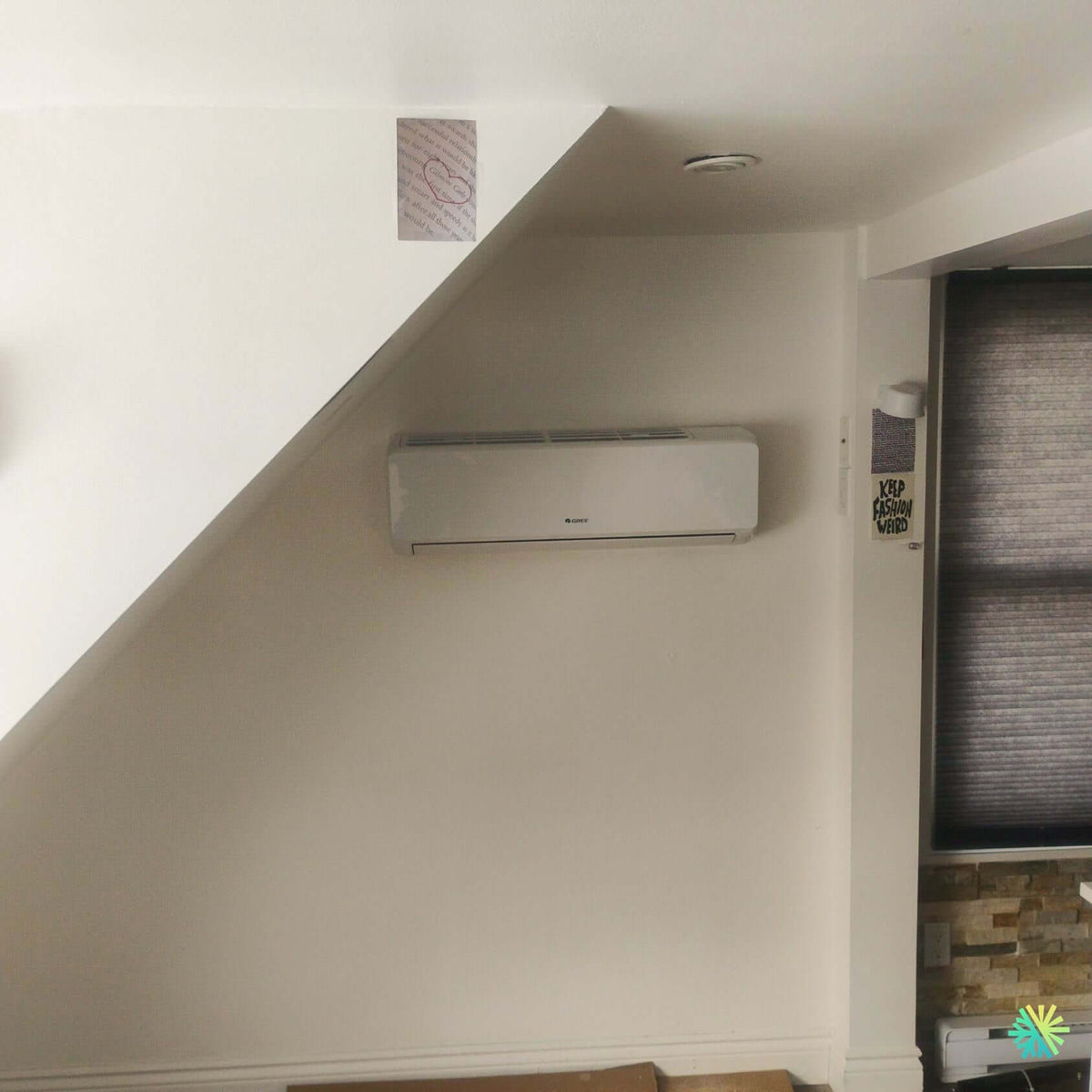
AirGreen installs a GREE CHARMO R32 Mini Split wall-mounted heat pump in the West Island, under a sloped ceiling, with a clean, efficient, and tailored HVAC solution for residential comfort.
In summer, the outdoor unit rejects the house's heat outside.
Generic illustration of this type of installation, not a survey of this job site. Tap a number.
Mounted level on a wall plate, high enough for the air to reach the whole room, with enough space around it to slide the filters out easily.
The refrigerant lines, the communication cable and the drain go through the wall in a single opening, sealed against water, cold air and insects.
Two insulated copper pipes connect the two units. Outside, a line cover can protect them from sun, knocks and weather.
A shut-off switch near the outdoor unit isolates it safely for service. It must stay accessible at all times.
The compressor and the fan. In heating mode it captures heat from the outdoor air, even in winter, and moves it inside.
On the ground or on the wall, it keeps the unit above accumulated snow. The unit stays clear and defrost water can drain away.
The fan needs to blow freely. Storage, a fence or a wall too close, and efficiency drops while noise goes up.
An HVAC installation designed for an atypical space under a sloped ceiling
In Montreal's West Island, AirGreen recently completed the installation of a GREE CHARMO R32 wall-mounted heat pump, a Mini Split system designed to offer reliable, discreet, and efficient comfort in a room where the architecture presented several significant constraints. The photo of this installation immediately highlights a key element: the indoor unit was installed under a sloped ceiling, in a narrow space, framed by a side wall, an opening to another area of the house, and a window with a dark blind.
This type of configuration requires much more than a simple wall mounting. A successful HVAC installation in a sloped space demands a precise understanding of the volume, airflow, minimum distances recommended by the manufacturer, and the room's usage habits. In this specific case, our team had to position the wall-mounted air conditioner to ensure good air distribution without creating uncomfortable direct drafts, while maintaining adequate access for future HVAC maintenance.
The GREE CHARMO R32 proved to be an excellent choice for this residential project, thanks to its compact wall-mounted design, quiet operation, Inverter technology, and its use of R32 refrigerant, an increasingly sought-after option for modern installations in Quebec. In the West Island, where many homes feature renovated spaces, attic rooms, finished basements, or open areas with irregular ceilings, this type of unit offers a versatile solution to improve comfort without heavily altering the existing structure.
The main challenge: installing a wall-mounted heat pump in an irregularly shaped area
The room had a pronounced sloped ceiling, which limited placement options for the indoor unit. In a more standard installation, a clear wall with regular height, good distance from the ceiling, and sufficient clearance on each side is often preferred. Here, the available space was more technical: the slope limited the useful height to the left of the unit, while the column and the opening towards the window limited options to the right.
Our technicians therefore evaluated several elements before finalizing the location:
- the unit's ability to project air into the occupied zone;
- the distance between the top of the unit and the sloped ceiling;
- the impact of the slope on air return;
- the possibility of neatly routing refrigerant lines;
- future access to filters and the front panel;
- the visual integration of the unit into an already furnished residential space.
The objective was not just to install a heat pump: it was to integrate it into the room in a consistent, durable, and comfortable way. The positioning visible in the photo shows an installation well-centered in the usable part of the wall, at a height that allows treated air to circulate efficiently throughout the room. The presence of the sloped ceiling made this choice particularly important, as poor positioning could have led to excessively rapid air recirculation or an uneven comfort zone.
Why the GREE CHARMO R32 is well-suited for West Island homes
The GREE CHARMO R32 is a popular model for residential projects seeking a balance between performance, discretion, and controlled budget. For West Island homeowners, this solution often addresses several common needs: air conditioning a difficult-to-cool room, adding efficient supplemental heating, reducing reliance on electric baseboards, or improving comfort on a floor where temperature varies greatly depending on sun exposure.
The R32 refrigerant also constitutes a significant technical advantage. It generally allows for better heat transfer efficiency than several older refrigerants used in older residential systems. For customers comparing different wall-mounted air conditioner or wall-mounted heat pump options, this feature is becoming increasingly relevant, especially from a sustainability and seasonal performance perspective.
In this installation, the GREE CHARMO R32 was chosen for its ability to meet the needs of a specific area of the house without imposing a more expensive or invasive central system. This is precisely one of the great advantages of Mini Split systems: they allow for precise treatment of a room or targeted zone, while offering a more flexible installation than traditional ducts.
A clean, discreet installation adapted to the existing decor
One of the priorities for this project was to maintain a neat appearance. The room already featured a light interior finish, decorative baseboards, a windowed area with stone wall cladding, and a partially furnished space. The wall unit therefore had to be installed without giving the impression of having been haphazardly added.
At AirGreen, we place great importance on the aesthetics of installations, particularly in homes in the West Island, Montreal, Laval, Longueuil, the North Shore, and the South Shore, where residential configurations vary enormously from one neighborhood to another. A good installation is not limited to mechanical performance. It must also respect the interior architecture, the visual lines of the room, and the client's preferences.
In this case, the unit was installed discreetly under the sloped ceiling. Its white casing naturally blends with the light wall, while its position avoids cluttering the area near the window. The final result is understated, functional, and easy to use daily.
Key steps in our intervention
Before any installation, our team conducts a complete analysis of the area to be air-conditioned or heated. For this West Island residence, several checks were necessary to ensure optimal operation.
Room and airflow evaluation
We observed the room's shape, the presence of the slope, the window's position, and natural circulation to adjacent spaces. In a room like this, air can behave differently than in a classic rectangular space. The sloped ceiling can influence hot air stratification, while the window can create solar gains or heat losses depending on the season.
The unit therefore had to be installed in a location that allowed for regular distribution. A unit placed too low would have reduced the air's reach. A unit too close to the slope would have hindered air return. The chosen compromise allows for efficient use in both cooling and heating modes.
Wall preparation and mounting plate installation
Installing a wall-mounted heat pump requires solid and perfectly leveled support. A poorly installed plate can lead to vibrations, imperfect condensate drainage, or a misaligned appearance. Our technicians therefore took the time to locate the structure, check the level, and prepare a stable mounting.
This detail is essential in a sloped installation, as visual cues can sometimes deceive the eye. The sloped ceiling gives an impression of imbalance if the unit is not perfectly aligned. Precise leveling ensures both aesthetics and proper condensate drainage.
Piping routing and drainage management
A quality HVAC installation heavily depends on the routing of refrigerant lines, communication wire, electrical supply, and condensate drain. These elements must be installed neatly, adequately protected, and positioned to reduce the risk of future problems.
In this project, the available wall space required careful planning to avoid obstacles and maintain a clean finish. The drain had to maintain an adequate slope to ensure reliable water drainage in cooling mode. This is an aspect often underestimated by clients, but it is one of the frequent causes of problems when an installation is carried out too quickly or without attention to detail.
Commissioning and operational verification
After installation, we performed the usual checks: connection inspection, operational test, airflow validation, listening for any vibrations, checking heating and cooling modes, and explaining usage to the client. Proper commissioning confirms that the unit is operating under expected conditions and that the client understands how to get the best performance from it.
Mistakes to avoid in this type of installation
Rooms with sloped ceilings may seem simple to equip, but they hide several pitfalls. We have often been called in the greater Montreal area, in Laval, in Longueuil, on the North Shore and on the South Shore, to correct installations where the initial positioning was poorly chosen.
Here are the most frequent mistakes:
- installing the unit too close to a sloped ceiling, which limits air return;
- choosing a purely aesthetic location, without considering the blowing range;
- neglecting the slope of the condensate drain;
- undersizing or oversizing the unit for the room;
- placing the unit to blow directly onto a resting area;
- forgetting filter access for HVAC maintenance;
- neglecting perceived noise level in a small room.
In this West Island project, the choice of location avoided these problems. The unit is accessible, well-positioned, and capable of effectively treating the area without compromising the room's appearance.
A comfortable, quiet, and durable result for a West Island home
Once the installation was complete, the client could enjoy a discreet wall-mounted system capable of quickly stabilizing the room's temperature. The difference is especially noticeable in spaces that previously relied solely on natural air circulation or localized electric heating. A GREE CHARMO R32 wall-mounted heat pump offers better control, a faster response, and a more pleasant daily use.
Comfort in cooling mode
In summer, rooms located under a slope or near a window can accumulate a lot of heat. Even when the rest of the house remains relatively comfortable, these areas can sometimes become difficult to use. The wall-mounted air conditioner installed here helps reduce this heat accumulation and maintain a more stable temperature.
The wall-mounted positioning allows cool air to circulate in the room without taking up floor space. Unlike a portable unit, a Mini Split system avoids temporary window hoses, reduces indoor noise, and improves overall efficiency.
Comfort in heating mode
In cold weather, a well-installed heat pump can provide efficient heating for a targeted zone. In a West Island home, where winters demand a reliable solution, adding a wall-mounted system can improve comfort in a room often cooler than the rest of the residence.
Inverter technology allows the unit to adjust its capacity according to demand, rather than operating only in abrupt on-off cycles. This modulation helps maintain a more stable temperature, while limiting uncomfortable variations.
The importance of HVAC maintenance after installation
Even a high-performance unit like the GREE CHARMO R32 requires regular maintenance. Filters must be cleaned, the indoor unit must remain clear, and periodic inspection helps check the system's overall condition. Good HVAC maintenance helps maintain the equipment's efficiency, comfort, and lifespan.
We recommend that homeowners regularly check filters, especially if the unit is used frequently in summer or winter. Dust accumulation can reduce airflow, increase noise, and impair performance. During professional maintenance, our technicians can also inspect the drain, connections, coil condition, and overall unit behavior.
What this installation demonstrates about the AirGreen approach
This installation in the West Island clearly illustrates our working method. We do not apply a single method to all homes. Each project is analyzed according to the actual configuration of the premises, the client's expectations, and technical constraints. A room under a sloped ceiling is not treated like an open living room, a downtown Montreal condo, a house in Laval, a duplex in Longueuil, a property on the North Shore, or a residence on the South Shore.
Our experience in HVAC installation allows us to anticipate the details that will make a difference after several months or years of use: the correct height, the right blowing angle, proper drain management, the quality of fasteners, aesthetic integration, and ease of maintenance.
A relevant choice for renovations and difficult spaces
The GREE CHARMO R32 is particularly relevant for renovated homes, extensions, basement rooms, rooms above a garage, home offices, and spaces with sloped ceilings. In these contexts, it is often difficult or costly to add central ductwork. The Mini Split then becomes an effective, targeted, and less invasive solution.
In the West Island, many residences feature varied configurations: single-family homes, cottages, semi-detached houses, condos, renovated spaces, and multi-functional rooms. A personalized analysis helps avoid incorrect sizing and choose a unit genuinely adapted to the room's use.
Practical advice for homeowners considering a similar installation
For those looking to install a wall-mounted heat pump in a room with a sloped ceiling or limited space, here are some tips from our experience:
- Do not choose the location based solely on appearance. Airflow should always guide the decision.
- Ensure the unit can be easily maintained. Access to filters is essential.
- Make sure the condensation drain can be installed with a reliable slope.
- Avoid placing the unit too close to an obstruction, a beam, or a ceiling slope.
- Request an on-site evaluation to confirm the correct sizing.
- Compare models based on performance, noise, warranty, refrigerant used, and parts availability.
- Choose an HVAC contractor who understands the realities of buildings in Greater Montreal.
These tips may seem simple, but they often determine long-term satisfaction. A good installation results in a quiet, efficient, and easy-to-use appliance. A rough installation can lead to noise, leaks, poor air distribution, or premature wear.
AirGreen, a local HVAC partner for Greater Montreal
AirGreen supports homeowners in choosing, installing, and maintaining HVAC solutions adapted to their needs. Whether it's for a heat pump, a wall-mounted air conditioner, a Mini Split system, an installation in the West Island, in Montreal, in Laval, in Longueuil, on the North Shore or on the South Shore, our goal remains the same: to provide clean, reliable, and well-thought-out work.
This GREE CHARMO R32 project shows how a seemingly simple installation can require real expertise when carried out in an architecturally unique space. By considering the ceiling slope, airflow, interior aesthetics, and future maintenance, we delivered a solution that significantly improves home comfort.
Conclusion: a discreet installation that transforms daily comfort
This installation of a GREE CHARMO R32 wall-mounted heat pump in Montreal's West Island represents exactly the type of project where on-site expertise makes all the difference. The unit had to be integrated under a sloped ceiling, in a restricted area, while ensuring effective air distribution and a visually clean result.
Thanks to rigorous planning and careful execution, AirGreen installed a high-performance, discreet Mini Split system adapted to the room. For homeowners who wish to improve the comfort of a difficult-to-cool or heat space, this type of solution deserves serious consideration, especially when entrusted to a team accustomed to the realities of homes in Greater Montreal.
How it goes, from the first call to the end
The main steps of this kind of job at AirGreen. Every house has its quirks: the estimate brings them out.
We look at the room, the outside wall, the line route and where the outdoor unit will go. That is where the capacity gets chosen.
Model, capacity and price, in writing. We also check whether the model qualifies for assistance programs.
Floors and furniture protected, wall plate position marked level, wall opening located.
A single opening, with the slope the drain needs to flow outside.
Set on a stand raised above the snow, with the clearances the manufacturer requires.
Connected, insulated and protected. The opening is then sealed against water, cold air and insects.
A dedicated circuit and an accessible disconnect near the outdoor unit.
Leak test, vacuum, then start-up and a check of heating and cooling.
Remote, modes, filters: we show you the essentials before we leave.
- The on-site estimateWe look at the room, the outside wall, the line route and where the outdoor unit will go. That is where the capacity gets chosen.
- The quoteModel, capacity and price, in writing. We also check whether the model qualifies for assistance programs.
- Getting readyFloors and furniture protected, wall plate position marked level, wall opening located.
- The wall openingA single opening, with the slope the drain needs to flow outside.
- The outdoor unitSet on a stand raised above the snow, with the clearances the manufacturer requires.
- Lines, cable and drainConnected, insulated and protected. The opening is then sealed against water, cold air and insects.
- The electrical workA dedicated circuit and an accessible disconnect near the outdoor unit.
- Tests and start-upLeak test, vacuum, then start-up and a check of heating and cooling.
- The walkthroughRemote, modes, filters: we show you the essentials before we leave.
And at your place?
Two quick checks with real numbers: what heat costs, and what your current heaters add up to in BTU/h.
Conversion: 1 W = 3.412 BTU/h. An indication, not a load calculation: baseboards and furnaces are often stronger than the real need, and they can stay as backup. AirGreen confirms the capacity on site.
What to do, season by season
Three habits per season for this unit. They take a few minutes and prevent many calls.
- Clean the indoor unit's filters.
- Clear leaves and debris left on the outdoor unit by winter.
- Test cooling before the first hot days.
- Clean the filters more often when the unit runs a lot.
- Keep plants away from the outdoor unit.
- Check that no water drips from the indoor unit.
- Rake the leaves around the outdoor unit.
- Test heating before the first cold days.
- Book periodic maintenance before winter.
- Keep snow away from the stand and the front of the unit.
- Let the unit defrost: it is normal.
- Never hit the ice on the fins; call us if the unit stays iced up.
Which type of equipment for your project?
Pick what looks like your need.
Four mistakes we do not make
Flip each card to see what we do instead.
What people ask us about this kind of work
Does a wall-mounted heat pump heat in winter?
Wall-mounted or multi-zone: how do I choose?
Where does the outdoor unit go?
Are there grants?
Do I need a permit?
How cold can it heat?
How much can I save?
How is the LogisVert assistance calculated?
Is it noisy?
The outdoor unit is covered in ice: is that normal?
Does AirGreen hold the required licences?
Is the estimate free?
No question matches. Write to us: we answer.
Useful pages for what comes next
More jobs to see, near you
By town, by equipment or by region: browse more than 4,700 published projects.
Each dot: a town where AirGreen has published projects. The glowing dot: this job.
Tell us about your house. We come and see it for free.
The on-site estimate is free and the quote follows within 24 hours.
Text and photo: a real AirGreen Climatisation & Chauffage job. The diagrams are generic illustrations of the type of installation, not a survey of this job site. Sources of the added figures: airgreen.ca product pages (NEEP / AHRI performance), Hydro-Québec (Heat pumps page, LogisVert, read on 13 October 2026), Régie de l’énergie (rate D as of 1 April 2026).