
Installation of a GREE VITA R32 wall-mounted heat pump mini split air conditioner in Verdun with an outdoor unit on wall brackets by AirGreen
AirGreen installs a GREE VITA R32 wall-mounted heat pump in Verdun: outdoor unit on wall mounts, protected piping, R32 mini split, and clean HVAC installation.
- City
- Region
- Equipment
- Brand
- Challenges
- Published
The job on one screen
The article, chapter by chapter
A clean and sturdy outdoor installation on a residential facade in Verdun
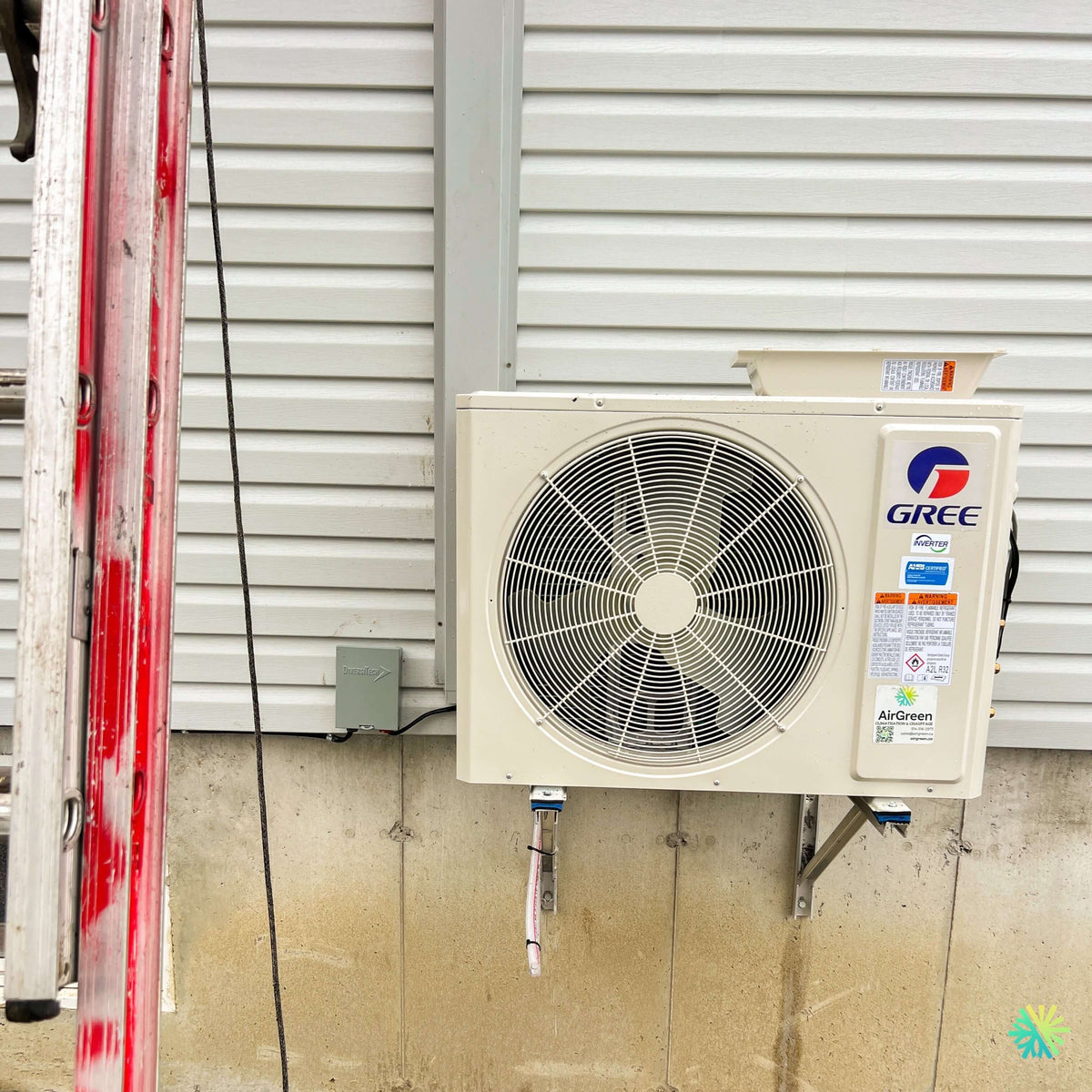
In Verdun, our AirGreen team installed a GREE VITA R32 wall-mounted heat pump, a mini split air conditioning system designed to improve indoor comfort while respecting the real constraints of a Montreal residential building. The photo highlights an essential part of the project: the GREE outdoor unit installed on wall mounts, fixed at the foundation level, with the line set neatly protected by a vertical line cover.
This installation clearly illustrates the kind of detail that makes a difference in an HVAC project. An outdoor unit is not simply placed outside the house. Its positioning directly affects performance, perceived noise level, durability, access for HVAC maintenance, defrost water drainage, and protection against snow. In an area like Verdun, where houses are often close together, side yards can be narrow, and facades must remain clean, every decision must be made methodically.
In this installation, several important elements stand out: the unit is elevated, the wall mounts are anchored into a solid surface, clearance around the fan is well maintained, the electrical disconnect box is installed nearby, and the routing of the lines is aligned with the exterior siding. These choices result in a functional, durable, and well-integrated installation within the building envelope.
An outdoor unit on wall mounts: a relevant choice in Verdun
In many installations in Montreal, especially in neighborhoods like Verdun, Rosemont, Villeray, Ahuntsic, or the Southwest, outdoor spaces are limited. It is not always ideal to place the outdoor unit directly on the ground. A base on the ground can be exposed to snow accumulation, leaves, standing water, or movement caused by freezing and thawing.
The choice of wall mounts allows the unit to be lifted off the ground and kept at a more practical height. In the example shown, this approach also helps maintain a cleaner installation on a facade with horizontal siding. The mounts are fixed at the foundation level, which offers better stability than some more fragile anchoring points.
However, this choice must be executed correctly. A poorly prepared wall installation can transmit vibrations to the building, create noise inside, or cause premature wear of the fastenings. At AirGreen, we pay special attention to the quality of the supports, their alignment, the strength of the anchoring, and the distance between the unit and the facade.
The role of the vertical line cover in a neat installation
One of the visible details in the photo is the vertical line cover placed behind and above the outdoor unit. It protects the refrigerant lines, communication wiring, and insulation against weather, UV rays, and mechanical damage. In a durable HVAC installation, the line cover is not just aesthetic: it contributes to the protection of components.
In a dense neighborhood like Verdun, the exterior appearance matters a lot. Owners generally want an efficient installation but also a facade that remains tidy. A straight layout, a well-secured line cover, and a clean transition to the outdoor unit give the impression of professional work while facilitating inspections and future maintenance.
We also took the exterior cladding into account. On a vinyl or aluminum facade, rough fastenings, unnecessary drilling, and poorly sealed passages must be avoided. Each penetration point must be carefully treated to protect the building against water infiltration and movements related to temperature variations.
Why the GREE VITA R32 is suitable for this type of project
The GREE VITA R32 is a range of wall-mounted heat pumps designed to offer a compact and efficient solution for air conditioning and heating. GREE Canada presents the VITA R32 series with several capacities, including 9,000, 12,000, 18,000, and 24,000 BTU, in 115 V and 230 V configurations depending on the project needs. The range also features Inverter G20 technology, Wi-Fi connectivity, a remote control with an LCD screen, a wall thermostat option, a composite drainage tray, copper coils with aluminum fins, and a refrigerant leak detector on the indoor units.
For owners, the main advantage is flexibility. A GREE VITA R32 wall-mounted heat pump can be used to stabilize a main room, a dwelling, a floor, or a specific area, depending on the selected capacity. In this project in Verdun, the model was chosen to meet a concrete need: improving indoor comfort without installing a complete central system.
The Inverter compressor adjusts its operation according to actual demand. Rather than running only at full capacity and then stopping, the unit modulates its effort, which promotes more stable comfort and better-controlled consumption. This modulation is especially useful in Montreal buildings, where solar gains, insulation, window placement, and room orientation can create significant temperature differences from one area to another.
R32: a modern refrigerant that requires rigorous installation
The GREE VITA R32 uses the refrigerant R32, visible on the safety label of the outdoor unit. This point is important. R32 belongs to a newer generation of refrigerants than many older systems, but it must be handled with professional procedures. On equipment, the A2L markings remind that the refrigerant is classified as mildly flammable, which requires a serious approach during installation, connections, and commissioning.
For this reason, we always emphasize the importance of a complete installation carried out by qualified technicians. Refrigerant connections must be well prepared, vacuuming must be done correctly, leak tests must be thorough, and the startup must confirm that the system operates within expected parameters.
An R32 installation should never be improvised. This applies as much in Verdun as in Laval, Longueuil, on the North Shore or the South Shore. Choosing the right unit matters, but the quality of the installation remains the element that determines real daily performance.
Clearances around the outdoor unit
The outdoor unit visible in the photo is positioned with a clear space in front of the fan. This clearance is essential. The fan must be able to expel air without obstruction, both in cooling and heating. An obstacle too close to the grille can reduce efficiency, increase noise, and force the unit to work harder.
In Verdun, this aspect often requires more planning than in a detached house in the suburbs. Yards are sometimes narrow, side passages can be used for storage, and neighbors are close. We must therefore choose a location that respects both technical requirements, building constraints, and neighborhood comfort.
We analyze in particular:
- the distance in front of the ventilation grille;
- the height relative to the ground and snow;
- access to the service panel;
- the proximity of windows, doors, and walkways;
- the routing of the pipes;
- the presence of an electrical disconnect box;
- the stability of the anchoring surface;
- the possibility of performing maintenance without dismantling the installation.
These are practical decisions, but they directly influence the system’s lifespan.
An AirGreen method designed for buildings in Montreal, Laval, Longueuil, North Shore, and South Shore
An installation planned from the site evaluation stage
Before installing the wall-mounted heat pump, our team evaluated the indoor location, the distance between the indoor and outdoor units, the routing of the pipes, and the constraints of the facade. Good planning avoids unnecessary routes, excessive bends, poorly placed visible passages, and maintenance difficulties.
In this project, the outdoor unit was placed to group essential elements in a logical area: wall mounts, pipe routing, electrical box, and service access. This organization makes the installation clearer and easier to maintain over time.
Another important detail is the height of the unit. In winter, the accumulation of snow and ice can affect the operation of a heat pump. A unit placed too low risks being blocked after a storm or after clearing the yard. A properly elevated unit limits this risk and allows better evacuation of air and defrost water.
Performance and features to know
According to product data available for the VITA R32 range, wall-mounted units offer a low indoor noise level, with values that can drop to around 24 dB(A) depending on the configuration, as well as variable airflow depending on the selected speed. GREE Canada also indicates compact dimensions for some indoor units, for example 835 × 275 × 200 mm for a wall-mounted configuration, which facilitates integration into various types of rooms.
These features are useful in a house or apartment in Verdun, where rooms may be narrower and the indoor unit must fit in without dominating the space. A well-thought-out installation achieves a good balance between comfort, discretion, and performance.
For the outdoor unit, the most important factor remains the quality of the location. Even a high-performance device can lose efficiency if the air circulation is poor, if the pipes are poorly protected, or if service access is compromised. That’s why our team places as much importance on the exterior as on the interior.
Subsidies: check exact eligibility before purchase
Clients often ask us questions about available subsidies for heat pumps. For Hydro-Québec’s LogisVert program, it is necessary to check if the exact installed combination is among the eligible equipment. Hydro-Québec recommends consulting its search tool before purchase and specifies that heat pumps installed from November 26, 2025, must be ENERGY STAR certified to qualify for financial aid.
In the case of a GREE VITA R32, eligibility should never be assumed based solely on the series name. It depends on the exact combination of the outdoor and indoor units, capacity, applicable certification, and installation date. At AirGreen, we validate these elements at the time of the estimate to avoid unpleasant surprises.
When the device is eligible, we provide the necessary information for the client’s file: detailed invoice, model numbers, installation date, and useful technical information. This support is especially appreciated by owners who want to compare the real cost after subsidy with other heating and air conditioning solutions.
Mistakes to avoid with a wall-mounted outdoor unit
An outdoor installation like this may seem simple, but several mistakes can compromise long-term performance.
The first mistake is installing the unit too close to the ground. In Montreal, winter imposes serious constraints: snow, ice, defrost cycles, accumulation around walls, and narrow passages. A low unit can be obstructed more quickly.
The second mistake is neglecting vibration. A wall mount must be solid and well installed. The location must also be chosen considering the building structure and adjacent rooms. A poorly fixed unit can transmit unpleasant vibrations.
The third mistake concerns the line cover. Exposed pipes age faster, especially if the insulation is exposed to sun, wind, rain, and frost. A well-installed line cover protects the system and improves the appearance of the facade.
The fourth mistake is placing the unit in a hard-to-reach area. CVAC maintenance requires being able to clean, inspect, and intervene without dismantling half of the installation. In this project, the unit remains accessible for future checks.
A lasting and well-integrated result
The final result in Verdun is a clean, stable outdoor installation consistent with the building’s needs. The GREE unit is well positioned on its supports, front clearance is respected, conduits are protected, and the whole remains accessible for future interventions.
For the client, the benefit is concrete: a mini split system capable of improving indoor comfort, while being professionally installed outdoors. The project also shows that a successful installation is not just about brand choice. Positioning, supports, conduit routing, electrical work, clearance, and commissioning are all crucial.
Maintenance tips after installation
After installing a GREE VITA R32 wall-mounted heat pump, we recommend monitoring the outdoor unit throughout the year. In winter, avoid snow blocking the grille or accumulating under the unit. In summer, keep the area clear of leaves, dust, and objects stored too close to the fan.
Indoors, filters must be cleaned regularly. A clogged filter reduces airflow, increases system effort, and can affect comfort. Periodic professional maintenance also allows checking the drain, coils, connections, damper operation, and the overall condition of the system.
At AirGreen, we often see the difference between a simply installed device and a well-maintained system. A clean, accessible, and well-adjusted heat pump maintains better performance and offers a more stable experience throughout the seasons.
Why choose AirGreen for an HVAC installation in Verdun
AirGreen operates throughout Greater Montreal for projects involving wall-mounted heat pumps, mini split air conditioners, central systems, and light residential or commercial HVAC solutions. Our experience in Montreal, Laval, Longueuil, on the North Shore and the South Shore allows us to adapt each installation to the actual building, rather than applying a one-size-fits-all method.
This GREE VITA R32 installation in Verdun illustrates our approach: precise analysis, clean execution, attention to visible and invisible details, and a result designed to last. The client gets an efficient system, well integrated into the facade and ready to operate under the demanding conditions of the Quebec climate.
The job tools
Two quick checks with real numbers: what heat costs, and what your current heaters add up to in BTU/h.
Conversion: 1 W = 3.412 BTU/h. An indication, not a load calculation: baseboards and furnaces are often stronger than the real need, and they can stay as backup. AirGreen confirms the capacity on site.
How the job unfolds
The main steps of this kind of job at AirGreen. Every house has its quirks: the estimate brings them out.
We look at the room, the outside wall, the line route and where the outdoor unit will go. That is where the capacity gets chosen.
Model, capacity and price, in writing. We also check whether the model qualifies for assistance programs.
Floors and furniture protected, wall plate position marked level, wall opening located.
A single opening, with the slope the drain needs to flow outside.
Set on a stand raised above the snow, with the clearances the manufacturer requires.
Connected, insulated and protected. The opening is then sealed against water, cold air and insects.
A dedicated circuit and an accessible disconnect near the outdoor unit.
Leak test, vacuum, then start-up and a check of heating and cooling.
Remote, modes, filters: we show you the essentials before we leave.
- The on-site estimateWe look at the room, the outside wall, the line route and where the outdoor unit will go. That is where the capacity gets chosen.
- The quoteModel, capacity and price, in writing. We also check whether the model qualifies for assistance programs.
- Getting readyFloors and furniture protected, wall plate position marked level, wall opening located.
- The wall openingA single opening, with the slope the drain needs to flow outside.
- The outdoor unitSet on a stand raised above the snow, with the clearances the manufacturer requires.
- Lines, cable and drainConnected, insulated and protected. The opening is then sealed against water, cold air and insects.
- The electrical workA dedicated circuit and an accessible disconnect near the outdoor unit.
- Tests and start-upLeak test, vacuum, then start-up and a check of heating and cooling.
- The walkthroughRemote, modes, filters: we show you the essentials before we leave.
What we check on a job like this one
Each number is a point we check on site. Switch between summer and winter to watch air and heat move.
In summer, the outdoor unit rejects the house's heat outside.
Generic illustration of this type of installation, not a survey of this job site. Tap a number.
Mounted level on a wall plate, high enough for the air to reach the whole room, with enough space around it to slide the filters out easily.
The refrigerant lines, the communication cable and the drain go through the wall in a single opening, sealed against water, cold air and insects.
Two insulated copper pipes connect the two units. Outside, a line cover can protect them from sun, knocks and weather.
A shut-off switch near the outdoor unit isolates it safely for service. It must stay accessible at all times.
The compressor and the fan. In heating mode it captures heat from the outdoor air, even in winter, and moves it inside.
On the ground or on the wall, it keeps the unit above accumulated snow. The unit stays clear and defrost water can drain away.
The fan needs to blow freely. Storage, a fence or a wall too close, and efficiency drops while noise goes up.
Is your home ready?
Check what applies at your place. A "no" is not a refusal: it is what we sort out during the estimate.
Good habits, once the unit is in place
Six simple habits that keep the unit going. Your list stays on this device.
What to do, season by season
Three habits per season for this unit. They take a few minutes and prevent many calls.
- Clean the indoor unit's filters.
- Clear leaves and debris left on the outdoor unit by winter.
- Test cooling before the first hot days.
- Clean the filters more often when the unit runs a lot.
- Keep plants away from the outdoor unit.
- Check that no water drips from the indoor unit.
- Rake the leaves around the outdoor unit.
- Test heating before the first cold days.
- Book periodic maintenance before winter.
- Keep snow away from the stand and the front of the unit.
- Let the unit defrost: it is normal.
- Never hit the ice on the fins; call us if the unit stays iced up.
The right pages, at the right time
Four statements: true or false?
It all comes down to details you have just seen.
1. In heating mode, the outdoor unit can produce water.
During defrost cycles. That water must drain away without forming ice.
2. You pick the capacity with a simple square-footage rule.
Windows, insulation, orientation and how the room is used all count. Capacity is chosen on site.
3. A multi-zone connects several indoor heads to a single condenser.
One head per room, all on the same condenser. Each room keeps its own temperature.
4. The disconnect can sit behind the patio furniture.
It must stay accessible: it is what shuts the unit off for service.
0 / 4 right answers
What people ask us about this kind of work
Does a wall-mounted heat pump heat in winter?
Wall-mounted or multi-zone: how do I choose?
Where does the outdoor unit go?
Are there grants?
Do I need a permit?
How cold can it heat?
How much can I save?
How is the LogisVert assistance calculated?
Is it noisy?
The outdoor unit is covered in ice: is that normal?
Does AirGreen hold the required licences?
Is the estimate free?
No question matches. Write to us: we answer.
More jobs to see, near you
By town, by equipment or by region: browse more than 4,700 published projects.
Each dot: a town where AirGreen has published projects. The glowing dot: this job.
An on-site estimate, the right capacity, the right equipment.
The on-site estimate is free and the quote follows within 24 hours.
Text and photo: a real AirGreen Climatisation & Chauffage job. The diagrams are generic illustrations of the type of installation, not a survey of this job site. Sources of the added figures: airgreen.ca product pages (NEEP / AHRI performance), Hydro-Québec (Heat pumps page, LogisVert, read on 13 October 2026), Régie de l’énergie (rate D as of 1 April 2026).