
Installation of a GREE All Match Slim Duct R32 Ducted Heat Pump in Laval-des-Rapides: Discreet Comfort, Integrated Ducts, and On-Site Performance Validation
AirGreen installs a GREE All Match Slim Duct R32 ducted heat pump in Laval-des-Rapides, with discreet ducts, temperature validation at 5.8 °C, and integrated HVAC comfort.
- City
- Region
- Equipment
- Brand
- Challenges
- Published
The job on one screen
The article, chapter by chapter
A GREE ducted system installed to offer almost invisible comfort in a property in Laval-des-Rapides
In Laval-des-Rapides, an area with renovated houses as well as condos, plexes, and properties with architectural constraints, installing a GREE ducted heat pump often represents a particularly smart solution. In this project carried out by AirGreen, the goal was not simply to add heating and air conditioning: it was necessary to integrate a HVAC system that is discreet, efficient, well-balanced, and capable of distributing air to targeted rooms without imposing the visible presence of a wall unit.
The chosen solution belongs to the GREE All Match Slim Duct R32 family, a range of ducted systems designed to be installed in a false ceiling, technical space, attic, or hidden area, depending on the building's layout. This type of system is ideal when the client wants to preserve interior aesthetics while enjoying the comfort of a modern heat pump that is efficient and well-suited to the Quebec climate.
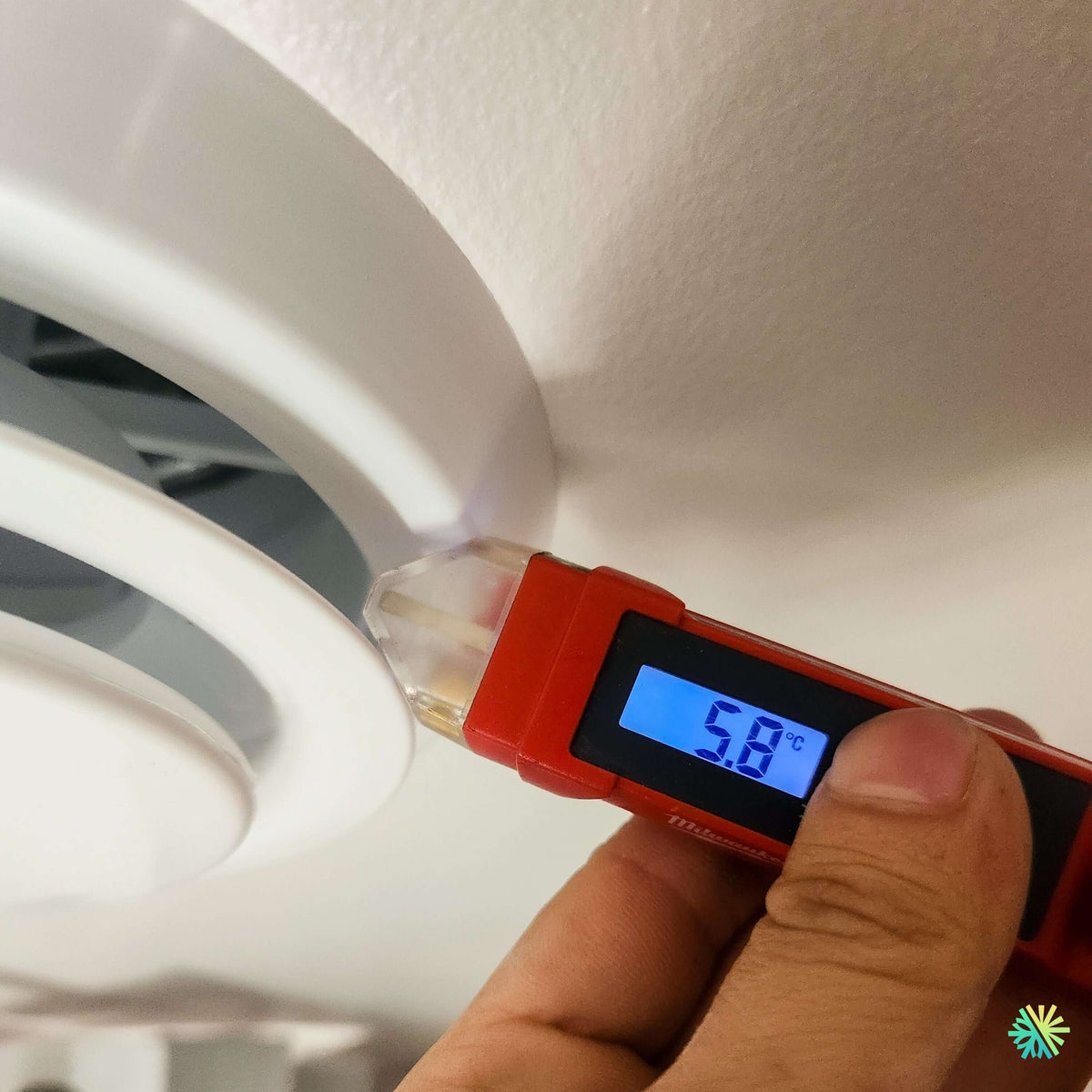
In this installation, the detail that stood out during our commissioning was the direct verification of the air temperature blown out at the diffuser outlet. A measurement of about 5.8 °C was taken using a digital thermometer, confirming that the system provided stable and effective cold air during the air conditioning tests. This kind of on-site check is essential: it allows validation not only of the machine's operation but also the actual quality of the HVAC installation, air balancing, and proper airflow in the ducts.
Why choose a ducted system rather than a traditional wall unit?
A wall-mounted heat pump remains an excellent option for many clients in Montreal, Laval, Longueuil, on the North Shore and the South Shore. However, in some projects, the wall unit does not perfectly meet aesthetic or technical expectations. In Laval-des-Rapides, the client wanted a more integrated solution, with softer and less localized air diffusion.
The ducted system allows air to be distributed through discreet grilles, often installed in the ceiling or high on walls. The result is cleaner: the main equipment remains hidden, while comfort is felt in the served areas. This approach is particularly interesting for:
- condos where wall space is limited;
- high-end renovations where aesthetics are a priority;
- open rooms where direct air jets are to be avoided;
- properties with several nearby zones to air condition or heat;
- projects where a more discreet integration of the HVAC system is desired.
In this specific case, installing a GREE All Match Slim Duct R32 allowed for even air distribution while respecting the existing interior finish.
GREE All Match Slim Duct R32: a flexible range for residential and multi-zone projects
The GREE All Match Slim Duct R32 range offered by AirGreen includes several capacities, notably 9,000 BTU, 12,000 BTU, 18,000 BTU, 24,000 BTU, 30,000 BTU, and 36,000 BTU, depending on the type of project, the calculated thermal loads, and the duct network configuration. This flexibility is very useful when adapting the solution to an existing property rather than a new building designed from the start to receive a central system.
The choice of capacity is never made randomly. At AirGreen, we validate several elements before recommending a configuration:
- the actual area to be served;
- the level of insulation;
- the orientation of the windows;
- solar gains;
- the ceiling height;
- the pressure losses related to the ducts;
- the number of air outlets;
- the desired noise level;
- the available space for the indoor unit;
- the possible location of the outdoor unit.
In a ducted system, calculating static pressure is as important as choosing the BTU. A properly sized unit, but connected to poorly designed ducts, can produce disappointing comfort. This is precisely where the experience of our refrigeration technicians makes the difference.
The role of static pressure in a ducted installation
A ducted duct installation requires a precise understanding of air movement. Unlike a wall-mounted air conditioner, which blows directly into the room, a ducted system must push air through a network of ducts, bends, grilles, and sometimes additional filters. Each component adds resistance.
The GREE range includes solutions in low static pressure and high static pressure, allowing the equipment to be chosen based on the network to be created or adapted. In a compact space, with short ducts and few outlets, a low-pressure configuration may be sufficient. In a larger project, with several branches or a greater distance between the indoor unit and the grilles, a higher static pressure often becomes necessary.
In Laval-des-Rapides, analyzing the available space was a key step. The goal was to achieve a short, clean, and well-insulated network to limit performance losses and reduce air circulation noise. The ducts were designed to maintain a stable flow, avoid unnecessary restrictions, and allow reasonable access for future HVAC maintenance.
A discreet installation, but technically demanding
The discreet nature of a ducted system can give the impression that it is a simple installation. In reality, it is often the opposite. Since the indoor unit is hidden, every decision made before closing ceilings or technical spaces has a direct impact on future performance.
Our technicians paid special attention to several points:
The location of the indoor unit
The positioning had to allow service access, good condensate drainage, and an efficient connection to the ducts. A ducted unit must not be permanently enclosed without an access panel. This is a common mistake in some poorly planned projects: the installation looks clean at first, but becomes problematic as soon as maintenance or diagnostics are needed.
Condensate drainage
In cooling mode, the humidity removed from the air must be properly drained. The slope, drain path, possibility of future cleaning, and prevention of backflow are non-negotiable details. A poorly installed drain can cause water damage, odors, or operational interruptions.
Duct insulation
An uninsulated or poorly insulated duct can cause condensation, lose energy, and reduce comfort. In a ducted installation, duct insulation is as important as the machine's performance itself. We therefore validated the joints, transitions, and exposed sections to limit thermal losses.
The quality of grilles and diffusers
The choice of grilles influences perceived comfort. A poor grille can create an unpleasant draft, whistling, or uneven distribution. We favored gentle diffusion, aligned with the client's main goal: to achieve effective but almost imperceptible air conditioning.
On-site validation: measure, adjust, confirm
The image of this installation shows a simple but very important step: measuring the temperature directly at the air outlet. The thermometer indicated about 5.8 °C, a value consistent with a system demanding cooling and operating efficiently.
This measurement does not replace all technical checks, but it provides a clear indication of the system's ability to produce cold air. At AirGreen, commissioning generally includes several validations:
- Blowing temperature;
- Return temperature;
- Thermostat or control response;
- Operating noise;
- Airflow at the grilles;
- Condensate drainage;
- Operation of the outdoor unit;
- Visual tightness of connections;
- Explanation to the client on how to use the system.
In a ducted installation, this step is even more important because design or adjustment errors can be less visible than with a wall unit. A diffuser may seem well installed but blow too little. A grille may be aesthetic but poorly oriented. A duct may be hidden but too restrictive. Commissioning allows these details to be corrected before the project is fully completed.
R32, energy efficiency, and subsidy eligibility
The GREE All Match Slim Duct R32 models belong to a new generation of systems using the refrigerant R32, valued for its efficiency and reduced environmental impact compared to some older refrigerants. For customers in Laval, Montreal, Longueuil, the North Shore, and the South Shore, choosing a modern heat pump can also open the door to certain financial aids when the installed model meets the criteria of current programs.
At AirGreen, we place great importance on this step. We help customers understand eligibility criteria, necessary documents, and information to keep after installation. Subsidy programs can vary depending on capacity, certification, equipment type, and administrative updates. That’s why we always recommend verifying the exact model and applicable conditions at the time of purchase.
Beyond subsidies, energy savings remain a major argument. A well-sized ducted heat pump can reduce dependence on less efficient heating systems, improve comfort in the shoulder seasons, and provide effective air conditioning during hot periods.
Why AirGreen is particularly well positioned for GREE ducted systems
AirGreen is a GREE Elite dealer, which gives us enhanced expertise on the brand's products, installation procedures, diagnostics, and access to original parts. For a ducted system, this advantage is concrete. It's not just about installing a machine; it's about designing a complete solution.
Our teams regularly work on projects where constraints are real: condos with co-ownership rules, limited ceilings, difficult access, restricted mechanical spaces, acoustic requirements, long piping distances, aesthetic integration, and precise client demands who want impeccable finishing.
In several installations carried out in Montreal, especially in buildings where other contractors had deemed the project too complex, our technicians managed to find more logical routes, cleaner locations, and solutions that respect both the building and the client's expectations. This experience is directly applicable to Laval-des-Rapides, where properties often have varied and sometimes tight configurations.
Mistakes to avoid with a ducted heat pump
A ducted system can offer excellent comfort, but only if the installation is well designed. Here are the most common mistakes we observe when a project is poorly planned:
Choosing capacity based only on area
The area gives a first idea, but it is not enough. Two homes of the same size can have very different needs depending on insulation, sun exposure, number of windows, and room layout.
Neglecting static pressure
A duct network that is too long or too restrictive can prevent the unit from delivering its nominal flow. The result: a machine that runs, but a room that remains uncomfortable.
Installing without service access
A well-placed access hatch can prevent having to open a ceiling during future maintenance. This is a detail that must be planned from the start.
Forgetting air balancing
Each outlet must receive an appropriate flow rate. Without balancing, one room can become too cold while another remains too warm.
Underestimating drainage
Condensate must be drained reliably. An aesthetic installation that is poorly drained can quickly become a source of problems.
The result for the client in Laval-des-Rapides
After installation and commissioning, the client got exactly what they were looking for: stable comfort, discreet air distribution, and a very understated visual integration. The temperature measured at the diffuser outlet confirmed the performance in cooling mode, while the overall system operation was validated by our technicians.
This project perfectly illustrates the value of a well-thought-out HVAC installation. The choice of a GREE All Match Slim Duct R32 is not limited to the brand or capacity. Success depends on the whole: building analysis, model selection, duct layout, quality of connections, insulation, drainage, commissioning, and explanations given to the client.
For owners in Laval-des-Rapides who want to improve their comfort without installing a visible wall unit, the GREE ducted system is a serious option. It suits both renovation projects and properties where interior aesthetics are a priority.
AirGreen, your HVAC team for ducted installations in Laval and Greater Montreal
At AirGreen, we install heat pumps, wall air conditioners, central systems, and ducted ducts throughout Greater Montreal, including Montreal, Laval, Longueuil, the North Shore, and the South Shore. Our approach is based on clear estimates, equipment selection adapted to each building, experienced refrigeration technicians, and structured after-sales service.
Installing a GREE ducted heat pump requires precision that cannot be improvised. This project in Laval-des-Rapides demonstrates our method: offer a discreet solution, verify performance on site, respect the building’s constraints, and deliver a system that truly works under the client’s conditions.
For an owner, the right HVAC contractor is not just the one who sells a machine. It’s the one who can anticipate constraints, explain options, install neatly, measure results, and remain available after the work. It is this rigor that allows AirGreen to carry out reliable, clean, and durable projects, from the first call to the final commissioning.
The job tools
Two quick checks with real numbers: what heat costs, and what your current heaters add up to in BTU/h.
Conversion: 1 W = 3.412 BTU/h. An indication, not a load calculation: baseboards and furnaces are often stronger than the real need, and they can stay as backup. AirGreen confirms the capacity on site.
How the job unfolds
The main steps of this kind of job at AirGreen. Every house has its quirks: the estimate brings them out.
We look at the ducts, the current indoor module, the electrical panel and the planned spot for the outdoor unit.
The equipment combination, capacity and price, in writing. We check whether the combination qualifies for assistance programs.
Access protected, old unit disconnected and removed when it is being replaced.
Electric furnace or air handler, with its coil, connected to the supply and return ducts.
On a level base, raised above the snow, with free space all around.
Insulated, they enter through a sealed opening and run to the indoor coil.
Dedicated circuits, accessible disconnect, a thermostat that works with the heat pump and the backup heat.
Leak test, vacuum, start-up, airflow check and a test of both modes.
Filter, thermostat, backup heat in extreme cold: what to know before winter.
- The on-site estimateWe look at the ducts, the current indoor module, the electrical panel and the planned spot for the outdoor unit.
- The quoteThe equipment combination, capacity and price, in writing. We check whether the combination qualifies for assistance programs.
- Getting readyAccess protected, old unit disconnected and removed when it is being replaced.
- The indoor moduleElectric furnace or air handler, with its coil, connected to the supply and return ducts.
- The outdoor unitOn a level base, raised above the snow, with free space all around.
- The refrigerant linesInsulated, they enter through a sealed opening and run to the indoor coil.
- Electrical and thermostatDedicated circuits, accessible disconnect, a thermostat that works with the heat pump and the backup heat.
- Tests and start-upLeak test, vacuum, start-up, airflow check and a test of both modes.
- The walkthroughFilter, thermostat, backup heat in extreme cold: what to know before winter.
What we check on a job like this one
Each number is a point we check on site. Switch between summer and winter to watch air and heat move.
In summer, the outdoor unit rejects the house's heat outside.
Generic illustration of this type of installation, not a survey of this job site. Tap a number.
It captures or rejects heat outside. It sits on a level base, above the snow, with free space all around.
The insulated refrigerant lines enter the house through a sealed opening and run to the indoor coil.
A shut-off switch near the outdoor unit isolates it safely for service.
Sitting on the indoor module, it moves heat between the house air and the refrigerant.
Electric furnace or air handler: its fan pushes air through the ducts. The electric backup takes over in extreme cold.
Supply ducts bring air to the rooms; returns bring it back to the unit. Their condition matters as much as the unit's.
It protects the coil and the fan. A dirty filter cuts airflow, so it gets checked regularly.
It runs the heat pump and the backup heat. It must be compatible with the installed system.
Is your home ready?
Check what applies at your place. A "no" is not a refusal: it is what we sort out during the estimate.
Good habits, once the unit is in place
Six simple habits that keep the unit going. Your list stays on this device.
What to do, season by season
Three habits per season for this unit. They take a few minutes and prevent many calls.
- Check the indoor module's filter.
- Clear winter debris from the outdoor unit.
- Test cooling before the heat arrives.
- Check the filter more often in peak season.
- Keep registers and returns clear.
- Watch condensate drainage near the coil.
- Change or clean the filter.
- Test heating and backup heat before the cold.
- Book periodic maintenance.
- Clear snow around the outdoor unit.
- Store nothing in front of the indoor module.
- Note any unusual noise or smell and call us.
The right pages, at the right time
Four statements: true or false?
It all comes down to details you have just seen.
1. A central heat pump uses the house's ducts.
It connects to the existing ducts to heat and cool everywhere.
2. In extreme cold, electric backup heat can take over.
The indoor module (furnace or air handler) works with the heat pump and takes over in extreme cold.
3. The filter only gets changed when the unit breaks down.
A dirty filter cuts airflow. It gets checked regularly.
4. You can reuse the old unit's size without checking.
The house may have changed: insulation, windows, added rooms. Capacity is confirmed on site.
0 / 4 right answers
What people ask us about this kind of work
Can I keep my current ducts?
What happens in extreme cold?
Furnace, air handler, ducted: what is the difference?
Are there grants?
Do I need a permit?
How much can I save?
How is the LogisVert assistance calculated?
Will my current thermostat work?
Central or wall units: which one?
Does AirGreen hold the required licences?
Is the estimate free?
No question matches. Write to us: we answer.
More jobs to see, near you
By town, by equipment or by region: browse more than 4,700 published projects.
Each dot: a town where AirGreen has published projects. The glowing dot: this job.
An on-site estimate, the right capacity, the right equipment.
The on-site estimate is free and the quote follows within 24 hours.
Text and photo: a real AirGreen Climatisation & Chauffage job. The diagrams are generic illustrations of the type of installation, not a survey of this job site. Sources of the added figures: airgreen.ca product pages (NEEP / AHRI performance), Hydro-Québec (Heat pumps page, LogisVert, read on 13 October 2026), Régie de l’énergie (rate D as of 1 April 2026).