
Installation of a GREE All Match Slim Duct R32 Slim Duct Ducted System in Bois-des-Filion on the North Shore
AirGreen installs a GREE All Match Slim Duct R32 ducted system in Bois-des-Filion: custom ducts, discreet comfort, precise air distribution, and HVAC expertise on the North Shore.
In summer, the outdoor unit rejects the house's heat outside.
Generic illustration of this type of installation, not a survey of this job site. Tap a number.
It captures or rejects heat outside. It sits on a level base, above the snow, with free space all around.
The insulated refrigerant lines enter the house through a sealed opening and run to the indoor coil.
A shut-off switch near the outdoor unit isolates it safely for service.
Sitting on the indoor module, it moves heat between the house air and the refrigerant.
Electric furnace or air handler: its fan pushes air through the ducts. The electric backup takes over in extreme cold.
Supply ducts bring air to the rooms; returns bring it back to the unit. Their condition matters as much as the unit's.
It protects the coil and the fan. A dirty filter cuts airflow, so it gets checked regularly.
It runs the heat pump and the backup heat. It must be compatible with the installed system.
A GREE ducted installation designed for discreet, uniform, and well-distributed comfort
In Bois-des-Filion, on the North Shore, our AirGreen team completed a HVAC installation that perfectly illustrates the benefits of a ducted system, also called ducted conduit, Slim Duct, or ductable, in a residence where comfort needed to remain discreet, efficient, and well integrated into the interior architecture. The project was not just about installing a heating and cooling unit: it required designing an intelligent, compact, and durable air distribution system capable of supplying multiple zones from equipment hidden in a technical space.
The client was looking for a solution different from a traditional wall-mounted heat pump. In some homes, especially when you want to avoid visible wall units in main rooms, a GREE ducted system becomes a particularly interesting option. The indoor unit is hidden in a ceiling, false ceiling, attic, or mechanical space, while the air is distributed through a duct network to different rooms. The result is discreet, quiet, and very comfortable.
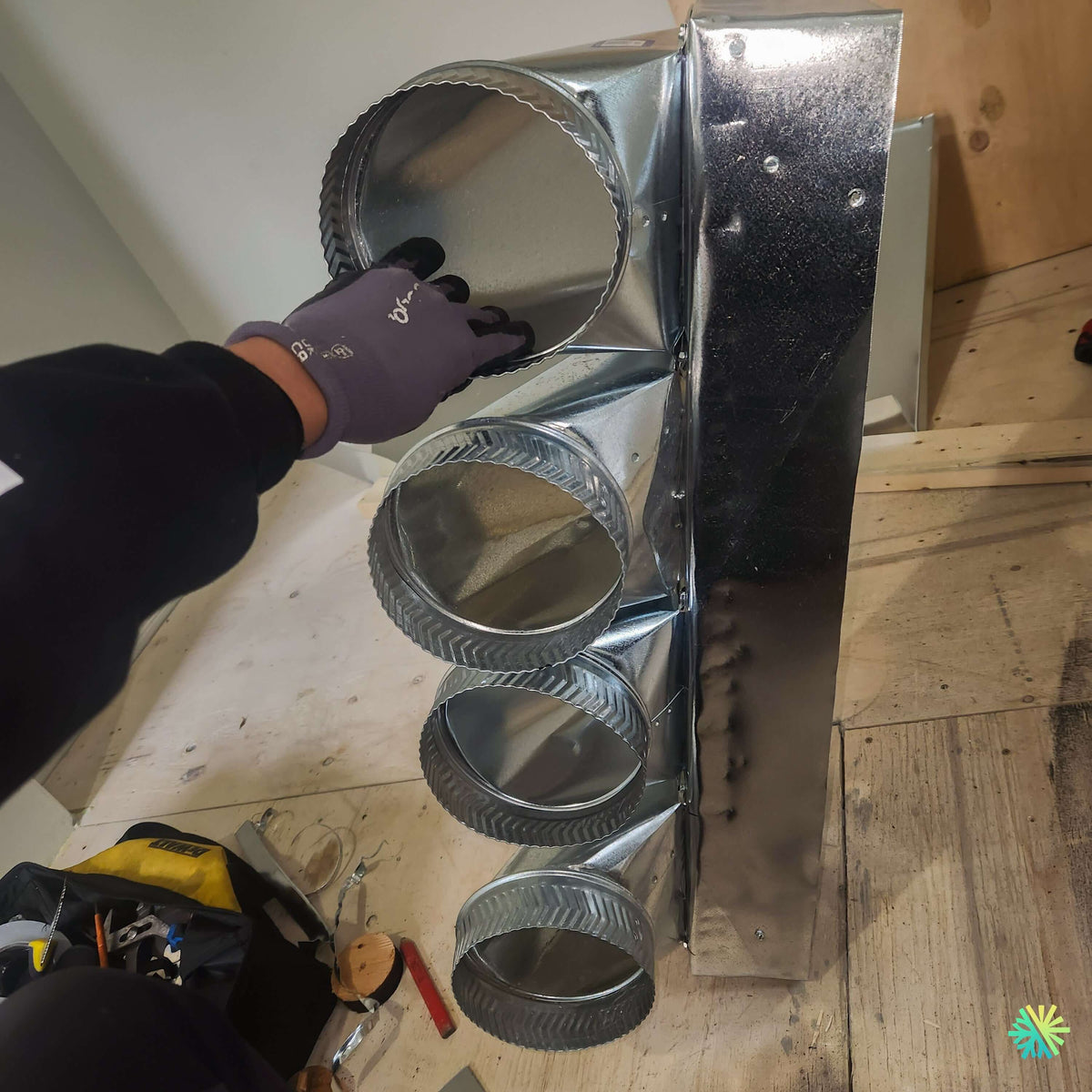
In this installation, one of the most important elements was the fabrication and adjustment of the distribution plenum. The site photo clearly shows a galvanized metal piece with several round outlets intended to feed flexible or rigid ducts. This type of connection requires excellent precision: each outlet must be designed according to the required airflow, duct length, available static pressure, and the system's final balancing.
At AirGreen, we handle this type of installation with a comprehensive approach: equipment selection, available space validation, duct design, mechanical installation, refrigeration and electrical connections, startup, airflow verification, and client advice for daily use.
Why a GREE ducted system in Bois-des-Filion?
The choice of a GREE All Match Slim Duct R32 met several concrete objectives. The client wanted a high-performance solution without compromising interior aesthetics. In a house where ceilings, walls, and living areas must remain clean, the ducted system allows only supply and return grilles to be visible, rather than a wall unit in each room.
This approach is particularly relevant in several residential contexts on the North Shore, notably in Bois-des-Filion, Terrebonne, Sainte-Thérèse, Rosemère, Blainville, and Laval, where you find renovated houses, extensions, finished basements, open spaces, and projects where comfort must be distributed across several rooms.
The GREE ducted systems offered by AirGreen cover different capacities, including 9,000 BTU, 12,000 BTU, 18,000 BTU, 24,000 BTU, 30,000 BTU, and 36,000 BTU, depending on models and configurations. Sizing should never be chosen at random. A unit that is too small will unnecessarily strain, while a unit that is too large could cause short cycling, less effective humidity control, and a less stable comfort sensation. For this type of project, we evaluate the area, insulation, solar orientation, number of rooms served, heat losses, and duct constraints.
The central role of the distribution plenum
The part visible in the photo represents an element often underestimated by clients but essential for the performance of a ducted system: the plenum. This piece serves as a distribution chamber between the indoor unit and the ducts supplying the different rooms.
A poorly designed plenum can create several problems:
- loss of airflow in certain rooms;
- air noise in the ducts;
- too high static pressure;
- discomfort between zones;
- performance lower than that expected by the manufacturer;
- premature wear of certain components.
In this project in Bois-des-Filion, the work had to be compact and precise. The mechanical space required a vertical configuration with several closely spaced duct outlets. Our technicians therefore paid special attention to the alignment of the outlets, the strength of the metal joints, the tightness of the connections, and ease of access for subsequent work.
A Slim Duct system is never limited to the machine alone. Its true performance depends on the whole: indoor unit, outdoor unit, ducts, grilles, air return, insulation, drainage, wall control, and balancing.
Low static pressure or high static pressure: an important technical choice
The GREE ducted range includes configurations with low static pressure and high static pressure. The choice depends on the planned duct network.
A low static pressure unit is generally suitable for shorter installations, with a limited number of outlets and well-sized ducts. It is often used in projects where the indoor unit is close to the rooms served, with a simple and compact network.
A high static pressure unit becomes relevant when ducts are longer, when several rooms need to be supplied, or when the layout involves more bends and pressure losses. It allows air to be pushed more efficiently through a more demanding network, provided the design is done correctly.
In an installation like that of Bois-des-Filion, this consideration is essential. Having multiple distribution outlets requires a serious analysis of airflow rates. The goal is not simply to add ducts but to deliver the right amount of air to the right place, with an acceptable noise level and stable temperature.
A discreet solution for heating and air conditioning
The GREE All Match Slim Duct R32 system follows a logic of invisible comfort. In summer, it allows for gentle air conditioning of targeted zones, without a harsh direct air jet. In winter, depending on the selected model and installation conditions, it can contribute to heating with performance suited to Quebec winters.
The GREE models offered by AirGreen include options designed to operate at low temperatures, with some configurations capable of delivering performance down to about -30 °C depending on the model. This capability is important in Quebec, where a heat pump must be evaluated not only for its summer cooling but also for its performance during cold periods.
The use of the refrigerant R32 in the All Match Slim Duct R32 series also represents a technical advantage. This refrigerant is increasingly present in new generations of HVAC systems, notably to improve efficiency and reduce environmental impact compared to some older solutions.
An AirGreen project where every duct detail matters
Installing a GREE ducted duct requires close coordination between design and the field. Unlike a wall unit, where the indoor location is often visible and direct, a ducted system requires a more global vision. You have to think about what the client will see, but also everything that will be hidden behind ceilings, soffits, or technical spaces.
In Bois-des-Filion, our team had to work in a space under construction or preparation, with exposed wood flooring and technical areas being set up. This type of context is ideal for a ducted installation, as it allows ducts to be integrated before the surfaces are fully closed. However, it also requires precision: a positioning error can complicate interior finishing, move a grille to the wrong place, or make service access more difficult.
The key steps of this HVAC installation
Our working method for this type of project follows a rigorous sequence.
1. Space analysis and concept validation
Before installation, we validate the location of the indoor unit, possible duct routes, the areas to be served, and structural constraints. In a residence, it is important to avoid compromising joists, respect clearances, plan access to the filter, and maintain an adequate slope for condensation drainage.
2. Choosing the appropriate GREE configuration
The choice of a GREE ducted system must take into account the BTU capacity, static pressure, number of outlets, duct length, and desired noise level. AirGreen offers several GREE models, including 9,000, 12,000, 18,000, 24,000, 30,000, and 36,000 BTU, allowing the solution to be adapted to the home rather than forcing the home to adapt to the machine.
3. Fabrication and adaptation of the plenum
The visible metal piece in the photo plays a major role. It distributes air to several ducts. The metalwork must be clean, solid, and airtight. Each round collar must be well secured to avoid vibrations, air leaks, and performance losses.
4. Duct installation and insulation
Ducts must be installed carefully, without crushing, without excessively tight bends, and with proper insulation when necessary. Poor duct installation can reduce airflow, increase noise, and decrease the overall system efficiency.
5. Refrigerant, electrical connections, and drainage
As with any heat pump, refrigerant connections must be made by qualified professionals. The lines must be properly sized, protected, and tested. Drainage must be reliable, especially in a concealed installation, as condensation leaks can damage ceilings or interior finishes.
6. Startup and balancing
Once the system is installed, we proceed with startup, operational checks, temperature inspection, noise control, and airflow adjustments when required. Balancing is an important step to ensure each room receives the correct volume of air.
Common mistakes to avoid with a ducted system
A ducted project can deliver remarkable results, but only if the installation is well planned. Here are the mistakes we sometimes encounter when clients call us to fix poorly designed work:
- choosing a BTU capacity based only on area, without calculating the actual loads;
- using a low static pressure unit on a network that is too long;
- multiplying outlets without checking the available airflow;
- installing ducts that are too small;
- neglecting the air return;
- forgetting access to the filter and maintenance;
- placing supply grilles in uncomfortable locations;
- underestimating the importance of duct insulation;
- not planning condensation drainage properly.
At AirGreen, we know that a successful HVAC installation is not judged only on the day of startup. It is judged after several seasons, when the customer notices that the system is quiet, stable, easy to use, and reliable.
Why AirGreen is well positioned to install GREE ducted systems
AirGreen is a GREE Elite dealer, which gives us a concrete advantage for installing GREE ducted systems in Montreal, Laval, Longueuil, on the North Shore and the South Shore. This expertise is not limited to selling machines. It covers understanding the ranges, access to original parts, technical training, diagnostics, repairs, and support after installation.
For a customer, this changes many things. A ducted system requires a contractor capable of understanding the device as well as the building. The choice of model, static pressure, air distribution, site constraints, and after-sales service must be treated as a single whole.
We also offer a transparent approach: clear estimates, explained model choices, detailed pricing, support for subsidies when a model is eligible, and installation by experienced technicians. Several GREE Energy Star models may be eligible for subsidy programs depending on current criteria, capacity, certification numbers, and applicable requirements at the time of purchase. For each project, we verify relevant information to avoid unpleasant surprises.
The comfort achieved after installation
Once the system is installed, the customer enjoys more uniform comfort, without a visible wall unit in each room. The air is distributed through discreet outlets, allowing for a more elegant integration into the interior design. For a home in Bois-des-Filion, this type of solution is particularly interesting when you want to modernize comfort without changing the appearance of the rooms.
The GREE ducted system also offers a different feel from a wall-mounted system. The airflow can be distributed more gently, with better coverage of targeted areas. In bedrooms, hallways, offices, or open rooms, this more subtle diffusion is often highly appreciated.
Practical advice for homeowners considering a Slim Duct system
Before choosing a Slim Duct system, it is important to properly prepare the project. Here are the points we recommend checking:
Plan the space before finishing work
If you are renovating, expanding, or building, the best time to install a ducted system is before the ceilings and walls are fully closed. This allows optimizing the ducts and reducing compromises.
Do not compare only the price of the machine
Two installations with the same unit can yield very different results. The quality of the ducts, plenum, grilles, drainage, and commissioning directly affects comfort.
Consider maintenance from the start
A hidden system must remain accessible. The filter, service panels, and important components must be reachable without demolition.
Choose a team experienced with ducted systems
A very skilled wall-mounted installer is not necessarily specialized in ducted systems. Understanding static pressure, airflow, and duct design is essential.
An installation that well represents AirGreen’s approach on the North Shore
This project in Bois-des-Filion clearly shows what we aim to deliver at AirGreen: an HVAC solution tailored to the building, not a standardized installation. The client wanted discreet comfort. The GREE All Match Slim Duct R32 system met this need with a clean integration, structured air distribution, and modern technology.
The quality of this type of installation relies on details that are not always visible once the work is completed: the shape of the plenum, the tightness of the connections, the logic of the duct network, the selection of the unit, adherence to clearances, the precision of the connections, and the final balancing. These are precisely the details that make the difference between a simply installed system and a truly high-performing system.
For owners in Bois-des-Filion, Laval, Terrebonne, Blainville, Rosemère, Montreal, Longueuil, from the North Shore and the South Shore, the GREE ducted system is a serious option when comfort, aesthetics, and performance need to work together.
How it goes, from the first call to the end
The main steps of this kind of job at AirGreen. Every house has its quirks: the estimate brings them out.
We look at the ducts, the current indoor module, the electrical panel and the planned spot for the outdoor unit.
The equipment combination, capacity and price, in writing. We check whether the combination qualifies for assistance programs.
Access protected, old unit disconnected and removed when it is being replaced.
Electric furnace or air handler, with its coil, connected to the supply and return ducts.
On a level base, raised above the snow, with free space all around.
Insulated, they enter through a sealed opening and run to the indoor coil.
Dedicated circuits, accessible disconnect, a thermostat that works with the heat pump and the backup heat.
Leak test, vacuum, start-up, airflow check and a test of both modes.
Filter, thermostat, backup heat in extreme cold: what to know before winter.
- The on-site estimateWe look at the ducts, the current indoor module, the electrical panel and the planned spot for the outdoor unit.
- The quoteThe equipment combination, capacity and price, in writing. We check whether the combination qualifies for assistance programs.
- Getting readyAccess protected, old unit disconnected and removed when it is being replaced.
- The indoor moduleElectric furnace or air handler, with its coil, connected to the supply and return ducts.
- The outdoor unitOn a level base, raised above the snow, with free space all around.
- The refrigerant linesInsulated, they enter through a sealed opening and run to the indoor coil.
- Electrical and thermostatDedicated circuits, accessible disconnect, a thermostat that works with the heat pump and the backup heat.
- Tests and start-upLeak test, vacuum, start-up, airflow check and a test of both modes.
- The walkthroughFilter, thermostat, backup heat in extreme cold: what to know before winter.
And at your place?
Two quick checks with real numbers: what heat costs, and what your current heaters add up to in BTU/h.
Conversion: 1 W = 3.412 BTU/h. An indication, not a load calculation: baseboards and furnaces are often stronger than the real need, and they can stay as backup. AirGreen confirms the capacity on site.
What to do, season by season
Three habits per season for this unit. They take a few minutes and prevent many calls.
- Check the indoor module's filter.
- Clear winter debris from the outdoor unit.
- Test cooling before the heat arrives.
- Check the filter more often in peak season.
- Keep registers and returns clear.
- Watch condensate drainage near the coil.
- Change or clean the filter.
- Test heating and backup heat before the cold.
- Book periodic maintenance.
- Clear snow around the outdoor unit.
- Store nothing in front of the indoor module.
- Note any unusual noise or smell and call us.
Which type of equipment for your project?
Pick what looks like your need.
Four mistakes we do not make
Flip each card to see what we do instead.
What people ask us about this kind of work
Can I keep my current ducts?
What happens in extreme cold?
Furnace, air handler, ducted: what is the difference?
Are there grants?
Do I need a permit?
How much can I save?
How is the LogisVert assistance calculated?
Will my current thermostat work?
Central or wall units: which one?
Does AirGreen hold the required licences?
Is the estimate free?
No question matches. Write to us: we answer.
Useful pages for what comes next
More jobs to see, near you
By town, by equipment or by region: browse more than 4,700 published projects.
Each dot: a town where AirGreen has published projects. The glowing dot: this job.
Tell us about your house. We come and see it for free.
The on-site estimate is free and the quote follows within 24 hours.
Text and photo: a real AirGreen Climatisation & Chauffage job. The diagrams are generic illustrations of the type of installation, not a survey of this job site. Sources of the added figures: airgreen.ca product pages (NEEP / AHRI performance), Hydro-Québec (Heat pumps page, LogisVert, read on 13 October 2026), Régie de l’énergie (rate D as of 1 April 2026).