
Installation of a GREE FreeMatch R32 2-head heat pump in Contrecœur (Marguerite-D'Youville RCM)
“Minimum room area”: the label on an R-32 wall-mounted heat pump displays a figure that almost no one reads, and it is not the same from one unit to another. Why a larger compressor can disqualify a small bedroom. Installation in Contrecœur.
In summer, the outdoor unit rejects the house's heat outside.
Generic illustration of this type of installation, not a survey of this job site. Tap a number.
Mounted level on a wall plate, high enough for the air to reach the whole room, with enough space around it to slide the filters out easily.
The refrigerant lines, the communication cable and the drain go through the wall in a single opening, sealed against water, cold air and insects.
Two insulated copper pipes connect the two units. Outside, a line cover can protect them from sun, knocks and weather.
A shut-off switch near the outdoor unit isolates it safely for service. It must stay accessible at all times.
The compressor and the fan. In heating mode it captures heat from the outdoor air, even in winter, and moves it inside.
On the ground or on the wall, it keeps the unit above accumulated snow. The unit stays clear and defrost water can drain away.
The fan needs to blow freely. Storage, a fence or a wall too close, and efficiency drops while noise goes up.
Two figures are printed on the side of your appliance, and they are not the same as those on your neighbor's
Contrecoeur is named after Antoine Pécaudy de Contrecœur, an officer to whom Jean Talon granted the seigneury in 1672. The parish was long called Sainte-Trinité-de-Contrecœur—not out of abstract devotion, but because Pécaudy's wife, whom he married in 1667, was named Barbe Denys de La Trinité. The current name dates from 1955, and city status from 1997. Along Marie-Victorin Road stands the 1815 windmill, a cylindrical stone tower classified as a heritage building on February 11, 1983—converted into a residence in 1913, bought back by the city in 1999, and restored in 2009.
It is also a city of steel and river: approximately two million tonnes produced annually within its territory, a chain of 22 islands protected since 1981 as a national wildlife area, and a port terminal worth approximately $2.3 billion whose marine works began in August 2026. A city growing quickly—the population rose from approximately 7,500 in 2014 to nearly 9,900 in 2022, according to the Institut de la statistique du Québec.
A lot of new homes, then. And a lot of appliances whose side labels have never been read by anyone.
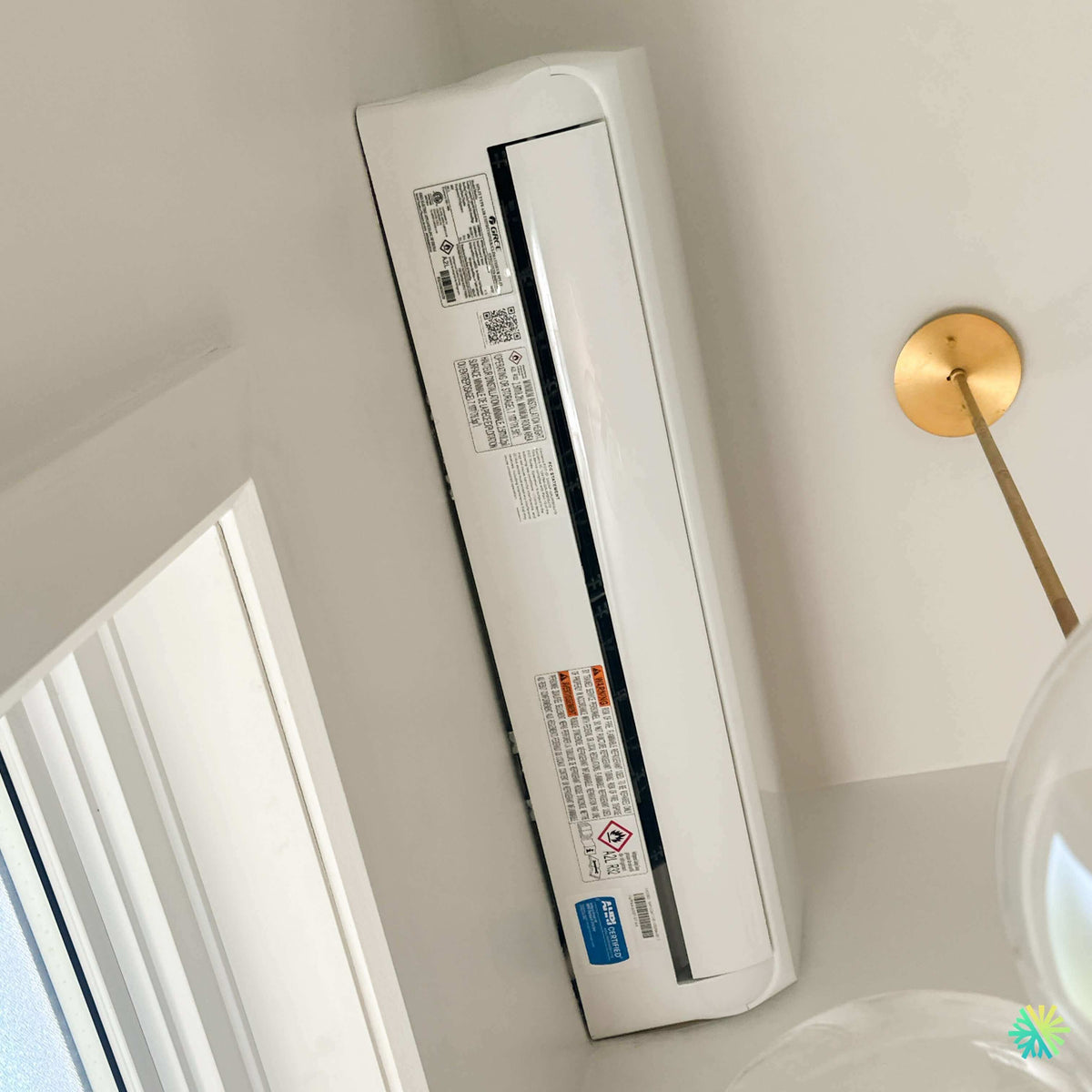
In the photo of this project, the indoor head is still under its protective film, and its labels are perfectly legible. Two statements appear on them, in French and English:
MINIMUM INSTALLATION HEIGHT
MINIMUM ROOM AREA
These are not comfort recommendations. They are installation conditions, and they sometimes determine that a room cannot accommodate that particular appliance.
The project at a glance
| Municipality | Contrecoeur, Marguerite-D'Youville RCM, Montérégie |
| Appliance | GREE FreeMatch R32 — GWHD(42)ND6MO |
| Configuration | 2 wall-mounted heads: 15,000 + 15,000 = 30,000 BTU/h, on a chassis that accepts up to 5 heads |
| Refrigerant | R-32 (A2L), 2,700 g — the largest charge in the range |
| Efficiency ratings | SEER2 21 · HSPF2 10 · EER2 12 · EER 3.81 · COP 3.90 |
Why these two figures exist
R-32 is classified as A2L: low toxicity, low flammability. A high concentration and considerable ignition energy are required to ignite it—we have published the orders of magnitude in Saint-Césaire and will not revisit them here. But “low” does not mean “zero,” and the standard governing these appliances draws a very concrete geometric consequence from that fact.
The reasoning unfolds in three steps:
- If all the refrigerant in the circuit leaked into a room, it would mix with the surrounding air.
- R-32 is heavier than air: it would accumulate near the bottom rather than disperse toward the ceiling.
- The concentration reached therefore depends on two things: the amount of fluid and the volume available to dilute it.
That is why the two statements are printed. The minimum room area ensures sufficient dilution volume. The minimum installation height ensures that any potential leak point is high enough for the fluid to dilute as it descends, instead of already reaching floor level in a concentrated form.
The leak detector built into the unit—present throughout this range—is a second line of defense, not a replacement for the first. The room's geometry remains the primary requirement.
The confusion to clear up: why it is not 2.5 m everywhere
This is where homeowners—and part of the industry—get it wrong, and it deserves to be stated clearly, because we ourselves published different figures on two pages of this site.
On an earlier installation, we recorded a minimum height of 2.5 m and a minimum area of 7.1 m² from the label. On another, the stated minimum height was 1.8 m. Both readings are accurate, and they do not contradict each other.
Because these figures are not constants defined by the standard. They are values calculated for a specific unit, based on the charge in its circuit.
The higher the refrigerant charge, the greater the required minimum area. The lower the release point, the greater the required area as well—height and area offset each other in the manufacturer's calculation. A 9,000 BTU/h head on a small single-split system and an 18,000 BTU/h head connected to a multi-zone compressor charged with 2,700 g do not have the same values, and it would be surprising if they did.
The practical consequence is clear, and it is the only thing to remember from this section: the number that applies to you is the one printed on your unit, not one read in an article, forum, or nearby technical datasheet. Reusing the number from another unit is exactly the mistake these labels exist to prevent. We are correcting our own pages here, which could have suggested a universal value: there is no such value.
The selection consequence no one anticipates
It follows directly from the foregoing, and it is counterintuitive.
This project uses a GWHD(42)ND6MO for only two heads—30,000 BTU/h on a nominal 42,000. The reason is expansion: this chassis accepts up to five heads, and adding zones later to an existing compressor costs infinitely less than installing a second system. It is a defensible decision, and a common one in newer homes in Contrecœur where rooms are finished in stages.
But it comes with a price that does not appear on the quote: the GWHD(42) carries the highest charge in the range, 2,700 g, compared with 900 g for the GWHD(18). Three times as much.
And therefore: the capacity selected with the future in mind changes the minimum area required in today's bedroom. A small room that could easily accommodate a head connected to a small compressor may be disqualified for the same head connected to a large one. It is not the head that determines this; it is the circuit it belongs to.
That is why, at our company, surface-area verification is done when the compressor is selected, not upon delivery. Discovering on site that a bedroom is too small for the unit already ordered means the project is stopped.
What this disqualifies in practice
Without citing a universal figure—because there isn't one—here are the configurations where verification most often fails:
- A small enclosed bedroom, especially a child’s bedroom or an office partitioned off in a finished basement.
- A basement with a low ceiling, where the minimum installation height simply cannot be met beneath a beam or duct.
- A bathroom or utility room converted into habitable space.
- An open space leading to a hallway but closed off by a door: the relevant area is that of the enclosed room, not the entire level.
When the verification fails, there are options, and none of them is “just tighten things up”: serve the room from a larger adjacent space, choose a lower-capacity head on a less heavily loaded compressor, or switch to a different type of indoor unit. These are design decisions made before ordering.
No one lives here yet: who are we demonstrating it to?
Look at the photo again. The protective film is still on the appliance. The labels are intact. The room is empty—freshly painted walls, a new light fixture, no furniture, no curtains.
This is an extremely common situation and one that is almost never discussed: the appliance is installed before anyone moves in. New construction, major renovation, a unit between tenants, or a house being prepared for sale. And this creates a problem the industry handles poorly.
What gets lost when the home is empty
Commissioning a heat pump normally ends with a demonstration: how the remote control works, what silent mode is for, why the appliance should not be turned off at the circuit breaker, how to remove and rinse the filter, and what to check every summer.
When the space is empty, this demonstration is given to no one—or, worse, to someone who will not live there: a general contractor, a broker, or a non-occupying owner. The information is delivered, the box is checked, and the actual occupant never received anything.
The symptom appears months later: a filter that was never removed, an appliance left in automatic mode all year, a drain that was never checked, a remote control misplaced during the move.
What we do when no one is there
- The closeout file is prepared for the future occupant, not the person who signs. Model, serial numbers, AHRI codes, developed lengths, added charge where applicable, clearances and the reasons for them.
- The QR code printed on the casing is identified in the file as the gateway to the manufacturer's documentation. It is the only element that remains physically attached to the appliance when everything else has been lost.
- A second demonstration is offered when the actual occupant arrives, and this option is put in writing rather than promised verbally to someone who will not be there.
- Remote controls, wall mounts, manuals, and parts are left together, in a location recorded in writing—not left on a countertop in a house that will be cleaned by a finishing crew.
The protective film and the labels: what to remove and what to keep
Two separate steps that are often confused.
The protective film is removed at the end of commissioning. If left in place, it heats up, sticks, and tears off in pieces six months later, taking the finish with it. An appliance delivered still wrapped is not an appliance delivered.
The safety labels, however, remain. The one showing the minimum surface area and minimum height, the A2L diamond, the warning not to pierce the piping, and the rating plate: these are the only data that will stay with the unit for fifteen years, through a change of ownership, a move, or a different contractor. Removing them because they are visible is a mistake that cannot be undone.
That is also why we photograph these labels and upload the images to the file before the film comes off: a label faded by ten years of indirect sunlight remains legible in a file.
Permits and regulations in Contrecoeur: what we will not claim
We were unable to read the city's bylaws. Zoning Bylaw 858-1-2009 (updated July 18, 2023) and Bylaw 860-1-2009 on permits and certificates are inaccessible to automated reading, as is the bylaw concerning nuisances and public peace.
We will therefore publish no setbacks, no permitted or prohibited yards, no screening requirement, no height limit, and no decibel threshold for Contrecoeur—and we will draw no conclusion from the fact that the heat pump does not appear among the seventeen topics the city highlights on its main bylaws page. An omission from a summary is not an exemption.
What we know about the structure of the zoning bylaw: its provisions on accessory buildings and equipment are found in Chapter 6, the same section that governs fences, hedges, and sheds. That is where a rule on air-conditioning units would be found, if one exists.
The reliable route: Urban Planning and Environment Department, 5000 Marie-Victorin Road, 450-587-5901 ext. 222. A practical detail worth noting before planning: the service counter is closed on Wednesdays, and closes at noon on Fridays.
The selected unit
| Feature | GWHD(42)ND6MO |
|---|---|
| Rated capacity | 42,000 BTU/h in cooling mode · 44,300 BTU/h in heating mode |
| Capacity modulation range (heating) | 8,870–54,590 BTU/h |
| Connectable indoor units | 2 to 5 |
| Efficiency ratings | SEER2 21 · HSPF2 10 · EER2 12 · EER 3.81 · COP 3.90 |
| Operating range | −30 °C to 48 °C in cooling mode, −30 °C to 24 °C in heating mode |
| Refrigerant | R-32 (A2L), 2,700 g, integrated leak detector |
| Electrical | 208/230 V · MCA 30 A · MOCP 45 A |
| Piping | precharge 50 m (the longest in the range), total 100 m, elevation difference 25 m |
| AHRI codes | 214931590 / 214931596 / 214931600 |
Two nuances to know before choosing this chassis for only two heads. Its modulation floor is 8,870 BTU/h—the highest in the range: it does not turn down as low during the shoulder seasons as a GWHD(30). And its efficiency is not the best: with an EER of 3.81 and a COP of 3.90, it remains behind the GWHD(30) and its 4.00 / 4.19. Here, you are buying expansion capacity and a 50 m precharge, not efficiency. If no additional zone is actually planned, a smaller compressor is the better choice.
Mistakes to avoid
- Use the minimum-area figure read elsewhere instead of the one printed on your unit.
- Check the areas after ordering rather than when choosing the compressor.
- Forget that a larger compressor increases the load, and therefore the required area in each room it serves.
- Remove the safety labels because they are visible.
- Leave the protective film in place upon delivery.
- Demonstrate it to the person signing rather than the person who will live there.
- Plan on stopping by the planning department on a Wednesday.
Rebates, service area, and support
These units are eligible for local rebates, and the AHRI codes above are required by the programs. We support every application for LogisVert, Rénoclimat, and Chauffez vert—without advertising amounts, since the rates are set by the programs.
In the Marguerite-D'Youville RCM, we have documented installations in Varennes, Verchères, Saint-Amable, and Sainte-Julie. Our teams cover Montréal, Laval, Longueuil, the North Shore, and the South Shore, as far as the municipalities along the river.
Why AirGreen
The two figures printed on the side of a wall-mounted unit are the most overlooked part of an HVAC installation—and the only ones that can make a room ineligible. At AirGreen, we verify them before ordering, photograph them before the film is removed, and add them to the file for the occupant who was not there on installation day. We quote the regulations without interpreting them, even if that means writing, as we do here, that we were unable to read them.
For an assessment in Contrecoeur, write to us: we measure before making recommendations.
How it goes, from the first call to the end
The main steps of this kind of job at AirGreen. Every house has its quirks: the estimate brings them out.
We look at the room, the outside wall, the line route and where the outdoor unit will go. That is where the capacity gets chosen.
Model, capacity and price, in writing. We also check whether the model qualifies for assistance programs.
Floors and furniture protected, wall plate position marked level, wall opening located.
A single opening, with the slope the drain needs to flow outside.
Set on a stand raised above the snow, with the clearances the manufacturer requires.
Connected, insulated and protected. The opening is then sealed against water, cold air and insects.
A dedicated circuit and an accessible disconnect near the outdoor unit.
Leak test, vacuum, then start-up and a check of heating and cooling.
Remote, modes, filters: we show you the essentials before we leave.
- The on-site estimateWe look at the room, the outside wall, the line route and where the outdoor unit will go. That is where the capacity gets chosen.
- The quoteModel, capacity and price, in writing. We also check whether the model qualifies for assistance programs.
- Getting readyFloors and furniture protected, wall plate position marked level, wall opening located.
- The wall openingA single opening, with the slope the drain needs to flow outside.
- The outdoor unitSet on a stand raised above the snow, with the clearances the manufacturer requires.
- Lines, cable and drainConnected, insulated and protected. The opening is then sealed against water, cold air and insects.
- The electrical workA dedicated circuit and an accessible disconnect near the outdoor unit.
- Tests and start-upLeak test, vacuum, then start-up and a check of heating and cooling.
- The walkthroughRemote, modes, filters: we show you the essentials before we leave.
And at your place?
Two quick checks with real numbers: what heat costs, and what your current heaters add up to in BTU/h.
Conversion: 1 W = 3.412 BTU/h. An indication, not a load calculation: baseboards and furnaces are often stronger than the real need, and they can stay as backup. AirGreen confirms the capacity on site.
What to do, season by season
Three habits per season for this unit. They take a few minutes and prevent many calls.
- Clean the indoor unit's filters.
- Clear leaves and debris left on the outdoor unit by winter.
- Test cooling before the first hot days.
- Clean the filters more often when the unit runs a lot.
- Keep plants away from the outdoor unit.
- Check that no water drips from the indoor unit.
- Rake the leaves around the outdoor unit.
- Test heating before the first cold days.
- Book periodic maintenance before winter.
- Keep snow away from the stand and the front of the unit.
- Let the unit defrost: it is normal.
- Never hit the ice on the fins; call us if the unit stays iced up.
Which type of equipment for your project?
Pick what looks like your need.
Four mistakes we do not make
Flip each card to see what we do instead.
What people ask us about this kind of work
Does a wall-mounted heat pump heat in winter?
Wall-mounted or multi-zone: how do I choose?
Where does the outdoor unit go?
Are there grants?
Do I need a permit?
How cold can it heat?
How much can I save?
How is the LogisVert assistance calculated?
Is it noisy?
The outdoor unit is covered in ice: is that normal?
Does AirGreen hold the required licences?
Is the estimate free?
No question matches. Write to us: we answer.
Useful pages for what comes next
More jobs to see, near you
By town, by equipment or by region: browse more than 4,700 published projects.
Each dot: a town where AirGreen has published projects. The glowing dot: this job.
Tell us about your house. We come and see it for free.
The on-site estimate is free and the quote follows within 24 hours.
Text and photo: a real AirGreen Climatisation & Chauffage job. The diagrams are generic illustrations of the type of installation, not a survey of this job site. Sources of the added figures: airgreen.ca product pages (NEEP / AHRI performance), Hydro-Québec (Heat pumps page, LogisVert, read on 13 October 2026), Régie de l’énergie (rate D as of 1 April 2026).