
Installation of a Hitachi airHome 600 wall-mounted heat pump in Repentigny, in Lanaudière on Montreal’s North Shore
In Repentigny, AirGreen installs and checks a Hitachi airHome 600 wall-mounted heat pump: cooling test, heating down to -25 °C, Inverter technology, FrostWash, and Wi-Fi control.
- City
- Region
- Equipment
- Brand
- Challenges
- Published
The job on one screen
The article, chapter by chapter
A rigorous commissioning process to confirm the heat pump’s actual performance
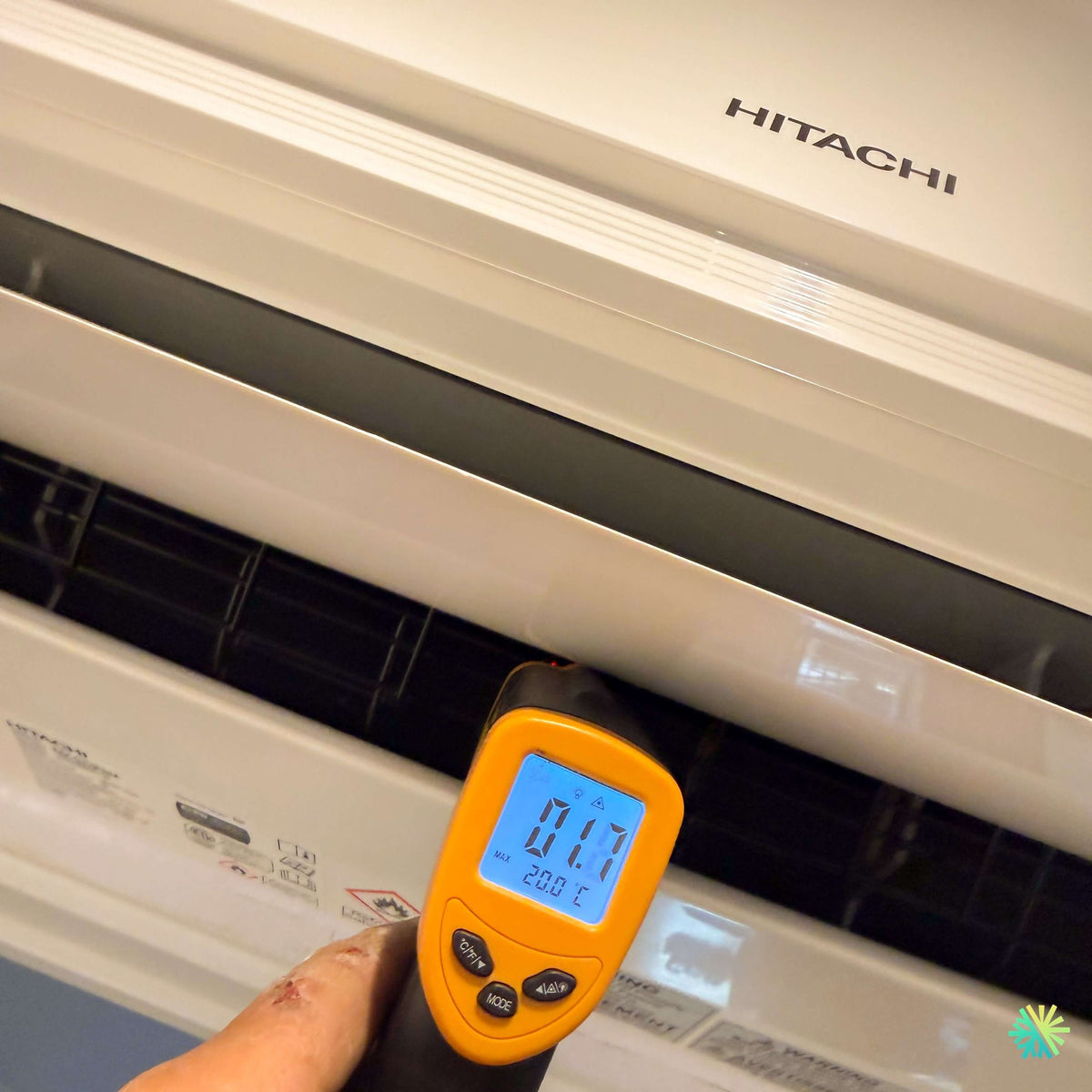
For this installation completed in Repentigny, our job-site photo shows a step that often goes unnoticed but plays a decisive role in the final quality of an HVAC installation: verifying the heat pump’s operation after it has been turned on.
The indoor Hitachi airHome 600 unit is already running, its air-distribution louver is open, and our technician is taking a reading with an infrared thermometer. The measured area shows approximately 7.7 °C, confirming that surfaces located in the cooled airflow quickly reach a low temperature.
This measurement does not replace a complete air-temperature reading with a suitable probe. An infrared thermometer primarily measures the temperature of the targeted surface, not directly that of moving air. Nevertheless, it is an excellent tool for a quick check to identify an issue, confirm that heat exchange is underway, and compare different areas of the unit.
At AirGreen, we never consider a heat pump properly installed simply because it starts up. We check its operation, drainage, air distribution, connections, and ability to respond to commands before completing the job.
A wall-mounted heat pump designed for Repentigny’s conditions
Homes in Repentigny are exposed to significant temperature variations throughout the seasons. Summers can be hot and humid, while winters require the heat pump to continue producing heat when the outdoor temperature falls well below freezing.
The Hitachi airHome 600 series was designed to operate:
- in cooling mode when the outdoor temperature is between approximately -18 °C and 46 °C;
- in heating mode down to an outdoor temperature of -25 °C;
- with a heating capacity rated at 100% at -15 °C;
- with an Inverter technology compressor, capable of adapting its speed to the building’s needs.
This modulation is particularly important in a home in Repentigny. A traditional heat pump that operates only in on-off cycles can cause more noticeable temperature fluctuations. The Inverter system instead adjusts its output gradually, promoting a more stable indoor temperature and limiting abrupt restarts.
The airHome 600 range includes nominal configurations of 9,000, 12,000, 15,000, 18,000, and 22,000 BTU/h for cooling, with nominal heating capacities of up to 25,200 BTU/h, depending on the combination of units selected. The manufacturer's documentation also indicates performance of up to 23.0 SEER2 and up to 9.2 HSPF2 for climate region 5.
Sizing must match the building, not just its floor area
The exact capacity of a wall-mounted heat pump should never be determined solely based on the number of square feet. Two homes of similar size in Repentigny may have very different heating and cooling loads.
We must take several factors into account, including:
- The quality of the wall and attic insulation.
- The number, size, and orientation of the windows.
- Sun exposure.
- The open or compartmentalized layout of the rooms.
- The ceiling height.
- The floor where the indoor unit is located.
- Air infiltration.
- The presence of another heating system.
- The occupants' temperature preferences.
- The ability of air to circulate between the different areas.
A heat pump that is too small may operate almost continuously without reaching the requested temperature during the coldest periods. Conversely, an oversized heat pump may lower the temperature too quickly in summer, without running long enough to remove humidity effectively.
The right choice is to select a capacity that meets the home's actual needs while maintaining efficient modulation on milder days.
An indoor unit installed to distribute air without obstruction
The photo clearly shows the opening of the main louver and access to the indoor unit's airflow. The positioning of a wall-mounted heat pump directly affects its performance and the comfort it provides in the room.
We normally look for a location that provides:
- unobstructed airflow in front of the unit;
- sufficient air intake through the upper section;
- air distribution toward the largest possible area;
- an adequate drainage slope;
- a clear path for the refrigerant piping;
- reasonable access for future maintenance;
- a seamless visual integration into the room.
A unit installed too close to the ceiling, a cabinet, or a side wall may not have enough air at the intake. A unit directed toward an obstacle may also cause cooled or heated air to return prematurely toward its own sensor. The system then thinks the room has already reached the requested temperature, even though more distant areas remain uncomfortable.
Our job is therefore to find a balance between aesthetics, building constraints, and system performance.
Checks Performed During Commissioning
The visible reading in the photo represents only one step in our procedure. Depending on the type of project and the unit configuration, our inspections may include the following items.
Airflow and Temperature Control
We operate the unit in cooling and heating modes to verify the response of the compressor, fan, and deflectors.
We specifically observe:
- the stability of the airflow;
- the response to setpoint changes;
- the absence of abnormal vibration;
- the return-air and supply-air temperatures;
- the movement of the louvers;
- the indoor unit’s noise level.
The airHome 600 series can operate at a very low noise level. Hitachi documentation indicates a level starting at approximately 27 dB(A) for a 12,000 BTU/h configuration in quiet mode, depending on the manufacturer’s test conditions. In a bedroom or living space, this feature can make a significant difference during the night.
Condensate Drainage Inspection
In cooling and dehumidification modes, the indoor unit removes moisture from the air. This water must be drained without backflow, leaks, or accumulation in the drain pan.
We check:
- the slope of the drain;
- the stability of the connections;
- flow toward the outside or the designated drain point;
- the absence of kinks in the pipe;
- the seal around the wall penetration;
- the behavior of the drain when the fan is running.
Improper drainage can cause water to run down the wall, odors, drywall deterioration, or moisture buildup inside the unit.
Inspection of the refrigerant connections
The copper connections must be properly prepared, flared, and tightened with precision. A minor leak may not be immediately visible, but it can gradually reduce the heat pump’s performance and damage the compressor over the long term.
The Hitachi airHome 600 series uses the refrigerant R32. Depending on the capacity, the refrigerant connections may vary, particularly between:
- 1/4 in. and 3/8 in. for certain smaller capacities;
- 1/4 in. and 1/2 in. for certain intermediate capacities;
- 1/4 in. and 5/8 in. for the largest configuration.
We must always adhere to the diameter required for the specific indoor and outdoor unit combination. Changing the dimensions without technical validation can affect oil return, pressures, capacity, and compressor durability.
Electrical Inspection
Depending on the airHome 600 model, the circuit's minimum ampacity and maximum overcurrent protection vary. The documentation indicates, among other things, MCA values ranging from 12 to 20 amps, with maximum protection of 15 or 25 amps, depending on the capacity.
The installation must include:
- an appropriate circuit;
- a properly rated circuit breaker;
- an outdoor disconnect;
- proper wiring;
- grounding;
- connections tightened according to the manufacturer's requirements.
A larger circuit breaker is not a solution for repeated tripping. A trip may indicate a wiring error, a poor connection, inadequate protection, a voltage problem, or an appliance defect.
The benefits of the Hitachi airHome 600 for comfort, air quality, and maintenance
The heat pump installed in Repentigny is not only used to cool a room. The Hitachi airHome 600 series combines heating, cooling, and several indoor air quality functions.
FrostWash 3.0: A Coil Self-Cleaning Cycle
A wet indoor coil can retain dust and contaminants. Over time, this buildup reduces the quality of heat exchange and may contribute to odors.
The FrostWash 3.0 technology uses a three-step cycle:
- The coil is heated to help detach greasy particles.
- It is then cooled until it forms a layer of ice that traps the dirt.
- The ice melts and carries some of the contaminants into the drain.
This function does not replace professional HVAC maintenance, but it helps limit buildup between cleanings. A wall-mounted unit must still be inspected and cleaned periodically, particularly when it operates for several months of the year.
PM2.5 Filtration and Activated Carbon
The airHome 600 includes a stainless steel prefilter and an activated carbon purification filter designed for fine PM2.5 particles.
Activated carbon also helps reduce certain odors in the room. This function can be useful in:
- an open area near the kitchen;
- a residence with pets;
- a room exposed to traffic;
- a space where the windows are rarely opened in winter.
However, integrated filtration in a wall-mounted heat pump should be distinguished from a central purification system. A wall-mounted unit primarily treats the air circulating in the room where it is located. It does not replace an air exchanger, central filtration, or a comprehensive ventilation strategy.
Mold Protection
After certain cycles, the mold protection function may circulate air through the internal components and heat the coil to help dry it.
This step helps reduce the conditions that promote odors inside the unit. However, it remains preventive. A heat pump that is already heavily contaminated must be cleaned mechanically; an automatic function cannot remove an old buildup in the tangential fan, pan, or internal ducts.
Continuous low-temperature heating
In Repentigny, winter heating capacity is an essential criterion. The airHome 600 is designed to continue heating down to -25 °C.
Available capacity nevertheless decreases when the outdoor temperature becomes extremely low. This applies to all heat pumps. For example, depending on the selected capacity, Hitachi documentation still indicates maximum output ranging from approximately 7,200 to 15,000 BTU/h at -25 °C.
It is therefore important to distinguish between two elements:
- the minimum temperature at which the heat pump can operate;
- the amount of heat it can still provide at that temperature.
In some homes, the heat pump can meet most of the heating needs during the majority of the winter, while a supplemental heating system takes over or supplements its output during the coldest periods.
Adaptive defrost and heating element in the outdoor pan
When a heat pump is heating, its outdoor unit becomes cold and may accumulate frost. The system must periodically perform a defrost cycle.
The airHome 600 series includes adaptive defrost technology as well as a heating element in the condensate pan. This element helps defrost water drain away instead of gradually forming a block of ice beneath the coil.
The location of the outdoor unit nevertheless remains essential. It must be installed at a sufficient height to account for:
- snow accumulation;
- drainage of defrost water;
- snowbanks created by snow removal;
- air circulation around the condenser;
- access for maintenance.
Wi-Fi control with airCloud Go
The Wi-Fi adapter is included with the models listed in the series documentation. The airCloud Go app allows you to adjust the temperature, create a weekly schedule, and control the unit remotely.
Some smart functions also allow you to:
- to track an estimated consumption;
- to create a monthly budget limit;
- to use a compatible voice command;
- to adjust operation based on occupancy;
- to activate energy-saving functions.
The Smart Eco function uses a motion sensor. When the room remains unoccupied for a certain period, the unit can automatically reduce its energy consumption, then resume operation when someone is detected.
Errors that can compromise a good installation
Even efficient equipment can deliver disappointing results when it is improperly selected or installed.
Among the errors we seek to avoid on our heat pump projects in Repentigny, Montreal, Laval, Longueuil, the North Shore and the South Shore are:
- choosing the capacity based solely on floor area;
- placing the indoor unit in an enclosed hallway;
- blocking the upper intake;
- neglecting the drain slope;
- concealing connections that are difficult to access;
- using improper piping diameters;
- omitting a complete vacuum evacuation;
- installing the outdoor unit too close to the ground;
- directing outdoor air toward a wall or nearby obstruction;
- completing the work without testing the heating and cooling functions;
- presenting a rebate as guaranteed before validating the AHRI number.
Rebates and eligibility
The airHome 600 series carries ENERGY STAR certification for the combinations indicated by Hitachi and may qualify for certain financial assistance programs.
Eligibility must never be confirmed solely based on the heat pump's commercial name. It generally depends on:
- the exact indoor unit model;
- the exact outdoor unit model;
- the AHRI reference number;
- the recognized capacity at a given temperature;
- the type of building;
- the existing heating source;
- the rules in effect on the installation date.
Before signing the contract, we verify the precise combination so that the customer clearly understands which conditions must be met.
A verified result rather than a merely visual installation
The photograph of this Hitachi airHome 600 installation in Repentigny clearly reflects our approach. The equipment is in place, but our work does not stop at its outward appearance. The temperature shown by the thermometer is part of a series of checks intended to confirm that the heat pump is actually beginning to transfer heat as expected.
A quality installation relies on several details that are not always visible once the work is complete: sizing, connection preparation, evacuation, drainage, electrical supply, clearance around the outdoor unit and operational testing.
At AirGreen, we apply this method to our wall-mounted heat pump installations throughout Greater Montreal, particularly in Repentigny, Terrebonne, Mascouche, Laval, Montreal, Longueuil, the North Shore and the South Shore. The goal remains the same: to deliver a properly installed system, suited to the building and inspected before everyday use.
The job tools
Two quick checks with real numbers: what heat costs, and what your current heaters add up to in BTU/h.
Conversion: 1 W = 3.412 BTU/h. An indication, not a load calculation: baseboards and furnaces are often stronger than the real need, and they can stay as backup. AirGreen confirms the capacity on site.
How the job unfolds
The main steps of this kind of job at AirGreen. Every house has its quirks: the estimate brings them out.
We look at the room, the outside wall, the line route and where the outdoor unit will go. That is where the capacity gets chosen.
Model, capacity and price, in writing. We also check whether the model qualifies for assistance programs.
Floors and furniture protected, wall plate position marked level, wall opening located.
A single opening, with the slope the drain needs to flow outside.
Set on a stand raised above the snow, with the clearances the manufacturer requires.
Connected, insulated and protected. The opening is then sealed against water, cold air and insects.
A dedicated circuit and an accessible disconnect near the outdoor unit.
Leak test, vacuum, then start-up and a check of heating and cooling.
Remote, modes, filters: we show you the essentials before we leave.
- The on-site estimateWe look at the room, the outside wall, the line route and where the outdoor unit will go. That is where the capacity gets chosen.
- The quoteModel, capacity and price, in writing. We also check whether the model qualifies for assistance programs.
- Getting readyFloors and furniture protected, wall plate position marked level, wall opening located.
- The wall openingA single opening, with the slope the drain needs to flow outside.
- The outdoor unitSet on a stand raised above the snow, with the clearances the manufacturer requires.
- Lines, cable and drainConnected, insulated and protected. The opening is then sealed against water, cold air and insects.
- The electrical workA dedicated circuit and an accessible disconnect near the outdoor unit.
- Tests and start-upLeak test, vacuum, then start-up and a check of heating and cooling.
- The walkthroughRemote, modes, filters: we show you the essentials before we leave.
What we check on a job like this one
Each number is a point we check on site. Switch between summer and winter to watch air and heat move.
In summer, the outdoor unit rejects the house's heat outside.
Generic illustration of this type of installation, not a survey of this job site. Tap a number.
Mounted level on a wall plate, high enough for the air to reach the whole room, with enough space around it to slide the filters out easily.
The refrigerant lines, the communication cable and the drain go through the wall in a single opening, sealed against water, cold air and insects.
Two insulated copper pipes connect the two units. Outside, a line cover can protect them from sun, knocks and weather.
A shut-off switch near the outdoor unit isolates it safely for service. It must stay accessible at all times.
The compressor and the fan. In heating mode it captures heat from the outdoor air, even in winter, and moves it inside.
On the ground or on the wall, it keeps the unit above accumulated snow. The unit stays clear and defrost water can drain away.
The fan needs to blow freely. Storage, a fence or a wall too close, and efficiency drops while noise goes up.
Is your home ready?
Check what applies at your place. A "no" is not a refusal: it is what we sort out during the estimate.
Good habits, once the unit is in place
Six simple habits that keep the unit going. Your list stays on this device.
What to do, season by season
Three habits per season for this unit. They take a few minutes and prevent many calls.
- Clean the indoor unit's filters.
- Clear leaves and debris left on the outdoor unit by winter.
- Test cooling before the first hot days.
- Clean the filters more often when the unit runs a lot.
- Keep plants away from the outdoor unit.
- Check that no water drips from the indoor unit.
- Rake the leaves around the outdoor unit.
- Test heating before the first cold days.
- Book periodic maintenance before winter.
- Keep snow away from the stand and the front of the unit.
- Let the unit defrost: it is normal.
- Never hit the ice on the fins; call us if the unit stays iced up.
The right pages, at the right time
Four statements: true or false?
It all comes down to details you have just seen.
1. In heating mode, the outdoor unit can produce water.
During defrost cycles. That water must drain away without forming ice.
2. You pick the capacity with a simple square-footage rule.
Windows, insulation, orientation and how the room is used all count. Capacity is chosen on site.
3. A multi-zone connects several indoor heads to a single condenser.
One head per room, all on the same condenser. Each room keeps its own temperature.
4. The disconnect can sit behind the patio furniture.
It must stay accessible: it is what shuts the unit off for service.
0 / 4 right answers
What people ask us about this kind of work
Does a wall-mounted heat pump heat in winter?
Wall-mounted or multi-zone: how do I choose?
Where does the outdoor unit go?
Are there grants?
Do I need a permit?
How cold can it heat?
How much can I save?
How is the LogisVert assistance calculated?
Is it noisy?
The outdoor unit is covered in ice: is that normal?
Does AirGreen hold the required licences?
Is the estimate free?
No question matches. Write to us: we answer.
More jobs to see, near you
By town, by equipment or by region: browse more than 4,700 published projects.
Each dot: a town where AirGreen has published projects. The glowing dot: this job.
An on-site estimate, the right capacity, the right equipment.
The on-site estimate is free and the quote follows within 24 hours.
Text and photo: a real AirGreen Climatisation & Chauffage job. The diagrams are generic illustrations of the type of installation, not a survey of this job site. Sources of the added figures: airgreen.ca product pages (NEEP / AHRI performance), Hydro-Québec (Heat pumps page, LogisVert, read on 13 October 2026), Régie de l’énergie (rate D as of 1 April 2026).