
Installation of a MIDEA MIDEA28 wall-mounted heat pump in Rivière-Beaudette: a vertical configuration on wall brackets to optimize limited space
In Rivière-Beaudette, AirGreen installs a MIDEA28 wall-mounted heat pump high up on reinforced brackets—a compact solution that optimizes space while preserving access, stability, and airflow.
Take a tour of the installation
Each number is a point we check on site. Switch between summer and winter to watch air and heat move.
In summer, the outdoor unit rejects the house's heat outside.
Generic illustration of this type of installation, not a survey of this job site. Tap a number.
Mounted level on a wall plate, high enough for the air to reach the whole room, with enough space around it to slide the filters out easily.
The refrigerant lines, the communication cable and the drain go through the wall in a single opening, sealed against water, cold air and insects.
Two insulated copper pipes connect the two units. Outside, a line cover can protect them from sun, knocks and weather.
A shut-off switch near the outdoor unit isolates it safely for service. It must stay accessible at all times.
The compressor and the fan. In heating mode it captures heat from the outdoor air, even in winter, and moves it inside.
On the ground or on the wall, it keeps the unit above accumulated snow. The unit stays clear and defrost water can drain away.
The fan needs to blow freely. Storage, a fence or a wall too close, and efficiency drops while noise goes up.
In Rivière-Beaudette, an MIDEA28 installation where outdoor space management was at the heart of the project
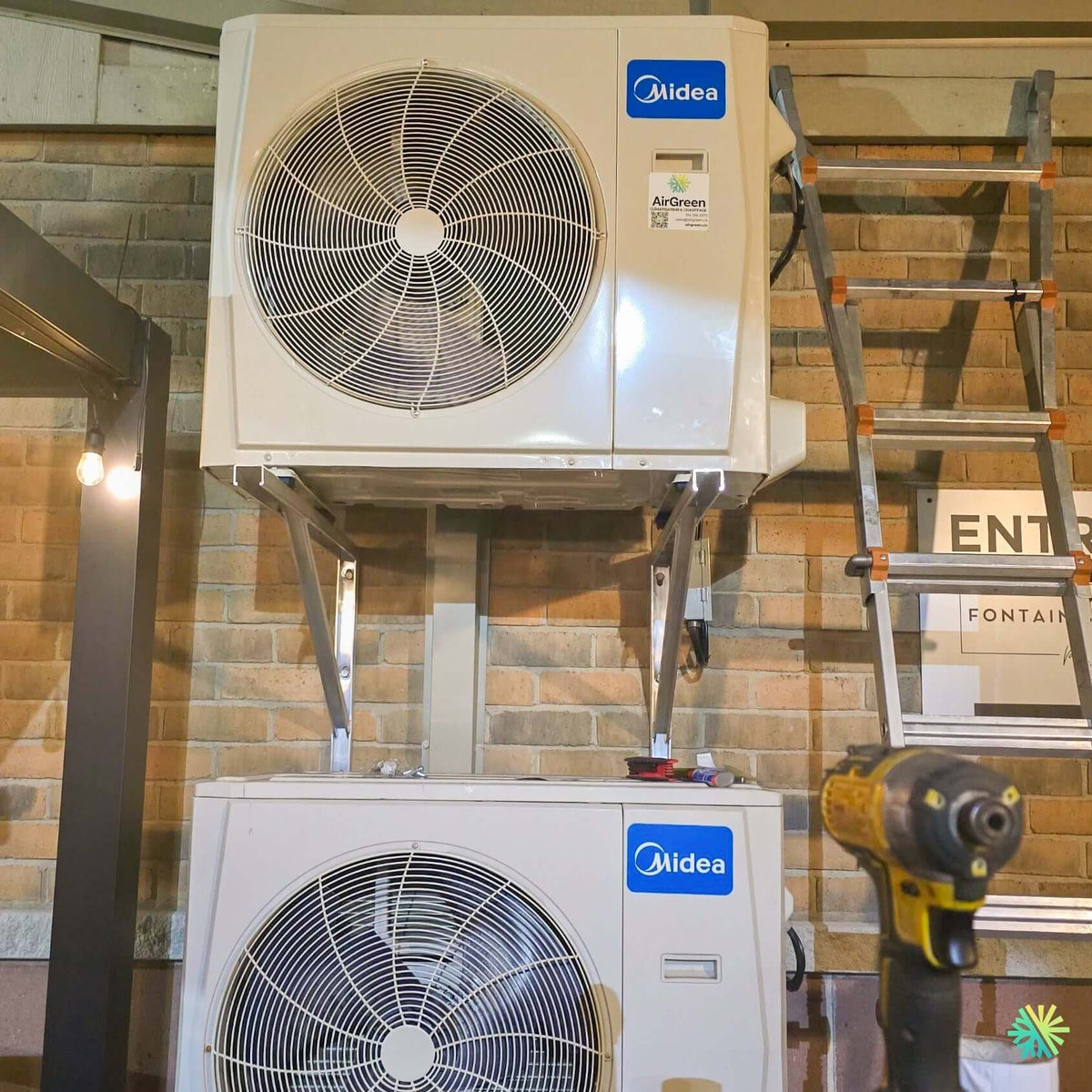
This MIDEA MIDEA28 wall-mounted heat pump installation in Rivière-Beaudette presents a particularly interesting configuration: rather than placing all the outdoor units side by side, we used the available height on the brick wall to organize the mechanical space efficiently.
The photograph taken during the work clearly shows two Midea outdoor units in the same area. One is in the lower section, while the upper unit was installed on large triangular metal wall brackets, securely fastened to the wall. This positioning makes it possible to use the vertical space without unnecessarily taking up a larger portion of the ground.
Our identification can also be seen AirGreen on the upper unit, the wiring and connections on the side of the unit, as well as the tools still present on the job site. This photo therefore does not show a staged installation several weeks after the work was completed: it documents an actual intervention by our technicians during the installation phase.
On a project like this, a few centimetres can make a real difference. Sufficient clearance must be provided for the fan, heat exchanger, connections, future maintenance, and access to both units. It is also essential to ensure that the wall structure can properly support the brackets.
The MIDEA28 is classified by the manufacturer as a upper wall-mounted series. The range uses R-454B, is identified Cold Climate V6.1, can operate in heating mode down to -30 °C and reaches up to 27.4 SEER2 and 13.5 HSPF2, depending on the selected capacity.
A vertical configuration that addresses a genuine installation constraint
On this project Rivière-BeaudetteThe brick wall offered considerable height, but the available floor space had to be used intelligently.
Placing two outdoor units directly next to each other would have required more width. Depending on the building layout, this can become problematic when a circulation area, access to a door, a service passage, or simply space for future servicing must also be maintained.
So we worked with the vertical dimension.
The upper unit rests on two metal brackets reinforced with diagonal braces. This geometry is important: it transfers the weight of the unit to the wall mounting points while maintaining a stable platform.
Obviously, it is not enough to fasten two arbitrary brackets to the masonry. Before installation, it is necessary to consider:
- the unit’s weight;
- the strength of the mounting surface;
- the length and type of anchoring;
- clearance beneath the unit;
- access to the side panels;
- air circulation around the two heat pumps;
- the potential transmission of vibrations;
- the routing of the wiring and refrigerant lines.
This is exactly the kind of detail that distinguishes a professional HVAC installation of a simple equipment installation.
Two visible units do not necessarily mean that they interfere with each other
Installing several heat pumps in the same area requires careful consideration of air movement.
Each outdoor unit must be able to draw air through its heat exchanger and then properly discharge the air through its fan.
In the photo, the two large front grilles remain oriented toward an open area. There is no wall directly in front of the fans.
This is essential.
Poor placement can promote recirculation of discharged air. A heat pump could then draw in some of the air it has just discharged itself, which may impair operating conditions.
In an installation with several units, we must therefore consider the entire area, not just each unit individually.
The MIDEA28 offers five capacities, from 9,000 to 33,000 BTU
Unlike some product lines with only two or three sizes, the MIDEA28 is available in a relatively wide range of capacities.
According to Midea documentation, the proposed configurations are:
| Cooling capacity | Indoor model | Outdoor model | AHRI reference |
|---|---|---|---|
| 9,000 BTU/h | MSEHU-H09B-2A | MO1HS-H09B-2A | 215471380 |
| 12,000 BTU/h | MSEHU-H12B-2A | MO1HS-H12B-2A | 215471381 |
| 18,000 BTU/h | MSEHU-H18B-2A | MO1HS-H18B-2A | 215471382 |
| 24,000 BTU/h | MSEHU-H24B-2A | MO1HS-H24B-2A | 215471383 |
| 33,000 BTU/h | MSEHU-H33B-2A | MO1HS-H33B-2A | 215471384 |
For heating, Midea lists, respectively, 12,000, 12,000, 18,000, 29,000, and 36,000 BTU/h nominal capacity depending on the combination.
The nameplate of the photographed unit is not legible enough to confirm unambiguously the exact capacity installed in Rivière-Beaudette. We therefore prefer to retain this qualification rather than arbitrarily assigning a BTU rating to the installation.
Up to 27.4 SEER2, but performance varies with capacity
The MIDEA28 does not deliver exactly the same performance in each of its sizes.
Midea’s published SEER2 values are:
- 27.4 SEER2 for the 9,000 BTU unit;
- 25.4 SEER2 for the 12,000 BTU unit;
- 21.4 SEER2 for the 18,000 BTU model;
- 21.0 SEER2 for the 24,000 BTU model;
- 19.5 SEER2 for the 33,000 BTU model.
For heating, the listed HSPF2 IV values are, respectively, 12.5, 10.5, 11.0, 13.5, and 10.5.
This variation is important for homeowners comparing multiple quotes.
A contractor should always specify the exact combination rather than simply advertising “up to 27.4 SEER2” for all capacities.
The right number of BTUs depends on the building, not just its floor area
The MIDEA28’s extensive range can meet different needs, but the model must be selected methodically.
At AirGreen, we examine in particular:
- the floor area of the space;
- the level of insulation;
- the number and size of windows;
- the building’s orientation;
- ceiling height;
- the layout of the rooms;
- the amount of exterior wall area;
- air infiltration;
- low-temperature heating needs.
Two homes of the same size in Rivière-Beaudette may require different capacities.
That is why the shortcut of automatically choosing a capacity based on a square-footage figure can lead to imperfect sizing.
Heating down to -30°C for the entire series
Midea’s documentation indicates a heating operating range of -30°C to 24°C for all five MIDEA28 capacitiesThe published cooling range also extends from -30°C to 50°C.
This low-temperature operating capacity is particularly valuable for Quebec.
In Rivière-Beaudette, as elsewhere in Greater Montreal and Montérégie, winter temperatures can drop low enough that the performance of a cold-climate heat pump becomes a major consideration.
However, the statement “down to -30°C” must be interpreted correctly.
This indicates an operating range, not identical heating capacity at all temperatures.
What the MIDEA28 delivers at -15°C
The technical data sheet provides the rated heating capacities at -15°C :
- 11,500 BTU/h for the 9,000 BTU unit;
- 11,500 BTU/h for the 12,000 BTU unit;
- 18,000 BTU/h for the 18,000 BTU unit;
- 24,200 BTU/h for the 24,000 BTU unit;
- 35,000 BTU/h for the 33,000 BTU unit.
These figures allow for a much more meaningful analysis of winter performance.
When a homeowner wants to minimize the use of supplemental heating, we look at the available capacity under cold conditions, not just the rated capacity indicated in the unit’s name.
Variable-speed technology to modulate demand
The MIDEA28 benefits from the variable-speed technology described by Midea.
The compressor can adjust its operation as heating and cooling needs change instead of operating only on a conventional on-off cycle. The manufacturer associates this modulation with a more stable indoor temperature and a reduction in major fluctuations.
This ability to modulate is particularly useful when a heat pump is properly sized.
Once the desired temperature is reached, the unit can reduce its speed and maintain comfort with lower demand.
The weight of the unit becomes crucial when it is mounted on a wall
The photo of this project makes one point particularly clear: the weight of the outdoor unit must be known before choosing its bracket.
Depending on capacity, the MIDEA28 weighs:
- 72.75 lb for the 9,000 BTU unit;
- 72.75 lb for the 12,000 BTU unit;
- 99.87 lb for the 18,000 BTU model;
- 130.29 lb for the 24,000 BTU model;
- 156.97 lb for the 33,000 BTU model.
There is therefore a difference of more than 80 lb between the smallest and largest outdoor unit in the range.
For a ground-mounted unit, this information already determines the choice of base. When it is installed high on a façade, it becomes even more important.
The brackets, anchors, and structure supporting the assembly must be appropriate for the selected configuration.
Why triangulated arms are important
On our installation in Rivière-Beaudette, the brackets for the upper unit consist of more than just horizontal rails.
Each side has a diagonal arm that forms a triangle with the wall and the horizontal section.
This geometry limits bracket flexing and helps stabilize the load.
To the client, the bracket may seem like a simple metal accessory. To us, it is an integral part of theheat pump installation.
A machine weighing more than 100 lb and operating with a compressor and fan must remain stable during thousands of operating hours.
A wall-mounted installation must also manage vibrations
Every outdoor unit produces a certain level of vibration.
These vibrations are generally weak when the machine is operating normally, but a wall bracket can transmit them to the structure if the installation is improperly executed.
We must therefore pay attention to:
- bracket rigidity;
- heat pump leveling;
- the quality of the fastening points;
- metal-to-metal contact;
- wall stability;
- to the unit’s surroundings.
This is also why we never treat the bracket as a last-minute decision.
Outdoor sound level by capacity
Midea publishes the following outdoor sound levels at high speed:
- 56 dB(A) for the 9,000 and 12,000 BTU models;
- 59 dB(A) for the 18,000 BTU model;
- 61.5 dB(A) for the 24,000 BTU model;
- 63.5 dB(A) for the 33,000 BTU model.
The location of the outdoor unit must therefore take into account not only mechanical operation, but also nearby bedrooms, windows, and occupied areas.
The lines vary according to the size of the MIDEA28
Another important technical point: refrigerant pipe diameters are not identical across the entire series.
Midea indicates:
- 1/4 in and 3/8 in for the 9,000 and 12,000 BTU models;
- 1/4 in and 1/2 in for the 18,000 BTU model;
- 3/8 in and 5/8 in for the 24,000 BTU model;
- 3/8 in and 3/4 in for the 33,000 BTU model.
This is particularly important when a homeowner replaces an existing system.
We cannot simply assume that the old copper lines can be reused. Their diameter, condition, and compatibility with the new combination must be verified.
Refrigerant line lengths of up to 164 feet
The maximum permitted length also varies:
- 82 ft for the 9,000 and 12,000 BTU models;
- 98.4 ft for the 18,000 BTU model;
- 164 ft for the 24,000 and 33,000 BTU models.
This flexibility can be especially useful when the ideal indoor location is far from the available location for the outdoor unit.
Electrical requirements must be verified before installation
All the MIDEA28 configurations presented use a 208/230 V, single-phase, 60 Hz.
However, the minimum allowable amperage of the outdoor unit varies considerably:
- 15 A for the 9,000 BTU model;
- 15 A for the 12,000 BTU model;
- 19 A for the 18,000 BTU model;
- 24.9 A for the 24,000 BTU model;
- 34 A for the 33,000 BTU model.
The published maximum overcurrent protections range from 15 to 35 A depending on the model.
Before an HVAC installation in Rivière-Beaudette, so we must check the panel, circuit, and electrical protection corresponding to the exact combination.
A wide range of comfort features
The MIDEA35, MIDEA28, and MIDEA25 series offer several common features:
- ECO mode;
- Turbo mode;
- timer;
- night mode;
- Wi-Fi control;
- function Follow Me;
- automatic cleaning;
- quiet mode;
- 8°C heating;
- horizontal and vertical oscillation;
- smart sensor;
- humidity control;
- optional wired controller;
- optional 24 V interface.
Airflow can also be adjusted very precisely, with Midea announcing up to 100 levels of indoor fan control.
An interior design intended to facilitate cleaning
One practical long-term benefit concerns theHVAC maintenance.
Midea indicates that the indoor blower wheel on the MIDEA35, MIDEA28, and MIDEA25 series can be removed for thorough cleaning.
This detail is useful because filters are not the only components that get dirty.
After several seasons, dust can accumulate on the blower wheel, heat exchanger, and some internal surfaces. A design that facilitates access simplifies more extensive maintenance.
Subsidies: the AHRI number must always be verified
Each MIDEA28 capacity has its own AHRI reference, from 215471380 to 215471384, and the combinations are presented as Cold Climate V6.1.
When financial assistance is available, eligibility must nevertheless be verified according to:
- the exact combination installed;
- the AHRI number;
- the building;
- the program in effect;
- the conditions applicable at the time of application.
The simple trade name “MIDEA28” is therefore not sufficient to automatically promise a subsidy amount.
An attractive residential warranty according to Midea documentation
The brochure presents, for residential installations, a 12-year limited warranty on the compressor, 12 years on parts, and 10 years on labor, subject to the conditions applicable to the program.
As with all warranties, system registration and the manufacturer’s terms must be verified for the unit actually installed.
What this Rivière-Beaudette project particularly demonstrates
This installation of a MIDEA MIDEA28 wall-mounted heat pump in Rivière-Beaudette is distinguished not simply by the machine selected.
What makes the project particularly interesting is the use of the available height.
By positioning an outdoor unit on reinforced wall brackets above another unit, we were able to organize a mechanical zone where several systems must coexist without unnecessarily using the entire width of the wall.
The photo perfectly illustrates several aspects of our teams’ actual work: metal brackets, masonry fastening, access to the connections, tools still on-site, and AirGreen identification on the unit.
This type of configuration requires more planning than a heat pump installed on a ground-level slab. Weight, vibrations, fan clearance, maintenance, and technical routing must all be considered simultaneously.
It is this attention to detail that we also apply to our wall-mounted heat pump in Montréal, Laval, Longueuil, on the North Shore, and on the South Shore.
The MIDEA28 offers a range from 9,000 to 33,000 BTU, providing heating down to -30 °C, refrigerant R-454B, variable-speed technology, and efficiencies reaching up to 27.4 SEER2.
But even the best technical specifications cannot compensate for a poorly planned installation.
In Rivière-Beaudette, the space constraint was therefore transformed into a central element of the project: rather than seeking more floor width, We used the wall intelligently to create a compact, structured, and accessible installation.
The unit on this job, in figures
The range as published on airgreen.ca: pick a size to see its capacity in deep cold.
| Size | Heating at −8 °C | Heating at −15 °C | Coldest certified point | COP at −15 °C | SEER | HSPF | Indicative LogisVert aid |
|---|---|---|---|---|---|---|---|
| Midea Série 28 9 000 | 12,000 | 11,500 | −30 °C: 5,100 | 1.8 | 27.4 | 12.5 | – |
| Midea Série 28 12 000 | 12,000 | 11,500 | −30 °C: 5,900 | 1.8 | 25.4 | 10.5 | $1,440 |
| Midea Série 28 18 000 | 18,000 | 18,000 | −30 °C: 8,000 | 1.92 | 21.4 | 11.0 | $2,160 |
| Midea Série 28 24 000 | 22,200 | 24,200 | −30 °C: 11,900 | 2.34 | 21.0 | 13.5 | $2,664 |
| Midea Série 28 33 000 | 32,000 | 35,000 | −30 °C: 20,700 | 1.98 | 19.5 | 10.5 | $3,840 |
According to NEEP, it delivers 12,000 BTU/h at −8 °C (17 °F), as much as at 8 °C. It heats as hard in moderate cold as in mild weather.
At 8 °C, its certified maximum capacity reaches 16,000 BTU/h, 78% more than its nominal 9,000 BTU size.
According to NEEP, its certified heating capacity at −15 °C (5 °F) is 11,500 BTU/h, 128% of its nominal 9,000 BTU size. Its COP there is 1.80.
According to NEEP, it delivers 12,000 BTU/h at −8 °C (17 °F), as much as at 8 °C. It heats as hard in moderate cold as in mild weather.
At 8 °C, its certified maximum capacity reaches 16,000 BTU/h, 33% more than its nominal 12,000 BTU size.
At −30 °C, its certified minimum capacity is 2,000 BTU/h (3,800 at 8 °C). It slows down instead of cycling on and off.
According to NEEP, it delivers 18,000 BTU/h at −8 °C (17 °F), as much as at 8 °C. It heats as hard in moderate cold as in mild weather.
According to NEEP, its certified heating capacity at −15 °C (5 °F) is 18,000 BTU/h, 100% of its nominal 18,000 BTU size. Its COP there is 1.92.
According to NEEP, its COP at −15 °C is 2.34: the highest of the Série 28 line, which ranges from 1.80 to 1.98 at that temperature.
At −30 °C, its certified minimum capacity is 2,400 BTU/h (11,800 at 8 °C). It slows down instead of cycling on and off.
According to NEEP, its certified heating capacity at −15 °C (5 °F) is 24,200 BTU/h, 101% of its nominal 24,000 BTU size. Its COP there is 2.34.
According to NEEP, its certified maximum capacity at −30 °C (−22 °F) is 20,700 BTU/h, 63% of its nominal 33,000 BTU size.
At −30 °C, its certified minimum capacity is 4,200 BTU/h (19,700 at 8 °C). It slows down instead of cycling on and off.
According to NEEP, its certified heating capacity at −15 °C (5 °F) is 35,000 BTU/h, 106% of its nominal 33,000 BTU size. Its COP there is 1.98.
Data read live from the airgreen.ca page of each size (NEEP / AHRI certified performance). When the title names the installed size, it is highlighted; otherwise the whole range is shown. The aid shown is today’s, using Hydro-Québec’s rule ($120 per 1,000 BTU/h at −8 °C); amounts quoted in the article date from its publication. Only Hydro-Québec confirms the assistance granted.A dash in the aid column: amount to be confirmed for this model.
The big day, step by step
The main steps of this kind of job at AirGreen. Every house has its quirks: the estimate brings them out.
We look at the room, the outside wall, the line route and where the outdoor unit will go. That is where the capacity gets chosen.
Model, capacity and price, in writing. We also check whether the model qualifies for assistance programs.
Floors and furniture protected, wall plate position marked level, wall opening located.
A single opening, with the slope the drain needs to flow outside.
Set on a stand raised above the snow, with the clearances the manufacturer requires.
Connected, insulated and protected. The opening is then sealed against water, cold air and insects.
A dedicated circuit and an accessible disconnect near the outdoor unit.
Leak test, vacuum, then start-up and a check of heating and cooling.
Remote, modes, filters: we show you the essentials before we leave.
- The on-site estimateWe look at the room, the outside wall, the line route and where the outdoor unit will go. That is where the capacity gets chosen.
- The quoteModel, capacity and price, in writing. We also check whether the model qualifies for assistance programs.
- Getting readyFloors and furniture protected, wall plate position marked level, wall opening located.
- The wall openingA single opening, with the slope the drain needs to flow outside.
- The outdoor unitSet on a stand raised above the snow, with the clearances the manufacturer requires.
- Lines, cable and drainConnected, insulated and protected. The opening is then sealed against water, cold air and insects.
- The electrical workA dedicated circuit and an accessible disconnect near the outdoor unit.
- Tests and start-upLeak test, vacuum, then start-up and a check of heating and cooling.
- The walkthroughRemote, modes, filters: we show you the essentials before we leave.
What would it look like at your place?
Two quick checks with real numbers: what heat costs, and what your current heaters add up to in BTU/h.
Baseboards and electric furnaces turn 1 kWh of electricity into 1 kWh of heat. A heat pump delivers more: that is its COP. At Hydro-Québec’s rate D (11.142¢/kWh above 40 kWh a day, since 1 April 2026):
Hydro-Québec: a heat pump can be up to three times more efficient than baseboards for heating in the colder months.
Estimate per kWh of heat, at the chosen temperature, using the certified COP from the product page. Taxes, access charge and backup heat not included.
Conversion: 1 W = 3.412 BTU/h. An indication, not a load calculation: baseboards and furnaces are often stronger than the real need, and they can stay as backup. AirGreen confirms the capacity on site.
Four mistakes we do not make
Flip each card to see what we do instead.
Your own project, step by step
What to do, season by season
Three habits per season for this unit. They take a few minutes and prevent many calls.
- Clean the indoor unit's filters.
- Clear leaves and debris left on the outdoor unit by winter.
- Test cooling before the first hot days.
- Clean the filters more often when the unit runs a lot.
- Keep plants away from the outdoor unit.
- Check that no water drips from the indoor unit.
- Rake the leaves around the outdoor unit.
- Test heating before the first cold days.
- Book periodic maintenance before winter.
- Keep snow away from the stand and the front of the unit.
- Let the unit defrost: it is normal.
- Never hit the ice on the fins; call us if the unit stays iced up.
Is your home ready?
Check what applies at your place. A "no" is not a refusal: it is what we sort out during the estimate.
Four statements: true or false?
It all comes down to details you have just seen.
1. In heating mode, the outdoor unit can produce water.
During defrost cycles. That water must drain away without forming ice.
2. You pick the capacity with a simple square-footage rule.
Windows, insulation, orientation and how the room is used all count. Capacity is chosen on site.
3. A multi-zone connects several indoor heads to a single condenser.
One head per room, all on the same condenser. Each room keeps its own temperature.
4. The disconnect can sit behind the patio furniture.
It must stay accessible: it is what shuts the unit off for service.
0 / 4 right answers
What people ask us about this kind of work
Does a wall-mounted heat pump heat in winter?
Wall-mounted or multi-zone: how do I choose?
Where does the outdoor unit go?
Are there grants?
Do I need a permit?
How cold can it heat?
How much can I save?
How is the LogisVert assistance calculated?
Is it noisy?
The outdoor unit is covered in ice: is that normal?
Does AirGreen hold the required licences?
Is the estimate free?
No question matches. Write to us: we answer.
More jobs to see, near you
By town, by equipment or by region: browse more than 4,700 published projects.
Each dot: a town where AirGreen has published projects. The glowing dot: this job.
Every house has its constraints. We see them before we install.
The on-site estimate is free and the quote follows within 24 hours.
Text and photo: a real AirGreen Climatisation & Chauffage job. The diagrams are generic illustrations of the type of installation, not a survey of this job site. Sources of the added figures: airgreen.ca product pages (NEEP / AHRI performance), Hydro-Québec (Heat pumps page, LogisVert, read on 13 October 2026), Régie de l’énergie (rate D as of 1 April 2026).