
Installation of a MIDEA MIDEA35 wall-mounted heat pump in Saint-Basile-le-Grand, on Montreal’s South Shore
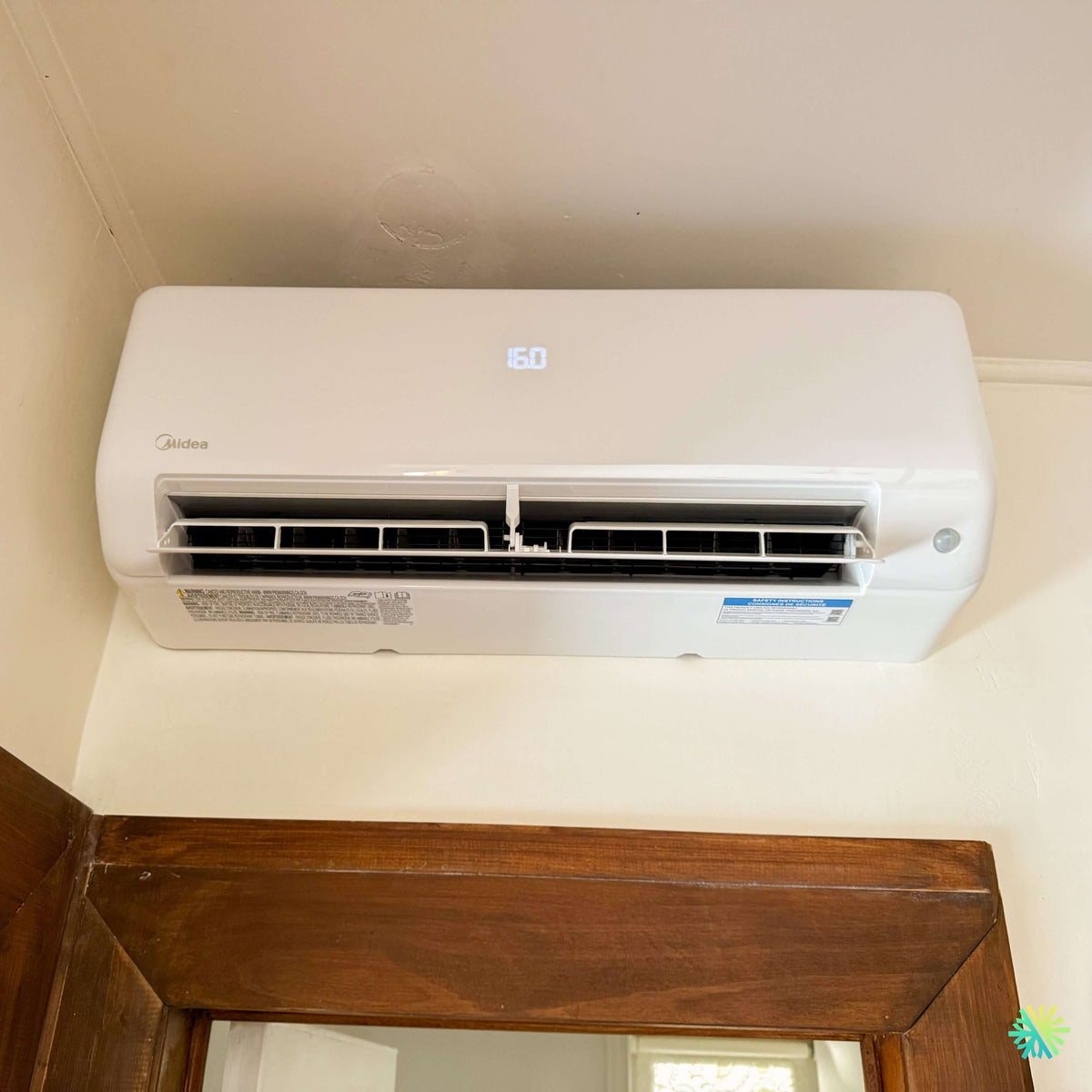
In Saint-Basile-le-Grand, we installed a MIDEA35 wall-mounted heat pump above a door, with a discreet finish, unobstructed airflow, and an HVAC installation designed for Quebec’s climate.
Take a tour of the installation
Each number is a point we check on site. Switch between summer and winter to watch air and heat move.
In summer, the outdoor unit rejects the house's heat outside.
Generic illustration of this type of installation, not a survey of this job site. Tap a number.
Mounted level on a wall plate, high enough for the air to reach the whole room, with enough space around it to slide the filters out easily.
The refrigerant lines, the communication cable and the drain go through the wall in a single opening, sealed against water, cold air and insects.
Two insulated copper pipes connect the two units. Outside, a line cover can protect them from sun, knocks and weather.
A shut-off switch near the outdoor unit isolates it safely for service. It must stay accessible at all times.
The compressor and the fan. In heating mode it captures heat from the outdoor air, even in winter, and moves it inside.
On the ground or on the wall, it keeps the unit above accumulated snow. The unit stays clear and defrost water can drain away.
The fan needs to blow freely. Storage, a fence or a wall too close, and efficiency drops while noise goes up.
A MIDEA35 installed above a door: making use of a challenging wall space without sacrificing comfort
In Saint-Basile-le-Grand, this installation placed us in a very specific situation that we regularly encounter in HVAC on the South Shore : the best location for a wall-mounted heat pump is not always a completely unobstructed large wall. Here, the available space was located directly above an interior door, between the solid wood frame and the ceiling.
The project photo clearly shows the result. We positioned the indoor unit MIDEA35 by MIDEA in this narrow area while maintaining a clean visual integration. The unit is centered relative to the opening, the airflow flap remains completely unobstructed, and no exposed line-set cover crosses the visible wall shown in the photo.
This type of installation requires more than a simple aesthetic choice. The unit’s height, access for maintenance, airflow projection, the structure behind the wall, the routing of the refrigerant lines, and condensate drainage must all be considered before the first hole is drilled.
The result achieved in Saint-Basile-le-Grand represents exactly what we look for at AirGreen: a wall-mounted heat pump installation that appears to be a natural part of the room rather than something added afterward.
A location above the door that offered a real advantage
Installing a wall-mounted unit above a door can be particularly useful when a wall has several windows, pieces of furniture, artwork, cabinets, or architectural features.
In this project, the door trim already occupied the lower part of the wall. Using the space above it therefore made it possible to preserve the other available surfaces in the room while positioning the wall-mounted air conditioner up high, where its airflow can be distributed effectively.
We paid particular attention to several elements:
- maintain sufficient clearance around the unit for operation and maintenance;
- ensure that the wooden frame beneath the unit does not block the air outlet;
- position the unit in a balanced way relative to the door;
- direct the airflow toward the occupied space rather than directly at a nearby obstacle;
- preserve the appearance of the existing wall and trim;
- properly plan the routing of the refrigerant lines, wiring, and drain.
In the final photo, the large lower flap is fully open and the louvers are unobstructed. The front display indicates 16.0 °C, confirming that the unit was powered and operating when the photo was taken. This value visible in the photo corresponds to a setpoint displayed at startup; it should obviously not be interpreted as the recommended comfort temperature for everyday use.
Why the choice of location directly affects performance
An excellent heat pump if poorly positioned, can provide a much less satisfactory experience than a correctly sized unit installed in the right place.
We therefore analyze the natural airflow before securing the indoor unit. A head placed too close to a corner, in front of a beam, behind a ceiling drop, or facing an obstacle can create a very hot or very cold zone near the unit while the rest of the room remains less comfortable.
In the case of this installation at Saint-Basile-le-Grand, the high position above the door leaves an open space in front of the unit for the air. The goal is for the heat pump to operate for long periods with modulated output rather than making abrupt temperature corrections.
This is particularly relevant with MIDEA’s variable-speed technology. According to the manufacturer’s technical documentation, the compressor can continuously adjust its operation to the room’s needs, reducing temperature fluctuations compared with a traditional system operating mainly through on-off cycles.
The MIDEA35: a wall-mounted heat pump designed for the Quebec climate
The MIDEA35 belongs to MIDEA’s premium wall-mounted range. It uses the refrigerant R-454B, is designed for cold-climate applications, and can provide heating down to -30 °C depending on the selected combination. The series reaches up to 33.3 SEER2 in cooling and up to 22.0 HSPF2 depending on the capacity.
The MIDEA35 range presented in the Quebec documentation includes three nominal cooling capacities, in particular:
| MIDEA35 configuration | Nominal cooling | Nominal heating | SEER2 | HSPF2 IV | AHRI reference |
|---|---|---|---|---|---|
| MSESU-H09B-2A / MO1SS-H09B-2A | 9,000 BTU/h | 12,000 BTU/h | 33,3 | 22,0 | 215471386 |
| MSESU-H12B-2A / MO1SS-H12B-2A | 12,000 BTU/h | 12,000 BTU/h | 29,4 | 14,5 | 215471387 |
| MSESU-H18B-2A / MO1SS-H18B-2A | 18,000 BTU/h | 20,000 BTU/h | 25,6 | 16,2 | 215471388 |
These values come from the certified combinations listed in the MIDEA35 brochure.
The exact capacity of the unit installed in Saint-Basile-le-Grand cannot be read from the photo provided. We therefore prefer not to turn an estimate based on visual dimensions into technical data. In a real HVAC file, the capacity must always be confirmed from the the outdoor unit model number, the AHRI number, and the sizing performed for the building.
This is an important distinction: two indoor units can look almost identical while belonging to different capacities.
The visible detail on the façade: the smart sensor
On the right side of the photographed indoor unit, we can see the circular module associated with this range’s smart functions.
The MIDEA35 series notably features a smart sensor, humidity control, highly gradual fan settings, ECO mode, quiet mode, horizontal and vertical oscillation, as well as several control options. MIDEA documentation also explains that the sensor can adjust operation based on room occupancy and that the unit can reduce its operating frequency after an extended period without occupants.
This type of function is useful in an installation like this because comfort depends on more than simply reaching a given temperature. The speed and direction of airflow also matter.
MIDEA offers up to 100 airflow adjustment levels in this family of units and also provides remote control through the SmartHome app and Wi-Fi when the selected configuration allows it.
Silence becomes particularly important when the indoor unit is close to living spaces
An indoor unit positioned above a door may be near a bedroom, living room, office, or passageway. Sound level then becomes a genuine selection criterion.
Depending on the MIDEA35 capacity, the documentation indicates indoor sound levels that can drop to approximately 19 dB(A) for the 9,000 and 12,000 BTU/h versions, and up to 16 dB(A) for the 18,000 BTU/h version in its quietest operating conditions.
It is of course important to distinguish a laboratory value from the sound level actually perceived in a home. Room acoustics, fan speed, distance from the unit, and even reverberation off the walls affect perception. However, this ability to operate at low speed is one of the reasons why a variable-speed compressor heat pump is well suited to extended use.
The technical details we verify before installing an MIDEA35 on the South Shore
A proper installation does not begin with drilling the wall. It begins by verifying the exact combination of equipment.
The refrigerant lines are not identical for all MIDEA35 models
A common mistake is to assume that all capacities in the same series necessarily use the same copper pipe diameters.
This is not the case with the MIDEA35.
For the models 9,000 and 12,000 BTU/h, MIDEA specifies liquid/gas lines of 1/4 in. and 3/8 in.. The 18,000 BTU/h instead uses 3/8 in. and 5/8 in.. The maximum lengths are also different: up to 82 ft for the two smaller configurations and up to 164 ft for the 18,000 BTU/h.
This detail becomes crucial when replacing an existing heat pump. We never assume that the lines already inside the wall are compatible merely because they appear to be in good condition.
The diameter, condition of the copper, total length, height difference, refrigerant used, and cleanliness of the circuit must be verified.
The same principle applies to the electrical supply
Electrical requirements also change with capacity.
The documentation indicates, among other things:
- MIDEA35 9,000 BTU: minimum circuit ampacity of 16 A, maximum overcurrent protection of 20 A;
- MIDEA35 12,000 BTU: minimum circuit ampacity of 16 A, maximum overcurrent protection of 20 A;
- MIDEA35 18,000 BTU: minimum circuit ampacity of 24.9 A, maximum overcurrent protection of 25 A.
Simply seeing an unused breaker in a panel is therefore not sufficient. Before an HVAC installation, we must verify the exact model, conductor size, voltage, overcurrent protection, and the capacity of the existing electrical installation.
R-454B: a new generation of refrigerant to consider from the time of installation
The MIDEA35 operates with R-454B, an A2L refrigerant. MIDEA incorporates into its design, among other things, a detection and management system associated with A2L refrigerant.
For the homeowner, operation remains simple. For our technicians, however, the refrigerant type is essential information before the service call: service equipment, work procedures, connections, leak testing, evacuation, and commissioning must all correspond to the system actually installed.
This is precisely why we place so much importance on the complete model number, and not just the words “MIDEA35” shown on a quote.
LogisVert installations: eligibility depends on the exact system, not just the brand
The question of subsidies comes up almost systematically during our wall-mounted heat pumps in Montreal, Laval, Longueuil, on the North Shore, and on the South Shore.
For installations completed since November 26, 2025, Hydro-Québec requires, among other things, that an eligible heat pump be ENERGY STAR certified, and the complete system must include an outdoor unit with a rated cooling capacity of at least 12,000 BTU/h. For an eligible cold-climate heat pump, the regular residential incentive is calculated at $120 per 1,000 BTU/h of heating capacity at -8 °C.
This rule explains why a subsidy amount should never be quoted solely based on the commercial name “MIDEA35.”
Rather, we verify:
- the indoor model;
- the outdoor model;
- the AHRI number;
- the rated capacity;
- the heating capacity at -8 °C;
- the LogisVert list applicable on the actual installation date;
- the other program conditions for the dwelling concerned.
Hydro-Québec also points out that the eligible lists and amounts may change and that the rules in effect on the installation date must be consulted.
In the specific case of the photograph from Saint-Basile-le-Grand, since the BTU capacity is not visible, we deliberately assign it no subsidy amount in this article.
Commissioning does not simply consist of pressing ON
Once the mechanical installation is complete, our work is not finished.
A proper commissioning of a wall-mounted heat pump includes checking the drainage, connections, operation of the indoor unit, outdoor unit, heating and cooling modes when conditions permit, remote control response, and louver movement.
The photograph taken in Saint-Basile-le-Grand shows the unit operating with its illuminated digital display and open air outlet louver. It is the last visible part of a job, much of which remains hidden behind the walls and in the connections.
This is also where the difference lies between an installation that is simply aesthetically pleasing and one designed to operate reliably over the long term.
The mistakes we strive to avoid on every wall-mounted heat pump installation
Our experience in Greater Montreal showed us that several problems could be eliminated even before installation.
Among the most important:
- choose a capacity solely based on floor area without considering the building’s layout;
- select the head unit’s location solely for its appearance;
- neglect future access for cleaning the filters and theHVAC maintenance;
- reuse refrigerant lines without checking their diameter and condition;
- install a unit without confirming the electrical requirements of the exact model;
- create a drain route that encourages buildup or backflow;
- size the system based on summer cooling while neglecting its performance during winter temperatures;
- announce a subsidy without checking the AHRI number and the regulations in effect.
The MIDEA35 deserves precise installation because its performance depends just as much on proper sizing and workmanship as on the specifications listed in its technical data sheet.
A particularly discreet result for this Saint-Basile-le-Grand home
The feature we appreciate most about this project is still its integration.
The wooden door frame has a lot of visual character. Installing a large unit too low, off-center, or with exposed conduits on that same wall could easily have made the whole space feel heavier.
Instead, we used the available space above. The white front panel of the MIDEA35 blends into the light-colored wall, and its horizontal shape naturally follows the line of the top of the door. When the unit is off, it remains relatively discreet. When operating, its location allows the airflow to exit directly into the space rather than against the frame.
This attention to proportions is important to us, whether in a house in Saint-Basile-le-Grand than in a condo in Montreal, a duplex in Longueuil, a residence in Laval or a property on the North Shore.
A wall-mounted heat pump remains visible for many years. A difference of a few centimeters at the time of installation can therefore have a daily impact on appearance, comfort, and ease of maintenance.
The MIDEA35 Beyond Its Performance Figures
The performance figures are impressive, but they tell only part of the story.
The MIDEA35 also offers features designed for everyday use: silent mode, night mode, ECO mode, Follow Me function, airflow control, 8°C heating, horizontal and vertical swing, automatic cleaning, and smart control options. The documentation also specifies a removable blower wheel to facilitate more thorough cleaning of the indoor unit.
This ease of access is particularly important to us from aheat pump maintenance. Even the best unit will gradually lose operating quality if the filters, heat exchanger, and blower wheel accumulate dust and contaminants over several years.
The positioning chosen in Saint-Basile-le-Grand therefore ensures not only an attractive integration, but also a long-term maintenance plan.
This project summarizes our approach to an HVAC installation
For us, this project is not simply another white wall-mounted unit fixed to the wall.
It summarizes several decisions that are part of a good heat pump installation on the South Shore : analyze the existing architecture, make intelligent use of a challenging space, preserve airflow, choose the right combination of equipment, meet refrigeration and electrical requirements, and then complete a full commissioning.
To Saint-Basile-le-Grand, the MIDEA35 fits precisely between the ceiling and a wooden door without appearing to have been installed in a default space.
It is this combination of performance, sizing, technical precision, and finish quality that we strive to replicate in every AirGreen project in Montreal, Laval, Longueuil, on the North Shore, and on the South Shore.
The unit on this job, in figures
The range as published on airgreen.ca: pick a size to see its capacity in deep cold.
| Size | Heating at −8 °C | Heating at −15 °C | Coldest certified point | COP at −15 °C | SEER | HSPF | Indicative LogisVert aid |
|---|---|---|---|---|---|---|---|
| Midea Série 35 9 000 | 11,000 | 13,500 | −30 °C: 7,500 | 2.0 | 33.3 | 14.6 | – |
| Midea Série 35 12 000 | 11,000 | 13,500 | −30 °C: 7,500 | 2.0 | 29.4 | 12.7 | $1,320 |
| Midea Série 35 18 000 | 19,300 | 22,600 | −30 °C: 11,900 | 2.34 | 25.6 | 16.2 | $2,316 |
According to NEEP, its certified maximum capacity at −30 °C (−22 °F) is 7,500 BTU/h, 83% of its nominal 9,000 BTU size.
At 8 °C, its certified maximum capacity reaches 17,200 BTU/h, 91% more than its nominal 9,000 BTU size.
According to NEEP, its certified heating capacity at −15 °C (5 °F) is 13,500 BTU/h, 150% of its nominal 9,000 BTU size. Its COP there is 2.00.
According to NEEP, its certified maximum capacity at −30 °C (−22 °F) is 7,500 BTU/h, 62% of its nominal 12,000 BTU size.
At 8 °C, its certified maximum capacity reaches 17,200 BTU/h, 43% more than its nominal 12,000 BTU size.
According to NEEP, its certified heating capacity at −15 °C (5 °F) is 13,500 BTU/h, 112% of its nominal 12,000 BTU size. Its COP there is 2.00.
According to NEEP, its COP at −15 °C is 2.34: the highest of the Série 35 line, which ranges from 2.00 to 2.00 at that temperature.
According to NEEP, its certified maximum capacity at −30 °C (−22 °F) is 11,900 BTU/h, 66% of its nominal 18,000 BTU size.
At 8 °C, its certified maximum capacity reaches 29,700 BTU/h, 65% more than its nominal 18,000 BTU size.
Data read live from the airgreen.ca page of each size (NEEP / AHRI certified performance). When the title names the installed size, it is highlighted; otherwise the whole range is shown. The aid shown is today’s, using Hydro-Québec’s rule ($120 per 1,000 BTU/h at −8 °C); amounts quoted in the article date from its publication. Only Hydro-Québec confirms the assistance granted.A dash in the aid column: amount to be confirmed for this model.
The big day, step by step
The main steps of this kind of job at AirGreen. Every house has its quirks: the estimate brings them out.
We look at the room, the outside wall, the line route and where the outdoor unit will go. That is where the capacity gets chosen.
Model, capacity and price, in writing. We also check whether the model qualifies for assistance programs.
Floors and furniture protected, wall plate position marked level, wall opening located.
A single opening, with the slope the drain needs to flow outside.
Set on a stand raised above the snow, with the clearances the manufacturer requires.
Connected, insulated and protected. The opening is then sealed against water, cold air and insects.
A dedicated circuit and an accessible disconnect near the outdoor unit.
Leak test, vacuum, then start-up and a check of heating and cooling.
Remote, modes, filters: we show you the essentials before we leave.
- The on-site estimateWe look at the room, the outside wall, the line route and where the outdoor unit will go. That is where the capacity gets chosen.
- The quoteModel, capacity and price, in writing. We also check whether the model qualifies for assistance programs.
- Getting readyFloors and furniture protected, wall plate position marked level, wall opening located.
- The wall openingA single opening, with the slope the drain needs to flow outside.
- The outdoor unitSet on a stand raised above the snow, with the clearances the manufacturer requires.
- Lines, cable and drainConnected, insulated and protected. The opening is then sealed against water, cold air and insects.
- The electrical workA dedicated circuit and an accessible disconnect near the outdoor unit.
- Tests and start-upLeak test, vacuum, then start-up and a check of heating and cooling.
- The walkthroughRemote, modes, filters: we show you the essentials before we leave.
What would it look like at your place?
Two quick checks with real numbers: what heat costs, and what your current heaters add up to in BTU/h.
Baseboards and electric furnaces turn 1 kWh of electricity into 1 kWh of heat. A heat pump delivers more: that is its COP. At Hydro-Québec’s rate D (11.142¢/kWh above 40 kWh a day, since 1 April 2026):
Hydro-Québec: a heat pump can be up to three times more efficient than baseboards for heating in the colder months.
Estimate per kWh of heat, at the chosen temperature, using the certified COP from the product page. Taxes, access charge and backup heat not included.
Conversion: 1 W = 3.412 BTU/h. An indication, not a load calculation: baseboards and furnaces are often stronger than the real need, and they can stay as backup. AirGreen confirms the capacity on site.
Four mistakes we do not make
Flip each card to see what we do instead.
Your own project, step by step
What to do, season by season
Three habits per season for this unit. They take a few minutes and prevent many calls.
- Clean the indoor unit's filters.
- Clear leaves and debris left on the outdoor unit by winter.
- Test cooling before the first hot days.
- Clean the filters more often when the unit runs a lot.
- Keep plants away from the outdoor unit.
- Check that no water drips from the indoor unit.
- Rake the leaves around the outdoor unit.
- Test heating before the first cold days.
- Book periodic maintenance before winter.
- Keep snow away from the stand and the front of the unit.
- Let the unit defrost: it is normal.
- Never hit the ice on the fins; call us if the unit stays iced up.
Is your home ready?
Check what applies at your place. A "no" is not a refusal: it is what we sort out during the estimate.
Four statements: true or false?
It all comes down to details you have just seen.
1. In heating mode, the outdoor unit can produce water.
During defrost cycles. That water must drain away without forming ice.
2. You pick the capacity with a simple square-footage rule.
Windows, insulation, orientation and how the room is used all count. Capacity is chosen on site.
3. A multi-zone connects several indoor heads to a single condenser.
One head per room, all on the same condenser. Each room keeps its own temperature.
4. The disconnect can sit behind the patio furniture.
It must stay accessible: it is what shuts the unit off for service.
0 / 4 right answers
What people ask us about this kind of work
Does a wall-mounted heat pump heat in winter?
Wall-mounted or multi-zone: how do I choose?
Where does the outdoor unit go?
Are there grants?
Do I need a permit?
How cold can it heat?
How much can I save?
How is the LogisVert assistance calculated?
Is it noisy?
The outdoor unit is covered in ice: is that normal?
Does AirGreen hold the required licences?
Is the estimate free?
No question matches. Write to us: we answer.
More jobs to see, near you
By town, by equipment or by region: browse more than 4,700 published projects.
Each dot: a town where AirGreen has published projects. The glowing dot: this job.
Every house has its constraints. We see them before we install.
The on-site estimate is free and the quote follows within 24 hours.
Text and photo: a real AirGreen Climatisation & Chauffage job. The diagrams are generic illustrations of the type of installation, not a survey of this job site. Sources of the added figures: airgreen.ca product pages (NEEP / AHRI performance), Hydro-Québec (Heat pumps page, LogisVert, read on 13 October 2026), Régie de l’énergie (rate D as of 1 April 2026).