
Installation of a MIDEA MIDEA35 wall-mounted heat pump in Saint-Mathieu-de-Beloeil, on Montreal’s South Shore
In Saint-Mathieu-de-Beloeil, AirGreen replaces an old unit with a MIDEA35 wall-mounted heat pump, installed high in a stairwell with particular attention to positioning, comfort, and winter performance.
In summer, the outdoor unit rejects the house's heat outside.
Generic illustration of this type of installation, not a survey of this job site. Tap a number.
Mounted level on a wall plate, high enough for the air to reach the whole room, with enough space around it to slide the filters out easily.
The refrigerant lines, the communication cable and the drain go through the wall in a single opening, sealed against water, cold air and insects.
Two insulated copper pipes connect the two units. Outside, a line cover can protect them from sun, knocks and weather.
A shut-off switch near the outdoor unit isolates it safely for service. It must stay accessible at all times.
The compressor and the fan. In heating mode it captures heat from the outdoor air, even in winter, and moves it inside.
On the ground or on the wall, it keeps the unit above accumulated snow. The unit stays clear and defrost water can drain away.
The fan needs to blow freely. Storage, a fence or a wall too close, and efficiency drops while noise goes up.
Replacing an old unit in a stairwell: an installation where positioning mattered as much as performance
In Saint-Mathieu-de-Beloeil, we completed the installation of a MIDEA MIDEA35 wall-mounted heat pump in a space that clearly sums up the challenges encountered during many residential replacement projects: an existing unit had already occupied the wall, access was directly above a staircase, and the new appliance had to be installed neatly without allowing the constraints of the old installation to dictate its position.
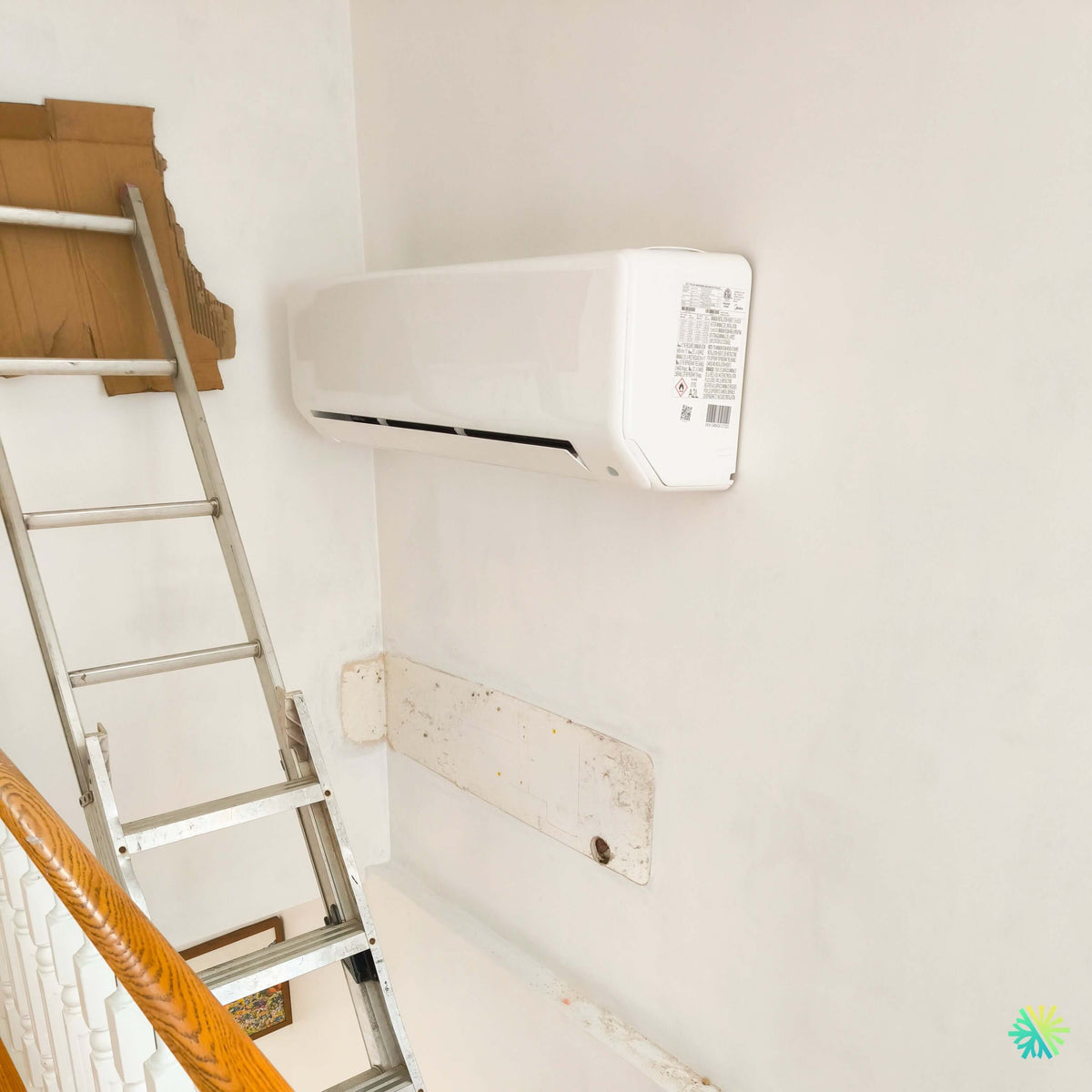
The photo taken during our work clearly shows the context. The new white wall-mounted unit is installed high up, near the ceiling, while the rectangular footprint of the old unit remains visible lower down on the wall. An old opening for the line passage can also be seen in this area. A large ladder set up in the stairwell illustrates the other difficulty of this installation: it was not simply a matter of mounting a new heat pump on a wall accessible from a flat floor.
For this type of project, our work at AirGreen begins well before the unit is started. We must determine where the indoor unit will work best, how to ensure adequate clearance, how to work safely in a tight space, and how to adapt the refrigerant line and drainage routes to the building’s actual configuration.
The result is a HVAC installation that does more than simply replace one unit with another: we adapt the new system to the home as it exists today.
Why was the new unit installed higher than the old one?
When replacing a wall-mounted heat pump, it may be tempting to automatically put the new indoor unit exactly where the old one was. This approach is practical only when the existing location remains compatible with the dimensions, clearances, and requirements of the new equipment.
Here, the difference between the old footprint and the position of the new unit MIDEA35 is particularly noticeable.
We always prioritize the unit’s operation and the quality of the installation over simply trying to hide the marks left by the previous system. The positioning of an indoor unit affects, among other things:
- air circulation in the area being served;
- the return airflow to the appliance;
- future access to the filters and components;
- condensate drainage;
- the route of the refrigerant lines;
- the clearances required around the unit;
- long-term ease of maintenance.
In a stairwell or vertical circulation area, these elements become even more important. A poorly positioned unit may send much of its airflow in an unhelpful direction or create a highly localized comfort zone rather than an effective distribution.
Marks from the old unit are not a defect in the new HVAC installation
The visible area beneath the new unit is typical of a replacement project. When an old wall-mounted air conditioner or heat pump is removed, it is common to find differences in paint, mounting marks, holes, or a surface that was not finished in the same way as the rest of the wall.
In the case of this installation at Saint-Mathieu-de-Beloeil, the old unit clearly occupied a noticeably different area from the new unit.
This is an important detail for homeowners planning to replace an old system: the dimensions of wall-mounted heat pumps are not universal. Even when two units have comparable capacity, their width, height, depth, and the position of their connections may differ.
We therefore recommend planning for paint or plaster finishing work afterward when necessary. It is better to install the new equipment in the technically appropriate location and then touch up the walls than to compromise the heat pump’s operation solely to hide the outline of the old unit.
A stairwell requires a different work method
The large ladder visible in the photo is not an insignificant detail. Installing a unit above a staircase requires much more precise planning than installing one at normal height in a living room.
Our technicians must be able to work on the indoor unit, level the mounting bracket perfectly, make the connections, and check the drainage while maintaining safe access.
This reality also affects future maintenance. A heat pump must remain accessible for:
- remove and clean the filters;
- inspect the heat exchanger;
- perform a HVAC maintenance thorough;
- check the condensate pan and drain;
- work on the electronic components;
- perform internal cleaning as needed.
The MIDEA35 series specifically features characteristics that make maintenance easier. Midea documentation notably indicates a removable ventilation wheelallowing better access during deep cleaning, as well as automatic cleaning functions.
MIDEA35: a wall-mounted heat pump designed for Quebec winters
Choosing a MIDEA MIDEA35 takes on its full meaning in a municipality like South Shore such as Saint-Mathieu-de-Beloeil, where a heat pump must be evaluated not only by its cooling performance, but especially by what it can provide when the outdoor temperature drops significantly.
MIDEA35 is the high-end wall-mounted series presented by Midea as an extreme-climate heat pump. The series operates with R-454B refrigerant, classified as A2L, and its combinations are specified for a heating operating range down to -30°C.
This is a determining factor in Quebec. A minimum temperature rating does not mean that a unit will deliver exactly its rated capacity down to that limit; its actual low-temperature capacity, COP, and the building’s heating load must also be considered.
That is why, at AirGreen, we never size a heat pump solely according to the number of square feet.
Three MIDEA35 capacities and different performance levels
The Midea brochure presents the MIDEA35 series in 9,000, 12,000, and 18,000 BTU/h of rated cooling capacity. The listed combinations have the reference numbers AHRI 215471386, 215471387, and 215471388.
The precise capacity of the photographed unit is not sufficiently legible on the nameplate visible on the side of the unit for us to state it with certainty. This distinction is important: we prefer to present the exact data for the series rather than arbitrarily assigning a capacity to an installation based solely on the unit’s apparent dimensions.
Depending on the MIDEA35 combination selected:
| Rated cooling capacity | SEER2 | HSPF2 Region IV | Rated heating at -15°C |
|---|---|---|---|
| 9,000 BTU/h | 33,3 | 22,0 | 13,500 BTU/h |
| 12,000 BTU/h | 29,4 | 14,5 | 13,500 BTU/h |
| 18,000 BTU/h | 25,6 | 16,2 | 22,600 BTU/h |
The documentation also indicates a COP of 3.60 at -15°C for the 9,000 and 12,000 BTU/h models and a COP of 4.40 at -15°C for the 18,000 BTU/h model.
These figures show why the term “MIDEA35” alone is not sufficient for comparing two quotes. The exact capacity and the indoor-outdoor combination must be clearly stated.
Up to 33.3 SEER2: what this value really means
The maximum value of 33.3 SEER2 belongs to the 9,000 BTU/h model in the series. The 12,000 BTU/h model is rated at 29.4 SEER2 and the 18,000 BTU/h model at 25.6 SEER2.
This distinction is important because an advertisement presenting “up to 33.3 SEER2” does not mean that all MIDEA35 capacities achieve this efficiency.
Variable-speed technology allows the compressor to adjust its operation according to demand rather than constantly alternating between full operation and complete shutdown. Midea associates this modulation with a more stable indoor temperature and reduced comfort fluctuations.
In a properly sized home, this modulation is especially useful during periods when demand is moderate: the heat pump can run longer at reduced output rather than repeatedly starting and stopping.
Particular attention to sound levels in an open indoor space
A stairwell can connect with several rooms or floors. The indoor unit’s sound level therefore deserves particular attention.
Depending on capacity, Midea indicates indoor sound levels that can drop as low as 19 dB(A) for certain 9,000 and 12,000 BTU/h configurations and up to 16 dB(A) to the quiet setting of the 18,000 BTU/h model.
The range also offers highly gradual airflow adjustment. Midea describes up to 100 fan speed levels and control functions that allow the airflow in the room to be adjusted more precisely.
In a passageway such as the one in this installation, this modulation helps prevent continuous operation at maximum airflow when the actual load does not require it.
R-454B, leak detection, and professional installation
The MIDEA35 uses R-454B, an A2L refrigerant. The A2L pictogram is also visible on the nameplate of the unit installed in our photo.
This new generation of equipment requires the installation to comply with the methods, components, and procedures corresponding to the refrigerant used. Midea’s documentation notably provides for an A2L refrigerant leak detection sensor in the series concerned.
For refrigerant lines, the dimensions change according to capacity:
- 9,000 BTU/h: 1/4 in and 3/8 in;
- 12,000 BTU/h: 1/4 in and 3/8 in;
- 18,000 BTU/h: 3/8 in and 5/8 in.
The maximum lengths indicated are 82 ft for the 9,000 and 12,000 BTU/h models and 164 ft for the 18,000 BTU/h model.
That is precisely why the automatic reuse of old lines is never a decision to make solely because “the pipes are already in the wall.” The diameter, condition, cleanliness of the circuit, refrigerant used by the old system, and the new manufacturer’s requirements must all be verified.
This Saint-Mathieu-de-Beloeil project illustrates the details that distinguish a simple replacement from a true HVAC installation
Do not size a heat pump solely so that it “heats more strongly”
A common mistake is to systematically choose a higher capacity as a precaution. An oversized heat pump is not automatically more comfortable.
We examine, in particular:
- the area actually served;
- the floor layout;
- openings between rooms;
- insulation;
- windows and exposure;
- heat loss;
- the indoor unit location;
- the actual low-temperature heating capacity.
When installing a unit in an open area near a staircase, how air moves between levels can be just as important as the capacity listed on the technical data sheet.
The electrical supply must match the exact model
The MIDEA35 units are powered by 208/230 V, single-phase, 60 Hz. For the outdoor unit, the documentation indicates a minimum allowable ampacity of 16 A for the 9,000 and 12,000 BTU/h models and 24.9 A for the 18,000 BTU/h model, with maximum protection listed at 20 A, 20 A, and 25 A, respectively.
These values further demonstrate the importance of working with the exact model number. Two units bearing the same series name may have different electrical requirements.
Comfort control, humidity, and smart features
The MIDEA35 series offers several useful everyday features: ECO mode, sleep mode, timer, horizontal and vertical swing, 8°C heat-maintenance mode, automatic cleaning, quiet mode, “Follow Me” function, temperature and humidity control, as well as Wi-Fi control options.
The Follow Me uses the remote control’s temperature sensor in particular so that the unit can adjust its operation while taking greater account of the temperature measured where the remote is located.
For a home with a staircase or temperature variations between different zones, this type of control can be particularly useful when the remote is positioned appropriately.
A particularly comprehensive residential warranty offered by Midea
Midea’s Quebec documentation presents, for the residential sector, a 12-year limited warranty on the compressor, 12 years on parts, and 10 years on labor, subject to the terms and conditions applicable to the product and its registration.
When purchasing a wall-mounted heat pump, we always recommend checking not only the stated warranty period, but also:
- registration requirements;
- exclusions;
- maintenance conditions;
- the actual labor coverage;
- how warranty claims are handled.
A long warranty is much more useful when the initial installation has been properly completed and documented.
LogisVert subsidy: verify the exact combination before promising an amount
The MIDEA35 range presented in the documentation has distinct AHRI references according to capacity and is identified in the brochure as a Cold Climate V6.1.
For an installation currently carried out in Québec, eligibility for Hydro-Québec’s LogisVert must nevertheless be verified using the exact combination of units and according to the rules in effect on the installation date.
Hydro-Québec specifies that, for heat pumps installed since November 26, 2025, the unit must be ENERGY STAR certified to be eligible. When all requirements are met, the assistance is $50 per 1,000 BTU/h at -8 °C for an ENERGY STAR heat pump and $120 per 1,000 BTU/h at -8 °C when it is ENERGY STAR Cold Climate certified. The calculation is therefore based on the recognized capacity at -8 °C, rather than simply relying on the figure of 9,000, 12,000, or 18,000 BTU/h used to designate the nominal cooling capacity.
That is why we avoid quoting a subsidy amount without validating the exact combination and its eligibility.
Mistakes this installation helps avoid
This project in Saint-Mathieu-de-Beloeil is a good example of the checks to perform before replacing an old wall-mounted heat pump.
Reusing the existing location without analyzing airflow
The old location is not automatically the best one for the new unit. The photo of our installation shows this very clearly.
Ordering according to the width of the old unit
Dimensions vary by brand and capacity. A 9,000- or 12,000-BTU/h MIDEA35 measures approximately 37.99 in wide, whereas the 18,000 BTU/h model is approximately 44.88 in.
Assuming that the existing lines are compatible
The required diameters vary according to capacity and must be validated before connection.
Forgetting wall touch-ups
When a new head does not cover the footprint of the old one, some paint may need touching up or plaster may need repairing. This finishing work is preferable to a technically compromised installation solely to conceal an old mark.
Choosing the BTUs without considering low-temperature heating
For the climate of the South Shore, actual winter performance must be examined, not just the nominal cooling capacity.
Our approach at AirGreen for wall-mounted heat pump replacements
On a job like this, we assess the existing situation before determining the final configuration. Older installations often hold surprises: a poorly positioned wall opening, drainage that needs to be redone, incompatible lines, a power supply that needs to be checked, or a new unit whose dimensions do not match the old one.
Our goal is to address these constraints during installation rather than pass them on to the owner as future problems.
This method applies to our wall-mounted heat pumps in Montreal, Laval, Longueuil, on the South Shore, and on the North Shore. Every building is different, whether it is a bungalow, a two-story house, a condo, a duplex, or a property under renovation.
In Saint-Mathieu-de-Beloeil, this MIDEA35 particularly illustrates this principle: a clean replacement does not necessarily reproduce the old installation exactly. It takes into account the new equipment, its dimensions, airflow, maintenance access, and the physical reality of the house.
A MIDEA35 installed to work with the building, not against it
The new unit installed higher up gives this work its distinctive character. The image immediately shows the contrast between the old location and the new configuration.
For us, this detail precisely represents the work of an HVAC installer: not treating the wall as a simple surface on which to hang a machine, but understanding how the equipment will interact with the space for many years.
With heating capacity down to -30°C, with efficiency ratings reaching 33.3 SEER2 and 22.0 HSPF2 depending on the model, its variable-speed operation, R-454B refrigerant, and numerous control features, MIDEA35 is a very attractive option when the selected capacity truly matches the building’s needs.
And in a replacement installation like this one, the quality of the result depends just as much on this selection as on what happens on the ladder, behind the unit, and inside the wall.
At AirGreenthat is precisely where our experience in HVAC installation makes the difference.
How it goes, from the first call to the end
The main steps of this kind of job at AirGreen. Every house has its quirks: the estimate brings them out.
We look at the room, the outside wall, the line route and where the outdoor unit will go. That is where the capacity gets chosen.
Model, capacity and price, in writing. We also check whether the model qualifies for assistance programs.
Floors and furniture protected, wall plate position marked level, wall opening located.
A single opening, with the slope the drain needs to flow outside.
Set on a stand raised above the snow, with the clearances the manufacturer requires.
Connected, insulated and protected. The opening is then sealed against water, cold air and insects.
A dedicated circuit and an accessible disconnect near the outdoor unit.
Leak test, vacuum, then start-up and a check of heating and cooling.
Remote, modes, filters: we show you the essentials before we leave.
- The on-site estimateWe look at the room, the outside wall, the line route and where the outdoor unit will go. That is where the capacity gets chosen.
- The quoteModel, capacity and price, in writing. We also check whether the model qualifies for assistance programs.
- Getting readyFloors and furniture protected, wall plate position marked level, wall opening located.
- The wall openingA single opening, with the slope the drain needs to flow outside.
- The outdoor unitSet on a stand raised above the snow, with the clearances the manufacturer requires.
- Lines, cable and drainConnected, insulated and protected. The opening is then sealed against water, cold air and insects.
- The electrical workA dedicated circuit and an accessible disconnect near the outdoor unit.
- Tests and start-upLeak test, vacuum, then start-up and a check of heating and cooling.
- The walkthroughRemote, modes, filters: we show you the essentials before we leave.
What the unit delivers when it is cold
The range as published on airgreen.ca: pick a size to see its capacity in deep cold.
| Size | Heating at −8 °C | Heating at −15 °C | Coldest certified point | COP at −15 °C | SEER | HSPF | Indicative LogisVert aid |
|---|---|---|---|---|---|---|---|
| Midea Série 35 9 000 | 11,000 | 13,500 | −30 °C: 7,500 | 2.0 | 33.3 | 14.6 | – |
| Midea Série 35 12 000 | 11,000 | 13,500 | −30 °C: 7,500 | 2.0 | 29.4 | 12.7 | $1,320 |
| Midea Série 35 18 000 | 19,300 | 22,600 | −30 °C: 11,900 | 2.34 | 25.6 | 16.2 | $2,316 |
According to NEEP, its certified maximum capacity at −30 °C (−22 °F) is 7,500 BTU/h, 83% of its nominal 9,000 BTU size.
At 8 °C, its certified maximum capacity reaches 17,200 BTU/h, 91% more than its nominal 9,000 BTU size.
According to NEEP, its certified heating capacity at −15 °C (5 °F) is 13,500 BTU/h, 150% of its nominal 9,000 BTU size. Its COP there is 2.00.
According to NEEP, its certified maximum capacity at −30 °C (−22 °F) is 7,500 BTU/h, 62% of its nominal 12,000 BTU size.
At 8 °C, its certified maximum capacity reaches 17,200 BTU/h, 43% more than its nominal 12,000 BTU size.
According to NEEP, its certified heating capacity at −15 °C (5 °F) is 13,500 BTU/h, 112% of its nominal 12,000 BTU size. Its COP there is 2.00.
According to NEEP, its COP at −15 °C is 2.34: the highest of the Série 35 line, which ranges from 2.00 to 2.00 at that temperature.
According to NEEP, its certified maximum capacity at −30 °C (−22 °F) is 11,900 BTU/h, 66% of its nominal 18,000 BTU size.
At 8 °C, its certified maximum capacity reaches 29,700 BTU/h, 65% more than its nominal 18,000 BTU size.
Data read live from the airgreen.ca page of each size (NEEP / AHRI certified performance). When the title names the installed size, it is highlighted; otherwise the whole range is shown. The aid shown is today’s, using Hydro-Québec’s rule ($120 per 1,000 BTU/h at −8 °C); amounts quoted in the article date from its publication. Only Hydro-Québec confirms the assistance granted.A dash in the aid column: amount to be confirmed for this model.
And at your place?
Two quick checks with real numbers: what heat costs, and what your current heaters add up to in BTU/h.
Baseboards and electric furnaces turn 1 kWh of electricity into 1 kWh of heat. A heat pump delivers more: that is its COP. At Hydro-Québec’s rate D (11.142¢/kWh above 40 kWh a day, since 1 April 2026):
Hydro-Québec: a heat pump can be up to three times more efficient than baseboards for heating in the colder months.
Estimate per kWh of heat, at the chosen temperature, using the certified COP from the product page. Taxes, access charge and backup heat not included.
Conversion: 1 W = 3.412 BTU/h. An indication, not a load calculation: baseboards and furnaces are often stronger than the real need, and they can stay as backup. AirGreen confirms the capacity on site.
What to do, season by season
Three habits per season for this unit. They take a few minutes and prevent many calls.
- Clean the indoor unit's filters.
- Clear leaves and debris left on the outdoor unit by winter.
- Test cooling before the first hot days.
- Clean the filters more often when the unit runs a lot.
- Keep plants away from the outdoor unit.
- Check that no water drips from the indoor unit.
- Rake the leaves around the outdoor unit.
- Test heating before the first cold days.
- Book periodic maintenance before winter.
- Keep snow away from the stand and the front of the unit.
- Let the unit defrost: it is normal.
- Never hit the ice on the fins; call us if the unit stays iced up.
Which type of equipment for your project?
Pick what looks like your need.
Four mistakes we do not make
Flip each card to see what we do instead.
What people ask us about this kind of work
Does a wall-mounted heat pump heat in winter?
Wall-mounted or multi-zone: how do I choose?
Where does the outdoor unit go?
Are there grants?
Do I need a permit?
How cold can it heat?
How much can I save?
How is the LogisVert assistance calculated?
Is it noisy?
The outdoor unit is covered in ice: is that normal?
Does AirGreen hold the required licences?
Is the estimate free?
No question matches. Write to us: we answer.
Useful pages for what comes next
More jobs to see, near you
By town, by equipment or by region: browse more than 4,700 published projects.
Each dot: a town where AirGreen has published projects. The glowing dot: this job.
Tell us about your house. We come and see it for free.
The on-site estimate is free and the quote follows within 24 hours.
Text and photo: a real AirGreen Climatisation & Chauffage job. The diagrams are generic illustrations of the type of installation, not a survey of this job site. Sources of the added figures: airgreen.ca product pages (NEEP / AHRI performance), Hydro-Québec (Heat pumps page, LogisVert, read on 13 October 2026), Régie de l’énergie (rate D as of 1 April 2026).