
Installation of a Samsung WindFree™ MaxHeat 12,000 BTU wall-mounted heat pump in L’Île-Bizard–Sainte-Geneviève, Montreal
AirGreen installs a Samsung WindFree™ MaxHeat wall-mounted heat pump above a window in L’Île-Bizard–Sainte-Geneviève, with a compact route to the outdoor unit and optimal air distribution.
- City
- Region
- Equipment
- Brand
- Challenges
- Published
The job on one screen
The article, chapter by chapter
An installation above a window that transforms the comfort of the entire room
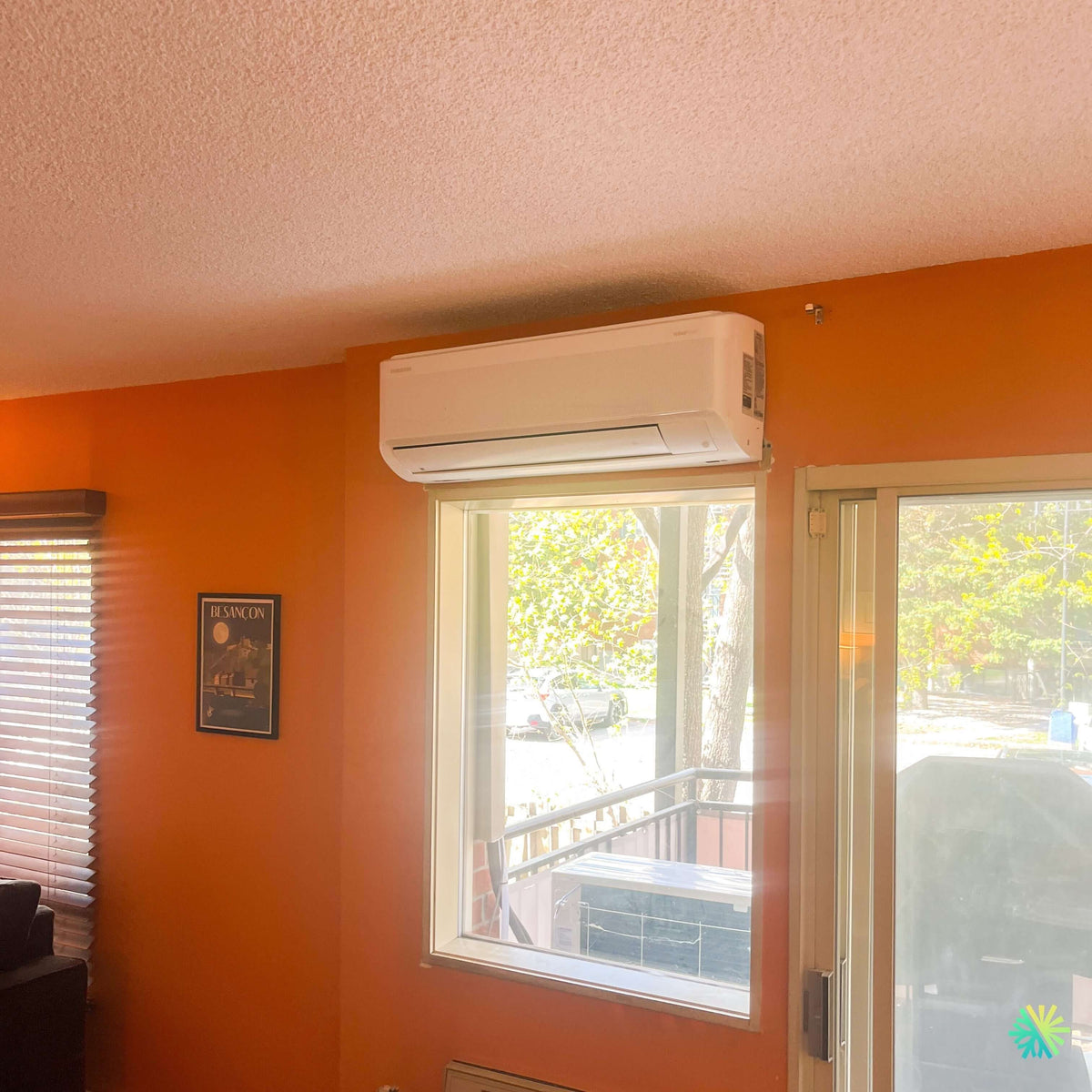
In this residence in L’Île-Bizard–Sainte-Geneviève, our AirGreen team had to integrate a Samsung WindFree™ MaxHeat wall-mounted heat pump into a bright room with several exterior openings, limited wall space, and a textured ceiling that had to be carefully preserved.
The challenge was very practical: choosing a location that would allow the indoor unit to distribute air effectively throughout the room without blocking the windows, interfering with use of the patio door, or visually unbalancing the wall. The available strip above the large window was the best location, but it required careful measurements.
We therefore installed the indoor unit directly above the window, near the ceiling and close to the patio door. This position preserves all usable surfaces, directs heating and cooling toward the center of the room, and reduces the distance between the indoor and outdoor units.
The outdoor unit placed on the balcony can also be seen through the window. The result is a compact installation: the indoor unit and outdoor unit are positioned almost back-to-back, which helps minimize the length of the refrigerant lines while simplifying their protection.
A room with very little available wall space
The photograph shows a common situation in homes and condominiums in western Montreal: a living area where the exterior walls are largely occupied by windows and doors.
In this room, we had to work around:
- a large central window;
- a patio door installed immediately to the right;
- a second window with a blind on the left;
- a narrow strip of wall beneath the ceiling;
- an electric baseboard heater located beneath the window;
- an outdoor unit installed on the balcony;
- an existing interior finish to preserve;
- a need to distribute air throughout the room.
Installing the unit on an adjacent wall would have increased the length of the lines and could have created less effective lateral airflow. Placing it too close to the corner would have limited access for maintenance. A lower installation would have overlapped the window and resulted in a much less harmonious finish.
Positioning it above the opening therefore served several objectives simultaneously: performance, aesthetics, accessibility, and minimizing the impact of the work.
Why installation above a window requires greater precision
A wall-mounted heat pump must be installed perfectly level and secured to a sufficiently sturdy structure. When space is limited, a few millimeters can determine whether the front panel will open properly or whether the unit can be serviced without difficulty.
Before securing the mounting plate, we check, among other things:
- the actual width available between obstacles;
- the distance between the top of the unit and the ceiling;
- the position of studs or structural supports;
- the possible presence of electrical wires;
- the path of the refrigerant lines;
- the slope required for condensate drainage;
- the complete opening of the panel and filters;
- the direction of the airflow;
- visual alignment with the window.
In this project in L’Île-Bizard–Sainte-Geneviève, the unit was centered above the window to maintain a clean, balanced appearance. This symmetry is not purely aesthetic. It also promotes better air distribution throughout the room.
Maintaining functional clearance below the ceiling
The indoor unit appears close to the ceiling, but it must never be compressed against it. A wall-mounted heat pump generally draws ambient air through its upper section before filtering and redistributing it through the lower louver.
Insufficient clearance could:
- reduce airflow;
- increase operating noise;
- make filter removal more difficult;
- interfere with heat exchanger cleaning;
- limit the panel’s opening;
- affect the unit’s performance.
Our team takes the manufacturer’s requirements and on-site conditions into account. The textured ceiling visible in the photograph also required careful handling to avoid marks, crumbling, or damage around the unit.
A Samsung heat pump designed for Quebec’s climate
The Samsung WindFree™ MaxHeat is an inverter wall-mounted heat pump designed to provide cooling in summer and heating during winter.
For a 12,000 BTU/h configuration, the range can achieve a seasonal efficiency of approximately 24 SEER2, depending on the exact pairing of the indoor and outdoor units. It is also designed to continue providing heating when the outdoor temperature drops to approximately -30 °C, although available capacity and efficiency gradually decrease as the temperature falls.
The manufacturer's documentation should always be consulted using the exact model numbers, as performance may vary depending on the installed combination. The commercial designation alone is not sufficient to confirm an efficiency rating or eligibility for financial assistance.
This heat pump is particularly well suited to homeowners looking for:
- effective heating during much of the winter;
- modulating air conditioning;
- quiet operation;
- less direct air distribution;
- precise temperature control;
- a complementary solution to electric baseboard heaters;
- connectivity that makes everyday management easier.
WindFree™ technology and comfort near windows
A unit installed above a window is well positioned to counter temperature variations that occur near glass surfaces. In winter, cooler air naturally descends along windows. In summer, solar radiation can quickly warm this area.
The WindFree™ system adds an important benefit. After reaching the requested temperature with conventional airflow, the unit can distribute cooled air through numerous micro-openings built into its front panel.
This distribution reduces the sensation of a direct draft. It is particularly appreciated in a living room where occupants sit for long periods or when the main airflow could reach a sofa, table, or passageway.
WindFree™ mode does not eliminate the need for stronger initial ventilation. Instead, it helps maintain the temperature with gentler air distribution once the room has reached the desired comfort level.
An inverter system that modulates its capacity
Unlike a unit that operates only at full capacity or is switched off, an inverter heat pump gradually adjusts its compressor speed.
When the room temperature is far from the setpoint, the system increases its output. As it approaches the requested temperature, it reduces its capacity to maintain a more stable environment.
This modulation helps to:
- limit temperature fluctuations;
- reduce abrupt starts;
- maintain quieter operation;
- improve efficiency at partial load;
- promote more consistent dehumidification;
- reduce consumption compared with on-off operation.
However, to enjoy these benefits, the system must be properly sized for the home. An oversized heat pump can reach its setpoint too quickly and run shorter cycles. An undersized unit may operate continuously without providing the expected comfort during the most demanding periods.
Why a 12,000 BTU capacity is not chosen based solely on floor area
Rated capacity is an important factor, but floor area is only one of the elements used to select a 12,000 BTU wall-mounted heat pump.
In a room like the one in this installation, glazed surfaces have a considerable influence on the thermal load. We also consider:
- window orientation;
- afternoon sunlight;
- the age of the building;
- insulation quality;
- air infiltration;
- ceiling height;
- traffic toward adjoining rooms;
- the number of occupants;
- heat-generating appliances;
- heating habits;
- the presence of electric baseboards.
In L’Île-Bizard–Sainte-Geneviève, some homes are exposed to stronger winds because of their proximity to bodies of water and open spaces. The building’s airtightness and façade exposure must therefore be taken into account during the assessment.
A short refrigeration line route between the interior and the balcony
The selected location made it possible to bring the indoor unit closer to the outdoor unit. The latter is visible from the window, installed on the balcony on the other side of the wall.
A compact route offers several advantages when technically feasible:
- fewer visible lines;
- a more discreet exterior finish;
- fewer changes in direction;
- reduced risk of vibration;
- an installation that is easier to inspect;
- easier protection for the wiring and lines;
- generally more direct drainage.
However, a short route does not mean that the lines can be installed without a method. The manufacturer’s minimum and maximum lengths must be respected, as must the requirements for flared connections, tightening torque, leak testing, and evacuation.
Evacuation: an invisible but essential step
Once the lines are connected, the circuit must be properly evacuated before opening the service valves.
This operation removes the air and moisture present in the pipes. Insufficient evacuation can leave moisture in the refrigeration circuit, which may cause:
- oil contamination;
- acid formation;
- abnormal pressures;
- reduced efficiency;
- premature compressor wear;
- difficult-to-diagnose problems.
At AirGreen, we consider this step a fundamental part of every HVAC installation, even though it is no longer visible after commissioning.
Condensate drainage above a window
When the indoor unit is installed above a window, the drainage system must be particularly reliable. In cooling mode, moisture removed from the air turns into water in the condensate pan.
This water must drain outside without flowing back toward the unit. An improperly designed slope could cause a leak above the window frame, risking damage to the paint, drywall, and interior finish.
We therefore check:
- the slope of the pipe;
- the absence of backflow;
- the strength of the connections;
- the actual water flow;
- the watertightness of the wall penetration;
- the protection of the outdoor outlet.
A drainage test is performed before the work is completed to confirm that the water drains properly.
From installation to daily use: the details that protect performance
Keep electric baseboard heaters as supplemental heating
The electric baseboard heater visible beneath the window does not need to be removed simply because a heat pump has been installed.
In many homes in Montréal, Laval, Longueuil, the North Shore and the South Shore, we recommend keeping the baseboard heaters as supplemental heating. They can be used in remote rooms, behind closed doors, or during periods of extreme cold.
To encourage the heat pump’s priority use, Hydro-Québec recommends setting the heat pump to a comfortable temperature, such as 21 °C, and then setting the baseboard heaters to a slightly lower temperature, such as 19 °C. This strategy prevents the baseboard heaters from starting before the heat pump has had a chance to meet the demand.
It is also preferable to avoid frequent setpoint changes. An inverter heat pump generally operates more efficiently when it maintains a relatively stable temperature.
Adjust the louvers according to the season
The louver settings strongly influence air distribution.
In heating mode, we generally direct the airflow downward and toward the center of the room, since warm air naturally tends to rise. In cooling mode, a slightly more horizontal direction helps the cool air gradually mix with the surrounding air.
In this project, the unit’s height above the window allows the airflow to travel across much of the room before descending. This configuration promotes a more even temperature than one achieved with a unit installed too low or directed toward a nearby obstacle.
Filter cleaning should not be neglected
The indoor unit’s filters trap dust and larger particles. When they become clogged, airflow decreases and the unit has to work harder to maintain the temperature.
We recommend inspecting them regularly, especially:
- during periods of continuous use;
- in homes with pets;
- after renovation work;
- when the windows are often left open;
- during pollen seasons;
- if the airflow seems weaker.
The filters must be removed carefully, cleaned according to the manufacturer’s recommendations, dried completely, and then put back correctly.
More thorough maintenance may also become necessary when the fan wheel, coil, or condensate pan accumulates contaminants. Professional HVAC maintenance can then help restore airflow and prevent odors.
Never block the indoor unit
Installing it above the window frees up wall space, but space in front of the unit must be maintained.
The following elements can interfere with its operation:
- a curtain rod installed too high;
- thick curtains that hang in front of the unit;
- a decorative shelf;
- a cabinet added later;
- objects placed on top;
- an enclosure built around the unit.
The heat pump must remain accessible and able to draw in and distribute air freely.
Protecting the outdoor unit’s operation
The outdoor unit located on the balcony must also remain unobstructed. Do not place furniture, a solid decorative panel, a cover, or an accumulation of seasonal items in front of it.
In winter, monitor:
- snow accumulation;
- ice beneath the unit;
- leaves or debris in the coil;
- defrost water;
- objects that could block the fan.
A heat pump normally produces water during its defrost cycles. This does not mean that the unit is leaking. However, the water must be able to drain away without creating a significant buildup around the base.
LogisVert Program Eligibility
A Samsung WindFree™ MaxHeat heat pump may be eligible for financial assistance when it appears on the list applicable on the installation date and all program conditions are met.
Hydro-Québec specifies that the exact combination of the indoor and outdoor units must be verified in its official tool before purchase. For installations carried out on or after November 26, 2025, the equipment must notably meet the applicable ENERGY STAR® requirements to be eligible.
Residential financial assistance may reach 6 700 $, depending on the model, its low-temperature capacity and the applicant’s situation. This maximum amount is not an automatic sum provided with every heat pump.
To submit an application, the owner must notably retain:
- the detailed invoice;
- the model numbers;
- proof of payment;
- the installation date;
- the contractor’s information;
- the requested photos or documents;
- the applicable ENERGY STAR® or AHRI references.
Hydro-Québec also indicates that the application must generally be submitted within nine months of the installation.
Common mistakes this project helps avoid
This wall-mounted heat pump installation in L’Île-Bizard–Sainte-Geneviève shows why preparation is just as important as the equipment itself.
Among the mistakes we avoid on this type of project:
- choose a unit based solely on floor area;
- install the unit too close to the ceiling;
- block access to the filters;
- direct the airflow toward a door or obstacle;
- overlook the drain slope above a window;
- drill without checking for concealed obstacles;
- leave the lines unprotected;
- create an unnecessarily long route;
- place the outdoor unit in a space without sufficient clearance;
- promise a rebate before verifying the exact models;
- remove the baseboard heaters when they can provide supplemental heat;
- skip evacuation and the leak test.
The result achieved in this L’Île-Bizard–Sainte-Geneviève residence
The Samsung heat pump fits neatly above the large window, despite limited wall space and the patio door’s immediate proximity.
The unit remains accessible for filter cleaning and future service. Its positioning promotes airflow toward the living area, while the outdoor unit installed on the balcony allows for a compact refrigerant line path.
The homeowner now benefits from:
- variable-capacity air conditioning;
- efficient heating in cold weather;
- the comfort of WindFree™ air distribution;
- better use of wall space;
- more precise temperature control;
- a solution that complements electric baseboard heaters;
- an installation adapted to the home’s actual architecture.
At AirGreen, we tailor every HVAC installation to the building rather than applying the same layout to every residence. In L’Île-Bizard–Sainte-Geneviève, as elsewhere in Montréal, Laval, Longueuil, the North Shore, and the South Shore, we assess the structure, openings, airflow, drainage, maintenance access, and outdoor constraints before finalizing the location.
This approach delivers an installation that does more than simply work on the day it is commissioned. It is designed to provide consistent comfort, a cohesive finish, and access to the heat pump throughout its service life.
The job tools
Two quick checks with real numbers: what heat costs, and what your current heaters add up to in BTU/h.
Conversion: 1 W = 3.412 BTU/h. An indication, not a load calculation: baseboards and furnaces are often stronger than the real need, and they can stay as backup. AirGreen confirms the capacity on site.
How the job unfolds
The main steps of this kind of job at AirGreen. Every house has its quirks: the estimate brings them out.
We look at the room, the outside wall, the line route and where the outdoor unit will go. That is where the capacity gets chosen.
Model, capacity and price, in writing. We also check whether the model qualifies for assistance programs.
Floors and furniture protected, wall plate position marked level, wall opening located.
A single opening, with the slope the drain needs to flow outside.
Set on a stand raised above the snow, with the clearances the manufacturer requires.
Connected, insulated and protected. The opening is then sealed against water, cold air and insects.
A dedicated circuit and an accessible disconnect near the outdoor unit.
Leak test, vacuum, then start-up and a check of heating and cooling.
Remote, modes, filters: we show you the essentials before we leave.
- The on-site estimateWe look at the room, the outside wall, the line route and where the outdoor unit will go. That is where the capacity gets chosen.
- The quoteModel, capacity and price, in writing. We also check whether the model qualifies for assistance programs.
- Getting readyFloors and furniture protected, wall plate position marked level, wall opening located.
- The wall openingA single opening, with the slope the drain needs to flow outside.
- The outdoor unitSet on a stand raised above the snow, with the clearances the manufacturer requires.
- Lines, cable and drainConnected, insulated and protected. The opening is then sealed against water, cold air and insects.
- The electrical workA dedicated circuit and an accessible disconnect near the outdoor unit.
- Tests and start-upLeak test, vacuum, then start-up and a check of heating and cooling.
- The walkthroughRemote, modes, filters: we show you the essentials before we leave.
What we check on a job like this one
Each number is a point we check on site. Switch between summer and winter to watch air and heat move.
In summer, the outdoor unit rejects the house's heat outside.
Generic illustration of this type of installation, not a survey of this job site. Tap a number.
Mounted level on a wall plate, high enough for the air to reach the whole room, with enough space around it to slide the filters out easily.
The refrigerant lines, the communication cable and the drain go through the wall in a single opening, sealed against water, cold air and insects.
Two insulated copper pipes connect the two units. Outside, a line cover can protect them from sun, knocks and weather.
A shut-off switch near the outdoor unit isolates it safely for service. It must stay accessible at all times.
The compressor and the fan. In heating mode it captures heat from the outdoor air, even in winter, and moves it inside.
On the ground or on the wall, it keeps the unit above accumulated snow. The unit stays clear and defrost water can drain away.
The fan needs to blow freely. Storage, a fence or a wall too close, and efficiency drops while noise goes up.
Is your home ready?
Check what applies at your place. A "no" is not a refusal: it is what we sort out during the estimate.
Good habits, once the unit is in place
Six simple habits that keep the unit going. Your list stays on this device.
What to do, season by season
Three habits per season for this unit. They take a few minutes and prevent many calls.
- Clean the indoor unit's filters.
- Clear leaves and debris left on the outdoor unit by winter.
- Test cooling before the first hot days.
- Clean the filters more often when the unit runs a lot.
- Keep plants away from the outdoor unit.
- Check that no water drips from the indoor unit.
- Rake the leaves around the outdoor unit.
- Test heating before the first cold days.
- Book periodic maintenance before winter.
- Keep snow away from the stand and the front of the unit.
- Let the unit defrost: it is normal.
- Never hit the ice on the fins; call us if the unit stays iced up.
The right pages, at the right time
Four statements: true or false?
It all comes down to details you have just seen.
1. In heating mode, the outdoor unit can produce water.
During defrost cycles. That water must drain away without forming ice.
2. You pick the capacity with a simple square-footage rule.
Windows, insulation, orientation and how the room is used all count. Capacity is chosen on site.
3. A multi-zone connects several indoor heads to a single condenser.
One head per room, all on the same condenser. Each room keeps its own temperature.
4. The disconnect can sit behind the patio furniture.
It must stay accessible: it is what shuts the unit off for service.
0 / 4 right answers
What people ask us about this kind of work
Does a wall-mounted heat pump heat in winter?
Wall-mounted or multi-zone: how do I choose?
Where does the outdoor unit go?
Are there grants?
Do I need a permit?
How cold can it heat?
How much can I save?
How is the LogisVert assistance calculated?
Is it noisy?
The outdoor unit is covered in ice: is that normal?
Does AirGreen hold the required licences?
Is the estimate free?
No question matches. Write to us: we answer.
More jobs to see, near you
By town, by equipment or by region: browse more than 4,700 published projects.
Each dot: a town where AirGreen has published projects. The glowing dot: this job.
An on-site estimate, the right capacity, the right equipment.
The on-site estimate is free and the quote follows within 24 hours.
Text and photo: a real AirGreen Climatisation & Chauffage job. The diagrams are generic illustrations of the type of installation, not a survey of this job site. Sources of the added figures: airgreen.ca product pages (NEEP / AHRI performance), Hydro-Québec (Heat pumps page, LogisVert, read on 13 October 2026), Régie de l’énergie (rate D as of 1 April 2026).