
Installation of a Samsung Premium FJM dual-zone heat pump on a flat roof in Lorraine, on Montreal’s North Shore
In Lorraine, AirGreen installs a Samsung Premium FJM dual-zone heat pump on a reinforced rooftop support, with protected lines and a multi-zone configuration adapted to Quebec’s climate.
In summer, the outdoor unit rejects the house's heat outside.
Generic illustration of this type of installation, not a survey of this job site. Tap a number.
Mounted level on a wall plate, high enough for the air to reach the whole room, with enough space around it to slide the filters out easily.
The refrigerant lines, the communication cable and the drain go through the wall in a single opening, sealed against water, cold air and insects.
Two insulated copper pipes connect the two units. Outside, a line cover can protect them from sun, knocks and weather.
A shut-off switch near the outdoor unit isolates it safely for service. It must stay accessible at all times.
The compressor and the fan. In heating mode it captures heat from the outdoor air, even in winter, and moves it inside.
On the ground or on the wall, it keeps the unit above accumulated snow. The unit stays clear and defrost water can drain away.
The fan needs to blow freely. Storage, a fence or a wall too close, and efficiency drops while noise goes up.
A multi-zone installation designed to protect the building as much as indoor comfort
In Lorraine, installing a Samsung Premium FJM dual-zone heat pump required far more than simply placing an outdoor unit. The project had to meet several requirements simultaneously: supply two separate indoor zones, neatly organize the refrigerant lines on a flat roof, stabilize a tall and narrow outdoor unit, protect the roof membrane, and ensure a durable installation despite the wind, snow, ice, and defrost cycles typical of the climate on the North Shore.
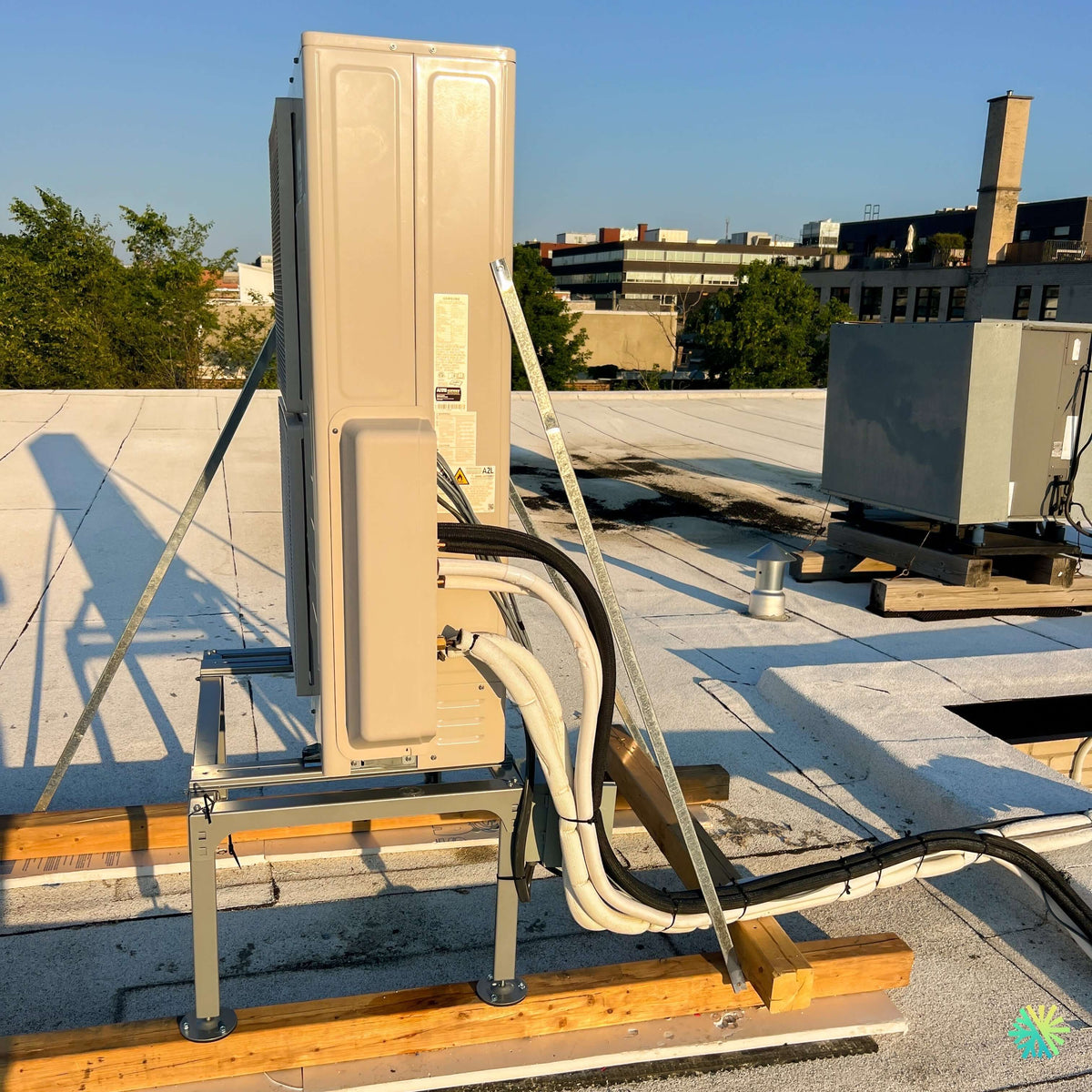
The project photo immediately shows the vertical configuration of the Samsung outdoor unit, installed on an elevated metal structure. Two sets of insulated lines leave the unit before following a carefully organized path across the roof. This arrangement corresponds to a dual-zone installation, in which a single outdoor unit powers two indoor units that can serve different areas of the property.
For this project, we paid particular attention to three elements that are often underestimated during a rooftop installation:
- weight distribution across the roof;
- the equipment’s resistance to movement caused by wind;
- mechanical protection for the lines and wiring.
The result is a HVAC installation designed as a complete system, rather than simply a series of components connected together.
Why choose a Samsung Premium FJM dual-zone heat pump?
The Samsung FJM line, or Free Joint Multi, belongs to the category of multi-zone systems. Depending on the configuration selected, one outdoor unit can power several indoor units, making it possible to heat or cool different spaces without multiplying the number of visible condensers outdoors. Samsung’s FJM Premium line is available in several capacities and can support up to four zones, depending on the exact model. It also uses a variable-speed compressor to adapt its operation to the building’s actual demand.
In this Lorraine property, the dual-zone configuration met two comfort needs with a single outdoor unit. This solution is particularly interesting when the rooms in question have different thermal loads. A sun-exposed floor, an open-plan area, a bedroom, or an office may require different adjustments throughout the day.
Each indoor unit has its own temperature setpoint. The system then modulates its output according to the overall demand. However, it is important to understand a key characteristic of multi-zone systems: indoor units connected to the same condenser generally operate in the same primary mode. They can have different temperature setpoints, but they normally cannot heat one zone while cooling the other.
This precision is essential when choosing a multi-zone heat pump in Lorraine, Laval, Montreal, or elsewhere in Greater Montreal. A good installation always begins with a realistic analysis of how the rooms are used.
Capacity selection based on actual loads
The capacity of a heat pump should never be selected solely according to a home's total area. For a dual-zone installation, we must consider in particular:
- the area of each zone;
- the number and orientation of the windows;
- insulation level;
- ceiling height;
- sun exposure;
- air infiltration;
- the location of the indoor units;
- the distance between the indoor units and the outdoor unit;
- heating needs during cold periods.
An undersized system may run continuously without reaching the desired temperature. Conversely, oversized equipment can cause shorter cycles, less efficient modulation, and less consistent summer dehumidification.
For this Samsung installation, the presence of two visible circuits alone does not confirm the exact capacity of each indoor unit. This must be verified using the model numbers, the manufacturer-approved combination, and the corresponding AHRI certificate. This verification is also important when a customer wants to determine whether their system may qualify for financial assistance.
A rooftop installation that requires careful preparation
Installing a heat pump on a flat roof presents different constraints from a ground-level or wall-mounted installation. We must first ensure that the equipment is accessible for commissioning, maintenance, and any necessary repairs. We must also reduce vibration risks and avoid work that could damage the membrane.
On this job, the outdoor unit rests on a metal support installed above wooden sleepers. This base extends the load-distribution area and prevents the entire weight of the appliance from being concentrated on four small points.
Beneath the structure, a protective layer separates the load-bearing elements from the roof surface. This method helps limit:
- direct friction against the membrane;
- localized compression of the roof insulation;
- damage caused by seasonal movement;
- the transmission of certain vibrations to the building.
The choice of location was also influenced by the route of the lines. An outdoor unit placed too far from the penetrations can result in unnecessary line-set lengths, higher costs, and more surface area exposed to the elements.
Useful elevation in winter
The support keeps the heat pump above the roof surface. This height is important in our climate because a heat pump produces water during its defrost cycles when operating in heating mode.
If the appliance is installed directly on the roof, this water can freeze around its base, block drainage, or cause ice to accumulate near the heat exchanger. A raised unit has better clearance beneath the chassis and is less vulnerable to wind-driven snow.
However, the selected height must remain compatible with the stability of the entire assembly. The higher an appliance is, the more seriously its exposure to wind must be considered.
Diagonal braces to stabilize a vertical outdoor unit
One of the most distinctive features of this installation is the presence of diagonal metal braces on each side of the Samsung unit. The condenser’s vertical format provides a relatively narrow footprint but presents a substantial surface area to the wind.
On an unobstructed roof, gusts can exert lateral forces far greater than those encountered at ground level. It is therefore not enough to check that the support legs are straight. We must assess the stability of the entire assembly, possible chassis movement, and the forces transmitted to the lines.
The visible diagonal braces help limit lateral movement. They reinforce the structure while preserving access to the service panels. This last consideration is important: a poorly positioned brace can make it difficult to remove a panel or access the valves, unnecessarily complicating future HVAC maintenance.
This approach is particularly relevant for rooftop installations in Montréal, where buildings may be exposed to wind corridors, but it also applies in Lorraine, Laval, Longueuil, on the North Shore, and on the South Shore.
Two clearly organized refrigeration circuits
The photo shows two sets of insulated lines coming out of the outdoor unit. Each set corresponds to an indoor zone and generally includes a liquid line, a refrigerant gas line, and the conductors required for communication or power, depending on the system architecture.
We grouped the lines together to maintain a clear, stable route. The bends were made with a sufficiently gradual radius to prevent the copper tubes from deforming. A bend that is too tight can reduce the pipe’s internal diameter, weaken the copper, or create permanent stress near a connection.
The white insulation visible around the lines plays an essential role. It reduces heat gain or loss and prevents condensation from forming directly on the cold copper during cooling mode. Outdoors, this insulation must also withstand ultraviolet rays, water, and temperature fluctuations.
The lines were fastened together at regular intervals. This fastening limits their movement in the wind and prevents them from continuously rubbing against the roof or a metal component.
Why avoid leaving lines loose on a roof?
Lines simply laid on a membrane may seem acceptable during installation, but several problems arise over time:
- Insulation can deteriorate through friction;
- Cables can be exposed to mechanical stress;
- Water can accumulate beneath the lines;
- Freeze-thaw cycles can shift the bundle;
- Technicians or roofers may accidentally walk on them;
- Vibrations can travel as far as the flared connections.
A careful installation must therefore account for the entire route, from the outdoor unit’s connections to the point where it enters the building.
Particular attention to the connections
The refrigerant connections are a critical point in any heat pump installation. Even a minor leak can gradually reduce performance, cause abnormal frost buildup, and eventually damage the compressor.
For this type of installation, our procedure includes, among other things:
- preparing and precisely flaring the tubing;
- tightening the connections to the proper torque;
- a pressure leak test using nitrogen;
- verifying pressure stability;
- evacuating the circuit;
- confirming that the vacuum holds before opening the valves;
- commissioning and verifying the operation of both zones.
We also pay close attention to ensuring that the connections are free of tension. The lines must not pull on the service valves. The loop and visible bends near the unit provide the flexibility needed to absorb slight movements without transferring the full load to the copper tubing.
A dual-zone heat pump is not configured like two independent units
Once the mechanical installation is complete, programming the multi-zone system becomes an essential step. Each indoor unit must be properly recognized and assigned to its port on the condenser.
We then test the zones separately and simultaneously. This check confirms:
- that each remote control operates the correct unit;
- that the units respond to the demand;
- that the fans operate properly;
- that the system switches between the permitted modes;
- that no error code is present;
- that the supply-air temperatures are consistent;
- that the condensate drains properly remove the water.
In a dual-zone configuration, it is also helpful to explain to occupants that the total capacity is shared. When both zones demand high capacity at the same time, the condenser distributes its available capacity according to its control logic.
This modulation is normal. It does not mean that the unit is malfunctioning. Proper sizing and an approved indoor-outdoor combination ensure stable operation.
The details that distinguish a durable installation from one that is merely functional
The mistakes we aim to avoid on a rooftop
A heat pump can start up properly on the day of installation while still having weaknesses that will only become visible after one or two winters. Among the most common errors are:
- a unit placed too close to an obstruction that limits airflow;
- a support that is too low for winter conditions;
- the absence of reinforcement on a wind-exposed unit;
- unprotected or improperly secured lines;
- a membrane crushed under points of load that are too small;
- refrigerant connections left under tension;
- improperly planned condensate drainage during defrosting;
- a service access blocked by the structure;
- roof penetrations that are poorly coordinated with the roofer.
In this installation in Lorraine, the elevated structure, long crossbars, diagonal braces, and arrangement of the lines directly address several of these risks.
The clearance around the outdoor heat exchanger
The Samsung unit must be able to draw in and discharge air without excessive recirculation. Poor placement can cause the unit to draw in some of the air it has just discharged, reducing its capacity and increasing its energy consumption.
In the photo, the heat pump is installed in a relatively open area. Despite the presence of other mechanical equipment on the roof, space is maintained around the condenser to allow airflow and technical access.
We always check the clearances specified in the documentation for the exact model. These distances may vary depending on the unit’s capacity, the direction of the air discharge, and the presence of walls or other units.
Coordination with the other trades
A rooftop installation often involves several parties: an HVAC contractor, electrician, roofer, building manager, and sometimes an engineer or general contractor.
We must ensure that the electrical supply meets the requirements listed on the nameplate. The circuit breaker, conductor gauge, and disconnecting means must never be determined solely from the number of BTUs.
Coordination with the roofer is equally important. The crossbars and supports must not obstruct the roof’s natural drainage or make future membrane repairs impossible. When roofing work is planned, the location of the HVAC equipment must be incorporated into the planning.
Eligibility for rebates must be verified based on the complete combination
Some heat pumps may qualify for financial assistance programs, but eligibility does not depend solely on the brand or series name.
For a Samsung multi-zone heat pump, the following must be verified:
- the exact model of the outdoor unit;
- the models of the two indoor units;
- the certified combination;
- the AHRI reference number;
- the heating capacity at the temperature required by the program;
- the criteria in effect on the installation date;
- the building type and the heating system being replaced or supplemented.
We therefore avoid promising an amount based on a photo or a general designation such as « Premium FJM ». The same product family may include several capacities and combinations with different performance levels.
Recommended maintenance for a rooftop installation
A heat pump installed on a roof requires periodic inspection suited to its environment. Leaves, dust, roofing debris, and winter buildup can affect airflow or drainage.
We particularly recommend checking:
- the cleanliness of the outdoor heat exchanger;
- the condition of the pipe insulation;
- the strength of the fasteners;
- the stability of the braces and support;
- the condition of the crossbars;
- the absence of rubbing against the membrane;
- the space available beneath the unit;
- signs of oil leaks near the connections;
- the operation of both indoor units;
- the cleanliness of the filters and drains.
Maintenance should not be limited to cleaning the indoor filters. In a multi-zone installation, performance also depends on the condition of the heat exchangers, the refrigerant charge, and the ability of both zones to exchange heat properly.
An AirGreen installation adapted to the building’s actual constraints
This Samsung Premium FJM dual-zone heat pump installation in Lorraine illustrates how we approach complex HVAC projects. We do not simply look for a location where the unit can fit. We analyze stability, wind, snow, piping routes, service access, the roof membrane, and the system’s future performance.
The metal reinforcements, raised support, load-distribution crossbars, and two carefully grouped circuits reflect this approach. Every detail is intended to reduce the risks of movement, vibration, insulation damage, or stress on the connections.
At AirGreen, we install Samsung multi-zone heat pumps in Lorraine and throughout Greater Montreal, including Montreal, Laval, Longueuil, the North Shore, and the South Shore. Whether it is a house, condominium, or building with a mechanical roof, we adapt the installation method to the structure and the occupants’ actual needs.
A high-performance heat pump deserves an installation capable of preserving its qualities for many seasons. In this project, dual-zone comfort relies as much on Samsung technology as on the quality of the support, connections, commissioning, and roof protection.
How it goes, from the first call to the end
The main steps of this kind of job at AirGreen. Every house has its quirks: the estimate brings them out.
We look at the room, the outside wall, the line route and where the outdoor unit will go. That is where the capacity gets chosen.
Model, capacity and price, in writing. We also check whether the model qualifies for assistance programs.
Floors and furniture protected, wall plate position marked level, wall opening located.
A single opening, with the slope the drain needs to flow outside.
Set on a stand raised above the snow, with the clearances the manufacturer requires.
Connected, insulated and protected. The opening is then sealed against water, cold air and insects.
A dedicated circuit and an accessible disconnect near the outdoor unit.
Leak test, vacuum, then start-up and a check of heating and cooling.
Remote, modes, filters: we show you the essentials before we leave.
- The on-site estimateWe look at the room, the outside wall, the line route and where the outdoor unit will go. That is where the capacity gets chosen.
- The quoteModel, capacity and price, in writing. We also check whether the model qualifies for assistance programs.
- Getting readyFloors and furniture protected, wall plate position marked level, wall opening located.
- The wall openingA single opening, with the slope the drain needs to flow outside.
- The outdoor unitSet on a stand raised above the snow, with the clearances the manufacturer requires.
- Lines, cable and drainConnected, insulated and protected. The opening is then sealed against water, cold air and insects.
- The electrical workA dedicated circuit and an accessible disconnect near the outdoor unit.
- Tests and start-upLeak test, vacuum, then start-up and a check of heating and cooling.
- The walkthroughRemote, modes, filters: we show you the essentials before we leave.
And at your place?
Two quick checks with real numbers: what heat costs, and what your current heaters add up to in BTU/h.
Conversion: 1 W = 3.412 BTU/h. An indication, not a load calculation: baseboards and furnaces are often stronger than the real need, and they can stay as backup. AirGreen confirms the capacity on site.
What to do, season by season
Three habits per season for this unit. They take a few minutes and prevent many calls.
- Clean the indoor unit's filters.
- Clear leaves and debris left on the outdoor unit by winter.
- Test cooling before the first hot days.
- Clean the filters more often when the unit runs a lot.
- Keep plants away from the outdoor unit.
- Check that no water drips from the indoor unit.
- Rake the leaves around the outdoor unit.
- Test heating before the first cold days.
- Book periodic maintenance before winter.
- Keep snow away from the stand and the front of the unit.
- Let the unit defrost: it is normal.
- Never hit the ice on the fins; call us if the unit stays iced up.
Which type of equipment for your project?
Pick what looks like your need.
Four mistakes we do not make
Flip each card to see what we do instead.
What people ask us about this kind of work
Does a wall-mounted heat pump heat in winter?
Wall-mounted or multi-zone: how do I choose?
Where does the outdoor unit go?
Are there grants?
Do I need a permit?
How cold can it heat?
How much can I save?
How is the LogisVert assistance calculated?
Is it noisy?
The outdoor unit is covered in ice: is that normal?
Does AirGreen hold the required licences?
Is the estimate free?
No question matches. Write to us: we answer.
Useful pages for what comes next
More jobs to see, near you
By town, by equipment or by region: browse more than 4,700 published projects.
Each dot: a town where AirGreen has published projects. The glowing dot: this job.
Tell us about your house. We come and see it for free.
The on-site estimate is free and the quote follows within 24 hours.
Text and photo: a real AirGreen Climatisation & Chauffage job. The diagrams are generic illustrations of the type of installation, not a survey of this job site. Sources of the added figures: airgreen.ca product pages (NEEP / AHRI performance), Hydro-Québec (Heat pumps page, LogisVert, read on 13 October 2026), Régie de l’énergie (rate D as of 1 April 2026).