
Installation of a Fujitsu Aquila XLTH triple-zone heat pump in Sainte-Victoire-de-Sorel, in Montérégie
In Sainte-Victoire-de-Sorel, AirGreen installs a Fujitsu Aquila XLTH triple-zone heat pump in a narrow passageway: one outdoor unit, three comfort zones, and a multi-zone installation designed for Quebec winters.
Take a tour of the installation
Each number is a point we check on site. Switch between summer and winter to watch air and heat move.
In summer, the outdoor unit rejects the house's heat outside.
Generic illustration of this type of installation, not a survey of this job site. Tap a number.
Mounted level on a wall plate, high enough for the air to reach the whole room, with enough space around it to slide the filters out easily.
The refrigerant lines, the communication cable and the drain go through the wall in a single opening, sealed against water, cold air and insects.
Two insulated copper pipes connect the two units. Outside, a line cover can protect them from sun, knocks and weather.
A shut-off switch near the outdoor unit isolates it safely for service. It must stay accessible at all times.
The compressor and the fan. In heating mode it captures heat from the outdoor air, even in winter, and moves it inside.
On the ground or on the wall, it keeps the unit above accumulated snow. The unit stays clear and defrost water can drain away.
The fan needs to blow freely. Storage, a fence or a wall too close, and efficiency drops while noise goes up.
A triple-zone installation designed for a property where outdoor space had to be used intelligently
At Sainte-Victoire-de-Sorel, we completed an installation that clearly demonstrates why a Fujitsu Aquila XLTH triple-zone heat pump can be a particularly attractive solution when a home has several spaces to heat and cool, but the number of outdoor units needs to be limited.
The project concept is simple on paper: a single Fujitsu outdoor unit supplies three indoor zones. In the field, however, a multi-zone installation requires much more consideration than simply connecting three evaporators to a condenser. The compatible capacities, the routing of each pair of refrigerant lines, the available space around the building, accessibility for future servicing, and, above all, the specific thermal behavior of each part of the house must all be taken into account.
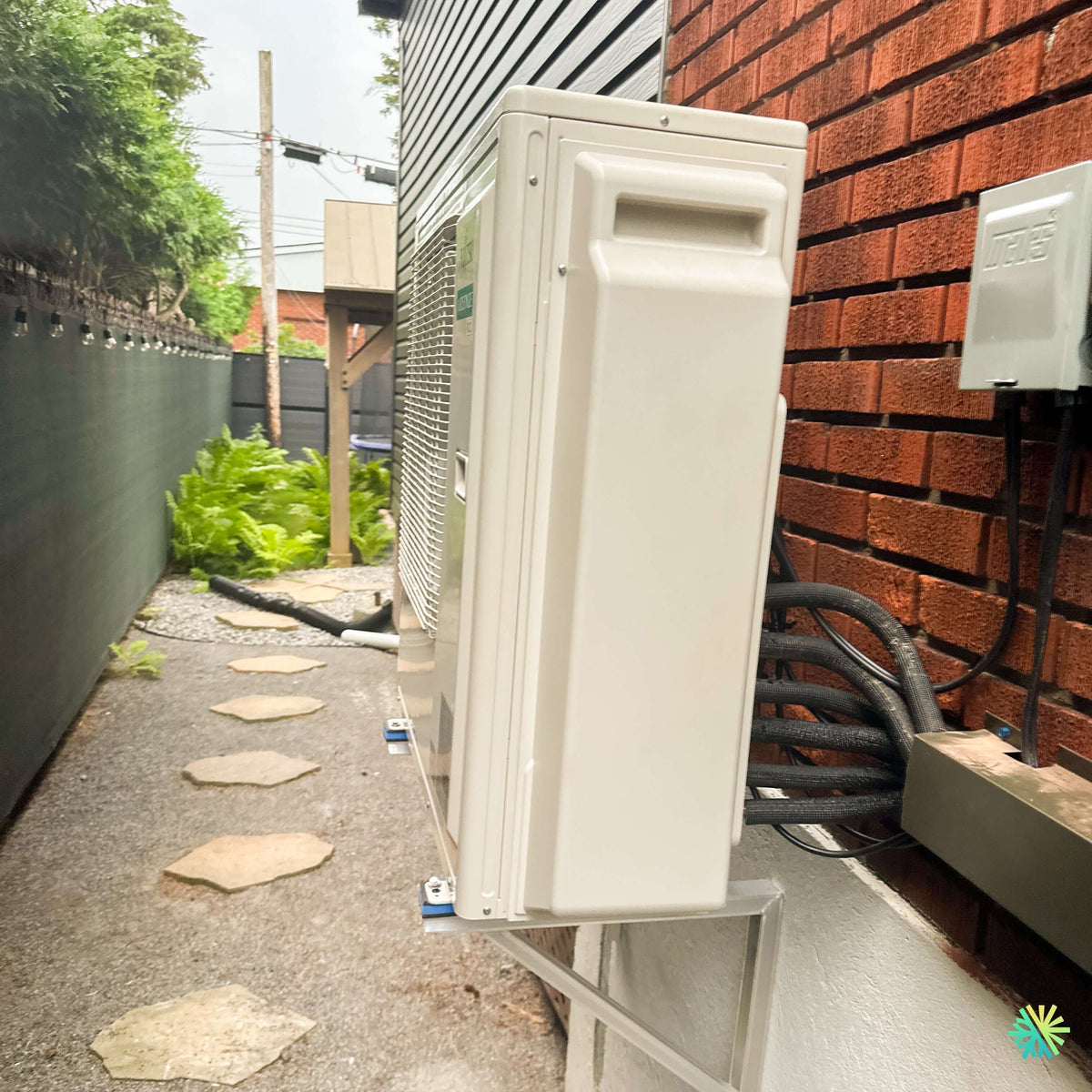
The photo of this project clearly shows one of these challenges. The Fujitsu AIRSTAGE condenser was installed in a relatively narrow side passage, between a brick wall and the landscaped property boundary. Despite this constraint, we had to maintain an orderly, safe, and accessible configuration.
The installation of the unit on a raised metal structure, rather than directly at ground level, is particularly noteworthy. Several insulated refrigerant lines converge at the outdoor unit, making it immediately clear that this is a multi-zone system rather than a simple single-zone wall-mounted heat pump.
Why install a Fujitsu Aquila XLTH triple-zone system instead of three independent systems?
To serve three zones with heat pumps, there are two main approaches.
The first is to install three independent systems, and therefore three outdoor units. This solution may be suitable in some buildings, but it requires more outdoor space and multiplies the number of condensers, electrical circuits, and visible equipment around the property.
The second approach is to use a multi-zone heat pump equipped with a single outdoor compressor that can serve several indoor units.
For this Sainte-Victoire-de-Sorel installation, the second approach made it possible to group most of the system in a single location.
The Fujitsu technical documentation for the AIRSTAGE H Aquila series indicates that the range offers outdoor units rated at 18,000, 24,000, 36,000, and 45,000 BTU/h, with the ability to connect up to two, three, four, or five indoor units, respectively, depending on the model and approved combinations. It also allows different wall-mounted units, Slim Duct units, compact cassettes, and Mid Static Duct units to be combined.
This flexibility is particularly important in a triple-zone configuration, since three rooms almost never have exactly the same needs.
Three zones do not mean three identical capacities
A common mistake when choosing a triple-zone heat pump is to simply divide the outdoor unit’s capacity by three.
A house is not thermally symmetrical.
A large, sun-exposed open area may require much more air conditioning than a small bedroom on the shaded side. An upper floor generally accumulates more heat in summer. A basement often has a much lower cooling load, but may have particular heating needs in winter.
We must therefore consider, among other factors:
- the actual area of each zone;
- ceiling height;
- the number and orientation of the windows;
- the building’s insulation;
- sun exposure;
- the layout of the floors;
- air infiltration;
- the use of each room;
- the distance between the indoor units and the condenser.
This is precisely why Fujitsu publishes highly detailed approved combination tables.
For an outdoor system capable of serving three zones, the documentation presents, for example, various combinations of indoor units such as 7 + 7 + 7, 7 + 7 + 9, 7 + 9 + 12, 9 + 9 + 12, and several other configurations. These figures represent the rated capacity categories of the indoor units in thousands of BTU/h.
It is therefore not a matter of arbitrarily choosing three wall-mounted units and connecting them to just any outdoor unit.
A multi-zone outdoor unit capable of accepting a connection capacity greater than its rated capacity
Fujitsu documentation also specifies that certain configurations allow for a connection capacity of up to 130%.
This feature is often misunderstood.
Suppose a combination of indoor units represents a total nominal capacity greater than that listed for the outdoor unit. This does not mean that the condenser will suddenly produce 130% of its maximum output.
Fujitsu explicitly states that exceeding 100% combined capacity does not increase the system’s output capacity.
In practice, this flexibility is mainly used to design a system suited to zones whose peak demands do not necessarily occur at the same time.
This is an essential distinction when a homeowner compares multiple quotes for a multi-zone HVAC installation.
The photo reveals a significant challenge: several refrigerant lines in a very limited space
The most visible technical aspect of this installation in Sainte-Victoire-de-Sorel is the grouping of the lines.
In the photo, several insulated lines run directly toward the back of the Fujitsu outdoor unit. In a three-zone system, each indoor unit must be properly integrated into the refrigeration circuit according to the configuration specified by the manufacturer.
In a narrow passage like this one, we must arrange the lines to avoid several problems:
- excessively tight bends;
- crushed pipes;
- a disorderly crossing of the lines;
- damaged insulation;
- blocked access to the service panels;
- an installation that would become difficult to diagnose several years later.
An installation may work on the day it is commissioned and yet become very problematic when maintenance is required five or ten years later. We therefore always try to think not only about the initial installation, but also about the next technician who will need to access the equipment.
Why raise the outdoor unit?
In this installation, the condenser is clearly installed on a metal bracket attached to the building’s structure.
This choice has several advantages in Quebec’s climate.
First, a heat pump operating in winter must remain as clear as possible of accumulated snow. During heating, the outdoor unit must draw a large amount of air through its heat exchanger.
If the condenser base becomes buried under a significant accumulation, operating conditions may deteriorate.
Next, a heat pump periodically performs defrost cycles. The water produced by this process must be able to drain and freeze in a location that does not immediately block the bottom of the machine.
Finally, a raised unit is generally more accessible for certain HVAC maintenance tasks, particularly inspecting the base, connections, and coil.
In this case, the side passage also contains gravel, stepping stones, and vegetation. The support keeps the condenser well above this area while preserving ground space.
An installation near a brick wall requires precise planning
Brick buildings are extremely common in our installations in Montreal, Laval, Longueuil, the North Shore, and the South Shore, and they present certain recurring challenges.
In particular, we must determine where to pass through the wall for the refrigerant and electrical lines without unnecessarily compromising the masonry.
The ideal route is rarely simply the shortest one. It is also necessary to consider what is on the other side of the wall: the structure, plumbing, wiring, interior finish, and location of the units.
In this installation, grouping the lines immediately near the outdoor unit helps limit the exposed piping in the passageway.
The electrical disconnect is also installed near the heat pump, an important measure that allows the equipment to be electrically isolated during technical work.
Fujitsu Aquila XLTH: understanding what makes a multi-zone system worthwhile in Quebec
Individual comfort is the true advantage of zoning
A Fujitsu triple-zone heat pump does not turn a home into three completely independent systems, but it gives occupants much more control than a single unit installed in a central area.
According to Fujitsu documentation, each indoor unit can be controlled independently with its own remote control.
This means that it becomes possible to choose a different setpoint for each space.
For example, a bedroom can remain cooler overnight while a living room maintains a slightly different temperature. A rarely used zone can be set more moderately.
The Inverter technology compressor then adjusts its operation to the system’s demand. Fujitsu indicates that this modulation is intended to improve comfort and energy savings compared with strictly on-off operation.
An important limitation to know: heating and cooling do not operate simultaneously
However, zone independence has one limitation that is best explained before installation.
Fujitsu multi-zone systems provide heating and cooling, but not simultaneously in opposite modes.
In other words, one indoor unit cannot call for heating while another, connected to the same condenser, simultaneously calls for cooling.
For the vast majority of residential applications, this operation makes perfect sense: when it is -15 °C outside, all zones generally need heating. During a hot day in July, the opposite is true.
The situation must nevertheless be assessed in certain buildings with significantly different solar exposures or particular internal loads.
A product range designed for cold temperatures
The documentation provided for the Fujitsu Aquila series includes the CTEB versions, designed for heating in cold climates down to -26 °C (-15 °F). It also indicates cooling operation down to an outdoor temperature of 50 °C (122 °F) for these versions.
For an installation in the Sainte-Victoire-de-Sorel region, winter performance is obviously an essential criterion.
However, we always distinguish between:
the minimum temperature at which equipment can operate and the heating capacity it can still provide when it is very cold.
This distinction is critical when sizing a heat pump in Quebec.
SEER2 and HSPF2 figures and rebates must be verified according to the exact combination.
With multi-zone systems, efficiency data should not be generalized to the entire product family.
The SEER2, EER2, and HSPF2 values, low-temperature capacity, and certification number may vary depending on the outdoor unit and the exact combination of indoor units.
The Fujitsu document provided with this project presents the capacities, compatible models, and authorized combinations, but these pages do not provide a unique SEER2 or HSPF2 rating that would allow a precise value to be assigned to the installation shown in the photograph.
The same applies to rebates available in Quebec: eligibility must be validated based on the exact combination installed, the AHRI number, or the reference recognized by the applicable program at the time of application.
We therefore prefer to avoid announcing a rebate amount simply because the name “Fujitsu Aquila” appears on the equipment.
The indoor units are not necessarily all wall-mounted.
Another advantage of the AIRSTAGE Aquila platform is the ability to combine multiple indoor unit formats.
Fujitsu lists, among others:
Wall-mounted units, suitable for many bedrooms and open areas;
Slim Duct units, which can be concealed in a ceiling or mechanical space;
compact cassettes, integrated into the ceiling;
Mid Static Duct units, intended for ducted applications.
This flexibility makes it possible to adapt the installation to the building’s architecture instead of systematically imposing three visible wall-mounted units.
However, Fujitsu imposes certain limits on the number of Mid Static Duct units that can be combined with certain outdoor units. These restrictions are among the reasons why the selection of a multizone system must be carried out using the manufacturer’s tables and tools.
One point Fujitsu itself emphasizes: combination tables do not replace proper sizing
The note included directly in the documentation is particularly important: combination tables must not be used to select system capacity.
Fujitsu recommends using its Design Simulator to select AIRSTAGE H Series equipment.
This aligns exactly with our approach on an AirGreen project.
A combination may be technically permitted by the manufacturer without necessarily being suitable for the building.
An installer’s work therefore does not consist solely of checking whether three models appear on the same line of a table. We must determine whether this combination matches the actual loads of each space.
Thorough commissioning is particularly important with three zones
When several indoor units share the same condenser, the quality of the commissioning becomes critical.
In particular, we must check:
- compliance of the refrigerant connections;
- the tightness of the circuit;
- the quality of the vacuum process;
- the correct configuration of the three zones;
- the electrical power supply;
- condensation drains;
- the operation of the indoor units;
- the compressor’s response to different demands;
- air circulation;
- the clearance around the condenser.
An error on a single branch can affect the overall system’s behavior.
That is also why a very clean multizone installation on the outside is generally a good indication of the thought that went into the connection work.
What this installation in Sainte-Victoire-de-Sorel demonstrates particularly well
This project is interesting because it did not take place in a large, open area where the condenser could be placed anywhere.
We had to integrate a Fujitsu Aquila XLTH triple-zone system into a relatively compact side passage, against a brick wall and with several refrigerant circuits to connect.
The selected solution makes it possible to group:
- a single outdoor unit;
- three indoor zones;
- several refrigerant lines carefully brought back to the same point;
- a raised support;
- an accessible electrical disconnect;
- a location that preserves ground-level passage.
This is exactly the type of project where the difference between an improvised installation and a planned HVAC installation becomes very apparent.
Mistakes to Avoid When Buying a Three-Zone Heat Pump
When we meet homeowners comparing different multi-zone solutions in Sainte-Victoire-de-Sorel, Montreal, Laval, Longueuil, on the North Shore or South Shore, a few mistakes come up regularly.
The first is to choose the outdoor unit solely based on the home’s total area.
The second is to select three indoor units with the same capacity without calculating the needs of each zone.
The third is to ignore the manufacturer’s compatibility tables.
The fourth is to place the outdoor unit where it is least visible, without considering airflow, snow, and access for maintenance.
The fifth is to compare only the purchase price without considering the quality of the refrigerant piping route, outdoor support, drainage, and commissioning.
With a multi-zone heat pump, these details have a direct impact on the quality of the final result.
AirGreen and Fujitsu multi-zone installations in Montérégie and Greater Montreal
At AirGreen, we work on installations where equipment selection must go hand in hand with the realities of the building.
A three-zone heat pump can be an excellent option when a home has several areas with different needs, but it must be designed as a complete system.
This Fujitsu Aquila XLTH installation in Sainte-Victoire-de-Sorel is a good example: the outdoor unit had to be integrated into a narrow side space, the three lines were neatly grouped together, and the condenser was raised to better suit Quebec’s outdoor conditions.
The real advantage, therefore, lies not merely in having “three heads on one machine.” It lies in the ability to create three coherent, properly sized comfort zones powered by a single outdoor platform.
For us, it is this combination of sizing, equipment selection, installation quality, and commissioning that enables a Fujitsu multi-zone heat pump to deliver the performance and comfort sought for many seasons.
The big day, step by step
The main steps of this kind of job at AirGreen. Every house has its quirks: the estimate brings them out.
We look at the room, the outside wall, the line route and where the outdoor unit will go. That is where the capacity gets chosen.
Model, capacity and price, in writing. We also check whether the model qualifies for assistance programs.
Floors and furniture protected, wall plate position marked level, wall opening located.
A single opening, with the slope the drain needs to flow outside.
Set on a stand raised above the snow, with the clearances the manufacturer requires.
Connected, insulated and protected. The opening is then sealed against water, cold air and insects.
A dedicated circuit and an accessible disconnect near the outdoor unit.
Leak test, vacuum, then start-up and a check of heating and cooling.
Remote, modes, filters: we show you the essentials before we leave.
- The on-site estimateWe look at the room, the outside wall, the line route and where the outdoor unit will go. That is where the capacity gets chosen.
- The quoteModel, capacity and price, in writing. We also check whether the model qualifies for assistance programs.
- Getting readyFloors and furniture protected, wall plate position marked level, wall opening located.
- The wall openingA single opening, with the slope the drain needs to flow outside.
- The outdoor unitSet on a stand raised above the snow, with the clearances the manufacturer requires.
- Lines, cable and drainConnected, insulated and protected. The opening is then sealed against water, cold air and insects.
- The electrical workA dedicated circuit and an accessible disconnect near the outdoor unit.
- Tests and start-upLeak test, vacuum, then start-up and a check of heating and cooling.
- The walkthroughRemote, modes, filters: we show you the essentials before we leave.
What would it look like at your place?
Two quick checks with real numbers: what heat costs, and what your current heaters add up to in BTU/h.
Conversion: 1 W = 3.412 BTU/h. An indication, not a load calculation: baseboards and furnaces are often stronger than the real need, and they can stay as backup. AirGreen confirms the capacity on site.
Four mistakes we do not make
Flip each card to see what we do instead.
Your own project, step by step
What to do, season by season
Three habits per season for this unit. They take a few minutes and prevent many calls.
- Clean the indoor unit's filters.
- Clear leaves and debris left on the outdoor unit by winter.
- Test cooling before the first hot days.
- Clean the filters more often when the unit runs a lot.
- Keep plants away from the outdoor unit.
- Check that no water drips from the indoor unit.
- Rake the leaves around the outdoor unit.
- Test heating before the first cold days.
- Book periodic maintenance before winter.
- Keep snow away from the stand and the front of the unit.
- Let the unit defrost: it is normal.
- Never hit the ice on the fins; call us if the unit stays iced up.
Is your home ready?
Check what applies at your place. A "no" is not a refusal: it is what we sort out during the estimate.
Four statements: true or false?
It all comes down to details you have just seen.
1. In heating mode, the outdoor unit can produce water.
During defrost cycles. That water must drain away without forming ice.
2. You pick the capacity with a simple square-footage rule.
Windows, insulation, orientation and how the room is used all count. Capacity is chosen on site.
3. A multi-zone connects several indoor heads to a single condenser.
One head per room, all on the same condenser. Each room keeps its own temperature.
4. The disconnect can sit behind the patio furniture.
It must stay accessible: it is what shuts the unit off for service.
0 / 4 right answers
What people ask us about this kind of work
Does a wall-mounted heat pump heat in winter?
Wall-mounted or multi-zone: how do I choose?
Where does the outdoor unit go?
Are there grants?
Do I need a permit?
How cold can it heat?
How much can I save?
How is the LogisVert assistance calculated?
Is it noisy?
The outdoor unit is covered in ice: is that normal?
Does AirGreen hold the required licences?
Is the estimate free?
No question matches. Write to us: we answer.
More jobs to see, near you
By town, by equipment or by region: browse more than 4,700 published projects.
Each dot: a town where AirGreen has published projects. The glowing dot: this job.
Every house has its constraints. We see them before we install.
The on-site estimate is free and the quote follows within 24 hours.
Text and photo: a real AirGreen Climatisation & Chauffage job. The diagrams are generic illustrations of the type of installation, not a survey of this job site. Sources of the added figures: airgreen.ca product pages (NEEP / AHRI performance), Hydro-Québec (Heat pumps page, LogisVert, read on 13 October 2026), Régie de l’énergie (rate D as of 1 April 2026).