
Installation of a FANTECH HERO 100E air exchanger in the Verdun borough of Montreal
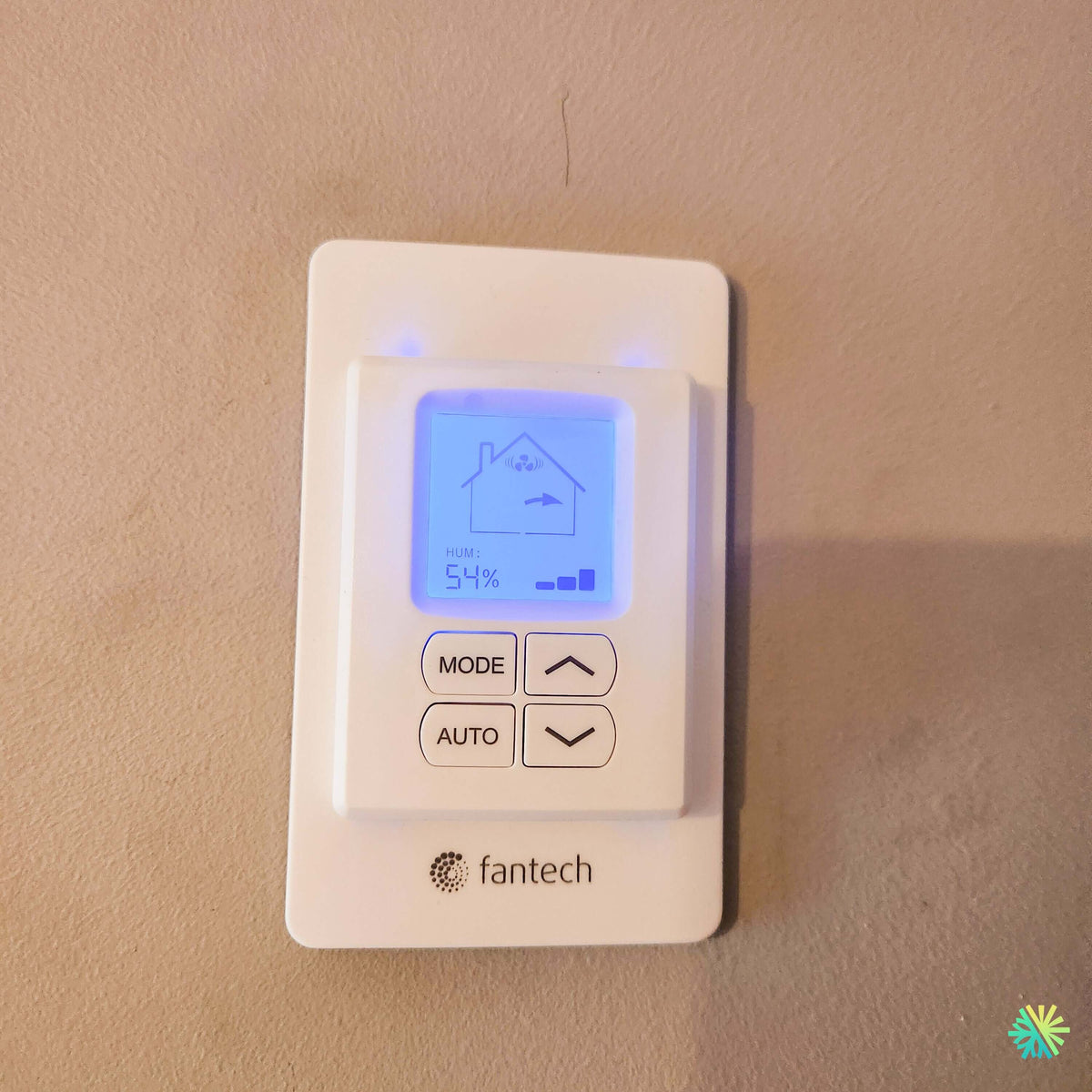
Humid basement in Verdun, with the screen showing 54% humidity: here’s why we chose a FANTECH HERO 100E heat recovery ventilator (ERV, 70% total recovery during heat waves) rather than an HRV, and how to adjust it.
- City
- Region
- Equipment
- Brand
- Challenges
- Published
The job on one screen
The article, chapter by chapter
“HUM: 54%” displayed on the hallway wall: what this number means, and what it does not mean
The wall control of an air exchanger continuously displays two pieces of information: the operating mode and the relative humidity measured in the home. At this Verdun job, the screen showed 54% when the system was commissioned, in the middle of August.
This number is perfectly acceptable in summer. The same number displayed on a January morning would indicate a building with a problem. That is the subtlety of indoor humidity: there is no single correct value; there is a correct value for the season, the outdoor temperature, and the type of windows installed. Almost no one explains this to homeowners when the unit is delivered, and it is probably the leading cause of improper use of an HRV or ERV in Quebec.
This article describes the installation of a FANTECH HERO 100E in a plex in Verdun and details what we explain to every client at the wall control before leaving.
The context: a half-basement two blocks from the river
The unit occupied the ground floor and half-basement of a 1950s plex, near the riverside promenade. Renovated three years earlier, insulated from the inside, with triple-sealed windows.
The complaint was not winter-related, unlike most of the calls we receive about an air exchanger. It was a summer problem. From late June to mid-September, the half-basement became damp. The bathroom towels did not dry from one day to the next. An earthy smell developed behind furniture placed against the foundation wall. The owner ran a portable dehumidifier and emptied it twice a day.
Two factors combined: the proximity of the river, which keeps outdoor humidity high in this part of Montreal throughout the summer, and a building made airtight without any mechanical air exchange being provided.
HRV or ERV: the distinction vendors gloss over
This is where the equipment choice was made, and it is worth explaining properly because the confusion is widespread.
A HRV—heat recovery ventilator—transfers only heat between outgoing and incoming air. In January, it recovers heat from stale air before expelling it. In July, it brings in outdoor air with all its moisture.
An ERV—energy recovery ventilator—transfers heat and some of the water vapor. In summer, some of the moisture in the incoming outdoor air is transferred to the outgoing stale air before it even reaches the house. In winter, the mechanism works in reverse and retains some of the moisture indoors that would otherwise be expelled.
What an ERV does, and especially what it does not do
Let's be precise, because this is exactly where disappointed customers come from: an ERV is not a dehumidifier. It does not remove moisture already present in the house. It reduces the amount of moisture that ventilation brings in from outside. The distinction is crucial.
In a half-basement in Verdun in July, an ERV therefore does two useful things: it prevents stagnant air from settling in, and it limits the moisture load brought in from outside. What remains—the vapor produced by showers, cooking, laundry, and occupants—must be removed by exhaust, while residual basement humidity is a matter for air conditioning or a properly sized dehumidifier.
We say this before signing, never afterward.
HERO 100E specifications
- Airflow: 40 to 102 ft³/min at 0.4 in. w.g., four 5-inch round connections on top.
- Adjusted sensible recovery efficiency: 88%, the best in the manufacturer's range of residential ERVs. Sensible recovery of 82% at 0 °C and 60% at -25 °C.
- Total recovery efficiency at 35 °C: 70%. This is the summer figure, the one that describes moisture transfer during a heat wave, and it is precisely the figure we examined for this building.
- Power consumption: 42 W at low speed, 91 W at high speed, maximum current of 1.0 A, efficiency of 1.2 ft³/min per watt.
- Recirculation defrost, the most energy-efficient mechanism and the one best suited to cold or humid outdoor conditions.
- Dimensions: 24 1/4 in × 23 1/4 in × 11 1/2 in, 47 lb, suspended by chains.
The wall control: the element almost everyone overlooks
A properly installed unit that is operated incorrectly produces the same result as a unit that is not there. We systematically devote the final half hour of a project to the controls.
Reading the display
The display combines three pieces of information:
- The house icon, with the fan symbol and an arrow indicating the current direction of airflow. This lets you see at a glance whether the unit is ventilating, recirculating, or stopped.
- The relative humidity reading, preceded by HUM. This is a measurement, not a setting: it describes the air in the room where the control is installed.
- The speed indicator, shown as bars. The more solid bars there are, the higher the airflow.
The modes and what they are actually for
The MODE button cycles through the unit's operating modes. The AUTO button lets the unit manage its own airflow based on measured humidity, and the arrows manually adjust the speed or setting.
- Ventilation mode is the one that brings in fresh air. It is the normal operating mode, to be maintained continuously at low speed.
- Recirculation mode circulates indoor air without bringing in outdoor air. It is used to even out temperatures between floors and during episodes of smog or wildfire smoke, when outdoor air is temporarily worse than indoor air.
- Standby mode shuts off ventilation. This is the setting in which we find appliances every year after an occupant paused them “for two days” three years ago.
The seasonal setting, the part we write down on paper
The humidity setting is not something you set once and leave unchanged. It shifts with the outdoor temperature.
In winter, the target value decreases as it gets colder outside. Around 0°C, a well-maintained home should be between 35% and 40%. At -20°C, it is often necessary to lower it to between 25% and 30%; otherwise, vapour condenses on the windows and runs into the frames. The most reliable indicator is not the display: it is the bottom of the coldest window in the house. If it is wet in the morning, the setting is too high, regardless of what the control displays.
In summer, the goal is to stay below 60%, ideally between 45% and 55%. The 54% recorded during commissioning was therefore within the appropriate range, at the high end, which matched exactly the muggy feeling described by the owner.
We are leaving these reference points in writing, along with the commissioning date and the measured airflow rates.
How the work proceeded
Control location
One detail that has a direct impact on the measurement: the control was installed in the central hallway, about 1.5 metres above the floor, away from heat sources and door drafts, and especially not in the bathroom or kitchen. A control installed in a bathroom reads 80% humidity every time someone takes a shower and makes the unit ramp up for no reason. The control cable was run to the unit at low voltage, separately from the power circuits.
The network
Since the unit had no central air distribution, an independent network was built:
- Exhaust in the bathroom, laundry room, and at the back of the half-basement—the dampest area of the home, and the one most often overlooked.
- Supply in both bedrooms and the living room, using insulated rigid ducts for most of the run.
- Exterior hoods installed through the side wall, spaced apart, oriented away from the adjacent dryer vent, and raised above the snow accumulation level.
- Condensate drain with a trap, continuously sloped to the drain, and tested with water.
- Manometer balancing at the end of the project, with supply and exhaust brought to within ten percent of each other.
The constraints specific to a half-basement
The clear height was six feet ten inches below the exposed joists. Every elbow gained in height came at the expense of clearance for movement. We therefore positioned the unit in the least-used corner of the mechanical room, while maintaining the front access needed to remove the core, and routed the ducts along the joists rather than across them, avoiding unnecessary penetrations and pressure losses.
A day and a half of work, with two technicians.
The humidity benchmarks we leave with every client
- Wet windows in the morning during winter: humidity is too high. Increase the airflow from the air exchanger and make sure the range hood and bathroom fan are being used.
- Dry throat, static electricity, wood floors creaking in February: humidity is too low. Reduce the airflow and consider a humidifier.
- Stale odor returning despite the unit running: insufficient airflow or a clogged filter, often both.
- Display showing a stable reading while the air feels heavy: check the controller's location before drawing any conclusions.
- Unit silent for weeks: standby mode. This is the first thing to check, before calling for service.
The mistakes we correct most often with this type of installation
- Choosing an HRV believing you are buying a dehumidifier. It limits incoming humidity; it does not remove humidity that is already there.
- Place the controller in a bathroom or near a supply vent. The readings become unusable.
- Never adjust the setpoint between December and July. A single year-round setting guarantees being wrong half the time.
- Forget to exhaust air from the basement's lowest point. That is where the most humid air accumulates.
- Discharge stale air a few feet from the intake. The unit re-aspirates what it has just expelled and operates in a vacuum.
Eligibility for grants
The Québec government's Rénoclimat program provides assistance of $500 for installing or replacing an HRV or ERV, provided the unit is certified by the Home Ventilating Institute (HVI) and an energy evaluation is conducted before and after the work, with the first evaluation taking place before the project begins. No retroactive claims are accepted. The terms and amounts change from year to year: confirm them when planning the work.
ERV maintenance
An ERV core transfers moisture, making it more susceptible to clogging than an HRV core.
- Every three months: Remove and clean the filters, and check that no vent is blocked by furniture or a curtain.
- Once a year: Remove the core and clean it according to the manufacturer's prescribed method for moisture-transfer cores, which is not the same as the method for an HRV core.
- Twice a year: Clear the exterior hoods.
HVAC maintenance performed at these intervals keeps the advertised 70% total recovery rate intact. If neglected, a clogged core first loses airflow, then efficiency, without triggering any alarm.
AirGreen in Verdun and Greater Montréal
We serve Verdun, L'Île-des-Sœurs, the Southwest, LaSalle, Lachine, and all of the boroughs of Montréal, as well as Laval, Longueuil, the North Shore, and the South Shore. We install air exchangers, wall-mounted and central heat pumps, and residential ventilation systems suited to the building rather than the catalog.
If your basement is damp every summer, your windows leak condensation every winter, or you have never known what the buttons on the wall control installed in your hallway were for, call us. We measure, adjust, and explain what your unit does—with the numbers to back it up.
How the job unfolds
The main steps of this kind of job at AirGreen. Every house has its quirks: the estimate brings them out.
We locate the wall for the two outdoor hoods, the unit's spot, service access and the drain.
The unit, its location and the price, in writing.
Hung or set level, with clear access to the filters and the core.
Fresh air intake and exhaust, kept apart and sealed.
The ones connected to the outside are insulated to prevent condensation inside the house.
Connected with its loop, when the unit needs one.
Installed where you will see it and use it.
Incoming and outgoing airflows are adjusted so the house is neither pressurized nor depressurized.
Speeds, filters, core: how to use it through the seasons.
- The on-site estimateWe locate the wall for the two outdoor hoods, the unit's spot, service access and the drain.
- The quoteThe unit, its location and the price, in writing.
- The unitHung or set level, with clear access to the filters and the core.
- The outdoor hoodsFresh air intake and exhaust, kept apart and sealed.
- The ductsThe ones connected to the outside are insulated to prevent condensation inside the house.
- The drainConnected with its loop, when the unit needs one.
- The wall controlInstalled where you will see it and use it.
- BalancingIncoming and outgoing airflows are adjusted so the house is neither pressurized nor depressurized.
- The walkthroughSpeeds, filters, core: how to use it through the seasons.
What we check on a job like this one
Each number is a point we check on site. Switch between summer and winter to watch air and heat move.
Generic illustration of this type of installation, not a survey of this job site. Tap a number.
It removes stale air and brings in fresh air. The two airflows cross in the core without mixing.
It recovers part of the heat from the outgoing air to temper the incoming air. Depending on the model, it also manages humidity.
An outdoor hood, kept away from the exhaust so the house does not pull back the air it just removed.
Humid, stale air leaves through its own hood, fitted with a damper.
The ducts that connect to the outside are insulated to prevent condensation inside the house.
Stale air is drawn from humid rooms and fresh air is sent to living areas. The airflows are balanced.
It sets the mode and speed. You use it more when the house is humid or full of people.
Depending on the model and the season, the core produces condensation, removed through a drain with its loop.
Is your home ready?
Check what applies at your place. A "no" is not a refusal: it is what we sort out during the estimate.
Good habits, once the unit is in place
Six simple habits that keep the unit going. Your list stays on this device.
What to do, season by season
Three habits per season for this unit. They take a few minutes and prevent many calls.
- Clean the filters and core as the manufacturer specifies.
- Check the outdoor hoods: nests, debris, dampers.
- Lower the speed if the outdoor air gets humid.
- Adjust the speed to the humidity in the house.
- Check that the drain flows.
- Keep the outdoor hoods clear.
- Clean the filters before the closed-house season.
- Check the exhaust damper.
- Book a full cleaning if the unit has not had one in a long time.
- Clear snow from both outdoor hoods.
- Raise the speed if condensation appears on windows.
- Let the unit run: with the house closed, humidity builds up.
The right pages, at the right time
Four statements: true or false?
It all comes down to details you have just seen.
1. In an air exchanger, fresh air and stale air mix.
The two airflows cross in the core without mixing.
2. The two outdoor hoods must be kept apart.
Otherwise the exchanger pulls back the air it just removed.
3. An air exchanger can help with condensation on windows.
It renews the air and helps keep humidity in the right range.
4. An exchanger never needs maintenance.
Filters and core get dirty and need regular cleaning.
0 / 4 right answers
What people ask us about this kind of work
What does an air exchanger do?
Does fresh air cool the house in winter?
What speed should it run at?
Does an exchanger need cleaning?
What are the signs of poor ventilation?
HRV or ERV: what is the difference?
Should it run in winter?
Does AirGreen hold the required licences?
Is the estimate free?
No question matches. Write to us: we answer.
More jobs to see, near you
By town, by equipment or by region: browse more than 4,700 published projects.
Each dot: a town where AirGreen has published projects. The glowing dot: this job.
An on-site estimate, the right capacity, the right equipment.
The on-site estimate is free and the quote follows within 24 hours.
Text and photo: a real AirGreen Climatisation & Chauffage job. The diagrams are generic illustrations of the type of installation, not a survey of this job site. Sources of the added figures: airgreen.ca product pages (NEEP / AHRI performance), Hydro-Québec (Heat pumps page, LogisVert, read on 13 October 2026), Régie de l’énergie (rate D as of 1 April 2026).