
Installation of a Lifebreath RNC5-HEX-TPD air exchanger in Deux-Montagnes, on the North Shore
Window condensation and 60% humidity in a renovated home in Deux-Montagnes. Our installation of a Lifebreath RNC5-HEX-TPD air exchanger: HRV vs. ERV choice, mechanical room constraints, measured balancing, and maintenance.
- City
- Region
- Equipment
- Brand
- Challenges
- Published
The job on one screen
The article, chapter by chapter
An airtight home, crying windows: the project that brought us to Deux-Montagnes
The homeowner contacted us in February, after spending a third winter wiping the bottoms of his windows every morning. His Deux-Montagnes home, a 1,650-square-foot bungalow renovated three years earlier—new windows, spray foam insulation in the crawl space, and replaced doors—had become noticeably more comfortable. It had also become too airtight to breathe on its own.
We encounter this scenario constantly on the North Shore. Energy-efficiency upgrades reduce heating bills, then create a humidity problem that the building envelope can no longer expel. Here is how we corrected it, with the figures, the actual constraints of the mechanical room, and the technical decisions behind each choice.
What the assessment revealed before we proposed anything
We never recommend a unit before taking measurements. Our technician spent an hour on-site with a hygrometer and a thermal camera.
- Indoor relative humidity: 58% to 61%, depending on the room, on a day when the outdoor temperature was -14°C. The healthy target is between 30% and 40% during Quebec winters.
- Condensation: abundant on the north-facing window frames, with the beginnings of mold in two corners of the primary bedroom.
- Existing ventilation: two bathroom fans and a range hood. No fresh-air intake. No air exchanger.
- CO₂ in a closed bedroom: above 1,400 ppm after a night, a direct indicator of insufficient ventilation.
The diagnosis was unequivocal. The house produced the normal amount of humidity generated by four occupants—showers, cooking, laundry, and breathing—with no controlled way for it to escape.
Why choose an HRV rather than an ERV in the Lower Laurentians
This is the first question to settle, and it is often misunderstood. An ERV (energy recovery ventilator) also transfers moisture between the two air streams. Useful in a hot, humid climate, where you want to prevent outdoor humidity from entering during the summer.
Deux-Montagnes se trouve en zone climatique 1 selon la classification de Lifebreath : hiver froid et prolongé, air extérieur sec. Dans ce contexte, un VRC — ventilateur récupérateur de chaleur, ou échangeur d'air au sens courant — est le bon appareil. Il récupère la chaleur sans retenir l'humidité, ce qui est précisément l'objectif quand le problème est un excédent d'humidité intérieure.
Deux-Montagnes is in climate zone 1 according to Lifebreath's classification: cold, prolonged winters and dry outdoor air. In this context, an HRV — heat recovery ventilator, or air exchanger in common usage — is the right unit. It recovers heat without retaining moisture, which is precisely the goal when the problem is excess indoor humidity.
Installing an ERV in this house would have worsened condensation. We still see improperly selected units in homes in Laval, Blainville, and Saint-Eustache, installed based on catalogs rather than the actual climate.
The Lifebreath RNC5-HEX-TPD: the data behind the selection
We selected the Lifebreath RNC5-HEX-TPD, an ENERGY STAR-qualified, HVI-certified residential HRV.
The patented HEX counterflow core
This is the element that distinguishes this unit from the standard RNC5 series. The HEX aluminum core operates in counterflow rather than cross-flow: the two air streams travel in opposite directions over a longer contact distance, increasing heat transfer.
The core is thermally conductive, fully washable, and removable by hand for cleaning. Lifebreath covers it with a lifetime warranty, including 5 years on replacement parts.
Measured performance, not marketing performance
| Here are the HVI-certified values for the RNC5-HEX-TPD, which we use for sizing: | Parameter |
|---|---|
| Value | 85 % Sensible recovery efficiency (SRE) at 0 °C |
| Apparent sensible effectiveness (ASE) at 0 °C | 77 % Sensible recovery efficiency (SRE) at 0 °C |
| SRE at 0 °C | 75% at 64 cfm |
| SRE at -25 °C | 69 % at 68 cfm |
| Net supply airflow at 0.1 in. w.g. | 110 cfm |
| Net airflow at 0.4 in. w.g. | 89 cfm |
The figure to remember is the 69% SRE at -25 °C. Many spec sheets display only efficiency at 0 °C, a temperature that has nothing to do with a January night in Deux-Montagnes. This unit retains more than two-thirds of the heat from stale air even in extreme cold.
Negligible power consumption
- 36 W at low speed (continuous operation mode, 90% of the time)
- 55 W at high speed
- 120 V, 0.5 A
In continuous low-speed operation, the unit consumes less than an old-fashioned incandescent light bulb. This is an argument we repeat often: concerns about the electricity bill make some homeowners hesitate, even though the actual annual cost amounts to tens of dollars.
Size and connection
- Dimensions: 18 3/4 in (H) × 29 1/4 in (W) × 15 in (D)
- Weight: 50 lb
- Collars: 5 in (125 mm), four in total
- Defrosting by recirculation damper (TPD version)
- Two 1/2-inch condensate drains
- Pre-painted 20-gauge galvanized steel cabinet, insulated against exterior condensation
- Balancing ports built into the door
The mechanical room: where the installation was really determined
The technical data sheet is the easy part. The job site never looks like the catalog.
Tight headroom beneath the slab
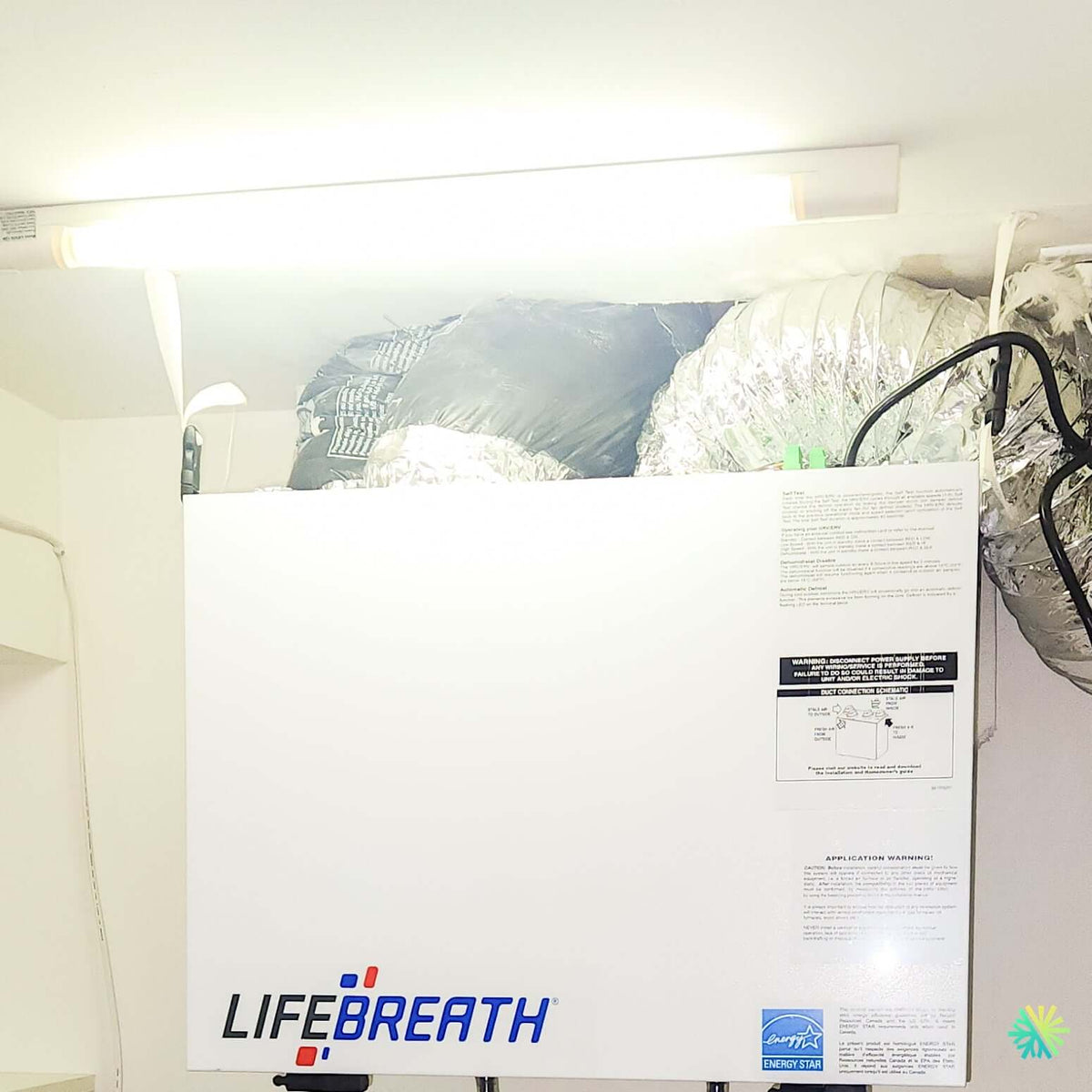
The mechanical room in this house is a utility room adjacent to the laundry room, with a finished ceiling and a surface-mounted fluorescent light fixture installed in the center. The available space between the top of the unit and the ceiling was limited—and the four collars of the RNC5-HEX-TPD exit precisely through the top.
Our solution: suspend the unit from the four threaded inserts at the cabinet corners using the supplied S-hooks and straps, shifting it laterally to create a duct corridor beneath the ceiling rather than above the unit. The insulated flex ducts run horizontally to the exterior wall instead of rising vertically.
A common mistake is to screw the unit directly to the floor joists. The suspension straps are not decorative accessories: they isolate motor vibrations from the structure. A rigidly bolted HRV transmits a hum throughout the house, and correcting it is impossible without removing the entire installation.
The 25-inch front clearance
Lifebreath specifies 25 in. (635 mm) of clearance in front of the unit for servicing. This is not an optional recommendation: it is the space required to open the door, remove the core, and take out the filters.
We repositioned an existing storage shelf to preserve this clearance. We categorically refuse to install an air exchanger in a space where maintenance will become impractical—a unit that cannot be cleaned is a unit that will stop working properly within three years.
Insulated flexible ducts and runs to the outdoors
The two ducts connecting the unit to the outdoor intake and exhaust grilles are insulated flex ducts with a continuous vapor barrier. This is mandatory, not optional: an uninsulated fresh-air duct running through a heated space will develop condensation and eventually drip into the ceiling.
We paid close attention to three points that are often handled poorly:
- Seal the vapor barrier at the collars with aluminum tape and a hose clamp to prevent any moisture bridging.
- Keep the bend radius generous. A crushed flexible duct in a tight bend can reduce airflow by 20 to 30%, undermining the entire design.
- 99-185 weather caps (5 inches, with 1/4-inch mesh), spaced according to the minimum clearances to prevent any recirculation of stale air toward the fresh-air intake.
The spring-loaded backdraft damper
Installed on the “stale air to outdoors” collar, with the hinged blade vertical. This small accessory prevents outdoor air from backflowing into the unit when the HRV is in standby or recirculation mode. Its absence explains many of the “cold draft” complaints we receive about installations performed by others.
The selected distribution network
We opted for a partially dedicated system:
- Dedicated exhaust in both bathrooms and near the kitchen, using rigid ducts and 5-inch TechGrilles 99-EAG5 mounted on Terminator 99-TM5 fittings. The TechGrille's adjustable central cone allows the airflow to be modulated room by room without touching the main dampers.
- Fresh-air supply connected to the central heating system's return, with the air-handler fan interlocked.
This choice avoids drilling an entire supply-duct network into an already finished house while ensuring that fresh air is distributed evenly rather than dumped into a single room.
Balancing: the step too many installers skip
An unbalanced air exchanger causes one of the following two problems:
- Positive pressure: moist air is pushed into the walls, where it condenses in the insulation.
- Negative pressure: combustion appliances may backdraft, and air is drawn from the basement, along with any radon present.
Our procedure on this project, using the 99-BAL-KIT balancing kit:
- Shut down all exhaust systems (range hood, dryer, bathroom fans).
- Central system fan running continuously.
- Unit operating at high speed.
- Measurement of the pressure at the door balancing ports, followed by adjustment of the dampers on the collars.
- Final verification of the measured airflow rates against the target airflow rate.
Measured result: 78 CFM supply and 76 CFM exhaust at 0.5 in. w.g., a difference of less than 3%—well within tolerance. The balancing report was provided to the owner.
The installed controls
A 99-DXPL02 digital wall control was installed in the central corridor:
- 5 ventilation speeds
- Built-in electronic dehumidistat
- Continuous ventilation mode, 20/40 and 10/50 cycles, and continuous recirculation
- High-speed boost: 20/40/60 minutes
- Service indicator
A 99-DET02 wireless timer was added to the main bathroom—approximately 40 feet of range, no wiring required, and installation in just a few minutes.
Maintenance: what we ask homeowners to do
- Washable filters: clean every three months with warm, soapy water. A clogged filter reduces airflow and makes the motors work harder.
- HEX core: remove and rinse once a year, ideally in the fall.
- Exterior caps: inspect seasonally, especially after thaws that cause the grilles to freeze.
- Condensate drains: inspect the trap annually.
Financial assistance: what you need to know before counting on it
A standalone air exchanger is generally not eligible for a direct subsidy in Quebec. However, it can be relevant as part of a Rénoclimat assessment, where improving the building envelope's airtightness makes mechanical ventilation necessary, and the entire set of work is evaluated. Programs evolve and criteria change from year to year, so we recommend confirming eligibility with the current program before budgeting for financial assistance.
Our other ventilation projects in the area
We regularly work in the Deux-Montagnes RCM and surrounding areas. Here are a few recent examples:
- Sainte-Marthe-sur-le-Lac: replacement of a 22-year-old air exchanger in a bungalow, with a complete overhaul of the exhaust network, which had originally been improperly sized.
- Saint-Eustache: installation of an HRV in a new build with a fully dedicated duct network, without connection to a central system.
- Boisbriand: Metro 120D installed in a condo's suspended ceiling, where the ultra-slim 9 3/4-inch format was the only viable option.
- Rosemère: correction of a faulty balancing issue on a unit installed by a third party, which was keeping the house under constant negative pressure.
Let's talk about your project
At AirGreen, we design, install, and maintain residential and commercial ventilation systems in Montreal, Laval, Longueuil, the North Shore, and the South Shore. Every project begins with an on-site assessment—humidity, airflow rates, and the mechanical room layout—before any equipment is recommended.
If your home has condensation on the windows, lingering odors, or heavy air in the morning, the problem is rarely the heating. It is almost always the ventilation.
How the job unfolds
The main steps of this kind of job at AirGreen. Every house has its quirks: the estimate brings them out.
We locate the wall for the two outdoor hoods, the unit's spot, service access and the drain.
The unit, its location and the price, in writing.
Hung or set level, with clear access to the filters and the core.
Fresh air intake and exhaust, kept apart and sealed.
The ones connected to the outside are insulated to prevent condensation inside the house.
Connected with its loop, when the unit needs one.
Installed where you will see it and use it.
Incoming and outgoing airflows are adjusted so the house is neither pressurized nor depressurized.
Speeds, filters, core: how to use it through the seasons.
- The on-site estimateWe locate the wall for the two outdoor hoods, the unit's spot, service access and the drain.
- The quoteThe unit, its location and the price, in writing.
- The unitHung or set level, with clear access to the filters and the core.
- The outdoor hoodsFresh air intake and exhaust, kept apart and sealed.
- The ductsThe ones connected to the outside are insulated to prevent condensation inside the house.
- The drainConnected with its loop, when the unit needs one.
- The wall controlInstalled where you will see it and use it.
- BalancingIncoming and outgoing airflows are adjusted so the house is neither pressurized nor depressurized.
- The walkthroughSpeeds, filters, core: how to use it through the seasons.
What we check on a job like this one
Each number is a point we check on site. Switch between summer and winter to watch air and heat move.
Generic illustration of this type of installation, not a survey of this job site. Tap a number.
It removes stale air and brings in fresh air. The two airflows cross in the core without mixing.
It recovers part of the heat from the outgoing air to temper the incoming air. Depending on the model, it also manages humidity.
An outdoor hood, kept away from the exhaust so the house does not pull back the air it just removed.
Humid, stale air leaves through its own hood, fitted with a damper.
The ducts that connect to the outside are insulated to prevent condensation inside the house.
Stale air is drawn from humid rooms and fresh air is sent to living areas. The airflows are balanced.
It sets the mode and speed. You use it more when the house is humid or full of people.
Depending on the model and the season, the core produces condensation, removed through a drain with its loop.
Is your home ready?
Check what applies at your place. A "no" is not a refusal: it is what we sort out during the estimate.
Good habits, once the unit is in place
Six simple habits that keep the unit going. Your list stays on this device.
What to do, season by season
Three habits per season for this unit. They take a few minutes and prevent many calls.
- Clean the filters and core as the manufacturer specifies.
- Check the outdoor hoods: nests, debris, dampers.
- Lower the speed if the outdoor air gets humid.
- Adjust the speed to the humidity in the house.
- Check that the drain flows.
- Keep the outdoor hoods clear.
- Clean the filters before the closed-house season.
- Check the exhaust damper.
- Book a full cleaning if the unit has not had one in a long time.
- Clear snow from both outdoor hoods.
- Raise the speed if condensation appears on windows.
- Let the unit run: with the house closed, humidity builds up.
The right pages, at the right time
Four statements: true or false?
It all comes down to details you have just seen.
1. In an air exchanger, fresh air and stale air mix.
The two airflows cross in the core without mixing.
2. The two outdoor hoods must be kept apart.
Otherwise the exchanger pulls back the air it just removed.
3. An air exchanger can help with condensation on windows.
It renews the air and helps keep humidity in the right range.
4. An exchanger never needs maintenance.
Filters and core get dirty and need regular cleaning.
0 / 4 right answers
What people ask us about this kind of work
What does an air exchanger do?
Does fresh air cool the house in winter?
What speed should it run at?
Does an exchanger need cleaning?
What are the signs of poor ventilation?
HRV or ERV: what is the difference?
Should it run in winter?
Does AirGreen hold the required licences?
Is the estimate free?
No question matches. Write to us: we answer.
More jobs to see, near you
By town, by equipment or by region: browse more than 4,700 published projects.
Each dot: a town where AirGreen has published projects. The glowing dot: this job.
An on-site estimate, the right capacity, the right equipment.
The on-site estimate is free and the quote follows within 24 hours.
Text and photo: a real AirGreen Climatisation & Chauffage job. The diagrams are generic illustrations of the type of installation, not a survey of this job site. Sources of the added figures: airgreen.ca product pages (NEEP / AHRI performance), Hydro-Québec (Heat pumps page, LogisVert, read on 13 October 2026), Régie de l’énergie (rate D as of 1 April 2026).