
Installation of a LIFEBREATH RNC5-TPD air exchanger in Boisbriand, Domaine Vert Nord area
His client wanted 200 CFM. We installed 104 CFM—and the house is better ventilated. A look back at the installation of an LIFEBREATH RNC5-HEX-TPD HRV with a HEX core at Faubourg Boisbriand: airflow calculation, documented balancing, Rénoclimat.
Take a tour of the installation
Each number is a point we check on site. Switch between summer and winter to watch air and heat move.
Generic illustration of this type of installation, not a survey of this job site. Tap a number.
It removes stale air and brings in fresh air. The two airflows cross in the core without mixing.
It recovers part of the heat from the outgoing air to temper the incoming air. Depending on the model, it also manages humidity.
An outdoor hood, kept away from the exhaust so the house does not pull back the air it just removed.
Humid, stale air leaves through its own hood, fitted with a damper.
The ducts that connect to the outside are insulated to prevent condensation inside the house.
Stale air is drawn from humid rooms and fresh air is sent to living areas. The airflows are balanced.
It sets the mode and speed. You use it more when the house is humid or full of people.
Depending on the model and the season, the core produces condensation, removed through a drain with its loop.
The Wall Control: The Small Component That Determines the Performance of an Entire Ventilation System
In installation photos, no one ever looks at the three-switch plate in the hallway. Yet that is where the difference lies between an air exchanger that truly improves a home's air quality and a unit that runs at low speed for twelve years without anyone touching it. The project we completed this summer in Boisbriand, in the Domaine Vert Nord area, illustrates this point exactly: the unit was well chosen, the ductwork was sound, and the problem the owners had experienced since purchasing the home stemmed from a control installed in the wrong place and never explained.
The Context: A 1994 House That Held on to Everything
The owners contacted us at the beginning of spring. A two-story cottage built in the mid-1990s, approximately 1,650 sq. ft., three bedrooms, finished basement, with the windows replaced in 2019. Since the window replacement, the house had closed in on itself: persistent condensation in the upstairs bathroom, cooking odors migrating to the bedrooms, and relative humidity measured at 58% one February morning when it should have been between 30% and 40%.
The original HRV, installed during construction, was still working. Technically. Its core had never been removed from the cabinet, the filters were saturated to the point of becoming rigid, and the wall control — a simple rotary dehumidistat in the basement, behind the mechanical-room door — had been set to “OFF” by a previous tenant. No one in the house knew what it was.
We encounter this scenario every week in Boisbriand, in Sainte-Thérèse, Blainville, Rosemère, and throughout the North Shore. The unit is there, it works, but it is invisible to the people living in the house.
Why We Chose the LIFEBREATH RNC5-TPD
The replacement was justified: the core was at the end of its service life, the motor was noisy, and the casing was corroded near the drains. We recommended the LIFEBREATH RNC5-TPD, the best-selling heat recovery ventilator in the Lifebreath lineup, and the choice was made for specific reasons.
The Numbers That Really Matter
- Net supply airflow: 156 CFM (73 L/s) at 0.2 in. w.g., 149 CFM at 0.3 in. w.g., and 136 CFM at 0.4 in. w.g. — a comfortable margin over the normalized total airflow required by the Quebec Building Code for a three-bedroom home, generally around 30 L/s.
- Apparent sensible effectiveness (ASE): 74% at 0 °C according to the Lifebreath selection sheet.
- Sensible recovery efficiency (SRE): 61% at 0 °C—and, much more importantly, 61% also at -25 °C. The curve does not collapse when the mercury drops, which is the only thing that really matters in the Laurentians in January.
- Consumption: 120 V, 69 W at low speed, 147 W at high speed, 1.7 A. In continuous low-speed ventilation, that works out to approximately 50 kWh per month.
- Cross-flow aluminum core, patented, removable, and washable, covered by a lifetime warranty. Replacement parts are covered for 5 years.
The unit is HVI-certified, CSA- and UL-listed, and manufactured to ISO 9001 standards. This HVI certification is not cosmetic: it determines eligibility for the rebate, as we explain below.
Recirculation defrost, and why it is the right choice here
The TPD suffix means Top Port, Recirculating Defrost: the connections are on top of the unit, and defrosting is carried out by a motorized damper that temporarily closes the outdoor air intake and recirculates indoor air through the core to defrost it.
The alternative, fan defrost (TPF models), instead shuts off the power. In a relatively airtight house like this one, heated in part by a wall-mounted heat pump on the ground floor, recirculation defrost avoids creating cyclical depressurization in the home. It is a detail that most quotes never mention, yet it has a direct effect on perceived comfort and on the behavior of combustion appliances.
The 5-inch oval collars and balancing dampers integrated into every collar also simplified the connection to the existing 5-inch network.
The real challenge: three switches, one control, zero wasted space
This is where the Boisbriand installation departs from the routine.
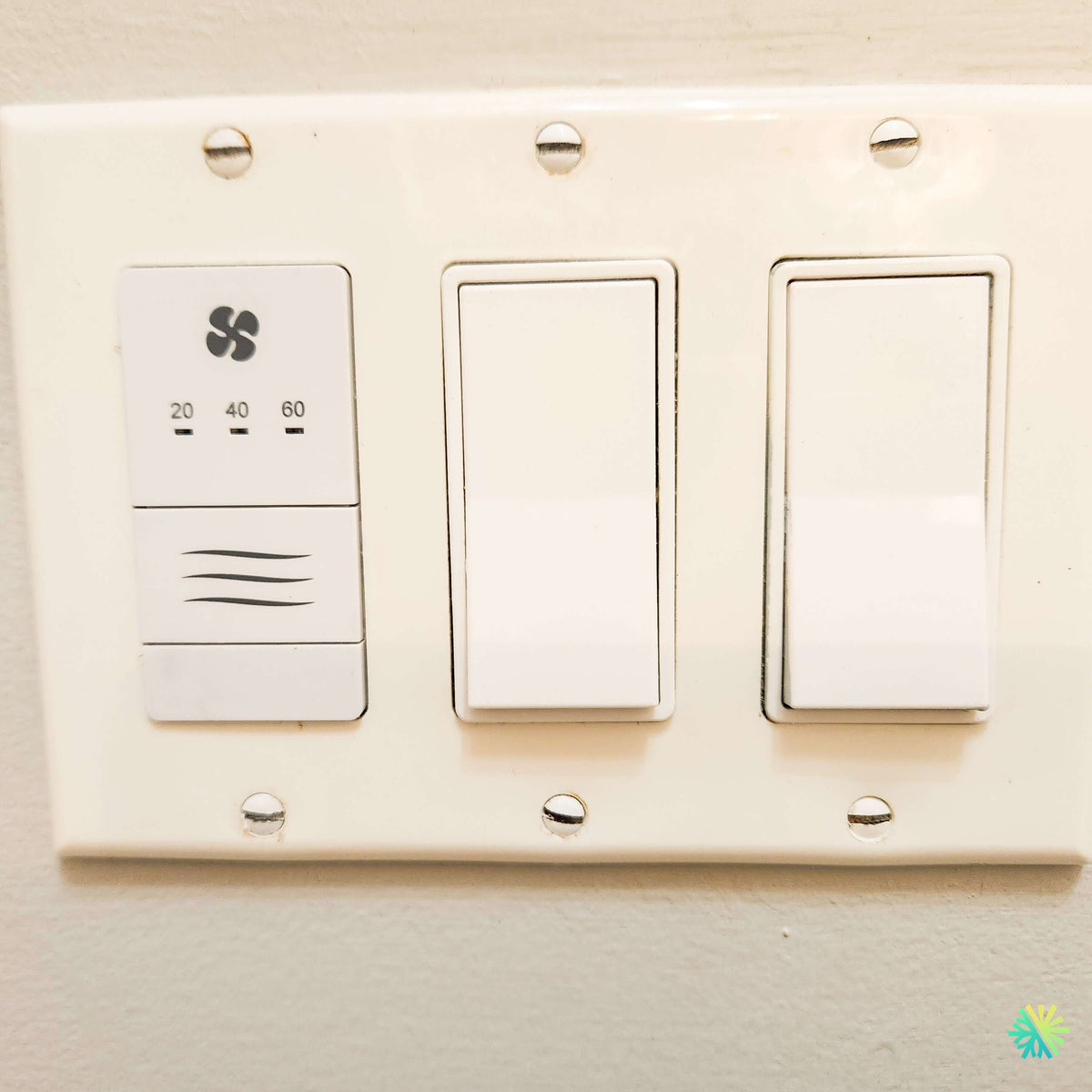
The homeowners did not want another control in the basement. So we moved the control point to the ground floor, into the central hallway, integrated into an existing three-switch plate—the one that controls the hallway and entrance lighting. The control 20/40/60 the Lifebreath control is positioned on the left, with its three indicator lights and continuous ventilation button below.
Where we place an air exchanger control, and why
Our rules, refined over several hundred jobs in Montréal, Laval, Longueuil, and on both shores:
- Never in the mechanical room. A control you cannot see is a control you will not use.
- At standard switch height, on a circulation wall. Central hallway, stair landing, kitchen entrance.
- Not in a bathroom. Humidity and steam distort the readings of models with a built-in dehumidistat.
- 20-gauge, 3-conductor wiring, with a maximum length of 100 ft to the unit. Beyond that, signal reliability decreases.
- A second timed control near the main bathroom or kitchen, when the layout allows it. This is the most cost-effective step of the entire job.
The 20/40/60 setting, explained the way it always should be
The logic is simple, but it is almost never explained to the customer at the end of the installation. The bottom button maintains continuous ventilation at low speed: this is the cruising setting, running 24 hours a day and managing background humidity. The top button activates high-speed boost ventilation for 20, 40, or 60 minutes, after which the unit automatically returns to its normal setting.
Morning shower: 20 minutes. Steaming dinner: 40 minutes. A gathering of ten people or painting work: 60 minutes. No switching the controls back and forth, no risk of forgetting the unit on high speed for three days and over-ventilating the house at -22 °C.
We spent twenty minutes with the homeowners explaining just this, with the unit running, having them press the buttons themselves. Those twenty minutes are worth more than ten efficiency points on a technical data sheet.
The installation, step by step
The job was completed in one day by two technicians.
- Removal of the old unit and inspection of the existing system. The insulated flexible ducts were in good condition, except for two sagging sections in the crawl space, which were straightened and re-hung.
- Suspension of the RNC5-TPD using the supplied adjustable 99-80-102 straps (four straps, four S-hooks), while maintaining 25 inches of clearance at the front for future maintenance. The unit weighs 51 lb (23 kg) and measures 17 1/4 x 22 3/4 x 14 in.
- Connection of the four ducts to the 5-inch oval collars, using aluminum tape and clamps, with no reduction in cross-sectional area.
- Replacement of the exterior hoods with 99-185 5-inch weather hoods with 1/4-inch mesh, properly spaced to prevent stale air from being drawn back into the intake.
- Reworking the condensate drains—two 1/2-inch drains on this model—with a loop trap and continuous slope toward the floor drain. An improperly trapped drain is the leading cause of odor problems with an HRV.
- Replacing two return grilles with 5-inch TechGrille 99-EAG5 grilles, whose adjustable central cone allows the airflow to be adjusted room by room without touching the unit's dampers.
- Wiring the wall control on the main floor and conducting functional tests.
Balancing: the step too many contractors charge for without doing
An unbalanced air exchanger puts a house under positive or negative pressure. Under negative pressure, outdoor air enters through cracks, the floor drain, and, in the worst cases, through the chimney of a combustion appliance. Under positive pressure, humid air is pushed into the walls, where it condenses.
We balanced the unit at the balancing dampers using a digital manometer, measuring the supply and exhaust airflow rates until achieving a difference of less than 10%, as required by the Code. The high speed was then set to H2 rather than the factory H3 setting, since H3 was too loud for a ground-floor hallway in a house of this size. The RNC5-TPD's three selectable high-speed settings make this adjustment possible without compromising compliance.
Every balancing job ends with us providing the customer with a measurement report: measured airflow rates, static pressure, selected speed setting, and the date of the next core inspection.
What this Boisbriand project reminds us about the North Shore and Greater Montreal
The mistakes we see most often
- Installing an HRV without touching the grilles. A new unit connected to dirty original grilles delivers mediocre results.
- Leaving the control in the basement. The most common mistake, and the easiest to correct.
- Neglecting the drain trap. It costs a few dollars and prevents a service call in the fall.
- Confusing a dehumidistat with continuous ventilation. A 99-DHO1 dehumidistat triggers high speed above a humidity threshold; it does not replace the basic operating mode.
- Skipping balancing. This is the only step that turns a unit that is compliant on paper into one that is compliant in practice.
Grants: What Rénoclimat Actually Covers
The Rénoclimat program provides $500 for the installation or replacement of an HRV or ERV. Two conditions are too often overlooked:
- The unit must appear in section 3 of the directory of products certified by the Home Ventilating Institute (HVI). The RNC5-TPD is HVI certified.
- An HRV alone is not eligible. The program requires the measure to be accompanied by other energy-efficiency work, and explicitly warns that an HRV installed on its own may increase energy consumption. An energy assessment before the work and a second one after the work are mandatory.
In other words: if replacing an air exchanger is being considered, it should be planned at the same time as insulation, air sealing, or replacement of a heating system. Our Boisbriand clients had already had their home assessed the previous fall, which made the process straightforward. Hydro-Québec's LogisVert program targets heat pumps, not HRVs — confusion between the two programs is constant.
Maintenance that truly extends the life of the unit
- Washable filters: wash in warm, soapy water every 3 months, in both air streams.
- Aluminum core: remove and rinse once a year, ideally in the fall before the heating season.
- Exterior hoods: check the screens in spring and remove dryer lint and insect nests.
- Drains: check the trap twice a year.
- Professional inspection: every 2 to 3 years, with balancing redone if work has modified the building envelope or ductwork.
Our other ventilation projects in the region
This project is part of a series of air exchanger replacements we have completed over the past few months: a unit built into the soffit of a condo tower in Laval, a side-mounted HRV in an upper-floor apartment in Montréal-Nord without a basement, an integration into the central network of a home in the West Island, and several replacements in Vaudreuil-Soulanges. Each configuration presents different constraints — available height, whether or not a drain is present, an existing central network or a dedicated network to be built — but the logic remains the same: the right unit, measured balancing, and controls that occupants understand.
Let's talk about your project
At AirGreen, we design, install, and balance residential and commercial ventilation systems in Boisbriand, throughout the North Shore, in Laval, Montréal, Longueuil, and on the South Shore. Our teams hold the required RBQ licenses and work with LIFEBREATH, Fantech, Broan-NuTone, and Greentek product lines.
For an assessment of your situation — replacing an old air exchanger, adding an HRV to a renovated home, or simply balancing an existing unit — contact us at (514) 316-2973 or sales@airgreen.ca.
The big day, step by step
The main steps of this kind of job at AirGreen. Every house has its quirks: the estimate brings them out.
We locate the wall for the two outdoor hoods, the unit's spot, service access and the drain.
The unit, its location and the price, in writing.
Hung or set level, with clear access to the filters and the core.
Fresh air intake and exhaust, kept apart and sealed.
The ones connected to the outside are insulated to prevent condensation inside the house.
Connected with its loop, when the unit needs one.
Installed where you will see it and use it.
Incoming and outgoing airflows are adjusted so the house is neither pressurized nor depressurized.
Speeds, filters, core: how to use it through the seasons.
- The on-site estimateWe locate the wall for the two outdoor hoods, the unit's spot, service access and the drain.
- The quoteThe unit, its location and the price, in writing.
- The unitHung or set level, with clear access to the filters and the core.
- The outdoor hoodsFresh air intake and exhaust, kept apart and sealed.
- The ductsThe ones connected to the outside are insulated to prevent condensation inside the house.
- The drainConnected with its loop, when the unit needs one.
- The wall controlInstalled where you will see it and use it.
- BalancingIncoming and outgoing airflows are adjusted so the house is neither pressurized nor depressurized.
- The walkthroughSpeeds, filters, core: how to use it through the seasons.
Four mistakes we do not make
Flip each card to see what we do instead.
Your own project, step by step
What to do, season by season
Three habits per season for this unit. They take a few minutes and prevent many calls.
- Clean the filters and core as the manufacturer specifies.
- Check the outdoor hoods: nests, debris, dampers.
- Lower the speed if the outdoor air gets humid.
- Adjust the speed to the humidity in the house.
- Check that the drain flows.
- Keep the outdoor hoods clear.
- Clean the filters before the closed-house season.
- Check the exhaust damper.
- Book a full cleaning if the unit has not had one in a long time.
- Clear snow from both outdoor hoods.
- Raise the speed if condensation appears on windows.
- Let the unit run: with the house closed, humidity builds up.
Is your home ready?
Check what applies at your place. A "no" is not a refusal: it is what we sort out during the estimate.
Four statements: true or false?
It all comes down to details you have just seen.
1. In an air exchanger, fresh air and stale air mix.
The two airflows cross in the core without mixing.
2. The two outdoor hoods must be kept apart.
Otherwise the exchanger pulls back the air it just removed.
3. An air exchanger can help with condensation on windows.
It renews the air and helps keep humidity in the right range.
4. An exchanger never needs maintenance.
Filters and core get dirty and need regular cleaning.
0 / 4 right answers
What people ask us about this kind of work
What does an air exchanger do?
Does fresh air cool the house in winter?
What speed should it run at?
Does an exchanger need cleaning?
What are the signs of poor ventilation?
HRV or ERV: what is the difference?
Should it run in winter?
Does AirGreen hold the required licences?
Is the estimate free?
No question matches. Write to us: we answer.
More jobs to see, near you
By town, by equipment or by region: browse more than 4,700 published projects.
Each dot: a town where AirGreen has published projects. The glowing dot: this job.
Every house has its constraints. We see them before we install.
The on-site estimate is free and the quote follows within 24 hours.
Text and photo: a real AirGreen Climatisation & Chauffage job. The diagrams are generic illustrations of the type of installation, not a survey of this job site. Sources of the added figures: airgreen.ca product pages (NEEP / AHRI performance), Hydro-Québec (Heat pumps page, LogisVert, read on 13 October 2026), Régie de l’énergie (rate D as of 1 April 2026).