
Installation of a 5-head GREE FreeMatch R32 heat pump in Pointe-Fortune, Vaudreuil-Soulanges RCM
Five zones on a GWHD(42)ND6MO, but only 36,000 BTU/h of indoor units on a 42,000 BTU compressor: our Pointe-Fortune project explains why a business open from nine to five is sized differently from a house, and what it costs to place an indoor unit above a door.
Take a tour of the installation
Each number is a point we check on site. Switch between summer and winter to watch air and heat move.
In summer, the outdoor unit rejects the house's heat outside.
Generic illustration of this type of installation, not a survey of this job site. Tap a number.
Mounted level on a wall plate, high enough for the air to reach the whole room, with enough space around it to slide the filters out easily.
The refrigerant lines, the communication cable and the drain go through the wall in a single opening, sealed against water, cold air and insects.
Two insulated copper pipes connect the two units. Outside, a line cover can protect them from sun, knocks and weather.
A shut-off switch near the outdoor unit isolates it safely for service. It must stay accessible at all times.
The compressor and the fan. In heating mode it captures heat from the outdoor air, even in winter, and moves it inside.
On the ground or on the wall, it keeps the unit above accumulated snow. The unit stays clear and defrost water can drain away.
The fan needs to blow freely. Storage, a fence or a wall too close, and efficiency drops while noise goes up.
A business set up in a house: the only case where the diversity factor does not apply
Nearly all the multizone projects we design rely on one assumption: the rooms will not require their full capacity at the same time. This is what makes it possible to install 50,000 BTU/h of indoor heads on a 42,000 BTU compressor. The Pointe-Fortune project is an exception, and that is what makes it interesting. In a service business open from nine to five, all the rooms are occupied during the same hours, every day. The assumption no longer applies, the sizing is reversed, and we installed less indoor capacity than the compressor can deliver—a ratio of 86%, the lowest we have published.
The building: a village house converted into a business
Pointe-Fortune is one of the smallest municipalities in the MRC de Vaudreuil-Soulanges: a few hundred residents on the banks of the Ottawa River, at the Ontario border, across from Carillon. A service business there draws customers from a wide area—Rigaud, Saint-André-d'Argenteuil, Hawkesbury—and cannot afford to close.
The building is a 1970s single-family home converted into a personal services salon. Residential construction, commercial use: drywall on wood framing, 2.4 m ceilings, original electric baseboards, no ductwork, and a rear exterior door that serves as the main entrance for customers.
It was this combination—a house structure subject to commercial-use conditions—that dictated every decision.
Why five zones instead of three
The owner initially asked us for a quote for two heads: the main service area and the reception area. After a one-hour visit, we proposed five, for three reasons that could be verified on site:
- The doors remain closed. Two enclosed treatment rooms receive no air from a head installed elsewhere. We documented the actual limits of air transfer between rooms in our article about the Saint-Cyprien-de-Napierville installation.
- The loads are highly uneven. A coloring room with a heating device and two people has a completely different thermal profile from an administrative office that is empty half the time.
- Discomfort has a direct cost. In a business, a room that is too hot does not result in a complaint; it results in an appointment that is not rescheduled. That is the fundamental difference between a residential project and a commercial project, and it justifies more precise zoning.
The GWHD(42)ND6MO, required by the number of indoor units
Only one unit in the FreeMatch R32 lineup accepts five indoor units. We published the complete table of connectable units by model in our article on the installation in Sainte-Martine; the choice of the GWHD(42)ND6MO is unquestionable once you reach five zones.
The values used here:
- Rated cooling capacity 42,000 BTU/h, modulation from 8,870 to 44,300 BTU/h
- Rated heating capacity 42,000 BTU/h, modulation up to 54,590 BTU/h, operating range down to -30 °C
- SEER2 21 / HSPF2 10 / EER2 12, ENERGY STAR certification, Cold Climate certification
- MCA 30 A / maximum protection 45 A — a single dedicated circuit, with all five indoor units powered by the outdoor unit
- R32 refrigerant (A2L), 2,700 g factory charge, leak detector included
- 63 dB(A), 79 kg, maximum total length 100 m, factory precharge covering 50 m
- AHRI 214931590 in non-ducted configuration
The distribution: 36,000 BTU/h of indoor units on a 42,000 BTU/h compressor
- 9,000 BTU/h — main service area
- 9,000 BTU/h — reception and waiting room, the area shown in our photo
- 6,000 BTU/h — second service area
- 6,000 BTU/h — enclosed treatment room
- 6,000 BTU/h — administrative office and staff break room
Total: 36,000 BTU/h of indoor units on a 42,000 BTU/h compressor, or 86%. This is the lowest ratio we have published, and it is deliberate.
Why we went below the compressor's capacity
The diversity factor is not a rule of thumb; it is a bet on schedules. In a home, the bet is a good one: bedrooms call for heating at night, the living area calls for it in the evening, and no one occupies all five rooms at full load simultaneously. We detailed this mechanism in our article on the installation in Saint-Denis-sur-Richelieu, and pushed it as far as 129% in a community building where the occupancy schedule justified it, in L'Île-Perrot.
In this business, the bet is lost before it starts. At eleven o'clock on a Wednesday, both service areas are operating, the treatment room is occupied, the reception is receiving clients, and someone is working in the office. All five zones call simultaneously, every business day, for seven hours.
We therefore did the opposite of the usual approach: rather than installing more heads than the compressor can supply and relying on non-simultaneous operation, we installed fewer. At 86%, no head is ever starved, even when all five call for full output during the height of a July afternoon. The principle of deliberate under-matching is the one we presented in our article on the Beauharnois installation; what is specific to this project is that it is not a refinement, but an operating requirement.
This was possible only because no room is large. A village house converted into a business consists of small partitioned rooms, and three of them are adequately served by a 6,000 BTU/h head. In a building with large open volumes, the same logic would have required a second system.
The reception head was moved up a size, and not because of its volume
Here is the project's most useful sizing decision. The waiting room is neither the largest nor the busiest room. Yet it received a 9,000 BTU/h head where its volume called for 6,000, for one reason only: it is the only zone in the building that experiences a repeated outdoor-air load, every time the entrance door opens.
This load appears in no calculation based on floor area. It is calculated from the number of door openings per day and the temperature difference, and in a service business it is far from negligible. The next section explains what it actually does to the unit.
The other side of the coin: the small head on its own on Mondays
Honesty requires presenting the other side, and it is more pronounced here than elsewhere. The system's modulation floor is 8,870 BTU/h, and this is a property of the entire system, not a value that can be divided by five. In other words, the minimum this compressor can produce is higher than the capacity of a 6,000 BTU/h head. On Mondays, when the business is closed and only the administrative office is occupied for accounting, the zone is structurally short-cycling. The mechanism is explained in detail in our article on the Saint-Chrysostome installation.
The correction applied here is simple and free: on days when the business is closed, the office head and the reception head operate together at a moderate setpoint rather than having only one operate at an aggressive setpoint. Two zones calling gently keep the compressor above its minimum operating level; one small zone calling hard puts it below that level. This setting is part of the operating sheet provided to the owner, and it is the kind of detail that distinguishes a properly tuned system from one that has merely been installed.
The second consequence, this one structural: there is no spare capacity for an additional workspace. In a business, the layout changes every four or five years. We included this in the quote, along with the reminder that no FreeMatch model accepts a sixth head—the subject is covered in our article on installation in Sainte-Martine.
What the use changes, and the construction does not
The building is a house. Its use is commercial. Three things follow the use, not the construction, and they regularly surprise our customers:
- Electricity rates. Premises used for commercial purposes are not necessarily billed at the same rate as a residence, and some business rates include a demand component in addition to the energy consumed. This does not change the choice of equipment, but it does change the profitability calculation, because a unit that draws heavily during peak periods cannot be compared with one that consumes a lot of energy. This must be verified directly with Hydro-Québec before projecting savings.
- Subsidy programs. Programs intended for owner-occupants do not apply to commercial premises. The relevant avenue is through energy-efficiency programs for business customers, a point we covered in our articles on installation in an office in Sainte-Julie and installation in a community building in L'Île-Perrot. The criteria change, so we verify them when preparing the application.
- Liability. Work in a building open to the public must be carried out with a valid RBQ licence and appropriate coverage. This is not an administrative detail when customers will be moving through the premises the next day.
The head installed above the entrance door: what the photo tells us
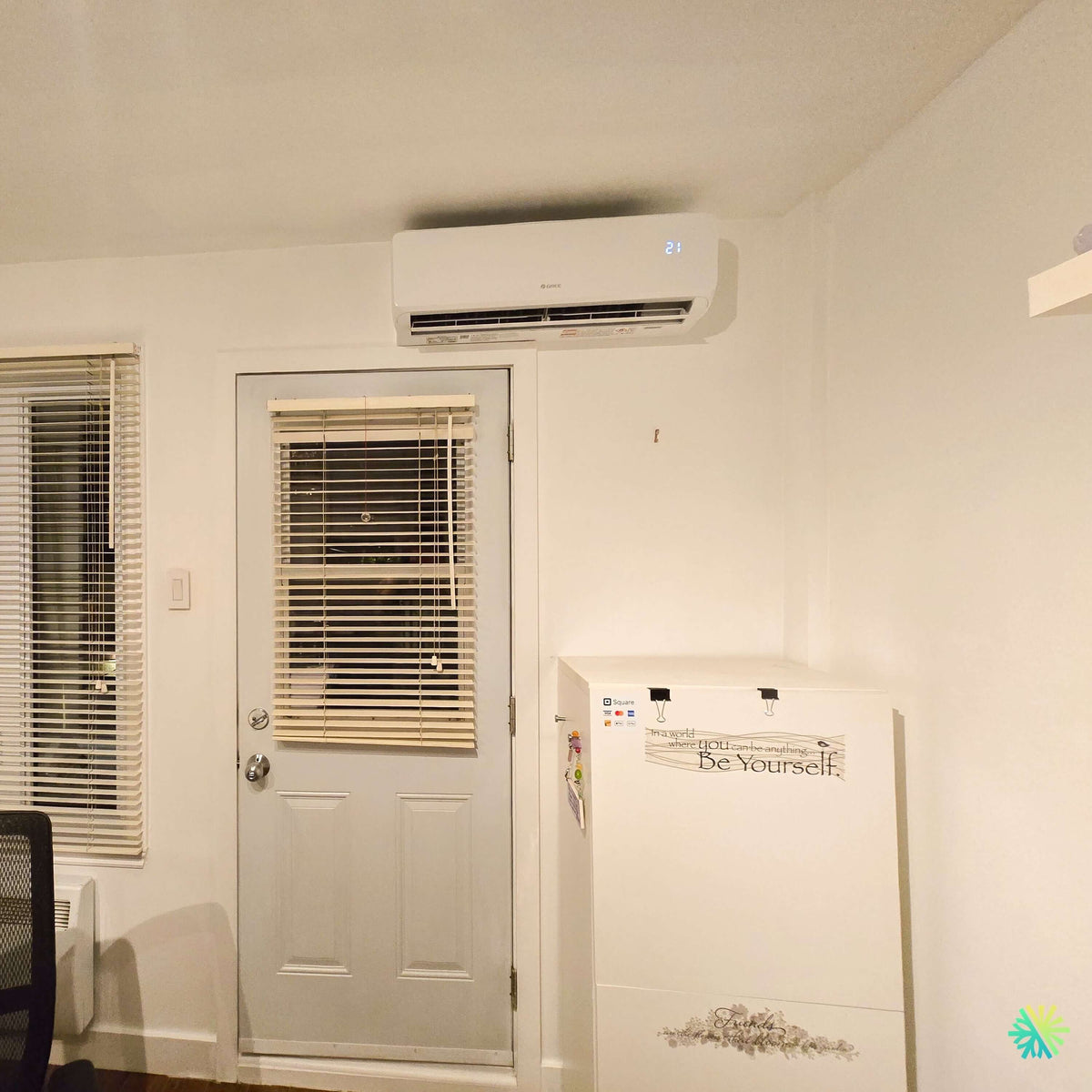
In the final project photo, the reception-zone head is mounted high, very close to the ceiling, directly above the exterior door through which all customers enter. To its left, a window with horizontal blinds and an electric baseboard heater. To its right, the reception counter. The display reads 21 degrees Celsius.
This is the most demanding position possible for a wall-mounted head, and it deserves to be explained rather than concealed.
What happens every time the door opens
The return grille of a wall-mounted air conditioner is located on top of the unit, and that is where the sensor that controls everything is located. Placing this assembly directly above an exterior door creates a precise mechanical problem:
- In winter, each opening pushes a cushion of cold air upward along the interior wall and past the grille. The sensor reads a lower temperature than that of the room, so the head speeds up and heats more than necessary. Fifteen minutes later, the reception area is overheated.
- In summer, the opposite occurs with hot, humid air, and the head cools too much.
- In both cases, the head responds to a thirty-second event rather than the actual state of the room, multiplying compressor operating-mode changes.
A home may open its front door perhaps ten times a day. A service business opens it fifty to eighty times, in addition to deliveries. The phenomenon goes from negligible to structurally significant.
Why the head is nevertheless located there
Because there was no other wall. In a fitted-out commercial space, wall surface is a scarce resource: mirrors, shelves, counters, signage, windows, fixed furniture. The only free wall segment, high enough, with the clearances required by the manufacturer and a short line run to the outside, was the one above the door.
We prefer to state this clearly rather than claim that it was the best location possible. The work then consists of correcting the consequences.
Our four corrections, applied on this project
- The head was shifted laterally relative to the door’s axis so that the incoming air cushion would not rise straight into the return grille. A few dozen centimeters are enough to change the behavior.
- Control relies on the wall-control sensor, installed on an interior wall at normal height, away from the door, rather than on the unit’s return-air sensor. This is the most effective of the four corrections. We explained how these sensors work and their pitfalls in our article about the Saint-Amable installation.
- The minimum fan speed was increased in this zone so that the return air would circulate a sufficient volume of air and not be overwhelmed by a localized burst.
- The real solution lies in the building envelope, not in the unit: a door closer adjusted so the door closes by itself, weatherstripping and the threshold checked, and the bottom door sweep replaced. This is not HVAC work, and we identified it as such in our report—but no heat pump can compensate for a door that remains ajar.
Let us add an observation specific to salons: clients and staff do not want the same temperature. A client sitting under a cape for forty minutes does not move; staff work standing all day. The 21 °C setpoint visible in the photo is a compromise discussed with the owner, not a default value. In the service areas, we adjusted comfort primarily through louver direction and fan speed rather than the setpoint.
Salon vapors and the indoor exchanger
A point that competing quotes never address and that directly affects the unit’s service life. A personal-services salon suspends dyes, solvents, hairsprays, and nail products in the air. These aerosols pass through the head’s filter and settle on the fins of the indoor exchanger, where they trap dust.
The mechanism is the same as that of cooking grease that we documented in our article about the Saint-Stanislas-de-Kostka installation, but with two important differences:
- The deposit is solvent-based, not greasy. It does not come off when rinsing the filter and requires deep cleaning of the exchanger by a technician, at shorter intervals than in a residential setting.
- There is an air-quality aspect to consider at work. A wall-mounted head does not ventilate: it recirculates room air over a coil and introduces no outdoor air. It therefore removes neither vapors nor odors. We explain this in our article about the Beauharnois installation. The honest solution for a business of this type is local extraction at the workstation and an air exchanger, not an additional heat pump.
Fouling caused by operating products is normally excluded from the warranty as a maintenance matter. It is therefore an operating expense to budget for, not a defect to claim under the warranty.
Installing five heads without closing the business
A service business cannot close for three days. The work was therefore divided up, and this organization is part of what we sell:
- The outdoor unit, electrical circuit, and line-set routing were completed on Monday, the day the business was closed.
- The zones were installed one at a time, starting at seven o'clock each morning and clearing the room before opening, rather than shutting down the entire premises.
- No drilling or sanding during business hours, in a space where clients receive facial and hair services.
- The heads remained under their protective film until commissioning, and each room was left clean at the end of the morning.
- Full commissioning took place the following Monday, system by system, with the owner present.
The work was spread over six calendar days for approximately three actual working days. It takes longer, but that is intentional, and it did not result in a single canceled appointment.
Mistakes to avoid in a commercial multi-zone project
- Applying a residential diversity factor to a commercial business. The schedules are not the same; neither is the calculation.
- Leaving control to the return-air sensor of a head located near an exterior door.
- Promising savings without verifying the applicable rate structure for the premises.
- Removing the electric baseboards. They remain as backup heat, set below the heads' setpoint.
- Treating fouling caused by operating products as a warranty issue rather than as a maintenance item.
- Crossing a copper line and its interconnection cable between two ports — the risk increases with the number of heads; our procedure is described in our article on the Hinchinbrooke installation.
- Forgetting to register the warranty: 10 years on the compressor and parts as standard, 12 years when registered with the distributor with proof of installation.
Maintaining a five-head system in commercial use
A business requires a tighter maintenance schedule than a residence because operating hours and particulate load are higher:
- Every 3 to 4 weeks: rinsing the filters in the two service areas
- Every 2 months: filters in the reception area, treatment room and office
- Twice a year: inspection of the five pans and drains, and a drainage test
- Annually, per technician: deep cleaning of the indoor heat exchangers, cleaning of the outdoor coil, pressure and temperature readings, and checking terminal tightness
A clogged filter first shows up as noise—the fan speeds up to compensate—before it shows up on the bill. In a room where people talk with customers all day, the symptom is quickly noticeable.
Our approach in Pointe-Fortune and Vaudreuil-Soulanges
Commissioning followed the same protocol as on all our multi-zone projects: deep vacuum evacuation with a standing vacuum test maintained below 500 microns, weighing of any additional refrigerant charge, followed by a functional test one zone at a time in both modes, with a physical check that the discharged air reaches the correct room. The handover file includes the serial numbers by zone, measured lengths, weighed charge, commissioning readings, the circuit number at the electrical panel, the warranty registration date and the operating sheet for closure days.
At AirGreen, we install wall-mounted heat pumps, multi-zone systems, central heat pumps and air conditioners in Pointe-Fortune, Rigaud, Vaudreuil-Dorion, Les Cèdres and Saint-Lazare, as well as throughout Montreal, Laval, Longueuil, on the North Shore and the South Shore. We hold an RBQ licence and serve residential customers as well as businesses, offices and institutional buildings.
If you operate a business in a residential-construction building, the first question to ask is not “what size unit?” It is “what hours are my rooms occupied, and are they all occupied at the same time or not?” The answer changes the sizing before we even open a catalogue.
The big day, step by step
The main steps of this kind of job at AirGreen. Every house has its quirks: the estimate brings them out.
We look at the room, the outside wall, the line route and where the outdoor unit will go. That is where the capacity gets chosen.
Model, capacity and price, in writing. We also check whether the model qualifies for assistance programs.
Floors and furniture protected, wall plate position marked level, wall opening located.
A single opening, with the slope the drain needs to flow outside.
Set on a stand raised above the snow, with the clearances the manufacturer requires.
Connected, insulated and protected. The opening is then sealed against water, cold air and insects.
A dedicated circuit and an accessible disconnect near the outdoor unit.
Leak test, vacuum, then start-up and a check of heating and cooling.
Remote, modes, filters: we show you the essentials before we leave.
- The on-site estimateWe look at the room, the outside wall, the line route and where the outdoor unit will go. That is where the capacity gets chosen.
- The quoteModel, capacity and price, in writing. We also check whether the model qualifies for assistance programs.
- Getting readyFloors and furniture protected, wall plate position marked level, wall opening located.
- The wall openingA single opening, with the slope the drain needs to flow outside.
- The outdoor unitSet on a stand raised above the snow, with the clearances the manufacturer requires.
- Lines, cable and drainConnected, insulated and protected. The opening is then sealed against water, cold air and insects.
- The electrical workA dedicated circuit and an accessible disconnect near the outdoor unit.
- Tests and start-upLeak test, vacuum, then start-up and a check of heating and cooling.
- The walkthroughRemote, modes, filters: we show you the essentials before we leave.
What would it look like at your place?
Two quick checks with real numbers: what heat costs, and what your current heaters add up to in BTU/h.
Conversion: 1 W = 3.412 BTU/h. An indication, not a load calculation: baseboards and furnaces are often stronger than the real need, and they can stay as backup. AirGreen confirms the capacity on site.
Four mistakes we do not make
Flip each card to see what we do instead.
Your own project, step by step
What to do, season by season
Three habits per season for this unit. They take a few minutes and prevent many calls.
- Clean the indoor unit's filters.
- Clear leaves and debris left on the outdoor unit by winter.
- Test cooling before the first hot days.
- Clean the filters more often when the unit runs a lot.
- Keep plants away from the outdoor unit.
- Check that no water drips from the indoor unit.
- Rake the leaves around the outdoor unit.
- Test heating before the first cold days.
- Book periodic maintenance before winter.
- Keep snow away from the stand and the front of the unit.
- Let the unit defrost: it is normal.
- Never hit the ice on the fins; call us if the unit stays iced up.
Is your home ready?
Check what applies at your place. A "no" is not a refusal: it is what we sort out during the estimate.
Four statements: true or false?
It all comes down to details you have just seen.
1. In heating mode, the outdoor unit can produce water.
During defrost cycles. That water must drain away without forming ice.
2. You pick the capacity with a simple square-footage rule.
Windows, insulation, orientation and how the room is used all count. Capacity is chosen on site.
3. A multi-zone connects several indoor heads to a single condenser.
One head per room, all on the same condenser. Each room keeps its own temperature.
4. The disconnect can sit behind the patio furniture.
It must stay accessible: it is what shuts the unit off for service.
0 / 4 right answers
What people ask us about this kind of work
Does a wall-mounted heat pump heat in winter?
Wall-mounted or multi-zone: how do I choose?
Where does the outdoor unit go?
Are there grants?
Do I need a permit?
How cold can it heat?
How much can I save?
How is the LogisVert assistance calculated?
Is it noisy?
The outdoor unit is covered in ice: is that normal?
Does AirGreen hold the required licences?
Is the estimate free?
No question matches. Write to us: we answer.
More jobs to see, near you
By town, by equipment or by region: browse more than 4,700 published projects.
Each dot: a town where AirGreen has published projects. The glowing dot: this job.
Every house has its constraints. We see them before we install.
The on-site estimate is free and the quote follows within 24 hours.
Text and photo: a real AirGreen Climatisation & Chauffage job. The diagrams are generic illustrations of the type of installation, not a survey of this job site. Sources of the added figures: airgreen.ca product pages (NEEP / AHRI performance), Hydro-Québec (Heat pumps page, LogisVert, read on 13 October 2026), Régie de l’énergie (rate D as of 1 April 2026).