
Installation of a GREE FreeMatch R32 five-zone heat pump in Rigaud, at the foot of Mount Rigaud
Five GREE FreeMatch R32 indoor units on the slope of Mount Rigaud: why the outdoor unit’s base determines the system’s lifespan, how frost heaving affects the copper, and why a SEER2 rating is not a prediction of your electricity bill.
- City
- Region
- Equipment
- Brand
- Challenges
- Published
The job on one screen
The article, chapter by chapter
On the mountainside, the most costly question is not which unit to choose, but what it rests on
A multi-zone wall-mounted heat pump is sold based on efficiency ratings and judged by its comfort. But it can underperform because of thirty centimetres of poorly prepared ground. On the five-head installation we completed in Rigaud, in the Vaudreuil-Soulanges RCM, the technical decision that required the most thought had nothing to do with choosing the model—it was underneath the unit.
At AirGreen, we install HVAC systems throughout Montérégie, in Montreal, Laval, Longueuil, on the North Shore, and on the South Shore. In Rigaud, one constraint comes up more often than elsewhere: the ground is not flat, it is not uniform, and it cannot always be excavated.
The context: Rigaud, between the Ottawa River and the mountain
Rigaud covers approximately 114 km² and is home to just over 8,000 residents, at the western tip of the Montérégie region, very close to the Ontario border and Autoroute 40. The city is bordered to the north by the Ottawa River and dominated by Mount Rigaud, a wooded hill that is home to a ski centre, the Notre-Dame-de-Lourdes sanctuary, and the famous “devil’s potato field”—an expanse of rounded boulders that gives a pretty good idea of what the subsoil looks like in places.
The municipality has both rural and peri-urban character: a heritage village core, agricultural land, recreational areas near the river, and steady residential development since the 1990s along the concession roads and mountain slopes. The property in question falls into this last category: a house set on a sloping, wooded lot, with shallow bedrock confirmed by the very first shovel strike.
All-electric heating by baseboard heaters, no ductwork, no central air conditioning, large open spaces on the ground floor, and smaller rooms upstairs. The client wanted five zones.
Five zones, five capacities
- Large living area (living room–dining room, open ceiling) : 24,000 BTU/h
- Kitchen and dining area : 12,000 BTU/h
- Primary bedroom : 9,000 BTU/h
- Second bedroom : 9,000 BTU/h
- Enclosed office : 6,000 BTU/h
Total indoor capacity: 60,000 BTU/h on a compressor with a nominal cooling capacity of 42,000 BTU/h. On paper, that produces a ratio of 143%, the highest we have published. It makes sense for cooling, where the five rooms are never all operating at full capacity at the same time: the large living area calls for cooling in the afternoon, the bedrooms at night, and the office during the week.
The figure to look at is not 143%
The diversity percentage is calculated based on the nominal cooling capacity. For a Quebec home, the more important figure appears elsewhere in the manufacturer's table: the maximum modulated heating capacity of the GWHD(42)ND6MO is 54,590 BTU/h.
In other words, this installation has 60,000 BTU/h of connected indoor capacity paired with a compressor that can never deliver more than 54,590 BTU/h in heating mode, and even that peak value is not achieved at -25 °C. This is the first time in this series that the installed capacity exceeds the unit's heating capacity ceiling, and we are stating it plainly rather than hiding it, because three conclusions follow:
- No electric baseboard heaters are removed. They are not obsolete leftovers; they are the home's backup heat during peak demand.
- The balance point is calculated and provided in writing to the client before the order—the mechanics of this calculation are explained in our Franklin article.
- The heads are not sized to heat on their own in extreme cold; they are sized to cover the season when the system is actually operating—namely, most of the fall, spring, and moderate winter days.
A contractor who proposes five heads while promising to disconnect the existing heating system has not shown you this line from the table.
The selected unit
Five zones require the GWHD(42)ND6MO: it is the only model in the GREE FreeMatch R32 range approved for two to five indoor units, a constraint we detailed in our Sainte-Martine article.
The relevant figures here are: SEER2 21, HSPF2 10, EER2 12, COP 3.9, code AHRI 214931590 in non-ducted configuration (214931596 in ducted configuration, 214931600 in mixed configuration), heating operating range down to -30 °C, heating modulation from 8,870 to 54,590 BTU/h, MCA 30 A and maximum protection 45 A on a single dedicated circuit since the indoor units are powered by the outdoor unit, 2,700 g of R32 factory charge, A2L leak detector included, intelligent defrost, automatic voltage adaptation, 79 kg at 1,020 × 826 × 427 mm. Certified ENERGY STAR according to the manufacturer's specifications.
The base: what a heat pump really rests on
A 79 kg condenser that vibrates, defrosts, and undergoes fifteen freeze-thaw cycles per winter is not an object simply resting on the ground. It is a load applied to shifting soil.
On flat, uniform ground, the issue can be resolved with a concrete base or a prefabricated support on a stone bed. On the slope of Mount Rigaud, three factors combined: a slope, shallow soil over bedrock, and glacial erratic boulders that made excavation unpredictable from one metre to the next.
Slab, screw piles, or wall bracket?
We systematically evaluate three solutions, and none is suitable everywhere.
- A stone-bed base, which provides drainage and quick installation, is suitable when the ground is stable and water can drain away. It is our first choice when conditions allow.
- Screw piles address frost heave when sufficient depth can be reached. On shallow bedrock, they cannot be driven deep enough, and forcing the installation results in poor anchoring.
- The wall bracket avoids touching the ground, but it transmits compressor vibrations into the framing—a real problem in a lightweight-frame house, whose acoustic consequences we described in our Saint-Chrysostome article. It also requires a wall capable of supporting the load, ruling out simple cladding.
On this project, the chosen solution was a raised base on a free-draining stone bed installed after local stripping and grading, with sufficient clearance beneath the frame for snow accumulation and the drainage of defrost water. The slope of the ground was handled by the base, not by shims beneath the appliance's feet: a condenser is leveled; it is not “wedged” into place.
Frost heave always eventually shows up in the copper
This is the point that almost no quote addresses. A poorly drained base does not merely settle: it tilts, a little each winter, because water trapped beneath it freezes and expands unevenly.
Two or three seasons later, the appliance is no longer level. The consequences appear in this order: the fan runs off-axis and becomes noisy; defrost water no longer leaves the pan on the proper side and forms a column of ice; and above all, the refrigerant lines and connections at the service valves are subjected to constant stress they were not designed to withstand. A slow refrigerant leak on a five-branch multi-zone system is one of the longest and most expensive faults to diagnose and correct—and its origin, two winters earlier, was a missing stone bed.
What we check: drainage beneath the base before installing anything, levelness verified with an instrument, sufficient clearance beneath the appliance, the disconnect and junction box above the snow line, and lines flexibly supported where they pass through the wall so that ground movement is not transmitted directly to the copper.
An appliance beneath the trees
A wooded property offers a real advantage—shade over the outdoor unit improves its operating conditions in cooling mode—and three nuisances that must be anticipated.
- Samara and seeds. Leaves can be swept away. Maple samaras, however, lodge between the fins and stay there. They are the most difficult debris to remove without bending the heat exchanger.
- Sap and resin. A condenser beneath a conifer becomes covered in a sticky film that collects dust. Annual cleaning of the heat exchanger is not an optional maintenance-contract item on this type of site; it is a performance requirement.
- Falling branches. Freezing rain and high winds settle the matter in their own way. An appliance placed beneath a dead branch is an appliance on borrowed time.
There is also the issue of rodents, which find a poorly reclosed control box very inviting in October; we discussed this in our Saint-Louis-de-Gonzague article.
The room in the photo: an installation nearing the end of renovation
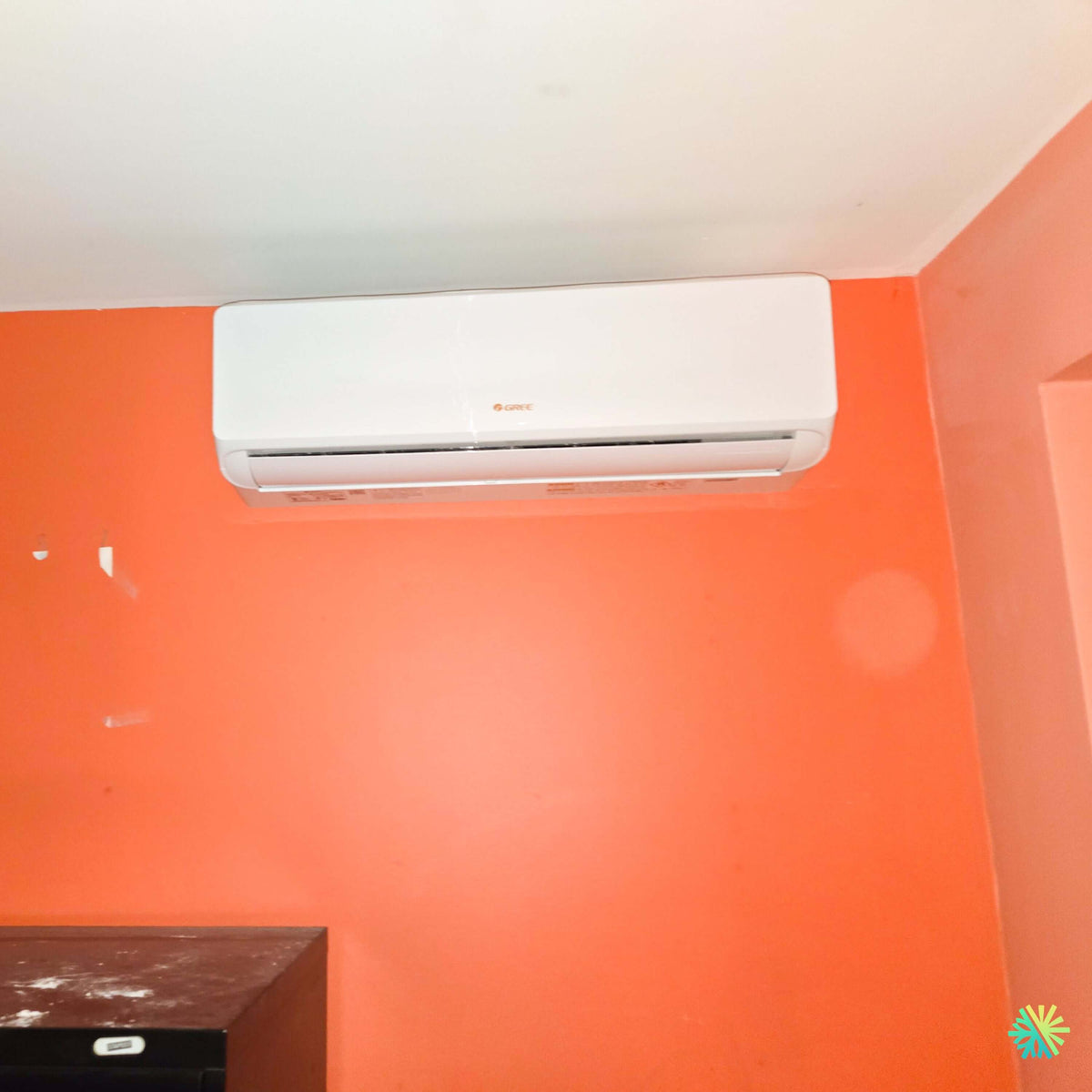
The head shown in the photo is installed high up, tucked just below the ceiling, near a wall corner, on a freshly painted partition in a deep orange. The factory labels are still in place beneath the unit, the work surface in the foreground is spattered with plaster and paint, and the wall still bears a few marks from removed anchors.
Installing equipment while a room is still under construction involves specific rules—drywall dust, paint aerosols, delayed commissioning—which we explained in detail in our Beauharnois article and will not repeat here. We will retain only the operating rule applied on this job: the unit is installed, protected, and left turned off until the trades generating dust and debris have finished and the room has been cleaned. A new head is neither construction heating nor a paint dryer.
What five zones really change on the bill, and why HSPF2 does not answer the question
This is the question customers ask last, often while walking the representative to the door, and it is the one that deserves the most honest answer.
A rating is a test result, not a forecast
SEER2 21 and HSPF2 10 are results obtained using a standardized testing method under reference conditions. They are excellent tools for comparing two units with each other. They are not consumption forecasts for a specific house on a mountainside in Rigaud, with a given building envelope and given habits.
The COP of 3.9 advertised for this model illustrates the physical principle: a heat pump does not create heat; it moves it, and therefore delivers several units of heat per unit of electricity consumed—whereas an electric baseboard delivers exactly one. But this ratio is not constant: it decreases as the outdoor temperature drops. The FreeMatch product sheet publishes no low-temperature capacity data, a documentation gap we noted in our Franklin article that prevents anyone from honestly calculating annual savings for you based on this document alone.
Air conditioning, on the other hand, increases consumption
Here's the point nobody makes during the sales process. Before this project, this house cooled two rooms with a portable unit used for a few weeks each summer. Afterward, it cools five zones comfortably throughout the entire warm season.
Summer consumption increases. That's arithmetic, and it's not a flaw: the customer is buying comfort they didn't have before. But presenting a five-head project as an energy-saving undertaking without mentioning this part is setting the customer up for disappointment when the August bill arrives.
The real savings are seasonal, and they are real
The savings come from heating, primarily in the temperature range where the system operates efficiently: fall, spring, and mild winter days, which account for a significant portion of the heating season in Montérégie. In very cold weather, the baseboard heaters gradually take over again and the advantage fades.
The honest wording—the one we use in our quotes—is: a five-zone project is first and foremost a comfort project, with an energy dividend for heating. Reversing these two terms is the source of most of the disappointments we hear about installations done elsewhere.
What a contractor can promise—and what they cannot
They can provide you with: the exact model, the capacity for each room, the corresponding AHRI code for the configuration actually installed, the planned line-set lengths, your home's estimated balance point, and the scope of the warranty.
They cannot guarantee you a percentage of savings on your annual bill. Too many variables are beyond their control: the building envelope, settings, occupancy, the severity of the winter, and the rates. A quote that shows a guaranteed percentage of savings without having performed a load calculation or an energy assessment is selling a number, not a system.
Let's clarify that everything above applies to a residence. In a commercial space, the billing structure is different and the profitability analysis changes; we covered this case in our Pointe-Fortune article, in the same RCM.
Mistakes to avoid
- Placing the outdoor unit on shims or concrete blocks set directly on the ground. The first winter will tell you nothing. The third will.
- Neglecting drainage beneath the base because the ground “looks” well drained.
- Choosing a wall bracket for convenience in a lightweight-frame house with a bedroom on the other side of the wall.
- Removing the electric baseboard heaters from an installation whose indoor capacity exceeds the compressor's heating capacity ceiling.
- Assuming that a SEER2 or HSPF2 rating predicts your energy bill.
- Letting a new unit operate in a room that is still under construction.
- Forgetting to register the warranty: 10 years of standard coverage, extended to 12 years upon registration with the distributor and proof of installation.
Rebates and eligibility
The GWHD(42)ND6MO is listed as eligible for local rebates on the manufacturer's product sheet. For an electrically heated residence in Vaudreuil-Soulanges, Hydro-Québec's energy-efficiency programs (LogisVert) and Rénoclimat generally apply; Chauffez vert, which targets the replacement of fossil-fuel heating, does not apply here. The criteria and amounts change from year to year, and the declared AHRI reference number must match the combination actually installed, otherwise an application may be rejected for a strictly administrative reason.
What we provide at the end of the project
The serial number of each head associated with its room, the measured length of each of the five lines, the amount of R32 added and weighed, the port-by-port assignment, commissioning readings, the dedicated circuit number, the description of the base and its drainage, the home's estimated balance point, and the warranty registration date.
At AirGreen, we design, install, and maintain multi-zone wall-mounted heat pump, air conditioning, and heating systems in Rigaud, Vaudreuil-Dorion, Saint-Lazare, Hudson, and throughout the Vaudreuil-Soulanges RCM, as well as in Montreal, Laval, Longueuil, on the North Shore, and on the South Shore. On sloped or rocky terrain, the site assessment determines the project far more than the catalog does.
AirGreen — RBQ 5645-9605-01 — (514) 316-2973 — sales@airgreen.ca
The job tools
Two quick checks with real numbers: what heat costs, and what your current heaters add up to in BTU/h.
Conversion: 1 W = 3.412 BTU/h. An indication, not a load calculation: baseboards and furnaces are often stronger than the real need, and they can stay as backup. AirGreen confirms the capacity on site.
How the job unfolds
The main steps of this kind of job at AirGreen. Every house has its quirks: the estimate brings them out.
We look at the room, the outside wall, the line route and where the outdoor unit will go. That is where the capacity gets chosen.
Model, capacity and price, in writing. We also check whether the model qualifies for assistance programs.
Floors and furniture protected, wall plate position marked level, wall opening located.
A single opening, with the slope the drain needs to flow outside.
Set on a stand raised above the snow, with the clearances the manufacturer requires.
Connected, insulated and protected. The opening is then sealed against water, cold air and insects.
A dedicated circuit and an accessible disconnect near the outdoor unit.
Leak test, vacuum, then start-up and a check of heating and cooling.
Remote, modes, filters: we show you the essentials before we leave.
- The on-site estimateWe look at the room, the outside wall, the line route and where the outdoor unit will go. That is where the capacity gets chosen.
- The quoteModel, capacity and price, in writing. We also check whether the model qualifies for assistance programs.
- Getting readyFloors and furniture protected, wall plate position marked level, wall opening located.
- The wall openingA single opening, with the slope the drain needs to flow outside.
- The outdoor unitSet on a stand raised above the snow, with the clearances the manufacturer requires.
- Lines, cable and drainConnected, insulated and protected. The opening is then sealed against water, cold air and insects.
- The electrical workA dedicated circuit and an accessible disconnect near the outdoor unit.
- Tests and start-upLeak test, vacuum, then start-up and a check of heating and cooling.
- The walkthroughRemote, modes, filters: we show you the essentials before we leave.
What we check on a job like this one
Each number is a point we check on site. Switch between summer and winter to watch air and heat move.
In summer, the outdoor unit rejects the house's heat outside.
Generic illustration of this type of installation, not a survey of this job site. Tap a number.
Mounted level on a wall plate, high enough for the air to reach the whole room, with enough space around it to slide the filters out easily.
The refrigerant lines, the communication cable and the drain go through the wall in a single opening, sealed against water, cold air and insects.
Two insulated copper pipes connect the two units. Outside, a line cover can protect them from sun, knocks and weather.
A shut-off switch near the outdoor unit isolates it safely for service. It must stay accessible at all times.
The compressor and the fan. In heating mode it captures heat from the outdoor air, even in winter, and moves it inside.
On the ground or on the wall, it keeps the unit above accumulated snow. The unit stays clear and defrost water can drain away.
The fan needs to blow freely. Storage, a fence or a wall too close, and efficiency drops while noise goes up.
Is your home ready?
Check what applies at your place. A "no" is not a refusal: it is what we sort out during the estimate.
Good habits, once the unit is in place
Six simple habits that keep the unit going. Your list stays on this device.
What to do, season by season
Three habits per season for this unit. They take a few minutes and prevent many calls.
- Clean the indoor unit's filters.
- Clear leaves and debris left on the outdoor unit by winter.
- Test cooling before the first hot days.
- Clean the filters more often when the unit runs a lot.
- Keep plants away from the outdoor unit.
- Check that no water drips from the indoor unit.
- Rake the leaves around the outdoor unit.
- Test heating before the first cold days.
- Book periodic maintenance before winter.
- Keep snow away from the stand and the front of the unit.
- Let the unit defrost: it is normal.
- Never hit the ice on the fins; call us if the unit stays iced up.
The right pages, at the right time
Four statements: true or false?
It all comes down to details you have just seen.
1. In heating mode, the outdoor unit can produce water.
During defrost cycles. That water must drain away without forming ice.
2. You pick the capacity with a simple square-footage rule.
Windows, insulation, orientation and how the room is used all count. Capacity is chosen on site.
3. A multi-zone connects several indoor heads to a single condenser.
One head per room, all on the same condenser. Each room keeps its own temperature.
4. The disconnect can sit behind the patio furniture.
It must stay accessible: it is what shuts the unit off for service.
0 / 4 right answers
What people ask us about this kind of work
Does a wall-mounted heat pump heat in winter?
Wall-mounted or multi-zone: how do I choose?
Where does the outdoor unit go?
Are there grants?
Do I need a permit?
How cold can it heat?
How much can I save?
How is the LogisVert assistance calculated?
Is it noisy?
The outdoor unit is covered in ice: is that normal?
Does AirGreen hold the required licences?
Is the estimate free?
No question matches. Write to us: we answer.
More jobs to see, near you
By town, by equipment or by region: browse more than 4,700 published projects.
Each dot: a town where AirGreen has published projects. The glowing dot: this job.
An on-site estimate, the right capacity, the right equipment.
The on-site estimate is free and the quote follows within 24 hours.
Text and photo: a real AirGreen Climatisation & Chauffage job. The diagrams are generic illustrations of the type of installation, not a survey of this job site. Sources of the added figures: airgreen.ca product pages (NEEP / AHRI performance), Hydro-Québec (Heat pumps page, LogisVert, read on 13 October 2026), Régie de l’énergie (rate D as of 1 April 2026).