
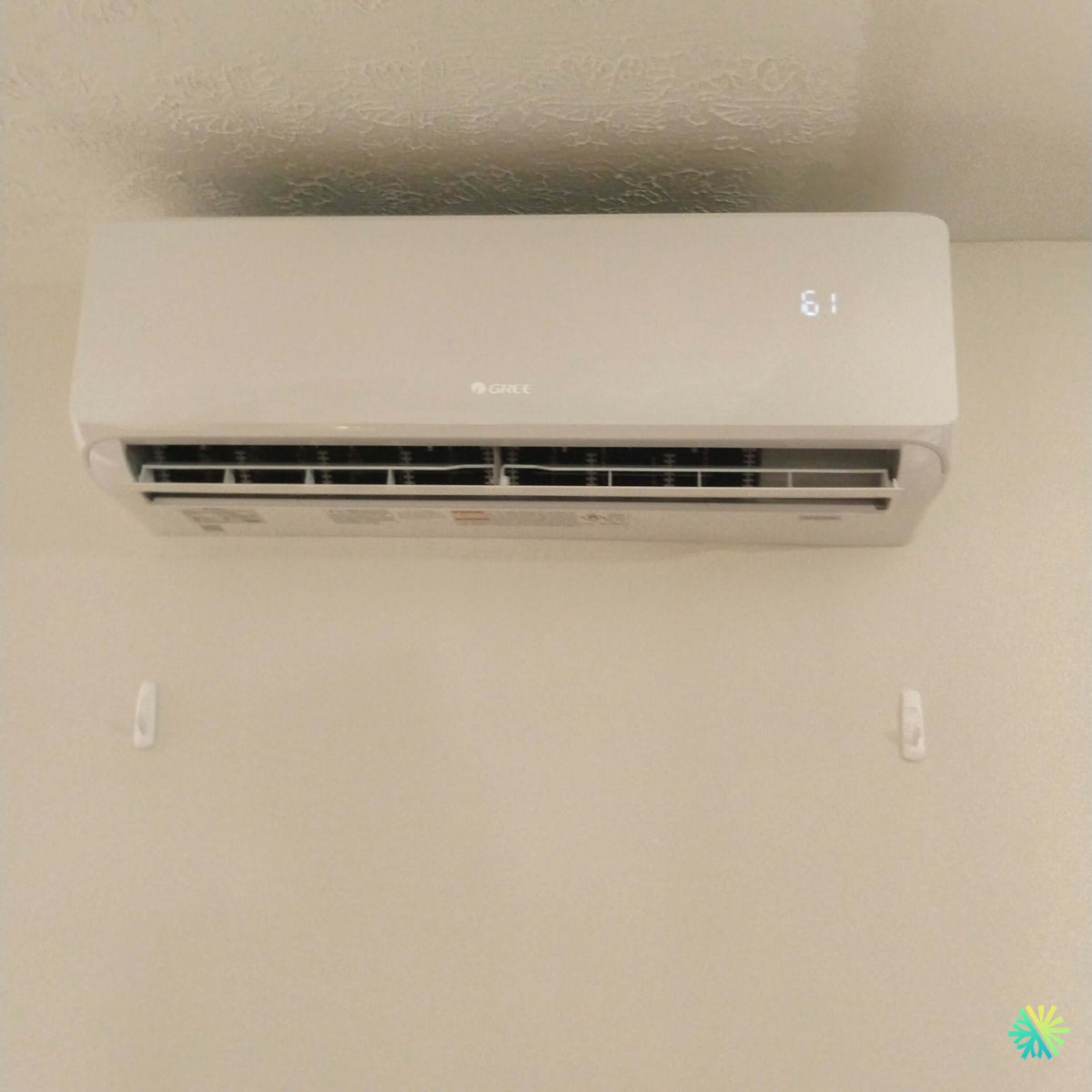
Installation of a GREE FreeMatch R32 two-head wall-mounted heat pump in Saint-Robert, Pierre-De Saurel RCM (Montérégie)
On the agricultural plain of Saint-Robert, the outdoor unit becomes the first obstacle for hundreds of meters—and builds its own snowdrift. Our GREE FreeMatch R32 2-head, 27,000 BTU installation on GWHD(24)ND6MO, and the placement choices that follow.
In summer, the outdoor unit rejects the house's heat outside.
Generic illustration of this type of installation, not a survey of this job site. Tap a number.
Mounted level on a wall plate, high enough for the air to reach the whole room, with enough space around it to slide the filters out easily.
The refrigerant lines, the communication cable and the drain go through the wall in a single opening, sealed against water, cold air and insects.
Two insulated copper pipes connect the two units. Outside, a line cover can protect them from sun, knocks and weather.
A shut-off switch near the outdoor unit isolates it safely for service. It must stay accessible at all times.
The compressor and the fan. In heating mode it captures heat from the outdoor air, even in winter, and moves it inside.
On the ground or on the wall, it keeps the unit above accumulated snow. The unit stays clear and defrost water can drain away.
The fan needs to blow freely. Storage, a fence or a wall too close, and efficiency drops while noise goes up.
The wind does not merely not to cool the appliance: it pushes above
At Saint-Robert, the horizon is a field. The municipality covers a little more than 64 km² across the agricultural plain that separates the Yamaska from the Richelieu, it has about 1,785 Robert residents and Robert residents, and it has existed as a municipality since October 17, 1857. This is not a tourist note : for a heat pump outdoor unit, a terrain unobstructed terrain upwind is a different installation condition from everything we encounter on the island of Montreal, in Laval, or on the South Shore urbanized.
The village has already served as a demonstration unintentional understanding of what “open sky” means or “open sky”: on June 14, 1994, a fall of meteorite scattered its fragments over the surrounding lands, the first picked up a few minutes after impact three kilometers east of the village, one about twenty more over the course of the next three following months, including one of 6.5 kg. Stones that fell from the sky find each other because there is nothing between them the sky and the ground. The winter wind takes advantage exactly the same geometry.
What “fetch” means for a an appliance installed in a field
In surface meteorology, the fetch is the distance over which the wind travels without encountering an obstacle. The longer it is, the more the wind is steady, fast near the ground, and the more snow it carries dries horizontally. In a neighborhood of Longueuil or Laval, fetch is measured in tens of meters: the neighboring house, the hedge, the shed disrupt the flow. In Saint-Robert, behind a residence in in rank, it is measured in hundreds of meters, sometimes in kilometers.
Two concrete consequences, that we we treat separately because they do not are not corrected in the same way.
The headwind works against the fan, not against the compressor
The unit outdoor unit of the series FreeMatch R32 blows forward: the fan the axial fan discharges air horizontally through the front, and the heat exchanger draws in from the rear and side. We we settle here a question that our previous pages have addressed in two different ways, and we retain the published reading for Saint-Théodore-d'Acton : it is the front face that determines the installation layout.
A wind that hits this front face head-on adds static pressure against which the fan must operate. The airflow drops — the unit is rated to 2,236 ft³/min in conditions under normal conditions — and in heating mode, less of air across the heat exchanger means a lower evaporation temperature lower, and therefore frost sooner and more frequent defrost cycles. This is the mechanism, and it must be stated properly: the ambient wind across the intake heat exchanger is not harmful, it would instead improve heat exchange. The the problem is strictly the headwind at the air outlet, the more recirculation that follows when the already cooled air is redirected toward the intake.
rewrite the physics of defrosting here We will not defrosting, published in detail for Saint-Ours — frost is first a matter of humidity, not cold. We are only adding the inlet of the design that this that page did not address: orientation relative to the prevailing wind.
The unit becomes the first obstacle from hundreds of meters
Second, less intuitive. Snow transported by blowing snow does not settle where the wind is strong; it settles where it slows, that is, immediately downwind of an obstacle. In a field, the obstacle, this is the unit outdoors. It builds its own snowdrift, and rebuilds it during every snowfall event windy.
This invalidates two common reflexes:
- Place the unit in a sheltered location, downwind of the building, hedge, or snow fence. That is precisely the deposition zone. Oka published the the “fence” version of this error: what stops the wind stops the snow it carries, and the the deepest snowdrift forms a few a few feet from the windbreak, on the sheltered side sheltered.
- Choose the base height according to the average thickness of the yard's snow cover. The The proper reference is neither the average of the ground (Lachine, Saint-Eustache : the snow from this year, not that from the day), nor the layer of ice that defrosting rebuilt every night (Saint-Ours), nor the flood elevation (Ormstown, Sainte-Marthe-sur-le-Lac). It is the snowdrift the unit creates for itself, which is almost always higher than the surrounding cover.
What we have retained on the Saint-Robert site
TheThe owners had shown us a logical location: the wall northwest, behind a row of cedars, “so it would be less exposed ». This is the location we chose set back, and we took the time to explain it on-site rather than move the appliance without explaining why.
The location selected:
- Air outlet perpendicular to the prevailing winter wind, rather than facing it or with its back to it. Facing facing it, the fan works against the wind; with its back to it, the snowdrift forms in front of the outlet. Across it, neither one nor the other.
- Raised base on a clean stone bed, the height chosen on the snowdrift local conditions observed by homeowners for twelve winters, not a value based on standardized. We do not publish a figure: the right height at Saint-Robert is not the right height to Sorel-Tracy, three rows away.
- No enclosure, no nearby screen. A housing around an appliance that releases steam during defrosting becomes a box that re-collects itself and on which the ice accumulates (Westmount).
- Discharge axis never directed toward a pedestrian walkway, nor toward the service door service.
- Asymmetrical side clearance compliant with our standards installation location, on the accessible connections without prior snow removal.
The smell of the spreading does not enter through the heat pump—and here is what really enters
It is the question that came before all the others others, and it deserves an clear answer rather than vague reassurance. On agricultural rows, spreading liquid manure in spring and fall is a calendar reality. The concern is legitimate: an appliance that “ circulates air” import the smell from the field into the living room?
No. A wall-mounted heat pump is an appliance recirculation: it draws in the air from the room, passes it through a heat exchanger, and returns it to the same room. It has no no outdoor air intake, none leads outside other than the penetration hole through which lets the copper, drain, and interconnection cable. We have published this principle for Beauharnois and it does not change here: what enters the smell in a house is the building envelope — doors, windows, heat recovery ventilator (HRV), infiltration — never the wall-mounted unit.
What the field actually located is removed outside, on the outdoor coil: earth dust and row dust from gravel, residue from hay and threshing, pollens, aerosols spreading. Saint-Télesphore has documented this rural dirt in detail, including the fact that none none of them triggers an error code. We do not revisit, except for the commercial consequence, which we we assume: on a property on a rural road, annual rinsing of the outdoor heat exchanger is part of the maintenance plan from the moment of signing, not a surprise bill in the third summer. The rinsing method was published for Pierrefonds-Roxboro, reading the indoor filter to Bois-des-Filion ; for the filters, the the only adjustment in Saint-Robert is a cleaning frequency cleaning schedule tightened during the weeks of collection.
The unit selected and the figures supporting the decision decision
We installed a GREE FreeMatch R32 2-head wall-mounted heat pump on outdoor unit GWHD(24)ND6MO, approved AHRI 214931587 in a non- ducted, ENERGY STAR and certified for cold climates.
| Data | Value |
|---|---|
| Nominal capacity (cooling / heating) | 24 000 BTU/h |
| Modulated range | 7 500 – 31 400 BTU/h |
| SEER2 / HSPF2 / EER2 | 21 / 10 / 12 |
| Nominal COP | 3,9 |
| Operating temperatures | −30 at 48 °C in cooling, −30 to 24 °C in heating |
| MCA / MOCP | 19.5 A / 25 A |
| Factory R32 charge | 1 700 g |
| Precharge / additional charge | 30 m / 20 g per meter additional |
| Total length maximum | 60 m |
| Maximum elevation difference | 15 m |
| Warranty | 10 years + 2 years upon registration |
Head distribution: 15,000 BTU/h in the open kitchen–dining room dining room–living room of the ground floor, 12,000 BTU/h in the large room upstairs. Total installed 27,000 BTU/h, that is 113% of nominal — an excess normal and intentional in multi-zone mode, because of the two heads never call for their full capacity at the same time at the same time, and because the total remains below the modulated maximum of 31,400 BTU/h.
Developed lengths: 14 m and 19 m, totaling 33 m — it is the actual path length traveled, elbows and rises included, never the distance measured on a plan (Saint-Lambert, Léry). Three meters beyond the 30 m precharge, therefore 60 g of R32 added, final charge 1,760 g, and surface verification minimal part A2L redone on this final charge and not on the factory charge. Elevation difference of approximately 3.5 m: note that on this model the limit is 15 m, not 25 m as on the larger units — the elevation line is the only one on the panel that does not match the capacity (Sainte-Thérèse, Pierrefonds-Roxboro).
On the electrical, dedicated circuit protected according to the 25 A MOCP ; the rationale complete information on the 100 A service entrance was published for Napierville and Saint-Édouard and we do not revisit them not. The existing electric baseboards were retained, as in the nearly all of our projects in Montérégie: they remain the backup heating of rooms not served and the mesh during prolonged outages, a topic covered in depth for Havelock.
Mistakes to avoid on an exposed property exposed
- Install the outdoor unit “sheltered” behind a windbreak, a cedar hedge or a building wall building.
- the unit for aesthetic reasons. box in, enclose, or fence off
- Set the base height to a value standard rather than on the snowbank observed.
- Direct the air outlet toward the driveway, service door, or snow-clearing path.
- Blow the outdoor unit with the blow snow or push it toward it to the tractor.
- Postponing the annual flushing of the heat exchanger because “nothing appears »: nothing will ever appear, since there is no no fault code for a clogged heat exchanger.
- Turn off the Turn off the breaker during an absence winter.
Rebates and eligibility
The unit is certified ENERGY STAR cold climate, which is the gateway to programs in effect in Quebec, including LogisVert of Hydro-Québec and Rénoclimat. Conditions, cumulative totals and timelines change from one year to each other and third-party sites regularly contradict each other: we do not we publish no amount. We verify eligibility on a case-by-case basis, before signing, with the numbers exact AHRI of the selected configuration.
Where we intervene
At AirGreen, we we carry out theHVAC installation and theHVAC maintenance heat pumps wall-mounted, multi-zone, and central Montreal, Laval, Longueuil, on the North Shore and on the South Shore, through the municipalities of the Pierre De Saurel RCM — Saint-Robert, Saint-Ours, Saint-David, Sorel-Tracy, Yamaska, Sainte-Victoire-de-Sorel. A construction site cannot be planned like a suburban construction site: a tiered the dust, distance, and wind reserve, heating are just as important as the calculation charge.
How it goes, from the first call to the end
The main steps of this kind of job at AirGreen. Every house has its quirks: the estimate brings them out.
We look at the room, the outside wall, the line route and where the outdoor unit will go. That is where the capacity gets chosen.
Model, capacity and price, in writing. We also check whether the model qualifies for assistance programs.
Floors and furniture protected, wall plate position marked level, wall opening located.
A single opening, with the slope the drain needs to flow outside.
Set on a stand raised above the snow, with the clearances the manufacturer requires.
Connected, insulated and protected. The opening is then sealed against water, cold air and insects.
A dedicated circuit and an accessible disconnect near the outdoor unit.
Leak test, vacuum, then start-up and a check of heating and cooling.
Remote, modes, filters: we show you the essentials before we leave.
- The on-site estimateWe look at the room, the outside wall, the line route and where the outdoor unit will go. That is where the capacity gets chosen.
- The quoteModel, capacity and price, in writing. We also check whether the model qualifies for assistance programs.
- Getting readyFloors and furniture protected, wall plate position marked level, wall opening located.
- The wall openingA single opening, with the slope the drain needs to flow outside.
- The outdoor unitSet on a stand raised above the snow, with the clearances the manufacturer requires.
- Lines, cable and drainConnected, insulated and protected. The opening is then sealed against water, cold air and insects.
- The electrical workA dedicated circuit and an accessible disconnect near the outdoor unit.
- Tests and start-upLeak test, vacuum, then start-up and a check of heating and cooling.
- The walkthroughRemote, modes, filters: we show you the essentials before we leave.
And at your place?
Two quick checks with real numbers: what heat costs, and what your current heaters add up to in BTU/h.
Conversion: 1 W = 3.412 BTU/h. An indication, not a load calculation: baseboards and furnaces are often stronger than the real need, and they can stay as backup. AirGreen confirms the capacity on site.
What to do, season by season
Three habits per season for this unit. They take a few minutes and prevent many calls.
- Clean the indoor unit's filters.
- Clear leaves and debris left on the outdoor unit by winter.
- Test cooling before the first hot days.
- Clean the filters more often when the unit runs a lot.
- Keep plants away from the outdoor unit.
- Check that no water drips from the indoor unit.
- Rake the leaves around the outdoor unit.
- Test heating before the first cold days.
- Book periodic maintenance before winter.
- Keep snow away from the stand and the front of the unit.
- Let the unit defrost: it is normal.
- Never hit the ice on the fins; call us if the unit stays iced up.
Which type of equipment for your project?
Pick what looks like your need.
Four mistakes we do not make
Flip each card to see what we do instead.
What people ask us about this kind of work
Does a wall-mounted heat pump heat in winter?
Wall-mounted or multi-zone: how do I choose?
Where does the outdoor unit go?
Are there grants?
Do I need a permit?
How cold can it heat?
How much can I save?
How is the LogisVert assistance calculated?
Is it noisy?
The outdoor unit is covered in ice: is that normal?
Does AirGreen hold the required licences?
Is the estimate free?
No question matches. Write to us: we answer.
Useful pages for what comes next
More jobs to see, near you
By town, by equipment or by region: browse more than 4,700 published projects.
Each dot: a town where AirGreen has published projects. The glowing dot: this job.
Tell us about your house. We come and see it for free.
The on-site estimate is free and the quote follows within 24 hours.
Text and photo: a real AirGreen Climatisation & Chauffage job. The diagrams are generic illustrations of the type of installation, not a survey of this job site. Sources of the added figures: airgreen.ca product pages (NEEP / AHRI performance), Hydro-Québec (Heat pumps page, LogisVert, read on 13 October 2026), Régie de l’énergie (rate D as of 1 April 2026).