
Installation of a GREE FREEMATCH R32 dual-zone wall-mounted heat pump (GWHD(24)ND6MO) in Napierville, in Les Jardins-de-Napierville
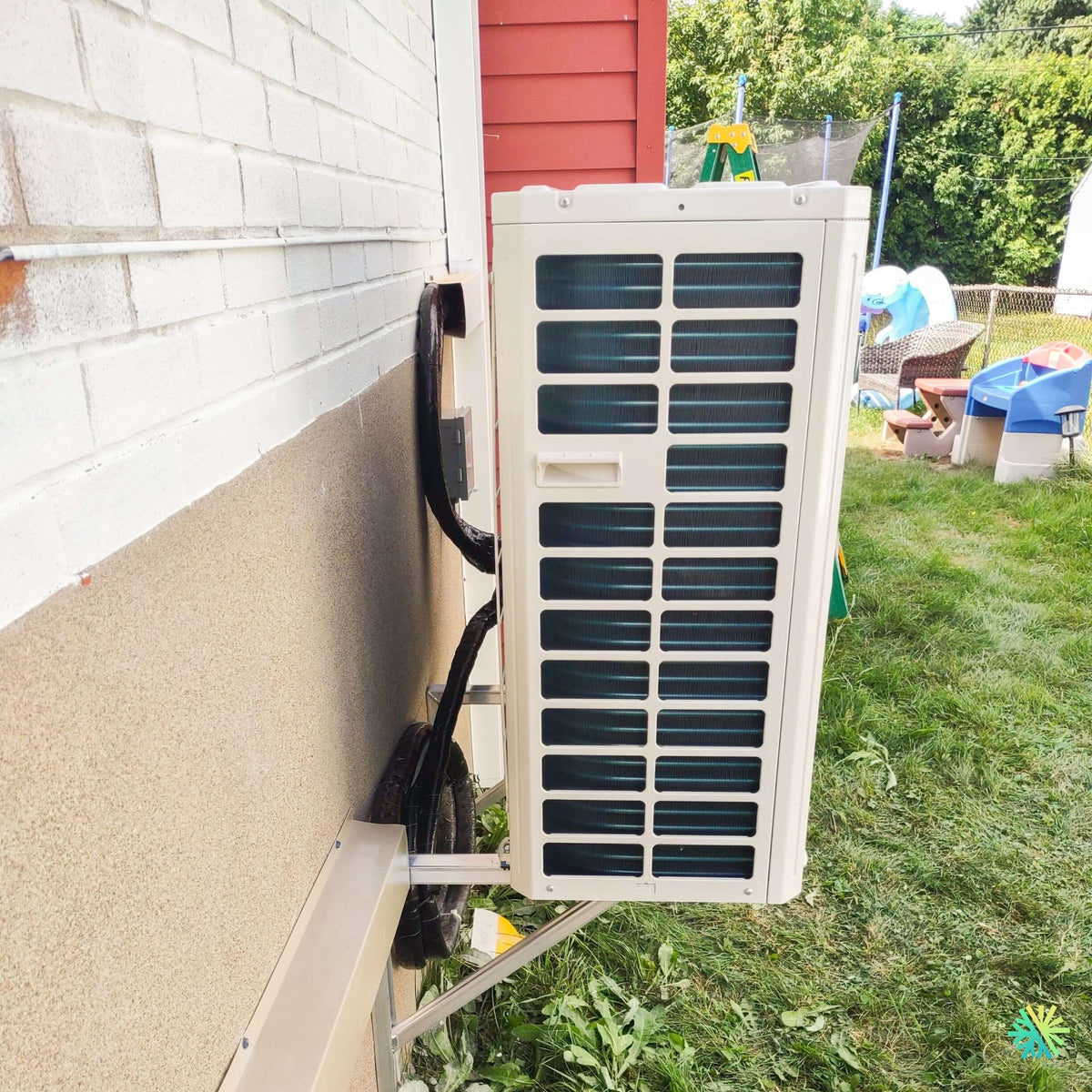
A GREE FREEMATCH R32 two-head heat pump mounted on brackets in a family yard in Napierville: what a ball, a string trimmer, and grass clippings really do to a coil—and why the unit never alerts you.
In summer, the outdoor unit rejects the house's heat outside.
Generic illustration of this type of installation, not a survey of this job site. Tap a number.
Mounted level on a wall plate, high enough for the air to reach the whole room, with enough space around it to slide the filters out easily.
The refrigerant lines, the communication cable and the drain go through the wall in a single opening, sealed against water, cold air and insects.
Two insulated copper pipes connect the two units. Outside, a line cover can protect them from sun, knocks and weather.
A shut-off switch near the outdoor unit isolates it safely for service. It must stay accessible at all times.
The compressor and the fan. In heating mode it captures heat from the outdoor air, even in winter, and moves it inside.
On the ground or on the wall, it keeps the unit above accumulated snow. The unit stays clear and defrost water can drain away.
The fan needs to blow freely. Storage, a fence or a wall too close, and efficiency drops while noise goes up.
An outdoor unit installed in a yard where children play every day
The photo from this de Napierville job site shows something technical specifications never address: the outdoor unit is mounted on wall brackets against the foundation, and three metres behind it there is a slide, a plastic playhouse, a trampoline, and a chain-link fence. This is the real context of the majority of our HVAC installations in residential areas, on the South Shore as well as the North Shore, and it is the one discussed the least.
We have already written elsewhere about the trade-off between a ground-mounted base and a wall bracket, the anchoring substrate, snow depth, and protective screens installed in front of a coil. These topics have been covered, and we will not revisit them here. What has never been written about, yet comes up with every service call in a family backyard, is what a child can do to an appliance—and what an appliance can do to a child.
What a fan grille stops—and what it does not
The grille that protects the fan blade of an outdoor unit is designed to prevent a hand from reaching the blades. It is not designed to stop a stick, a wand, a toy broom handle, or a twig. This is a distinction parents do not make instinctively, because the grille looks like a complete barrier.
What we actually find inside the cabinets we open for annual maintenance:
- sand and dirt thrown up by a water game or a sandbox that is too close;
- tennis balls and practice balls wedged between the coil and the panel;
- ribbons, strings, and skipping ropes wound around the fan hub;
- grass clippings compacted in the lower part of the coil, on the intake side;
- plastic toys left on top of the cabinet and forgotten there all winter.
None of these objects triggers an error code. That is precisely the problem, and we return to it in the second part of this article.
The ball that hits the fins does not damage what you might think
A ball thrown against a coil does not puncture anything. It bends the aluminum fins over an area the size of a hand. The owner looks, sees no damage, and never mentions it. Repeated for an entire season against the same yard wall, the effect is cumulative: one area of the coil stops allowing air to pass through, the appliance continues to operate, and the consequence appears elsewhere—in energy consumption first, then in capacity during extreme weather.
We straighten these areas with a fin comb during maintenance. It is a routine intervention when done every year, and much less routine when no one has opened the cabinet in six years.
The cabinet is not a stepstool.
An outdoor unit on wall brackets is at a convenient height. This is a real advantage: it is out of the mowing area, out of the snow, and above ground-level play. It is also, for a six-year-old, a visible and reachable platform as soon as there is a lawn chair, cooler, or crate nearby.
A 51 kg cabinet bolted to brackets is designed for its own weight, wind pull, and vibrational fatigue. It is not designed for a dynamic load applied from above. Our rules for residential worksites with young children:
- Nothing is placed on top of the cabinet—no toy, flowerpot, or coiled hose.
- Nothing climbable is left beside it: the chair, crate, and recycling bin are moved; the appliance is not.
- The garden hose is never directed at the appliance while it is operating, even to “rinse it.” The coil is rinsed with the appliance switched off, in the proper direction, and this is a maintenance task, not summer play.
- The area beneath the appliance is treated as a water zone. In air-conditioning mode, the appliance produces almost nothing there; in winter heating mode, each defrost cycle deposits water there. A play surface—a rubber mat, compacted grass, or slab—placed directly beneath an appliance becomes a sheet of ice in January. We choose the placement with consideration for where children pass in winter, not only where they play in July.
- The paths of the snowblower and lawn mower are discussed at delivery, along with the exact location of the lines and drain.
We do not publish any specific “safe height,” and we are wary of the figures found online: the out-of-reach guidelines in circulation come from guides covering toxic products and medications, not mechanical equipment. For a specific appliance, the only valid answer comes from the manufacturer’s installation manual and, where applicable, the municipality.
The string trimmer and lawn mower
The most common damage we see on an outdoor unit in a backyard is caused neither by frost, hail, nor a child: it is caused by a string trimmer. The line cuts into the power-cable sheath, opens the insulation on the suction line, and marks the cabinet. Nothing shows up for two or three years. The solution is simple and decided before drilling: a clear mineral zone—stone, paving slabs, or stone mulch—rather than a strip of lawn that has to be trimmed every week.
The photo also shows freshly cut grass all around the stand. This is not insignificant: mowing projects the clippings sideways, and a unit that draws air in through its sides catches them. Mowing away from the outdoor unit, rather than alongside it, genuinely changes the condition of the coil by the end of summer.
Discharge temperature: the data point no one watches that determines everything
This second part explains why the oversights described above come at a cost, and it concerns a physical quantity that owners are never told about: the compressor discharge temperature.
The hottest point in the system
A compressor does not merely move refrigerant; it compresses it, and compression heats the gas. The refrigerant leaving the compressor is the hottest point in the entire system—much hotter than the air blown into the room and much hotter than the pipe touched outside.
This temperature rises with the compression ratio, that is, the difference between the suction pressure and the discharge pressure. Two situations make it rise:
- heating in extreme cold, when the appliance must draw heat from air at −20 °C or −25 °C and deliver it to the room at 40 °C;
- air conditioning during a heat wave, when heat must be rejected into already very hot outdoor air.
In other words, the discharge temperature is highest precisely when the appliance is needed most.
R32 runs hotter, and that makes sense
The R32 is a single-component refrigerant with no temperature glide and a high volumetric capacity—which means less of it is needed to provide the same service. One of its well-known thermodynamic characteristics is that, under equivalent conditions, it produces a higher discharge temperature than the R410A it replaces.
This is not a defect; it is a property. It is addressed at the design stage through the choice of lubricant, electronic compressor management, and limiting strategies. On the FREEMATCH R32 range, G10 inverter technology continuously modulates the compressor speed, giving the control system exactly the lever it needs — slowing down before anything is damaged.
We have discussed elsewhere the chemistry of the transition from R410A to R32, global warming potential indicators, and the A2L classification. We will not revisit them here. What interests us here is the practical consequence.
What the appliance does when this temperature rises too high
A sensor continuously monitors the discharge. When the value approaches the permissible limit for the refrigerant and the oil, the control system reduces the compressor speed. If that is not enough, it stops the compressor.
This is the decisive point, and it is what connects the two halves of this article:
An appliance whose outdoor coil is partially blocked does not break down. It quietly becomes less efficient, and only in extreme weather.
What the control system interprets is not “the coil is dirty.” It is “my discharge temperature is rising too quickly.” Its response is to reduce the operating speed. The result for the occupant:
- in January at −22 °C, the house no longer quite reaches the setpoint, and the supplemental baseboard heaters work harder;
- in July at 33 °C, the air conditioner “can no longer keep up” in the afternoon;
- the rest of the year, everything works fine, so no one calls;
- no error code is displayed, because no protection limit has been exceeded: the appliance protected itself.
This is exactly how a balloon, a string trimmer, a pile of grass clippings, or a dirty screen turns into an electricity bill and discomfort two years later, without ever looking like a failure.
Other causes that raise discharge pressure
- An outdoor coil obstructed by snow or surrounded by an enclosed structure. An appliance never “runs away”: it rejects its own air back into itself.
- A tarp, wooden box, or “winter” enclosure. A heating appliance operates in winter; covering it is the most effective way to make it run hot.
- A clogged indoor filter or furniture in front of an indoor unit, which reduces airflow on the indoor side.
- An insufficient charge. We repeat this because it matters: a system that is low on refrigerant has a leak. Adding refrigerant is not maintenance; it is postponing a diagnosis.
What the oil undergoes, and why this shortens an appliance’s lifespan
The same temperature is experienced by the lubricant. Repeated episodes of high discharge pressure degrade the oil and, in the presence of residual moisture in the circuit, fuel an acidic reaction that eventually attacks the compressor motor’s insulation varnish. This is why, on every job we undertake, we place so much emphasis on the quality of the evacuation and the tightness of the connections: a compressor’s longevity is determined on the day of installation, not at its first service.
The installed equipment and the job-site context
| Item | Detail |
|---|---|
| Outdoor unit | GREE FREEMATCH R32 — GWHD(24)ND6MO |
| Indoor units | 2 wall-mounted units, 12,000 + 12,000 BTU/h |
| Nominal cooling capacity | 7,030 W — 24,000 BTU/h |
| Nominal heating capacity | 7,030 W — 24,000 BTU/h |
| Modulation range | 2,200 to 9,200 W (7,500 to 31,400 BTU/h) |
| Efficiency | SEER2 21 · HSPF2 10 · EER2 12 · EER 3.80 · COP 3.90 |
| Refrigerant | R32, 1,700 g factory charge |
| Power supply | 208/230 V — MCA 19.5 A, maximum fuse 25 A |
| Operating range | −30 °C to 48 °C in cooling mode, −30 °C to 24 °C in heating mode |
| Piping | 9 m + 14 m = 23 m of developed length, within the 30 m factory charge |
| Outdoor unit weight | 51 kg |
| AHRI number | 214931587 · ENERGY STAR certified |
| Leak detection | sensor A2L included as standard |
We will say it plainly: this capacity and distribution combination has already been used elsewhere in our series. A 12,000 + 12,000 pairing on a 24,000 BTU/h outdoor unit is the most common residential configuration in Quebec, and we will not pretend otherwise. What distinguishes this page is not the technical specifications, but the yard where the unit was installed.
Two technical details are worth noting for this capacity:
- The modulation floor is 7,500 BTU/h, the lowest in the range along with the 18,000 model. With two comparable zones, this provides excellent shoulder-season performance, with few short cycles in May and September.
- The outdoor unit accepts two to three indoor units. A third zone remains possible without changing the outdoor unit, within the maximum total allowable length of 60 m.
Program eligibility
The GWHD(24)ND6MO is ENERGY STAR certified and has a published AHRI number—two checks systematically required by Quebec financial assistance programs. Conditions vary depending on the heating system being replaced, the type of building, and the program year, and they change regularly. We do not publish amounts: we validate the application when it is opened, using the program documents then in effect, and prepare the supporting documents at the end of the work.
Napierville: the village where a republic was proclaimed
We had already written about Napierville—an early-20<sup>th</sup>-century village house with lath-and-plaster walls, no ductwork, baseboard heating supplemented by a wood stove, and a 100 A electrical service that dictated the choice of model. That page covers electrical sizing and drilling in older construction; this one covers the yard and the compressor. The two complement each other without repeating one another.
The village itself was founded in 1815, one of the three seigneurial villages laid out by notary Edme Henry, and was named after Napier Christie Burton (1758–1835), heir to the area's seigneuries. The Saint-Cyprien parish was established on January 1<sup>st</sup>, 1823, the village municipality in 1855, and the present church was rebuilt between 1886 and 1889 after a fire.
And on November 4, 1838, Dr. Robert Nelson arrived in Napierville and proclaimed the Republic of Lower Canada there. A commemorative monument was inaugurated in 1988. Few Quebec villages of this size have been the setting for a political episode of such importance.
The Jardins-de-Napierville RCM is now one of Quebec's major vegetable-growing regions, and we regularly work there—in Saint-Édouard, Saint-Cyprien-de-Napierville, Sainte-Clotilde, and Saint-Chrysostome, among others. Each village has its own constraints: older buildings, limited electrical service, service distances, and open-field wind. That is why we treat every installation as a unique case.
At AirGreen, we install and maintain heat pumps, wall-mounted air conditioners, and complete HVAC systems in Montreal, Laval, Longueuil, on the North Shore, on the South Shore, and throughout Montérégie. A children's play area, a string trimmer, and a backflow probe do not appear on any quote—yet they are what determine the value of the equipment ten years from now.
How it goes, from the first call to the end
The main steps of this kind of job at AirGreen. Every house has its quirks: the estimate brings them out.
We look at the room, the outside wall, the line route and where the outdoor unit will go. That is where the capacity gets chosen.
Model, capacity and price, in writing. We also check whether the model qualifies for assistance programs.
Floors and furniture protected, wall plate position marked level, wall opening located.
A single opening, with the slope the drain needs to flow outside.
Set on a stand raised above the snow, with the clearances the manufacturer requires.
Connected, insulated and protected. The opening is then sealed against water, cold air and insects.
A dedicated circuit and an accessible disconnect near the outdoor unit.
Leak test, vacuum, then start-up and a check of heating and cooling.
Remote, modes, filters: we show you the essentials before we leave.
- The on-site estimateWe look at the room, the outside wall, the line route and where the outdoor unit will go. That is where the capacity gets chosen.
- The quoteModel, capacity and price, in writing. We also check whether the model qualifies for assistance programs.
- Getting readyFloors and furniture protected, wall plate position marked level, wall opening located.
- The wall openingA single opening, with the slope the drain needs to flow outside.
- The outdoor unitSet on a stand raised above the snow, with the clearances the manufacturer requires.
- Lines, cable and drainConnected, insulated and protected. The opening is then sealed against water, cold air and insects.
- The electrical workA dedicated circuit and an accessible disconnect near the outdoor unit.
- Tests and start-upLeak test, vacuum, then start-up and a check of heating and cooling.
- The walkthroughRemote, modes, filters: we show you the essentials before we leave.
And at your place?
Two quick checks with real numbers: what heat costs, and what your current heaters add up to in BTU/h.
Conversion: 1 W = 3.412 BTU/h. An indication, not a load calculation: baseboards and furnaces are often stronger than the real need, and they can stay as backup. AirGreen confirms the capacity on site.
What to do, season by season
Three habits per season for this unit. They take a few minutes and prevent many calls.
- Clean the indoor unit's filters.
- Clear leaves and debris left on the outdoor unit by winter.
- Test cooling before the first hot days.
- Clean the filters more often when the unit runs a lot.
- Keep plants away from the outdoor unit.
- Check that no water drips from the indoor unit.
- Rake the leaves around the outdoor unit.
- Test heating before the first cold days.
- Book periodic maintenance before winter.
- Keep snow away from the stand and the front of the unit.
- Let the unit defrost: it is normal.
- Never hit the ice on the fins; call us if the unit stays iced up.
Which type of equipment for your project?
Pick what looks like your need.
Four mistakes we do not make
Flip each card to see what we do instead.
What people ask us about this kind of work
Does a wall-mounted heat pump heat in winter?
Wall-mounted or multi-zone: how do I choose?
Where does the outdoor unit go?
Are there grants?
Do I need a permit?
How cold can it heat?
How much can I save?
How is the LogisVert assistance calculated?
Is it noisy?
The outdoor unit is covered in ice: is that normal?
Does AirGreen hold the required licences?
Is the estimate free?
No question matches. Write to us: we answer.
Useful pages for what comes next
More jobs to see, near you
By town, by equipment or by region: browse more than 4,700 published projects.
Each dot: a town where AirGreen has published projects. The glowing dot: this job.
Tell us about your house. We come and see it for free.
The on-site estimate is free and the quote follows within 24 hours.
Text and photo: a real AirGreen Climatisation & Chauffage job. The diagrams are generic illustrations of the type of installation, not a survey of this job site. Sources of the added figures: airgreen.ca product pages (NEEP / AHRI performance), Hydro-Québec (Heat pumps page, LogisVert, read on 13 October 2026), Régie de l’énergie (rate D as of 1 April 2026).