MIDEA
MIDEA22 · 12,000 BTU · 208-230 V
MSGNS-H12B-2A / MO1BS-H12B-2A · AHRI 215471368
R-454B · NEEP record 387371
View the product page
514-316-2973
sales@airgreen.ca
The gist
The bottom and the top of MIDEA's 12,000 BTU wall range: certificates, cost per season, years to cover the price gap, the four-series ladder, extreme cold, sound and installation.
“Is the top of the range worth it?” The question comes up often in Longueuil and elsewhere. To answer it with figures rather than impressions, this page compares two 12,000 BTU wall units from the same brand: the MIDEA22, the entry series in MIDEA’s wall brochure, and the MIDEA35, which the same brochure calls its “série murale haut de gamme” (top-of-the-range wall series). Same manufacturer, same capacity, same refrigerant: what changes from one series to the other stands out more clearly.
MSGNS-H12B-2A / MO1BS-H12B-2A · AHRI 215471368
R-454B · NEEP record 387371
View the product page
MSESU-H12B-2A / MO1SS-H12B-2A · AHRI 215471387
R-454B · NEEP record 387352. Also sold as the SENVILLE ELITE 12,000: same certified NEEP values (record 371579).
View the product pageAirGreen estimate for the same 12,000 BTU/h zone, at Hydro-Québec’s Rate D, taxes included. Both heat pumps are calculated exactly the same way, with the same method as on all our comparison pages; only their certified efficiencies change. Electric baseboards serve as the reference point. Longueuil has no station of its own in the data used: the calculation takes Montréal Intl, across the river.
AirGreen method v1.1, November 9, 2026. An estimate is for comparing units under the same conditions. The actual bill depends on the house, the insulation, the settings and how it is used; this amount is not a promise.
That is the real question behind “investment or luxury”. Enter the price gap between your two quotes, installation included. The page takes the yearly electricity cost gap calculated just above, with the same rate and hours settings, and shows after how many years the two balance out. Change the hours or the rate above: the result follows.
Calculation: price gap ÷ yearly electricity cost gap, at today’s rate, with no inflation or interest, using the cost method shown above. It is not a promise of return: actual use, maintenance and future rates change the result. The price of each unit and its installation is in the quote.
Between the MIDEA22 and the MIDEA35, MIDEA offers two other 12,000 BTU series, the MIDEA25 and the MIDEA28, all on R-454B. Pick a measure: each bar comes from the certificate published by NEEP, and you can see at which step each figure changes. The two units compared on this page are in colour.
NEEP values read on November 17, 2026: records 387371 (MIDEA22, 208-230 V), 387363 (MIDEA25), 387358 (MIDEA28) and 387352 (MIDEA35). “Cold climate” tag: ENERGY STAR cold climate status shown by NEEP. The MIDEA28 and the MIDEA35 also have their own comparison page.
The earlier article summed up the question in a two-column table. Here is each of its lines, checked against the certificates and the MIDEA brochure for these two specific units.
Consumption: low versus medium to high
Both are certified heat pumps, well above electric baseboards. The gap between them shows in the certificates: HSPF2 Region V 7.0 and 9.5, SEER2 21.3 and 29.4. The cost section turns it into dollars.
Sound level: very quiet versus moderately noisy
At the lowest speed, the MIDEA brochure prints 18.5 dB(A) for the MIDEA22 and 19 dB(A) for the MIDEA35, without stating the method. Outdoors, 53.0 and 57.0 dB(A). Nothing in these figures puts the entry series among noisy units.
Lifespan: 15 to 20 years versus 8 to 12 years
No MIDEA document consulted publishes a lifespan for either series. These figures are not used: lifespan depends mostly on installation, maintenance and use.
Grants: yes versus sometimes not eligible
What NEEP shows today: MIDEA22 ENERGY STAR no, cold climate no; MIDEA35 ENERGY STAR yes, cold climate yes. Eligibility is checked in the program’s official list on the date of the application; this page promises no amount.
Technology: inverter and Wi-Fi versus basic
Both certificates give a capacity range, so a variable-speed compressor: heating at 8.3 °C, 4,200 to 14,100 and 4,000 to 17,200 BTU/h. The brochure states built-in Wi-Fi for the MIDEA22 and Wi-Fi control for the MIDEA35.
Upfront price: higher versus affordable
The price depends on the job and is in the quote. What the page can do is set that gap against the bill: that is the role of the “gap to cover” section.
At −15 °C, both certificates give a capacity: 8,000 and 13,500 BTU/h. Lower down, MIDEA had a point certified at −30 °C for the MIDEA35. For the MIDEA22, the brochure states a heating range that stops at −15 °C and publishes nothing colder: below that temperature, the house’s backup heating takes over.
One source for both: MIDEA’s “Systèmes de thermopompes sans conduit” brochure of August 20, 2025. Page 8 presents the MIDEA35, 28 and 25 series; page 9, the MIDEA22 series. A feature missing from a page is not necessarily missing from the unit: it is simply not stated there.
MIDEA22 : not stated.
MIDEA35 : “Capteur intelligent” (smart sensor): after more than 30 minutes of absence, the unit lowers its operating frequency (p. 8).
MIDEA22 : not stated; page 5 excludes the MIDEA22 from the dual temperature and humidity control.
MIDEA35 : humidity sensor (p. 8).
MIDEA22 : automatic cleaning (p. 9).
MIDEA35 : automatic cleaning and a removable fan wheel, for deep cleaning (p. 8).
MIDEA22 : horizontal swing, louver position memory, long-reach airflow (p. 9).
MIDEA35 : horizontal and vertical swing, longer airflow reach (p. 8).
MIDEA22 : R-454B; the A2L leak sensor is presented on page 5 with no series excluded.
MIDEA35 : R-454B; “A2L dispersion system” in the list for the 35, 28 and 25 series (p. 8).
MIDEA22 : built-in Wi-Fi, Follow Me, 8 °C heating, ECO, Turbo, silent mode; optional 24 V interface and wired control (p. 9).
MIDEA35 : Wi-Fi control, Follow Me, 8 °C heating, ECO, Turbo, silent mode, dry contact; optional 24 V interface and wired control (p. 8).
How to read these figures. Each point is a fan speed published in the MIDEA brochure (Turbo, High, Medium, Low, Silent); the lower the number, the quieter the unit at that speed. The brochure publishes no Turbo level for the MIDEA35 and states neither the distance nor the method.
Why this is not a ranking. Same manufacturer, same document: the figures are presented the same way. But half a decibel at the lowest speed cannot be heard, and a “Medium” speed is not the same airflow from one series to the other.
Measurements published by MIDEA in the same brochure, method not stated: not comparable to the decibel.
Both series share the same piping limits. What changes is the size: the MIDEA35 is wider indoors, and its outdoor unit is clearly larger and heavier, something to plan for on a wall bracket or a balcony.
Drawing to scale, from the published width of each indoor unit (MIDEA brochure, p. 13 and p. 10). The installation manual also sets clearances to the ceiling and the sides: they add to this width.
| According to the manufacturer | MIDEA22 | MIDEA35 |
|---|---|---|
| Maximum piping length | 82.0 ft | 82.0 ft |
| Pre-charged length | 24.6 ft | 24.6 ft |
| Refrigerant to add beyond | 0.16 oz/ft, R-454B | 0.16 oz/ft, R-454B |
| Maximum height difference | 49.2 ft | 49.2 ft |
| Liquid – gas diameters | 1/4 – 3/8 in | 1/4 – 3/8 in |
| Indoor unit W × H × D, weight | 32.87 × 11.61 × 8.19 in, 18.96 lb | 37.99 × 12.56 × 9.41 in, 28.22 lb |
| Outdoor unit W × H × D, weight | 30.12 × 21.85 × 11.93 in, 59.08 lb | 35.04 × 26.50 × 13.46 in, 99.65 lb |
| Factory refrigerant charge | 24.69 oz | 44.09 oz |
| Outdoor unit electrical protection | min. ampacity 13.0 A, max. fuse 15 A, 208-230 V | min. ampacity 16.0 A, max. fuse 20 A, 208-230 V |
| Stated heating / cooling range | −15 to 24 °C / −15 to 50 °C | −30 to 24 °C / −30 to 50 °C |
| Published outdoor sound | 53.0 dB(A), high speed | 57.0 dB(A), high speed |
| Indoor airflow, high speed | 294.3 cfm | 423.8 cfm |
higher marks the higher value of the same measure, under the same conditions. It is not a recommendation. Source: MIDEA “Systèmes de thermopompes sans conduit” brochure, 2025-08-20, p. 13 (MIDEA22, 208/230 V column) and p. 10 (MIDEA35). Dehumidification is not given a figure there.
That is the name MIDEA’s 2025 brochure gives it: “série murale haut de gamme” (top-of-the-range wall series). The page does not stop at the label: it shows what actually changes on the certificate, on the estimated bill and in the brochure, line by line.
Its certificate gives 8,000 BTU/h at −15 °C, and MIDEA states a heating range down to −15 °C. Below that temperature, the brochure publishes nothing: the house’s backup heating takes over, which the HSPF2 Region V calculation already allows for. For a house that keeps its baseboards, that is a common scenario.
It is a different certificate (AHRI 215471366): HSPF2 Region V 6.7 and 7,000 BTU/h at −15 °C according to NEEP. This page compares the 208-230 V version, the only one of the two that matches the MIDEA35, offered in 208-230 V only.
They are in the ladder above, with their certified values. The page sets the two ends of the range against each other, because that is where the “entry or top of the range” question is clearest. The MIDEA28 and the MIDEA35 have their own comparison page.
NEEP publishes exactly the same certified values for both (records 387352 and 371579), with different unit numbers. The page sticks to that observation.
At the lowest speed, the brochure prints 18.5 dB(A) for the MIDEA22 and 19 dB(A) for the MIDEA35; outdoors, 53.0 and 57.0 dB(A). The method is not stated: gaps this small do not allow a conclusion.
| Measure | MIDEA22 | MIDEA35 |
|---|---|---|
| Seasonal efficiency | ||
| SEER2 | 21.3 | 29.4 |
| EER2 | 10.8 | 14.2 |
| HSPF2 Region IV | 9.2 | 12.7 |
| HSPF2 Region V | 7.0 | 9.5 |
| Cooling at 35 °C | ||
| Capacity min. / rated / max. | 2,700 / 12,000 / 13,800 BTU/h | 3,100 / 12,000 / 16,500 BTU/h |
| COP min. / rated / max. | 3.60 / 3.17 / 2.83 | 5.05 / 4.14 / 3.50 |
| Heating at 8.3 °C (47 °F) | ||
| Capacity min. / rated / max. | 4,200 / 12,000 / 14,100 BTU/h | 4,000 / 12,000 / 17,200 BTU/h |
| COP min. / rated / max. | 5.13 / 3.35 / 3.15 | 5.86 / 3.59 / 3.17 |
| Heating at −8.3 °C (17 °F) | ||
| Capacity min. / rated / max. | 3,900 / 8,300 / 9,300 BTU/h | 1,600 / 11,000 / 14,600 BTU/h |
| COP min. / rated / max. | 2.20 / 2.32 / 2.11 | 1.88 / 2.41 / 2.26 |
| Heating at −15 °C (5 °F) | ||
| Capacity min. / rated / max. | 3,000 / 8,000 / 8,000 BTU/h | 900 / 13,500 / 13,500 BTU/h |
| COP min. / rated / max. | 1.76 / 1.80 / 1.80 | 1.15 / 2.00 / 2.00 |
| Coldest certified point | ||
| Test temperature | −15 °C (5 °F) | −30 °C (−22 °F) |
| Capacity min. / max. | 3,000 / 8,000 BTU/h, max. COP 1.80 | 4,100 / 7,500 BTU/h, max. COP 1.29 |
| Certificate | ||
| Refrigerant | R-454B (GWP 466, IPCC AR4; class A2L) | R-454B (GWP 466, IPCC AR4; class A2L) |
| Base pan heater declared to NEEP | Yes, 150 W, in heating | Yes, 150 W, in heating |
| ENERGY STAR | No; cold climate: no (NEEP) | Yes; cold climate: yes (NEEP) |
| AHRI certificate · NEEP record | 215471368 · 387371 | 215471387 · 387352 |
higher marks the higher value of the same measure, under the same conditions. It is not a recommendation. NEEP values read on November 17, 2026. The MIDEA brochure prints an HSPF2 of 14.5 and 10.0 and a COP of 3.60 at −15 °C for the MIDEA35, without stating the conditions; the page follows the certificate.
An estimate visit in Longueuil or elsewhere on the South Shore lets us price both options on your wall, with each one’s price in the same quote.
Data verified on November 17, 2026. Performance: AHRI certificates and the NEEP database. Dimensions, sound, piping, electrical and features: according to the manufacturer. When a source contradicts the AHRI certificate, the certificate prevails. The cost and the number of years are estimates whose method is shown on the page.
Trademarks. MIDEA and SENVILLE are trademarks of their respective owners. The logos only identify the products compared. AirGreen is a dealer of these brands; this page is not produced, sponsored or approved by the manufacturers.
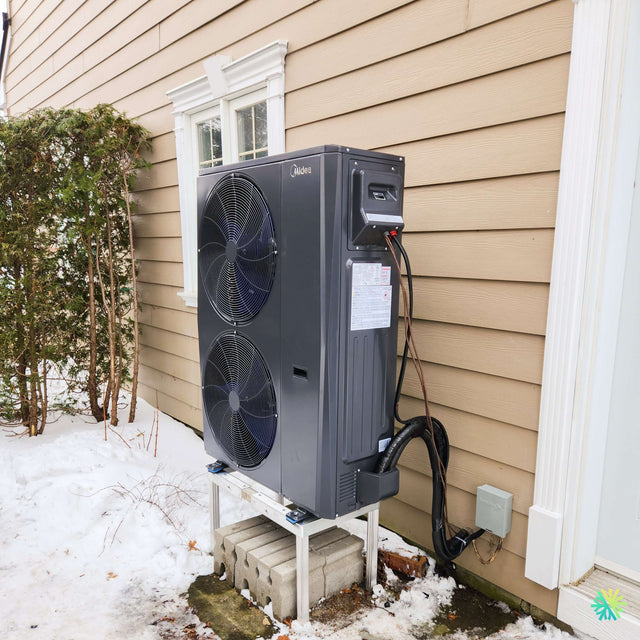
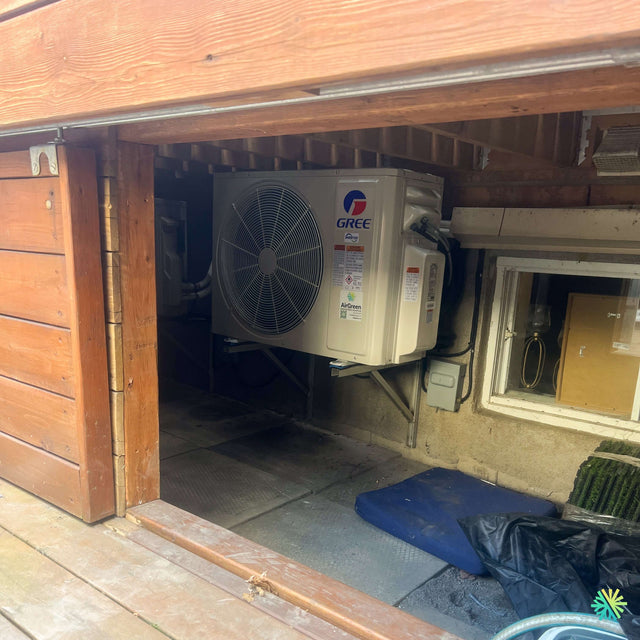
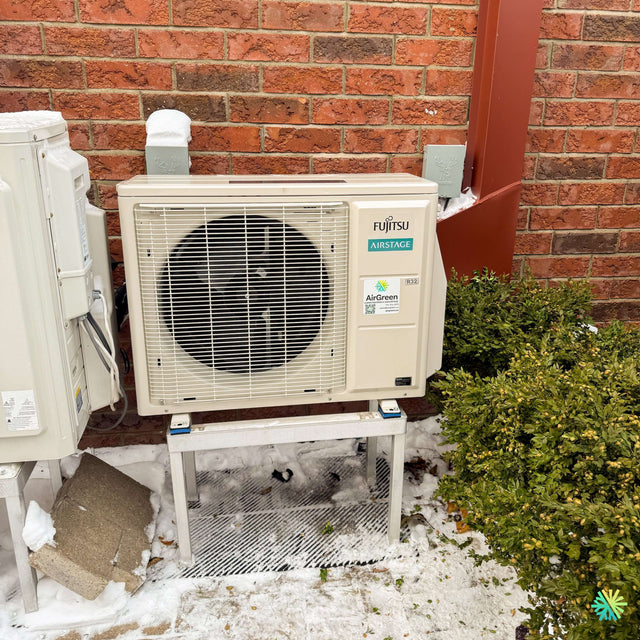
Photos: AirGreen and manufacturers, for identification.
Does a figure look wrong? Write to us: every reported figure is checked again.
An AirGreen advisor assesses your situation on site, free of charge, and gives you a quote within 24 hours.