BOSCH
Climate 5000 MAX PERFORMANCE R-454B
BMS500-AAU012-1AHWXD / BMS500-AAS012-1CSXHD · AHRI 215223282
See the product page
514-316-2973
sales@airgreen.ca
A century-old house raises three questions before comfort even comes up: what the electrical panel can take, what the brick wall will have to carry, and how far the refrigerant piping will have to run. Here are five wall-mounted heat pumps of the same size, one per brand, listed in alphabetical order with their certified values and the figures each manufacturer publishes. You sort them yourself.
BOSCHBMS500-AAU012-1AHWXD / BMS500-AAS012-1CSXHD · AHRI 215223282
See the product page FUJITSU AIRSTAGE
ASUH12KZAS / AOUH12KZAH1 · AHRI 214888802
Also sold as GENERAL AIRSTAGE.
See the product page GREE
GWH12AVDXE-D6DNA1B/I / GWH12AVDXE-D6DNA1B/O · AHRI 215386290
See the product page MIDEA
MSGNS-H12B-1A / MO1BS-H12B-1A · AHRI 215471366
See the product page SHARP
AY-XP12CHU / AE-X12CHU · AHRI 217512736
See the product pageAirGreen estimate for the same 12,000 BTU/h zone in Montréal, at Hydro-Québec’s Rate D, taxes included. All five heat pumps are calculated exactly the same way, with the same method as on all our comparison pages; only their certified efficiencies change. Electric baseboards serve as the reference point.
| Heat pump | Winter · heating | Summer · cooling | Full year | Less than baseboards, in winter |
|---|
The table follows the sliders and the price chosen above. Brands in alphabetical order.
AirGreen method v1.1, November 9, 2026. An estimate is used to compare units under the same conditions. The actual bill depends on the house, the insulation, the settings and the use; this amount is not a promise.
The starting order is alphabetical, by brand. Tap a header to sort that column; tap it again to reverse the order. A sort is not a ranking: it orders one measure at a time.
Certified values: AHRI, through the NEEP database, consulted November 17, 2026. Power supply, weight and width: each manufacturer’s documents (see sources). Bars: same scale for all five in each column.
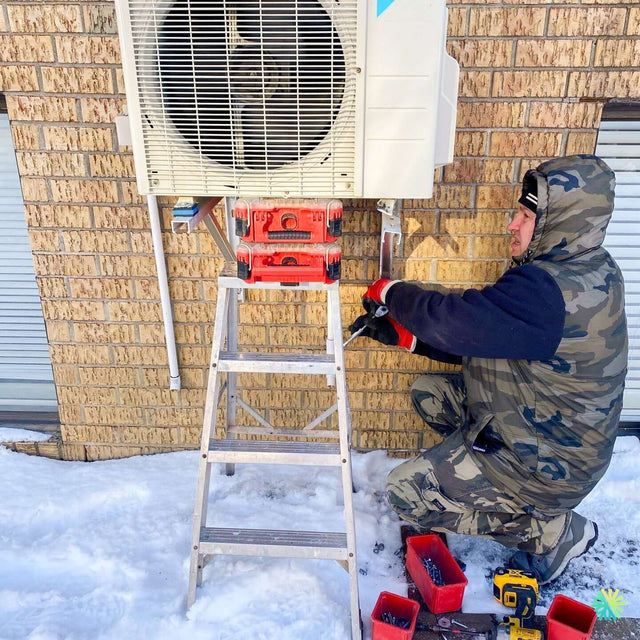
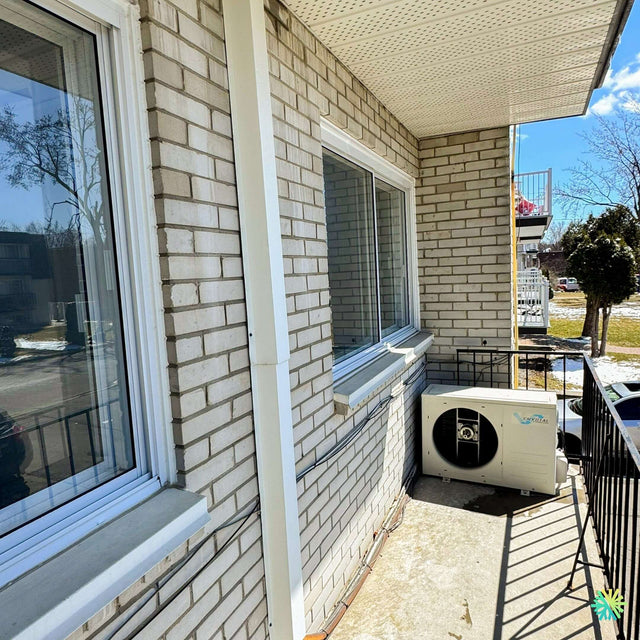
In a house built around 1910 or 1920, the choice often starts somewhere other than the efficiency sheet: the electrical service, the brick or stone façade, and the route to the yard. These three panels put side by side what each manufacturer publishes on these points.
Tap a breaker: the manufacturer’s data appears on the right. Four of the five are powered at 208-230 V; the MIDEA22 115 V is the only one rated at 115 V. Your panel’s capacity and the connection are checked on site by a master electrician.
Drawing to scale: the front of each outdoor unit, published width × height, with its net weight. Mounting on a brick or stone wall, the bracket and the base are the installer’s work.
Set the free width of your wall, between a window and a corner for example. Photos at the same width scale. Only the width of the unit itself is compared; the side clearances in the installation manual come on top.
Set the planned length between the indoor unit and the outdoor unit. For each unit: the part already charged at the factory, the amount of refrigerant to add beyond it at the published rate, and the maximum published length.
Amount to add = (length − precharged length) × rate published by the manufacturer. GREE: the EXTRÊME R32 brochure publishes 131.2 ft as the maximum; the service manual publishes 65.6 ft; this page follows the brochure and flags the difference. The exact charge is calculated on site.
NEEP publishes a heating point at −15 °C (5 °F) for each of the five: it is the coldest direct comparison that exists between them. Below that, each certificate stops at a different temperature.
Solid bar: maximum certified capacity at −15 °C, with its COP. Hollow dot: each unit’s last certified point, at its own temperature; these points are not compared with each other, since the temperatures differ.
Choose two of the five. The chart and the table show every point published below −15 °C: the points certified by NEEP, and those from the manufacturers’ capacity tables, outside the certificate.
Only what the documents consulted state. “Not stated” means the document is silent, not that the feature is absent.
BOSCH: yes, 150 W (NEEP listing).
FUJITSU AIRSTAGE: yes, 150 W (NEEP listing); “base pan heater” in brochure FG8153D.
GREE: yes, 72 W (NEEP listing).
MIDEA: yes, 150 W (NEEP listing).
SHARP: not declared to NEEP; not stated in the catalogue.
BOSCH: −30 to 24 °C.
FUJITSU AIRSTAGE: −26 to 24 °C, no shutoff device.
GREE: −30 to 30 °C.
MIDEA: −15 to 24 °C.
SHARP: −30 to 24 °C.
BOSCH: not stated in submittal BTC 769208308 B.
FUJITSU AIRSTAGE: built-in Wi-Fi, AIRSTAGE Mobile app.
GREE: Wi-Fi connectivity.
MIDEA: built-in Wi-Fi.
SHARP: control through the SHARP AIR app.
BOSCH: not stated in the submittal.
FUJITSU AIRSTAGE: not stated in brochure FG8153D.
GREE: not stated in the brochure.
MIDEA: 8 °C heating.
SHARP: 10 °C (50 °F) function.
BOSCH: not stated in the submittal.
FUJITSU AIRSTAGE: automatic defrost and auto-restart.
GREE: low-voltage start; anti-corrosion coated fins.
MIDEA: not stated in the brochure.
SHARP: “Hot Gas Pipe” defrost; auto restart.
BOSCH: not stated in the submittal.
FUJITSU AIRSTAGE: not stated in brochure FG8153D.
GREE: multi-speed fan; vertical and horizontal swing louvres.
MIDEA: ECO mode, timer, night mode, Follow Me, self-cleaning.
SHARP: Eco mode, 24 h timer, motion sensor.
Documents: BOSCH, submittal BTC 769208308 B (01.2026); FUJITSU AIRSTAGE, brochure FG8153D (rev. 4/2025); GREE, EXTRÊME R32 brochure No. 032025; MIDEA, wall-mounted heat pump brochure (2025-08-20), p. 13; SHARP, catalogue MNSPLT-CHUCU 1.1.1 (January 2026). Heated base pan: “pan heater” field of the NEEP listings, consulted November 17, 2026.
Each manufacturer publishes the sound levels of its indoor unit by fan speed, with its own method and its own number of speeds.
How to read these figures. dB(A) measures a noise level as the ear perceives it: the lower the number, the quieter the unit. Each dot is a published fan speed, from the slowest to the fastest.
Why this is not a ranking. The sheets do not all describe their measurement conditions, and they do not publish the same number of speeds or the same mode. One manufacturer’s “low” speed is not another’s “low” speed.
All published speeds
Measurements taken by each manufacturer with its own method: read them separately, not as a ranking.
BOSCH: submittal BTC 769208308 B. FUJITSU AIRSTAGE: brochure FG8153D. GREE: brochure No. 032025 and Airy Inverter R32 service manual (precharged length, rate to add). MIDEA: brochure 2025-08-20, p. 13. SHARP: catalogue MNSPLT-CHUCU 1.1.1 and submittal AE-X12CHU_AY-XP12CHU-EN1 (MCA). Base pan: NEEP listings. Inch fractions published by FUJITSU AIRSTAGE, GREE and SHARP are converted to decimals.
Not necessarily. Of the five, the MIDEA22 115 V is the only one rated at 115 V; the other four are powered at 208-230 V. What decides is the space and capacity in your electrical panel, which only a master electrician can confirm on site. The 115 V version also publishes different values than the 208-230 V models: 7,000 BTU/h certified at −15 °C and a heating range that stops at −15 °C.
The original article discussed these five brands, with different models and sizes. For the comparison to hold, this page takes one 12,000 BTU wall model per brand, on R-32 or R-454B refrigerant, each offered on AirGreen’s website: the MIDEA22 115 V from the original article, the FUJITSU AIRSTAGE ORION XLTH (the KZAH series it mentioned), and for BOSCH, GREE and SHARP the 12,000 BTU R-32 or R-454B wall models closest to the ones it named.
At −15 °C, the only temperature where all five are certified, the maximum certified capacity ranges from 7,000 BTU/h (MIDEA22 115 V) to 16,600 BTU/h (ORION XLTH). Below that, the certified points are no longer at the same temperature: −26.1 °C for the ORION XLTH, −30 °C for the BOSCH, the GREE and the SHARP. The “Extreme cold” section puts them side by side, two at a time.
The weight and size of the outdoor unit if it goes on the wall, the width of the indoor unit, and the piping length to the outdoor location. The outdoor units of these five models weigh from 61.29 to 86 lb according to the manufacturers. The choice of bracket, anchors and route belongs to the installer, after a visit.
Eligibility is checked against the official list in effect on the date of purchase. According to NEEP, four of the five carry the ENERGY STAR and cold-climate designations; the MIDEA22 115 V does not. This page promises no amount.
The ORION XLTH is also sold as GENERAL AIRSTAGE. The GREE EXTRÊME R32 is also called SAPPHIRE R32. According to NEEP, the BOSCH Climate 5000 MAX PERFORMANCE R-454B carries the same certified values as the SENVILLE AURA R454B (NEEP listing 385685).
higher marks the higher value of the same measure under the same conditions. It is not a recommendation. Capacities and COPs by point are not highlighted: the order changes depending on the point read.
For a century-old house, bring to your appointment what you know about the electrical panel, the planned outdoor location and the approximate length of the route.
Data verified November 17, 2026. Performance: AHRI certificates and the NEEP database. Dimensions, weights, power supply, piping, sound, ranges and features: according to the manufacturer. When a source contradicts the AHRI certificate, the certificate prevails. Article published June 28, 2026, entirely redone November 17, 2026 using the method of our comparison pages.
Trademarks. BOSCH, FUJITSU AIRSTAGE, ORION, GREE, MIDEA and SHARP are trademarks of their respective owners. Logos are used only to identify the products compared. AirGreen is a dealer of these brands; this page is not produced, sponsored or approved by the manufacturers.
Photos: AirGreen and manufacturers, for identification.
Does a figure look wrong? Write to us: every reported figure is checked again.
An AirGreen advisor assesses your situation on site, free of charge, and gives you a quote within 24 hours.