

Head to head · Wall-mounted heat pumps
LG vs SHARP wall-mounted heat pump, the technical comparison: ARTCOOL PRESTIGE R32 and SHARP CU at 15,000 BTU
Side by side
Technical comparison · 15,000 BTU wall unit
LG ARTCOOL PRESTIGE R32 and SHARP CU, two 15,000 BTU units on R-32
Two large wall units, the size often chosen for an open-plan area. They do not part ways at the same point: one keeps more capacity down to −25 °C and accepts a much longer line set, the other publishes a certified value at −30 °C and has an outdoor unit half the weight. Here are their numbers, with no ranking.
HSPF2 Region V 8.4 and 8.7
SEER2 25.0 and 24.0
Coldest certified points −25 and −30 °C
Max. line set 164 and 66 ft
Article published on January 21, 2026 · rewritten on November 16, 2026 with the AirGreen comparison-page method.

Estimated running cost
What the electricity costs, in dollars, winter and summer
A 15,000 BTU/h zone in Montréal, on Hydro-Québec Rate D, taxes included. Both wall units go through the same calculation as all our comparison pages; in winter, the gap comes from HSPF2 Region V, 8.4 for LG and 8.7 for SHARP. Electric baseboards serve as the reference.
How this amount is calculated
- Heat needed over the winter. A zone whose heat loss reaches 15,000 BTU/h (3.52 kW) at −23.1 °C, Montréal's design temperature: 3.52 kW × 24 h × 4,167 degree-days ÷ (18 − (−23.1)) = 8,558 kWh of heat for round-the-clock heating, all winter. Heating degree-days (18 °C base) and design temperature: Natural Resources Canada, HOT2000 climate data, Montréal Intl station. With fewer hours a day (“Heating” slider), the heat is reduced in the same proportion, for the heat pump and for the baseboards alike: a simplification that does not account for the recovery after a temperature setback.
- Electricity for heating. Heat pump: heat × 3.412 ÷ HSPF2 Region V, the value from the AHRI certificate published by NEEP. Region V is the coldest in the standard, and its calculation includes the backup electric heat expected when the heat pump can no longer keep up. Electric baseboards: 1 kWh of electricity for 1 kWh of heat.
- Electricity for cooling. {CAPTXT} BTU/h ÷ SEER2 × hours a day × 60 days ÷ 1,000: the method of Hydro-Québec's air-conditioning calculator, with the seasonal SEER2 efficiency from the AHRI certificate. The number of hours is a scenario, adjustable above from 1 to 24 h. At 24 h, the calculation assumes rated capacity all day long: that is a maximum, since a variable-speed unit slows down once the room is at the right temperature.
- Price. Hydro-Québec Rate D in effect on April 1, 2026: 7.065¢ per kWh up to 40 kWh a day, 11.142¢ above that; the average price, 9.104¢, is the one Hydro-Québec's calculators use. GST and QST included. Grid access charges, the same with or without a heat pump, are not counted.
AirGreen method v1.1, November 9, 2026. An estimate is for comparing units under the same conditions. The actual bill depends on the house, its insulation, the settings and how it is used; this amount is not a promise.
In winter, over a season
The calculation uses HSPF2 Region V, the coldest in the standard: 8.7 for the SHARP CU, 8.4 for the ARTCOOL PRESTIGE R32. In Region IV, the order flips: 11.2 and 11.0.
In extreme cold
At −15 °C, the certified maximum is 18,000 BTU/h for the ARTCOOL PRESTIGE R32 and 15,300 BTU/h for the SHARP CU. Below −25 °C, only SHARP publishes a capacity.
In summer
SEER2 of 25.0 and 24.0; EER2 of 15.0 and 13.4. The SHARP CU also publishes a lower maximum airflow: 636 CFM in cooling, against 813.
At installation
LG publishes up to 164 ft of line set and 98.4 ft of height difference; SHARP, 66 and 33 ft. The SHARP outdoor unit weighs 67 lb; the LG one, 135.4 lb.
Line set route
How far can the outdoor unit go?
This is where these two records differ the most. Set the line-set length and the height between the two units: for each unit, the page shows what its manufacturer publishes at that distance, and how much refrigerant it says to add.
ARTCOOL PRESTIGE R32, up to its published maximum lengthSHARP CU, up to its published maximum lengthbeyond the published maximum length
ARTCOOL PRESTIGE R32
Published by LG: 9.8 to 164 ft · 24.6 ft precharged · 0.32 oz per ft beyond · max. height 98.4 ft
SHARP CU
Published by SHARP: 10 to 66 ft · 25 ft precharged · 0.16 oz per ft beyond · max. height 33 ft
Diagram: the line set and the height are to the same scale; the units are not. Values from LG brochure PO_LG_R32_ArtCool_Premier_03_25_CA_FR and SHARP submittal AE-X15CU_AY-XP15CU-EN1 (January 2026). The actual route, supports and charge are set by the installer according to the manual supplied with the unit.
Extreme cold
Below −15 °C, every published point, with its source
LG publishes percentages in its brochure, SHARP a submittal with figures down to −30 °C: the two do not cover the same temperatures. Round dots: NEEP records; diamonds: manufacturer documents. With no published point, the table gives the two values that frame the temperature; after the last point, it repeats that point and what the manufacturer writes beyond it.
How to read this table. At −15 °C, both NEEP records give a maximum at the same temperature: 18,000 BTU/h for the ARTCOOL PRESTIGE R32 and 15,300 BTU/h for the SHARP CU. At −25 °C, NEEP certifies 12,330 BTU/h for the ARTCOOL PRESTIGE R32; SHARP publishes 11,100 BTU/h in its submittal, outside the certificate. At −20 °C, LG publishes a COP of 1.74 with no capacity. At −30 °C, NEEP certifies 8,900 BTU/h for the SHARP CU; LG publishes no capacity below −25 °C. Montréal's design temperature is −23.1 °C (Natural Resources Canada, HOT2000).
Features
What each manufacturer writes, line by line
LG's Canadian brochure says nothing about Wi-Fi, so that line cites the US spec sheet KSSAL181A. Each line names its source, and a silent document does not prove a feature is missing.
| Feature | ARTCOOL PRESTIGE R32 | SHARP CU |
|---|---|---|
| Defrost and base pan | Heater in the base pan; 90 W, on at 0 °C and below in heating mode NEEP record 385474 | Reverse-cycle defrost; “Hot Gas Pipe” de-icing SHARP submittal |
| Wi-Fi control | Yes; built-in Wi-Fi, ThinQ app LG US spec sheet KSSAL181A; the Canadian brochure does not name it | Yes; built-in Wi-Fi adapter, Sharp Air app SHARP submittal |
| Fan airflow, top speed (CFM) | Cooling, 813 · heating, 919 LG brochure | Cooling, 636 · heating, 674 SHARP submittal |
| Airflow direction and throw, per the manufacturer | Fast cooling and heating (Jet Cool / Jet Heat) US spec sheet KSSAL181A | “Coanda Airflow”, air throw stated at 50 ft; “Multi Space” circulation SHARP submittal |
| Compressor | Twin rotary LG brochure | Single rotary SHARP submittal |
| Dehumidification | 1.8 L/h 3.8 US pints/h per LG | 1.5 L/h 3.2 US pints/h per SHARP |
| Cooling in cold weather | Down to −10 °C; −18 °C with the optional wind and low-temperature kit LG brochure | Down to −10 °C SHARP submittal |
| Stated heating range | −25 to 18 °C wet bulb, LG brochure | −30 to 23.9 °C SHARP submittal |
Sound
The noise of each unit, according to its manufacturer
Indoor unit, cooling, published sound pressure
Each dot is a published fan speed. Further left = quieter.
Outdoor unit, published sound pressure
One value per manufacturer, in cooling.
dB(A)
How to read these numbers. A dB(A) measures a sound level weighted the way the ear hears it; the lower the number, the quieter the unit. LG publishes four speeds in cooling, SHARP five. The fastest speed of the ARTCOOL PRESTIGE R32 also moves more air: 813 CFM, against 636 for the SHARP CU.
Why this is not a ranking. SHARP publishes five speeds, LG four, and neither gives the measuring distance or method. Each scale shows the range its manufacturer states, not a test run in the same room.
Measurements taken by each manufacturer with its own method: different method — not comparable point by point.
Installation
Units, line set and electrical
Outdoors, the difference shows, and you feel it when lifting: 135.4 lb for the LG unit, 67 lb for the SHARP one. The indoor units and outdoor outlines below are to the same scale. The documents consulted show no clearances; the installer follows the manual supplied with the unit.
Indoor units to scale
ARTCOOL PRESTIGE R3241 23/32 in wide

41 23/32 in
SHARP CU41.4 in wide

41.4 in
Published heights: 14 3/16 in for the ARTCOOL PRESTIGE R32, 12.4 in for the SHARP CU.
Outdoor units, outlines to scale
ARTCOOL PRESTIGE R32 · KUSAL151A 37 13/32 × 32 3/16 in · 135.4 lbSHARP CU · AE-X15CU 30.7 × 21.3 in · 67 lb
The LG brochure prints an outdoor-unit depth of 10 7/16 in, the same as the indoor unit's; it is not repeated here.
| Installation, per the manufacturers' documents | ARTCOOL PRESTIGE R32 | SHARP CU |
|---|---|---|
| Maximum piping length | 164 ft minimum 9.8 ftLG brochure | 66 ft minimum 10 ftSHARP submittal |
| Precharged length | 24.6 ft 0.32 oz per ft beyond | 25 ft 0.16 oz per ft beyond |
| Maximum height difference | 98.4 ft | 33 ft |
| Liquid – gas diameters | 3/8 – 5/8 in | 1/4 – 3/8 in |
| Outdoor unit W × H × D, weight | 37 13/32 × 32 3/16 in, 135.4 lb | 30.7 × 21.3 × 10.6 in, 67 lb |
| Indoor unit, weight | 41 23/32 × 14 3/16 × 10 7/16 in, 37.7 lb | 41.4 × 12.4 × 9.8 in, 31 lb |
| Electrical protection | MCA 19 A · MOP 30 A | MCA 15 A · max. fuse 20 A |
| Stated heating / cooling range | −25 to 18 °C / −10 to 48 °C heating in wet bulb | −30 to 23.9 °C / −10 to 46.1 °C |
Questions
What people ask us about these two models
Why these two models?
The original article compared LG's ARTCOOL PRESTIGE with a model from a brand AirGreen does not sell. This version compares it with a wall unit AirGreen sells of the same type, on the same A2L refrigerant (R-32) and at the same size: the 15,000 BTU SHARP CU. Our pages compare the ARTCOOL PRESTIGE R32 at 15,000 BTU; the values for one size do not describe the others.
Which one heats more in extreme cold?
It depends on the temperature. At −15 °C, NEEP certifies a maximum of 18,000 BTU/h for the ARTCOOL PRESTIGE R32 and 15,300 BTU/h for the SHARP CU. At −25 °C, LG has a certified point of 12,330 BTU/h, and SHARP publishes 11,100 BTU/h outside the certificate. At −30 °C, only the SHARP CU has a published value: 8,900 BTU/h, NEEP certified.
Why does winter cost a little less with the SHARP CU, when its HSPF2 Region IV is lower?
The AirGreen method uses HSPF2 Region V, the coldest in the standard, because it comes closest to a Québec winter: 8.7 for the SHARP CU and 8.4 for the ARTCOOL PRESTIGE R32. In the milder Region IV, the order flips (11.0 and 11.2). Both values come from the same AHRI certificate; the real difference depends on the house and how it is used.
How far can the outdoor unit go?
According to the manufacturers, up to 164 ft of line set and 98.4 ft of height difference for the ARTCOOL PRESTIGE R32, and up to 66 ft and 33 ft for the SHARP CU. Beyond the precharged length (24.6 and 25 ft), each states how much refrigerant to add. The actual route is determined during the installation visit.
Are these models eligible for Hydro-Québec programs?
On Hydro-Québec's official list, look up 215828274 for the ARTCOOL PRESTIGE R32 and 217512734 for the SHARP CU. This page promises no amount and no eligibility: only the list in force on the purchase date counts.
Do both use the same refrigerant?
Yes, R-32, an A2L-class refrigerant (ASHRAE 34) with a global warming potential of 675 (IPCC, AR4). The AHRI certificate measures the performance of the complete unit, not of the refrigerant alone.
Certified data
AHRI certificate values, published by NEEP
| Certified value | ARTCOOL PRESTIGE R32 | SHARP CU |
|---|---|---|
| Seasonal efficiencies | ||
| SEER2 | 25.0 | 24.0 |
| EER2 | 15.0 | 13.4 |
| HSPF2 Region IV | 11.2 | 11.0 |
| HSPF2 Region V | 8.4 | 8.7 |
| Rated capacity at 35 °C (cooling) | 15,000 BTU/h | 15,000 BTU/h |
| Heating, min. / rated / max. capacity (BTU/h) | ||
| Min. / rated / max. capacity at 8.3 °C | 3,070 / 18,000 / 25,700 | 4,500 / 18,000 / 21,800 |
| Min. / rated / max. capacity at −8.3 °C | 2,934 / 10,900 / 20,200 | 5,200 / 18,100 / 18,100 |
| Min. / rated / max. capacity at −15 °C | 2,730 / 18,000 / 18,000 | 4,000 / 15,300 / 15,300 |
| Min. / rated / max. COP at 8.3 °C | 1.64 / 4.67 / 3.07 | 5.50 / 4.06 / 3.59 |
| Min. / rated / max. COP at −8.3 °C | 1.34 / 2.90 / 2.04 | 2.77 / 2.21 / 2.21 |
| Min. / rated / max. COP at −15 °C | 1.33 / 1.90 / 1.90 | 2.30 / 2.10 / 2.10 |
| Coldest point (different temperatures) | ||
| Test temperature | −25 °C (−13 °F) | −30 °C (−22 °F) |
| Min. / max. capacity at the coldest point | 2,218 / 12,330 BTU/h | 1,500 / 8,900 BTU/h |
| Max. COP at the coldest point | 1.45 | 1.70 |
| Certification | ||
| Refrigerant | R-32 GWP 675 (IPCC AR4), class A2L (ASHRAE 34) | R-32 GWP 675 (IPCC AR4), class A2L (ASHRAE 34) |
| ENERGY STAR · cold climate | Yes NEEP, Nov. 16, 2026 | Yes NEEP, Nov. 16, 2026 |
| AHRI certificate · NEEP record | 215828274 · 385474 | 217512734 · 507384 |
“higher” marks the higher value of the same measure, under the same conditions. It is not a recommendation.
Both are on the AirGreen website.
For a large room, the free estimate visit calculates the heat loss and measures the line-set route: that is where the 66 ft and 164 ft limits start to matter.
Sources
Documents consulted
NEEP, record 385474 (AHRI 215828274)LG KNSAL151A / KUSAL151A · consulted on Nov. 16, 2026
NEEP, record 507384 (AHRI 217512734)SHARP AY-XP15CU / AE-X15CU, “Single Zone” series · consulted on Nov. 16, 2026
LG, ARTCOOL PRESTIGE R32 single-zone brochure (FR)PO_LG_R32_ArtCool_Premier_03_25_CA_FR (2025) · capacities at −15, −18 and −25 °C, dimensions, piping, sound, airflow · consulted on Nov. 16, 2026
LG, US spec sheet KSSAL181AWi-Fi, ThinQ app, Jet Cool / Jet Heat · consulted on Nov. 9, 2026
SHARP, AE-X15CU / AY-XP15CU submittalAE-X15CU_AY-XP15CU-EN1, effective January 2026 (global.sharp) · capacities at −20, −25, −27.2 and −30 °C, sound, airflow, dimensions, piping, electrical · consulted on Nov. 16, 2026
Hydro-Québec, Electricity RatesApril 1, 2026, Rate D, sec. 2.5 · consulted on Nov. 9, 2026
NRCan, HOT2000 climate mapMontréal Intl station: 4,167 degree-days (18 °C base), design temperature −23.1 °C · consulted on Nov. 9, 2026
Data verified on November 16, 2026 (NEEP records, LG brochure and SHARP submittal). Performance: AHRI certificates and the NEEP database. Dimensions, sound, piping and features: per the manufacturer. When a source contradicts the AHRI certificate, the certificate prevails.
Trademarks. LG, ARTCOOL, ThinQ, SHARP and Sharp Air are trademarks of their respective owners. Logos are used only to identify the products compared. AirGreen is a dealer of both brands; this article is not produced, sponsored or approved by the manufacturers.
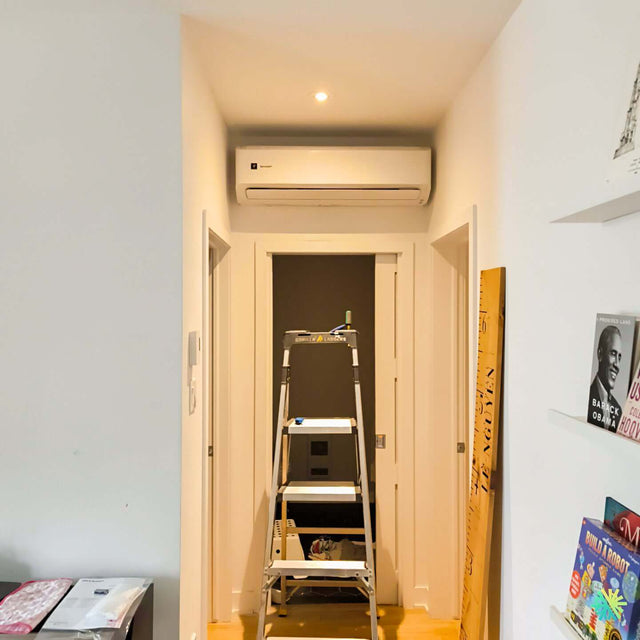
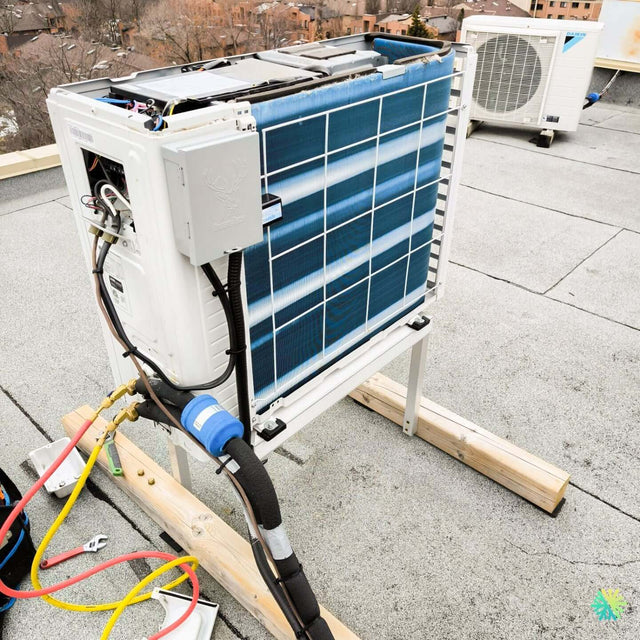
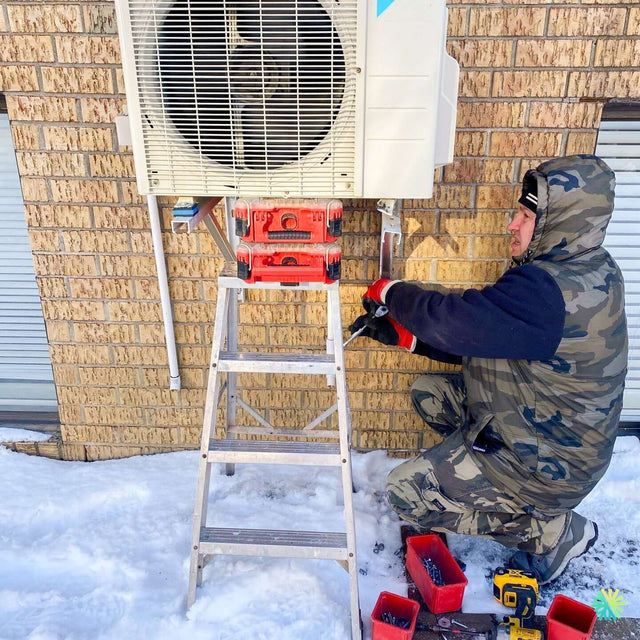
Photos: AirGreen and manufacturers, for identification.
Does a figure look wrong? Write to us: every reported figure is checked again.
Going further
You made it to the end.Share it with someone it could help.
AirGreen Climatisation & Chauffage
From reading to your home.
An AirGreen advisor assesses your situation on site, free of charge, and gives you a quote within 24 hours.
- RBQ licence 5645-9605-01Subclasses 15.8, 15.10 and 16
- Free on-site estimateAn advisor assesses your needs
- Quote within 24 hoursClear and detailed
Contents
AirGreen glossary