Trane · RunTru
RunTru 23U · 18,000
M5THS2318A11NA* + M5MHWUN18B1N0A* · AHRI 218067092
See it on airgreen.ca
514-316-2973
sales@airgreen.ca
The gist
Trane RunTru 23U and Lennox MHB, two 18,000 BTU wall-mounted heat pumps: AHRI and NEEP certified values, the heating range each manufacturer advertises, estimated cost in Montréal and installation.
Two North American brands, two 18,000 BTU/h wall units, two generations: Trane's RunTru 23U on R-454B and Lennox's MHB on R-410A. Their AHRI certificates line up side by side down to −15 °C. Below that, the two manufacturers do not advertise the same heating range, and that is where this page spends its time.
Trane · RunTru
M5THS2318A11NA* + M5MHWUN18B1N0A* · AHRI 218067092
See it on airgreen.ca Lennox
MHB018S4S-1P + MWHB018S4-1P · AHRI 208106645
See it on airgreen.caManufacturer images (Trane brochure 26-7326-R-02, Lennox sheet 496053), for identification.
AirGreen estimate for the same 18,000 BTU/h zone in Montréal, on Hydro-Québec Rate D, taxes included. Both heat pumps are calculated in exactly the same way, with the same method as on all our comparison pages; only their certified efficiencies change. Electric baseboards serve as the reference.
AirGreen method v1.1, November 9, 2026. An estimate is used to compare units under the same conditions. Your actual bill depends on the house, the insulation, the settings and how it is used; this amount is not a promise.
The winter gap comes from HSPF2 Region V: 8.2 for the RunTru 23U, 6.8 for the MHB. This seasonal figure includes, in its calculation, the electric backup expected when the heat pump is no longer enough; the next section shows how far down each one heats according to its manufacturer.
A wall-mounted heat pump does not have the same output at 8 °C and at −20 °C, and each manufacturer states a temperature below which it publishes nothing. Move the slider: the page only shows published values. Between two published points, it shows the range, each value with its temperature.
Maximum capacities from each unit's AHRI certificate, published by NEEP. Advertised ranges: Trane brochure 26-7326-R-02 (heating from −13 to 86 °F) and Lennox submittal sheet 496053 (heating from 5 to 86 °F). Montréal's design temperature, −23.1 °C, is NRCan's (HOT2000, Montréal Intl), also used for the cost.
At −15 °C, both certificates give a value at the same temperature: 13,600 and 11,700 BTU/h at maximum. That is the coldest point on the MHB's certificate, and the limit of the heating range Lennox advertises. The RunTru 23U's certificate goes down to −25 °C, its own advertised limit.
At −20 °C, neither unit has a published value: the RunTru 23U is shown as a range between its certified points at −15 and −25 °C. Below −25 °C, neither manufacturer states a capacity.
The two units are not from the same refrigerant generation. Here is only what the documents and standards publish: the name, the global warming potential (GWP) and the safety class.
Bars on the same scale. GWP compares the effect of one kilogram of released gas with that of CO₂ over 100 years; it says nothing about the unit's efficiency.
Only features written in the documents consulted appear here. The Trane brochure is two pages long and says less than the Lennox submittal sheet: a feature missing from a document is not a feature missing from the unit.
RunTru 23U: yes, CNT10078. MHB: yes, included.
Trane brochure 26-7326-R-02; Lennox sheet 496053.RunTru 23U: not stated in the brochure. MHB: M0STAT61Q-1 or M0STAT120L-1 (non-programmable), M0STAT120N-1 (programmable).
Lennox sheet 496053, accessories.RunTru 23U: speeds not stated in the brochure. MHB: 3 speeds, 271, 329 and 459 CFM.
Lennox sheet 496053, indoor unit.RunTru 23U: 2.2 US pints per hour (1.04 L/h). MHB: not stated in the sheet.
Trane brochure 26-7326-R-02.RunTru 23U: not stated in the brochure. MHB: yes, after a power failure.
Lennox sheet 496053.RunTru 23U: heating advertised down to −25 °C. MHB: defrost control and indoor pre-heat; heating advertised down to −15 °C.
Trane brochure 26-7326-R-02; Lennox sheet 496053.Trane publishes a single value; Lennox publishes one per fan speed.
One value per manufacturer, with no mode or distance stated.
How to read these figures. dB(A) measures a noise level; the lower the number, the quieter. Each dot is a value published by the manufacturer. Trane does not say which fan speed its indoor figure refers to.
Why this is not a ranking. The two manufacturers do not describe their method the same way (different method — not comparable), and perceived noise also depends on distance, the room and where the outdoor unit sits.
Measurements taken by each manufacturer with its own method: read them separately, not as a ranking.
The RunTru 23U's indoor unit is 43.31 in wide, the MHB's 38 1/4 in. Outside, the Trane unit is taller (27.51 in versus 21 7/8 in). Drawings to scale from the published dimensions.
Scale drawing of the indoor units (published width × height). The space to leave on each side and above is given in each unit's installation manual; it is not counted here.
Per Trane: 65 ft at most; the pre-charged length is not stated in the brochure consulted. Per Lennox: 98 ft at most, 25 ft pre-charged, then 0.16 oz per foot. The exact length is measured on site.
| Installation | RunTru 23U | MHB |
|---|---|---|
| Max. piping length | 65 ft | 98 ft |
| Pre-charged length | Not published by the manufacturerNot stated in brochure 26-7326-R-02 | 25 ftthen 0.16 oz per foot |
| Max. height difference | 49 ft | 66 ft |
| Liquid – gas diameters | 1/4 – 1/2 in | 1/4 – 1/2 in |
| Outdoor unit W × H × D, weight | 33.26 × 27.51 × 14.96 in, 86 lb | 32 1/8 × 21 7/8 × 12 1/2 in, 74 lb |
| Indoor unit, weightW × H × D | 43.31 × 13.11 × 8.74 in, 30.9 lb | 38 1/4 × 12 3/4 × 9 1/8 in, 25 lb |
| Electrical protectionPer the manufacturer | MOP 20 AMCA 12 A | MOCP 20 AMCA 15 A |
| Dehumidification | 1.04 L/h2.2 US pints per hour | Not published by the manufacturerNot stated in sheet 496053 |
| Advertised heating / cooling range | −25 to 30 °C / −15 to 55 °C−13 to 86 °F / 5 to 131 °F | −15 to 30 °C / −15 to 50 °C5 to 86 °F / 5 to 122 °F |
Because comparing takes certificates. The RunTru 23U (M5THS2318A11NA*) and the MHB (MHB018S4S-1P) are two 18,000 BTU/h wall units whose AHRI certificate is current in the NEEP directory, consulted on November 16, 2026. Their values describe these two units, not each brand's whole lineup.
We found no current wall-mounted heat pump certificate in NEEP under those two names. The figures the old article gave them (SEER, HSPF, −30 °C, under 24 dB) had no source; they were removed rather than copied over.
Per their manufacturers: down to −13 °F (−25 °C) for the RunTru 23U and down to 5 °F (−15 °C) for the MHB. Their certificates stop at those same temperatures: 9,000 BTU/h at maximum at −25 °C for the RunTru 23U, 11,700 BTU/h at −15 °C for the MHB. Below those limits, neither publishes a capacity.
The documents consulted state nothing below those temperatures. HSPF2 Region V, used for the estimated cost, accounts in its calculation for electric backup when the heat pump is no longer enough. How to plan that backup in a house is decided during the assessment, based on the room's heat loss.
It is a US EPA designation for heat pumps that meet performance criteria at −15 °C (5 °F). According to the ENERGY STAR database consulted on November 16, 2026, the RunTru 23U (AHRI 218067092) is certified with the cold climate designation; the MHB's certificate 208106645 is not listed.
This page does not say so. The criteria and amounts of Hydro-Québec's LogisVert program change; eligibility is checked on the official list, with the unit's AHRI number, at the time of the application.
No. It is an estimate made with the same method for both units, for an 18,000 BTU/h zone in Montréal. It is there to compare; your actual bill depends on the house, the insulation, the settings and how it is used.
| Certified value | RunTru 23U | MHB |
|---|---|---|
| Rated capacity at 35 °C | 18,000 BTU/h | 18,000 BTU/h |
| SEER2 | 23 | 19.5 |
| EER2 | 12.5 | 11 |
| HSPF2 Region IV | 10 | 8.7 |
| HSPF2 Region V | 8.2 | 6.8 |
| Heating at 8.3 °C (47 °F) | ||
| Min. / rated / max. capacity | 4,000 / 19,000 / 23,700 BTU/h | 3,230 / 18,800 / 20,570 BTU/h |
| COP min. / rated / max. | 3.66 / 3.64 / 2.89 | 3.51 / 3.04 / 3.21 |
| Heating at −8.3 °C (17 °F) | ||
| Min. / rated / max. capacity | 5,400 / 15,000 / 17,500 BTU/h | 2,183 / 11,400 / 14,370 BTU/h |
| COP min. / rated / max. | 2.55 / 2.56 / 2.14 | 2.06 / 2.57 / 2.49 |
| Heating at −15 °C (5 °F) | ||
| Min. / rated / max. capacity | 6,000 / 13,600 / 13,600 BTU/h | 3,200 / 11,700 / 11,700 BTU/h |
| COP min. / rated / max. | 1.79 / 1.80 / 1.80 | 1.80 / 2.07 / 2.07 |
| Coldest point of the certificate | ||
| Test temperature | −25 °C (−13 °F) | −15 °C (5 °F) |
| Capacity min. / max. | 6,500 / 9,000 BTU/h | 3,200 / 11,700 BTU/h |
| COP min. / max. | 1.36 / 1.36 | 1.80 / 2.07 |
| Certification | ||
| Refrigerant | R-454BGWP 466 (IPCC, Fourth Assessment Report) · class A2L (ASHRAE 34) | R-410AGWP 2,088 (IPCC, Fourth Assessment Report) · class A1 (ASHRAE 34) |
| ENERGY STAR, cold climate | Yes; cold climate: yes | Not listed |
| AHRI certificate · NEEP record | 218067092 · 266006 | 208106645 · 404476 |
"higher" marks the higher value of the same measure, under the same conditions. It is not a recommendation. Capacities and COP at the coldest point: two different temperatures, so nothing is highlighted. Certificate 218067092 has a twin, 215385436 (indoor unit M5MHWUN18A1N0AA), with the same AHRI-certified and NEEP values.
A question about sizing, heating range or where the outdoor unit would go at your place? Write to us or call us.
Data verified on November 16, 2026. Certified values: AHRI certificates published by NEEP. Declared values: the Trane and Lennox documents cited above. Cost: AirGreen estimate, method v1.1, not a promise.
Trane, RunTru, Lennox and the other brands mentioned belong to their owners. Logos and images are used only to identify the products. AirGreen is a dealer; this page is not produced, sponsored or approved by Trane or by Lennox.
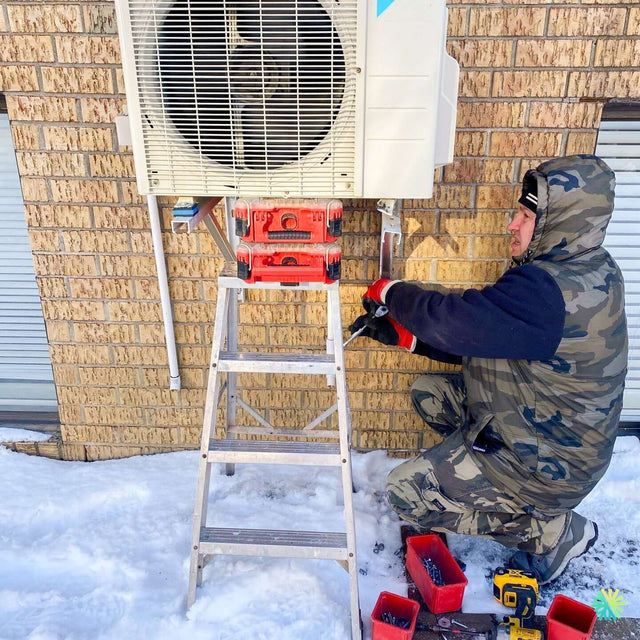
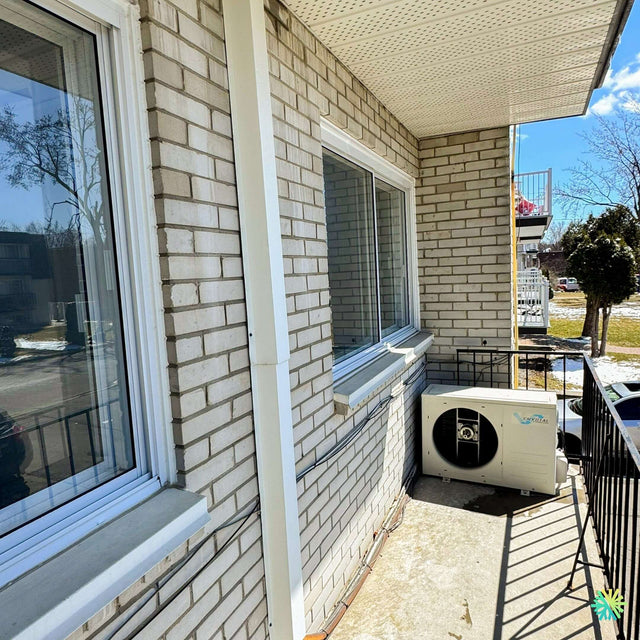
Photos: AirGreen and manufacturers, for identification. Units drawn to scale: diagram.
This article, first published in December 2025, was rewritten on November 16, 2026: it now compares certified values, with no verdict.
Does a figure look wrong to you? Write to us at sales@airgreen.ca.
An AirGreen advisor assesses your situation on site, free of charge, and gives you a quote within 24 hours.