
AirGreen job in
Service Call for a Wall-Mounted Heat Pump in Montreal
Stylised map, not to scale.
- Montréal
- Laval
- Longueuil
- South Shore
- North Shore
A wall-mounted heat pump that was still working but no longer providing the expected comfort
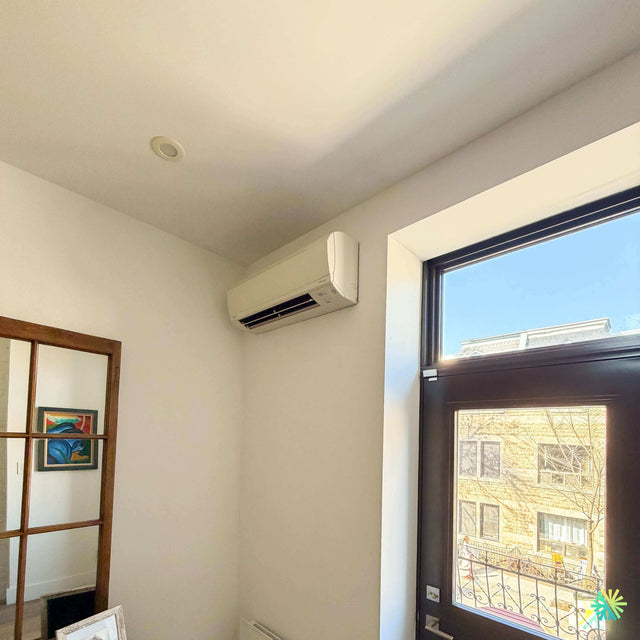
In a residential home in Montreal, our AirGreen team was called for a service call on a wall-mounted heat pump installed in a living room, above an open living space. At first glance, the indoor unit was clean, discreet, and well integrated into the layout: a wall installation near a window, with the piping hidden inside a white vertical line cover. Yet, despite this neat appearance, the customer had noticed for some time a drop in performance: the blown air seemed less powerful, the room took longer to cool, and a slight irregular noise was noticeable during operation.
This type of situation is common with mini-split wall-mounted heat pumps installed in apartments, condos, and townhouses in Montreal, Laval, Longueuil, on the North Shore and the South Shore. The system often continues to start normally, giving the impression that there is no major failure. However, dust buildup, partially blocked drainage, a dirty fan, or a poorly positioned sensor can be enough to significantly reduce comfort, increase electricity consumption, and create symptoms that worsen over time.
In this specific case, it was a residential wall-mounted heat pump, mini-split type, with an estimated capacity of around 12,000 BTU, suitable for a main room or a moderately sized open area. The exact brand was not visible on the unit’s front during the visual inspection, but the setup matched a standard residential installation: wall-mounted indoor unit, front air outlet, motorized fins, refrigerant line and condensation drain routed outside through the side wall.
Symptoms reported by the customer
The customer was not describing a complete breakdown. The device would turn on, respond to the remote control, and still produce tempered air. The problem was more subtle but disruptive enough to justify a full HVAC diagnosis:
- gradual decrease in ventilation power;
- slower cooling than before in the living room;
- feeling that the air was no longer distributing evenly;
- slight noise at startup or during speed changes;
- concern about a possible beginning of water leak or drain blockage;
- need to confirm that the heat pump could continue to operate safely.
These clues often point the diagnosis toward the indoor unit rather than the outdoor compressor. A wall-mounted heat pump can lose efficiency even if the compressor is working properly, simply because the heat exchange inside is no longer optimal.
First check: the wall installation and its environment
Even before opening the unit, we observed its positioning. The unit was installed high on the wall, near a corner and close to a window. This type of location is common in Montreal, especially in housing where available walls are limited. The installation seemed clean, but several elements needed to be checked:
- available space above the unit for air return;
- side clearance;
- airflow direction;
- presence of obstacles under the unit;
- visible condition of the line cover;
- probable slope of the condensate drain;
- unit response to ventilation and air conditioning controls.
Since the indoor unit was relatively close to the ceiling, special attention was paid to the upper return air. If this area is partially blocked by dust, a curtain, a tall piece of furniture, or poor clearance, the unit may have difficulty drawing in enough air. Result: reduced heat exchange, longer cycles, more noticeable fan noise, and less stable comfort.
In this case, the clearance was acceptable, but the unit showed typical signs of needing thorough maintenance.
HVAC diagnosis: airflow, heat exchanger, fan, and condensate
Our diagnosis was carried out in several steps to avoid concluding too quickly that there was an expensive failure. During a HVAC service call, it is essential to distinguish a true mechanical failure from a maintenance, drainage, or airflow problem.
Inspection of the filters and the indoor heat exchanger
The return air filters were loaded with fine dust. It wasn’t a complete blockage, but enough buildup to limit airflow. Behind the filters, the heat exchanger also showed deposits on some sections. On a wall-mounted heat pump, even a thin layer of dirt can reduce heat transfer between the refrigerant and the ambient air.
A dirty heat exchanger often causes:
- a drop in cooling performance;
- a feeling of less cold air;
- louder ventilation;
- an increase in operating time;
- sometimes early ice on the evaporator if airflow becomes insufficient.
No ice was visible during the intervention, but conditions were right for the problem to appear on very hot and humid days.
Ventilation turbine inspection
The turbine, also called the blower wheel, is often the forgotten element in residential maintenance. Filters protect part of the system, but they don’t completely prevent fine particles, moisture deposits, and contaminants from accumulating on the ventilation wheel fins.
In this case, the turbine showed moderate dirt buildup. This level of accumulation clearly explains the reduced airflow and slight irregular noise reported by the client. When dust sticks unevenly to the wheel, it can create a subtle imbalance, especially at low or medium speed.
Condensation drain inspection
Having an indoor unit above a couch or living space makes drainage especially important. Even a minor water leak can damage furniture, walls, flooring, or moldings.
We therefore checked the condensation tray and drain evacuation. The drain was not completely clogged, but early signs of restriction were visible. This kind of partial blockage may cause no damage for several weeks, then suddenly cause an overflow on a humid day when the heat pump produces a lot of water.
One of the most common mistakes owners make is waiting for water to drip before requesting service. In reality, when a wall-mounted heat pump starts leaking inside, the problem is often already advanced.
Service performed by AirGreen
After diagnosis, our team carried out a targeted intervention to restore the unit’s performance without unnecessarily replacing parts.
Technical cleaning of filters and heat exchanger
The filters were removed, cleaned, and inspected. The indoor heat exchanger was then treated with a method suited for residential wall units. The goal was to remove deposits that limited heat exchange without damaging the aluminum fins.
Overly aggressive cleaning can bend the fins, displace a sensor, or cause water infiltration into an electrical area. That’s why we always use a controlled method, especially when a unit is installed in a finished living room, above an occupied space.
Ventilation turbine cleaning
The turbine was cleaned to restore stable airflow. This step is particularly important for devices installed in living spaces where textile dust, fabric fibers, particles from furniture, pet hair, and ambient humidity can accumulate quickly.
After cleaning, the difference in airflow was noticeable. The air output was more uniform, and the irregular noise had decreased. The customer could immediately feel an improvement in airflow.
Clearing and testing the drain
The condensation drain was cleared and tested to confirm flow. We also checked the apparent level of the unit, the slope of the drain, and the absence of backflow in the indoor tray.
In a residential HVAC installation, the drain is sometimes as important as the refrigeration system itself. A heat pump can cool perfectly, but if the condensation water does not drain properly, the customer’s experience quickly becomes problematic.
Checking modes and remote control
The unit was then tested in cooling, ventilation, and dehumidification modes. We validated the response of the louvers, ventilation speeds, and the stability of the airflow. No error codes were present, and the overall behavior of the device indicated that a major repair was not necessary.
Result: comfort restored and device secured
At the end of the intervention, the wall-mounted heat pump offered better airflow, smoother operation, and more efficient cooling. The customer was reassured: the system showed no immediate signs of compressor failure, electronic board issues, or refrigerant leaks.
The problem mainly came from progressive clogging of the indoor unit and a partially restricted drain. This type of service often helps avoid much more costly repairs, especially when the intervention is done before a water leak or a complete breakdown occurs.
What this intervention reminds us about wall-mounted heat pumps
A wall-mounted heat pump installed in a condo or living room can operate for several years with little noise and little apparent maintenance. However, the air it draws in always contains dust, moisture, and particles. Over time, these deposits accumulate in areas the customer does not see: behind the filters, on the exchanger, in the turbine, and in the drain.
The signs to watch for are often subtle:
- The device takes longer to cool;
- The fan seems less powerful;
- A slight odor appears at startup;
- The unit makes a different noise;
- The water seems to accumulate more slowly in the drain;
- Comfort varies from one day to another.
At AirGreen, we recommend not waiting for the heat pump to stop working completely. A preventive service call can extend the system’s lifespan, maintain better energy efficiency, and avoid unpleasant surprises during intense heat periods in Montreal, Laval, Longueuil, on the North Shore and the South Shore.
Why choose AirGreen for a residential HVAC service call
Our approach is based on precise diagnosis before any recommendation. We do not replace a part simply because a symptom seems to indicate a failure. In the case of this wall-mounted heat pump in Montreal, the complete analysis identified a real, simple, and repairable cause: reduced airflow, dirty fan, and drainage to monitor.
Expertise tailored to residential installations in Montreal
Homes in Montreal often have particular constraints: brick walls, windows close to units, limited spaces, low ceilings, condos with co-ownership rules, hidden line passages, and sometimes limited outdoor access. These details influence how to diagnose and maintain a heat pump.
A unit installed near a window, as in this project, must be carefully checked to ensure that the airflow is not disrupted and that air intake remains effective. The positioning may be perfectly acceptable, but maintenance then becomes even more important to maintain good performance.
Mistakes to avoid with a wall-mounted heat pump
Several problems can be avoided with good habits:
Cleaning only the filters and forgetting the fan
Filters are important, but they are not enough. A dirty fan can significantly reduce airflow even if the filters appear clean.
Ignoring a slight fan noise
A new noise is not always serious, but it deserves a check. It can indicate buildup on the fan wheel, a slightly displaced part, or emerging vibration.
Waiting for a water leak before checking the drain
A partially clogged drain can work for a while, then suddenly overflow on a humid day. A drainage test is part of essential checks.
Jumping to the conclusion of a refrigerant shortage too quickly
A heat pump that cools less effectively does not automatically have a refrigerant leak. A dirty heat exchanger or insufficient airflow can create similar symptoms.
A useful service for property owners, tenants, and property managers
This type of HVAC service call is especially relevant for condo owners, plex managers, tenants responsible for routine maintenance, and residential building owners. A well-maintained wall-mounted heat pump offers better comfort, reduces the risk of water leaks, and maintains better efficiency.
AirGreen services wall systems throughout the greater metropolitan area: Montreal, Laval, Longueuil, North Shore, and South Shore. Whether the issue is related to performance drop, noise, leak, odor, error code, blocked drain, or electrical failure, our priority remains the same: find the real cause and apply the most logical solution.
Comfort restored without unnecessary replacement
In this service, the client did not need a full replacement. The unit simply required thorough technical service. After cleaning, drain clearing, and operational tests, the wall-mounted heat pump returned to normal performance.
This is exactly the kind of result we aim for: solve the problem, secure the installation, improve comfort, and give the client a clear understanding of the true condition of their system.
AirGreen: wall-mounted heat pump repair, maintenance, and diagnostics
At AirGreen, we know that a wall-mounted heat pump is more than just a device hanging on the wall. It’s the system that makes a room livable during the humid summer heat, stabilizes daily comfort, and must operate without excessive noise or water leaks.
A well-executed service call helps protect the client’s investment and avoid more extensive repairs. In this project in Montreal, the indoor unit was restored to optimal working condition through a methodical approach: observation, diagnosis, cleaning, drain inspection, and final testing.
For all needs in wall-mounted heat pump repair, HVAC maintenance, performance diagnostics, indoor unit cleaning, or drain inspection, AirGreen offers professional and affordable service in Greater Montreal, including Laval, Longueuil, the North Shore, and the South Shore.
The same service at your place?
Cleaning, repair or maintenance: tell us about your unit and we schedule the visit.
- RBQ licence 5645-9605-01Subclasses 15.8, 15.10 and 16
- $5M liability insuranceOn every job
- 15+ yearsFamily-owned, based in Montréal