
Repair of an Electric Furnace in Côte-des-Neiges–Notre-Dame-de-Grâce

A hard-to-access electric furnace, a crowded duct network, and comfort to restore quickly
In a residence in Côte-des-Neiges–Notre-Dame-de-Grâce, in Montreal, our AirGreen team was called to work on an electric furnace installed in a very compact mechanical room, shared with the laundry area. The setup was typical of many older residential buildings in Montreal: an indoor furnace connected to a galvanized sheet metal duct network, several insulated flexible ducts, restricted access to service panels, and an HVAC installation that had clearly undergone several adjustments over the years.
The customer contacted us because the system was no longer heating consistently. Some rooms still received a bit of air, but the flow seemed low, the temperature varied greatly from one zone to another, and the furnace took longer than usual to reach the thermostat setpoint. In this type of situation, it is important not to jump to the conclusion of a simple thermostat failure or a burnt heating element. An electric furnace depends on several elements that must work together: power supply, sequencer, relay, heating elements, blower motor, filter, return air, supply ducts, return ducts, access panels, and thermal safety.
At AirGreen, we approach every HVAC service call with a clear method: understand the symptoms, check critical components, spot visible anomalies, test the actual operation of the unit, then explain to the customer what needs to be fixed immediately and what should be monitored.
An indoor installation that revealed several challenges upon arrival
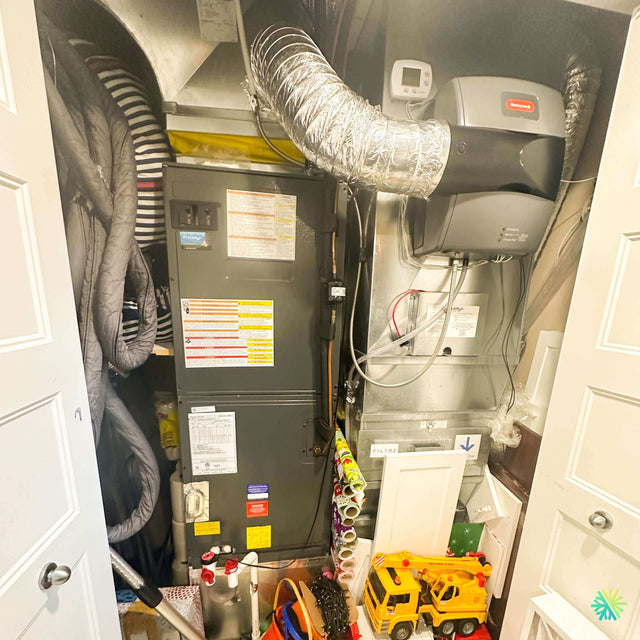
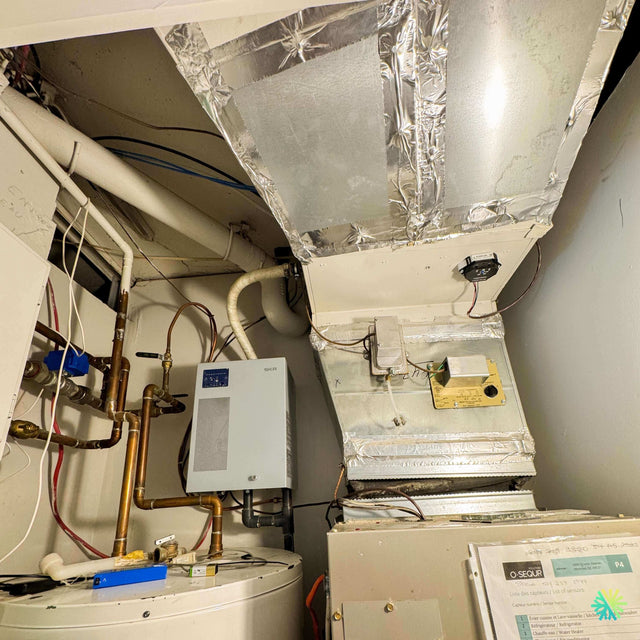
The first difficulty of this intervention was access. The furnace was installed under a dense network of ducts, with flexible ducts running in front of and above several important sections. You could see a furnace cabinet connected to a large main duct, metal connections, joints sealed with aluminum tape, as well as several insulated flexible ducts distributing air to different rooms.
In this type of environment, diagnosis requires patience. A technician must be able to open panels, follow the airflow path, check the filter condition, identify control wires, inspect low-voltage wiring, confirm the thermostat demand, then measure the furnace's actual response. A cluttered mechanical room can easily slow down the intervention, but it should never lead to an incomplete diagnosis.
The symptoms reported by the customer indicated three main leads:
- a possible airflow restriction;
- a control or electrical sequence problem;
- a partial heating failure, such as an element or relay that does not activate properly.
The installation image also showed an important point: the flexible ducts were numerous and very close to the furnace. When a flexible duct is compressed, too bent, poorly attached, or partially sagging, the airflow can decrease significantly. Even if the furnace is working, the warm air does not circulate properly. The customer then experiences a heating failure, while the problem may be worsened by the air distribution.
HVAC diagnosis: start from the thermostat, then validate the furnace piece by piece
Our technician started by checking the heating demand at the thermostat. In an electric furnace, the thermostat sends a low-voltage command that then triggers the internal components. If the thermostat requests heating but the furnace does not respond correctly, the control chain must then be checked.
The procedure included:
Checking the electrical power supply
An electric furnace can draw a significant load. Before testing the heating elements or the motor, it is necessary to confirm that the power supply is stable, that the associated circuit breakers are properly engaged, and that there are no obvious signs of overheating, loose connections, or intermittent interruptions.
In this case, the main power supply was present, but the system's behavior indicated that not all heating stages were engaging uniformly. This is exactly the kind of failure that can give the impression that "the furnace heats a little, but not enough."
Inspection of control components
Electric furnaces often use relays, sequencers, or control boards depending on the age and design of the unit. Their role is to progressively activate the heating elements and coordinate the blower. Activation that is too fast, too slow, or incomplete can cause insufficient heating, irregular cycles, or safety shutdowns.
Our team inspected accessible connections, control wires, and connection points. In a tight installation like this, vibrations, past modifications, or handling around the ducts can sometimes contribute to fragile connections.
Blower motor and airflow check
Even when the heating elements work, a furnace must move enough air to heat the home effectively. Low airflow can be caused by a very dirty filter, a dirty blower wheel, a worn motor, improperly set speed, or an overly restrictive duct network.
In this home in Côte-des-Neiges–Notre-Dame-de-Grâce, the mechanical space clearly showed that the air distribution deserved special attention. The flexible ducts needed to be inspected for folds, compressed areas, weakened joints, and air leaks near the connections.
The identified problem: irregular heating combined with weakened air circulation
After testing, our diagnosis confirmed that the problem was not limited to a single isolated element. The furnace responded to demand, but the heating sequence was irregular and the air circulation was less effective than expected. This combination perfectly explained the client’s symptoms: slow heating, uneven comfort, cooler air at the outlets, and cycles that seemed longer than usual.
In an electric furnace repair, it is common for a secondary problem to worsen the main failure. For example, a relay or a control component may reduce heating capacity, while a partially crushed duct or a clogged filter amplifies the loss of comfort. That’s why AirGreen doesn’t just replace a random part. We seek to understand why the system no longer delivers its real performance in the home.
Our intervention therefore focused on two aspects: restoring the furnace to good working condition and improving the air circulation conditions around the system.
Repairs, adjustments, and recommendations for a more reliable electric furnace
Restoration of the heating system order
The main repair consisted of fixing the control problem that prevented the furnace from heating steadily. Connections were checked, accessible components tested, and the elements involved in the heating sequence were inspected to confirm their response.
Once the intervention was completed, the furnace was restarted in heating mode. Our technician then observed the startup, the progressive activation of heating, the operation of the blower, and the temperature of the blown air. These tests are essential because a furnace may seem to operate for a few minutes, then fall back into an unstable cycle if the cause is not fully corrected.
Inspection of ducts and visible performance losses
The duct network of this installation had several important elements to monitor. The insulated flexible ducts, visible around the furnace, were numerous and installed in a very tight space. This type of configuration can work properly, but only if the ducts are well supported, well connected, and free from compression.
We paid special attention to the following points:
Duct connections
The joints between the rigid sheet metal and the flexible ducts must remain airtight. An air leak near the furnace can significantly reduce the airflow available to the outlet grilles. Even a small continuous leak can harm comfort, especially in homes where air distribution is already complex.
Ducts that are too tight or too bent
A flexible duct should not be treated like a simple hose that can be bent in any direction. The more it is compressed or bent, the harder it is for air to circulate. In some cases, the blower motor has to work harder, noise increases, and the furnace heats distant rooms less efficiently.
Access to service panels
An HVAC installation must remain accessible. When ducts, wires, or stored objects block the panels, each maintenance becomes more difficult. We explained to the client the importance of keeping a minimum clearance around the furnace to allow for future inspections, especially before winter.
Result: heating restored and client better informed about their system
After the repair and inspections, the furnace returned to a much more stable operation. The blown air was more consistent, the thermostat demand was better followed, and the client noticed an improvement in comfort. The goal was not just to "restart" the device, but to make the system more predictable and safer.
We also took the time to explain the limits of the existing installation. An electric furnace can be reliable for many years, but it strongly depends on its environment: duct quality, filter cleanliness, blower condition, connection solidity, electrical stability, and adequate access for maintenance. In an area like Montreal, where many homes have compact mechanical rooms, this reality often comes up during our service calls.
What the customer should watch for after an electric furnace repair
To prevent a similar problem from returning quickly, we gave the customer several practical tips:
- replace or clean the filter according to the recommended frequency;
- avoid storing objects in front of the furnace panels;
- monitor significant temperature variations from one room to another;
- report any unusual blower noise quickly;
- have the ducts checked if some vents blow much less than others;
- never ignore an electrical overheating smell;
- schedule maintenance before the coldest periods.
These tips are simple, but they can prevent costly breakdowns. Too often, a customer waits until the system completely stops working before calling. Yet, a drop in airflow, less consistent heat, or a longer heating cycle are already signs that an HVAC diagnosis is necessary.
Mistakes to avoid with an electric furnace
During this type of intervention, we regularly see errors that complicate the repair or accelerate system wear.
Replacing the thermostat without diagnosis
A thermostat may be the cause, but it is not always responsible. Replacing the thermostat without checking the furnace can hide the real problem and delay the repair.
Ignoring the ducts
Heating does not depend solely on the unit. A high-performance furnace with poorly configured ducts will provide poor comfort. In this case, inspecting the air distribution was an integral part of the diagnosis.
Blocking access to the unit
A furnace installed in a laundry room or storage space must remain accessible. Panels should be able to open, wires should not be pulled or pinched, and ducts should not block inspection.
Neglecting preventive maintenance
A dirty filter, a dusty blower, or a weakened connection can eventually cause a breakdown. Regular maintenance often helps detect these problems before they become urgent.
Why AirGreen intervenes methodically on residential HVAC systems
At AirGreen, we work on residential HVAC systems in Montreal, Laval, Longueuil, on the North Shore and the South Shore. Each area has its realities: condos with tight mechanical spaces, older homes with modified ducts, partially renovated apartments, aging central systems, electric furnaces combined with accessories like humidifiers or air exchangers.
Our role is to diagnose accurately, intervene properly, and clearly explain the options. In this case in Côte-des-Neiges–Notre-Dame-de-Grâce, the client needed a concrete solution but also a better understanding of their installation. Once the furnace was back in operation, they knew what to watch for, how to maintain system performance, and when to call us back if certain symptoms returned.
An intervention that demonstrates the importance of a true HVAC diagnosis
This repair of an electric furnace clearly illustrates a reality in the field: a heating failure is not always dramatic. Sometimes, the system works partially but not enough to ensure comfort. It is precisely in these cases that the experience of an HVAC technician becomes essential.
By checking the power supply, controls, heating sequence, blower, ducts, and the environment of the unit, we were able to pinpoint the cause of the problem and restore reliable operation. For the client, the result was immediate: more stable heating, better air circulation, and peace of mind knowing the furnace had been thoroughly inspected.
At AirGreen, every service call for electric furnace is treated as a full intervention, not just a quick visit. It is this rigor that allows us to offer sustainable HVAC service, both in Montreal and in Laval, Longueuil, on the North Shore and the South Shore.
The same service at your place?
Cleaning, repair or maintenance: tell us about your unit and we schedule the visit.
- RBQ licence 5645-9605-01Subclasses 15.8, 15.10 and 16
- $5M liability insuranceOn every job
- 15+ yearsFamily-owned, based in Montréal