
Installation of a Fujitsu AIRSTAGE Aquila XLTH dual-zone heat pump in Côte-Saint-Luc
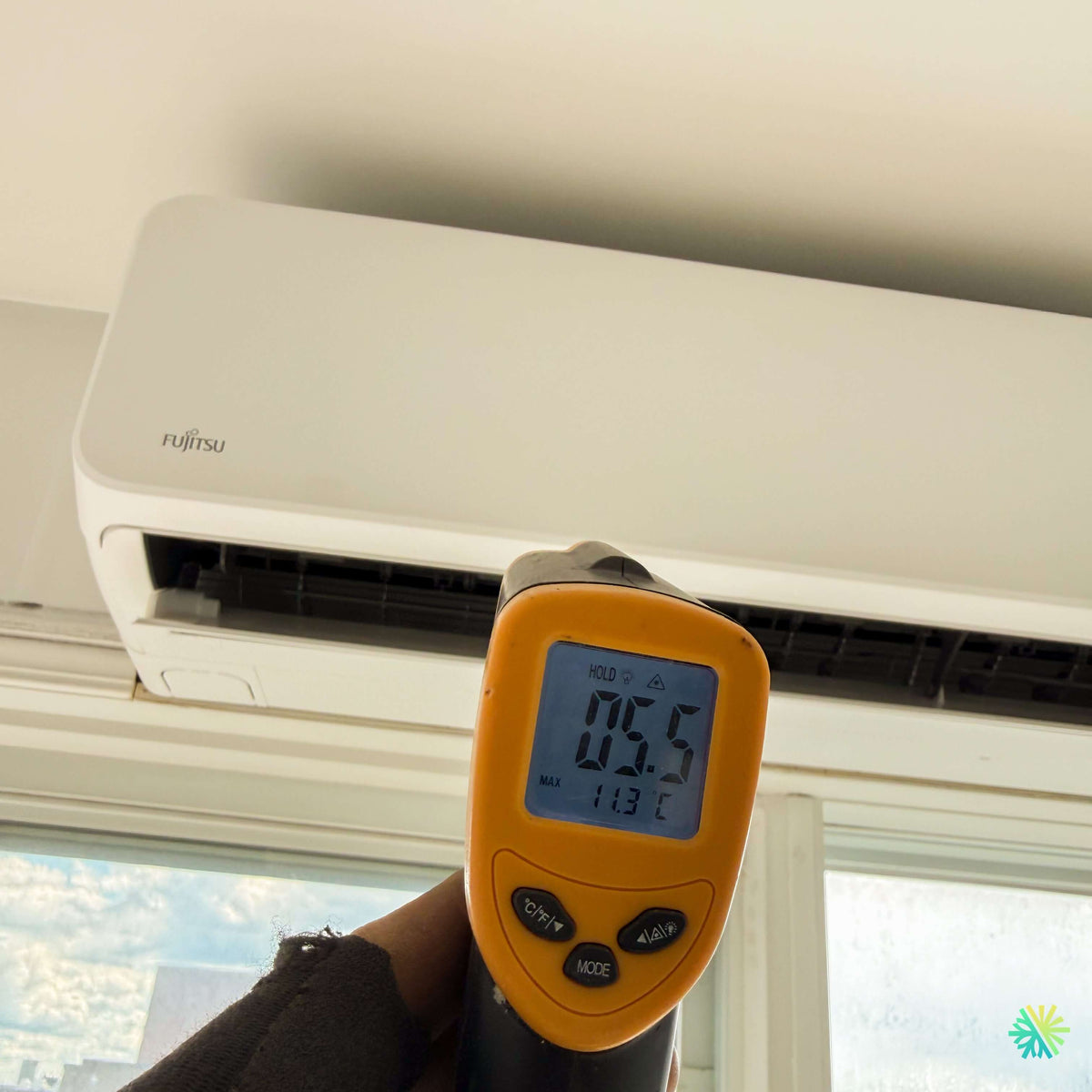
In Côte-Saint-Luc, AirGreen installs a Fujitsu Aquila XLTH dual-zone heat pump and verifies its performance by measuring an air discharge temperature of 5.5°C during commissioning.
Take a tour of the installation
Each number is a point we check on site. Switch between summer and winter to watch air and heat move.
In summer, the outdoor unit rejects the house's heat outside.
Generic illustration of this type of installation, not a survey of this job site. Tap a number.
Mounted level on a wall plate, high enough for the air to reach the whole room, with enough space around it to slide the filters out easily.
The refrigerant lines, the communication cable and the drain go through the wall in a single opening, sealed against water, cold air and insects.
Two insulated copper pipes connect the two units. Outside, a line cover can protect them from sun, knocks and weather.
A shut-off switch near the outdoor unit isolates it safely for service. It must stay accessible at all times.
The compressor and the fan. In heating mode it captures heat from the outdoor air, even in winter, and moves it inside.
On the ground or on the wall, it keeps the unit above accumulated snow. The unit stays clear and defrost water can drain away.
The fan needs to blow freely. Storage, a fence or a wall too close, and efficiency drops while noise goes up.
A multi-zone installation validated by concrete temperature measurements
At Côte-Saint-Luc, we installed a Fujitsu AIRSTAGE Aquila XLTH dual-zone heat pump to better control the temperature in two separate areas of the residence. The project did not simply involve installing two wall-mounted units and connecting them to an outdoor unit. We had to determine the appropriate capacity for each zone, choose locations that promoted even airflow, organize the routing of the lines, and verify during commissioning that each component responded correctly to the controls.
The photograph taken at the end of the work precisely illustrates this final step. Our technician is pointing an infrared thermometer at the air outlet of the Fujitsu wall-mounted unit. The device displays a measured temperature of approximately 5.5 °C, while a maximum recorded value of 11.3 °C also appears on the screen. This spot measurement, taken while the unit was operating in cooling mode, was part of the checks intended to confirm that the unit was indeed producing noticeably cooled air.
A cold reading at the unit’s outlet is encouraging, but it never constitutes a complete diagnosis on its own. At AirGreen, we interpret this data along with other observations: the room temperature, the remote control setting, the fan speed, operational stability, the condition of the louvers, airflow, and the system’s overall behavior.
Why measure the supply air temperature after installation?
An HVAC installation must be tested under real-world conditions before the project can be considered complete. A heat pump may start normally while still having a configuration, airflow, or communication problem between components.
The measurement visible in the photo helps us quickly validate several elements:
- the indoor unit responds to the cooling demand;
- the indoor coil reaches a sufficiently low temperature;
- the supply air is actually being cooled;
- the fan is operating and distributing air throughout the room;
- the system does not show any immediately abnormal behavior;
- the basic settings are consistent with the selected mode.
This reading is particularly useful when compared with the temperature of the return air in the room. The difference between the air entering the unit and the air leaving it, often called the temperature difference or delta T, provides a more meaningful indication than an isolated value.
A very low supply-air temperature does not automatically mean higher efficiency. It can vary depending on indoor humidity, the thermal load, fan speed, and the time elapsed since startup. The goal is to achieve stable, comfortable operation consistent with the system's specifications, rather than seeking the coldest possible reading.
A dual-zone heat pump for two different heating and cooling needs
In a house, two rooms of similar size can respond very differently to outdoor conditions. One may receive strong afternoon sunlight, while the other remains in the shade. An upstairs zone generally accumulates more heat in summer than a space on the lower level.
A dual-zone heat pump addresses this reality by using:
- a single outdoor unit;
- two indoor units;
- two temperature controls;
- two air-distribution circuits suited to separate spaces.
Each Fujitsu indoor unit can be controlled separately. Occupants can therefore adjust the temperature and airflow according to how each zone is used. A bedroom can be maintained at a different setpoint from a living area, without having to cool or heat the entire house uniformly.
However, it is important to understand a normal limitation of multi-zone systems: the indoor units share the same outdoor unit. They can operate at different settings, but they generally cannot heat and cool simultaneously. When the system is in heating mode, the active zones must call for heat; when it is in cooling mode, they must call for cooling.
Fujitsu documentation on H-series AIRSTAGE multi-zone systems confirms that each indoor unit can be controlled independently and that the system provides heating or cooling, without operating both modes at the same time.
Selecting indoor units: a more complex step than simply calculating floor area
Square footage is only one of the factors used to select a wall-mounted unit. To size each zone correctly, we must also consider several variables:
- the number and size of the windows;
- the room’s orientation;
- insulation quality;
- ceiling height;
- whether there is an upper floor or a roof directly above;
- the number of occupants;
- heat-generating appliances;
- whether the doors are usually open or closed;
- natural air circulation between the rooms.
In a dual-zone system, you must then verify that the combination of the two indoor units is permitted with the selected outdoor unit.
Fujitsu’s H Series table presents, among other options, an outdoor unit rated at 18,000 BTU/h that can accommodate up to two indoor units. Authorized combinations include nominal ratings of 7,000, 9,000, 12,000, and 15,000 BTU/h, depending on the zones’ needs. However, the document specifies that these tables are intended to confirm possible combinations, not to perform the final capacity calculation. Fujitsu recommends using its Design Simulator software to select AIRSTAGE equipment.
This distinction is essential. A combination technically authorized by the manufacturer is not necessarily the best choice for a given residence. Capacities must be matched to heat loss, solar gains, and the actual use of the rooms.
What a Connected Capacity Greater Than the Outdoor Capacity Means
Multi-zone systems can sometimes accommodate a combined indoor-unit capacity greater than the outdoor unit’s rated capacity. Fujitsu AIRSTAGE product-line documentation indicates a connection capacity of up to 130 %, depending on the configuration.
This flexibility is useful when the zones do not reach their maximum demand at the same time. For example, a very sunny room may have high demand in the afternoon, while a bedroom becomes more important in the evening.
However, this percentage should not be interpreted as an increase in the actual output of the outdoor unit. Fujitsu specifies that exceeding 100% in the combination of indoor units does not increase the system’s total output capacity. When both zones simultaneously call for full capacity, the available capacity must be divided between them.
A professional selection therefore aims to balance:
- the individual demand of each room;
- the frequency of simultaneous use;
- the actual capacity of the outdoor unit;
- the expected performance in very hot or very cold weather.
Fujitsu Aquila XLTH and operation in cold weather
In Côte-Saint-Luc, summer air conditioning represents an important part of the desired comfort, but winter heating capacity remains equally decisive. A system intended for the Quebec climate must be selected based on its performance when outdoor temperatures drop, not only according to its rated capacity under moderate conditions.
Fujitsu documentation presents the Aquila and Aquila CTEB systems as multi-zone solutions for cold climates. The CTEB versions mentioned in the document can provide heating down to -26 °C and cooling up to 50 °C.
The system uses a variable-speed compressor, also known as an inverter compressor. Rather than operating only at full power before shutting off, it can adjust its speed according to the building’s demand.
This modulation helps to:
- stabilize the indoor temperature;
- reduce repeated starts and stops;
- adjust output when only one zone is active;
- better track load variations;
- maintain smoother operation.
In a dual-zone installation, this modulation is particularly relevant. Requirements change continuously depending on the setpoints, sunlight, door openings, and room occupancy.
The location of the wall-mounted unit shown in the photo
The indoor unit was installed high up, directly above a window. This location makes use of a section of wall that would have few other functions, while also promoting air distribution throughout the room.
Before choosing such a location, several dimensions must be verified:
- the space between the top of the unit and the ceiling;
- the available height above the window frame;
- the presence of lintels or structural elements;
- the possible routing of pipes behind or near the unit;
- the slope of the condensate drain;
- accessibility for cleaning the filters;
- the direction of the airflow relative to the occupants.
In the photo, the unit is positioned close enough to the ceiling to use the wall effectively, while visible clearance remains above the cabinet. This clearance is important because the unit generally draws ambient air through its upper section before filtering, treating, and redistributing it throughout the room.
The air outlet louvers are open during the test. The thermometer is aimed at the airflow from a short distance to obtain a representative reading of the outgoing air.
A temperature test must be performed methodically
For an airflow temperature measurement to be useful, it must be carried out methodically. Briefly pointing a thermometer at the front of the unit can produce a misleading reading, since the plastic surface is not the same temperature as the airflow.
Instead, we aim to measure the airflow leaving the unit directly. The system must also be given enough time to stabilize its operation after startup.
Common errors during this type of test include:
- take the measurement immediately after startup;
- aim at the unit’s casing rather than the air outlet;
- ignore the ambient temperature;
- take the reading with a window open;
- compare two measurements taken at different fan speeds;
- conclude that there is a fault based solely on an infrared reading;
- forget that humidity affects system behavior.
The infrared thermometer visible in the photo is a quick inspection tool. For a more in-depth diagnosis, a technician may also use temperature probes, measure static pressure on a ducted system, check refrigerant parameters, or consult the equipment’s operating codes.
Checks performed during commissioning
A thorough commissioning process involves more than checking that the unit produces cold air. For this Fujitsu heat pump installation in Côte-Saint-Luc, the essential checks include:
Communication inspection
The indoor units must communicate properly with the outdoor unit. A wiring or addressing error can prevent a zone from starting or trigger error codes.
Drainage inspection
In air conditioning, moisture removed from the air becomes condensate. This water must drain without backflow, leaks, or unusual noise.
Refrigerant connection inspection
The connections must be leak-tight. Circuit evacuation, the quality of the flares, and compliance with the manufacturer's procedures have a direct impact on system reliability.
Mode and control verification
Each remote control is tested to confirm temperature changes, fan speed, louver direction, and selection of the available modes.
Sound level verification
We listen to the indoor unit and outdoor unit in operation to detect any abnormal vibration, rubbing, or airflow noise.
Initial performance measurement
The reading of approximately 5.5 °C visible in the photo documents one aspect of this control in cooling mode. It shows that the unit was blowing strongly cooled air at the time of the inspection.
Practical benefits of zoning for occupants
A Fujitsu Aquila XLTH dual-zone heat pump offers more precise comfort management than a single unit placed in a corridor or central area.
Occupants can, for example:
- lower the setpoint in a rarely used zone;
- cool a bedroom exposed to the sun more;
- maintain a comfortable living area without overcooling the other zone;
- adjust the fan speed separately;
- avoid relying solely on natural circulation between rooms.
This flexibility can also improve energy use, provided that the settings remain consistent. Maintaining one zone at a very low temperature while leaving the other unit turned off is not always the most efficient strategy, especially if air circulates freely between the two spaces.
We generally recommend keeping settings reasonably close when the zones are open to each other. In rooms separated by doors, the settings can be customized more extensively.
Recommended maintenance to preserve supply-air quality
The performance measured during installation must be maintained through regular maintenance. A clogged filter reduces airflow and can significantly alter the supply-air temperature.
The main habits to adopt are as follows:
- clean the filters regularly during periods of intensive use;
- keep the upper air intake clear;
- check that the louvers are not blocked;
- monitor for any signs of water beneath the unit;
- have the unit inspected when an unusual noise or odor appears;
- arrange for professional cleaning when the fan wheel and heat exchanger accumulate dust.
Thorough HVAC maintenance involves more than simply rinsing the filters. Over time, the blower wheel, condensate pan, and coil can accumulate particles that impair airflow and indoor air quality.
Mistakes to avoid with a multi-zone heat pump
After installation, certain practices can reduce comfort or complicate operation:
-
Requesting opposite modes in the two zones
One unit should not be set to heating while the other is requesting cooling. -
Constantly changing the setpoints
An inverter heat pump operates better when it can modulate gradually. -
Blocking the airflow with curtains or furniture
Air must be able to move through the room without an immediate obstruction. -
Neglecting the filters
Reduced airflow can lead to lower performance and noisier operation. -
Setting the temperature excessively low in summer
An unrealistic setpoint increases demand without necessarily improving comfort. -
Interpreting a single measurement as a complete diagnosis
The supply-air temperature must always be analyzed in context.
A Côte-Saint-Luc HVAC installation completed with genuine performance validation
This project illustrates how we carry out a heat pump installation in Côte-Saint-Luc: selecting a configuration suited to the zones, positioning each unit thoughtfully, completing the connections precisely, and finishing the work with measurable tests.
The photograph does not simply show a Fujitsu unit installed above a window. It shows an essential step in our method: validating the result. The temperature reading obtained at the air outlet confirms that the wall-mounted unit was operating correctly in cooling mode at the time of testing.
At AirGreen, we install wall-mounted heat pumps, dual-zone systems, and multi-zone solutions in Montreal, Laval, Longueuil, on the North Shore, and on the South Shore. We give equal importance to sizing, connection quality, the appearance of the line-set routing, and commissioning tests.
A quality machine can only deliver its full performance when it is properly selected and installed. In this Côte-Saint-Luc residence, the Fujitsu AIRSTAGE Aquila XLTH dual-zone system now provides separate control of two spaces, direct air distribution, and a solution adapted to the heating and cooling needs of Quebec’s climate.
The big day, step by step
The main steps of this kind of job at AirGreen. Every house has its quirks: the estimate brings them out.
We look at the room, the outside wall, the line route and where the outdoor unit will go. That is where the capacity gets chosen.
Model, capacity and price, in writing. We also check whether the model qualifies for assistance programs.
Floors and furniture protected, wall plate position marked level, wall opening located.
A single opening, with the slope the drain needs to flow outside.
Set on a stand raised above the snow, with the clearances the manufacturer requires.
Connected, insulated and protected. The opening is then sealed against water, cold air and insects.
A dedicated circuit and an accessible disconnect near the outdoor unit.
Leak test, vacuum, then start-up and a check of heating and cooling.
Remote, modes, filters: we show you the essentials before we leave.
- The on-site estimateWe look at the room, the outside wall, the line route and where the outdoor unit will go. That is where the capacity gets chosen.
- The quoteModel, capacity and price, in writing. We also check whether the model qualifies for assistance programs.
- Getting readyFloors and furniture protected, wall plate position marked level, wall opening located.
- The wall openingA single opening, with the slope the drain needs to flow outside.
- The outdoor unitSet on a stand raised above the snow, with the clearances the manufacturer requires.
- Lines, cable and drainConnected, insulated and protected. The opening is then sealed against water, cold air and insects.
- The electrical workA dedicated circuit and an accessible disconnect near the outdoor unit.
- Tests and start-upLeak test, vacuum, then start-up and a check of heating and cooling.
- The walkthroughRemote, modes, filters: we show you the essentials before we leave.
What would it look like at your place?
Two quick checks with real numbers: what heat costs, and what your current heaters add up to in BTU/h.
Conversion: 1 W = 3.412 BTU/h. An indication, not a load calculation: baseboards and furnaces are often stronger than the real need, and they can stay as backup. AirGreen confirms the capacity on site.
Four mistakes we do not make
Flip each card to see what we do instead.
Your own project, step by step
What to do, season by season
Three habits per season for this unit. They take a few minutes and prevent many calls.
- Clean the indoor unit's filters.
- Clear leaves and debris left on the outdoor unit by winter.
- Test cooling before the first hot days.
- Clean the filters more often when the unit runs a lot.
- Keep plants away from the outdoor unit.
- Check that no water drips from the indoor unit.
- Rake the leaves around the outdoor unit.
- Test heating before the first cold days.
- Book periodic maintenance before winter.
- Keep snow away from the stand and the front of the unit.
- Let the unit defrost: it is normal.
- Never hit the ice on the fins; call us if the unit stays iced up.
Is your home ready?
Check what applies at your place. A "no" is not a refusal: it is what we sort out during the estimate.
Four statements: true or false?
It all comes down to details you have just seen.
1. In heating mode, the outdoor unit can produce water.
During defrost cycles. That water must drain away without forming ice.
2. You pick the capacity with a simple square-footage rule.
Windows, insulation, orientation and how the room is used all count. Capacity is chosen on site.
3. A multi-zone connects several indoor heads to a single condenser.
One head per room, all on the same condenser. Each room keeps its own temperature.
4. The disconnect can sit behind the patio furniture.
It must stay accessible: it is what shuts the unit off for service.
0 / 4 right answers
What people ask us about this kind of work
Does a wall-mounted heat pump heat in winter?
Wall-mounted or multi-zone: how do I choose?
Where does the outdoor unit go?
Are there grants?
Do I need a permit?
How cold can it heat?
How much can I save?
How is the LogisVert assistance calculated?
Is it noisy?
The outdoor unit is covered in ice: is that normal?
Does AirGreen hold the required licences?
Is the estimate free?
No question matches. Write to us: we answer.
More jobs to see, near you
By town, by equipment or by region: browse more than 4,700 published projects.
Each dot: a town where AirGreen has published projects. The glowing dot: this job.
Every house has its constraints. We see them before we install.
The on-site estimate is free and the quote follows within 24 hours.
Text and photo: a real AirGreen Climatisation & Chauffage job. The diagrams are generic illustrations of the type of installation, not a survey of this job site. Sources of the added figures: airgreen.ca product pages (NEEP / AHRI performance), Hydro-Québec (Heat pumps page, LogisVert, read on 13 October 2026), Régie de l’énergie (rate D as of 1 April 2026).