
Installation of a GREE FREE MATCH R32 2-zone, 2-head DoubleZone heat pump in Senneville
AirGreen installs a GREE FREE MATCH R32 DoubleZone heat pump in Senneville: 2 zones, 2 heads, elevated outdoor unit under the deck, and a clean, durable, and efficient HVAC installation.
- City
- Region
- Equipment
- Brand
- Challenges
- Published
The job on one screen
The article, chapter by chapter
A multi-zone heat pump installed under a wooden structure, with a precise and durable approach in Senneville
In Senneville, heat pump projects often require a different approach than what we adopt in the denser areas of Montreal, Laval, or Longueuil. Properties there sometimes offer more space, but they also present significant architectural peculiarities: exposed foundations, wooden decks, landscaped yards, shaded areas, technical access under balconies or patios, and high aesthetic requirements. For this installation, our AirGreen team commissioned a DoubleZone GREE FREE MATCH R32 heat pump, configured as 2 zones with 2 wall-mounted units, in a covered outdoor space under a wooden structure.
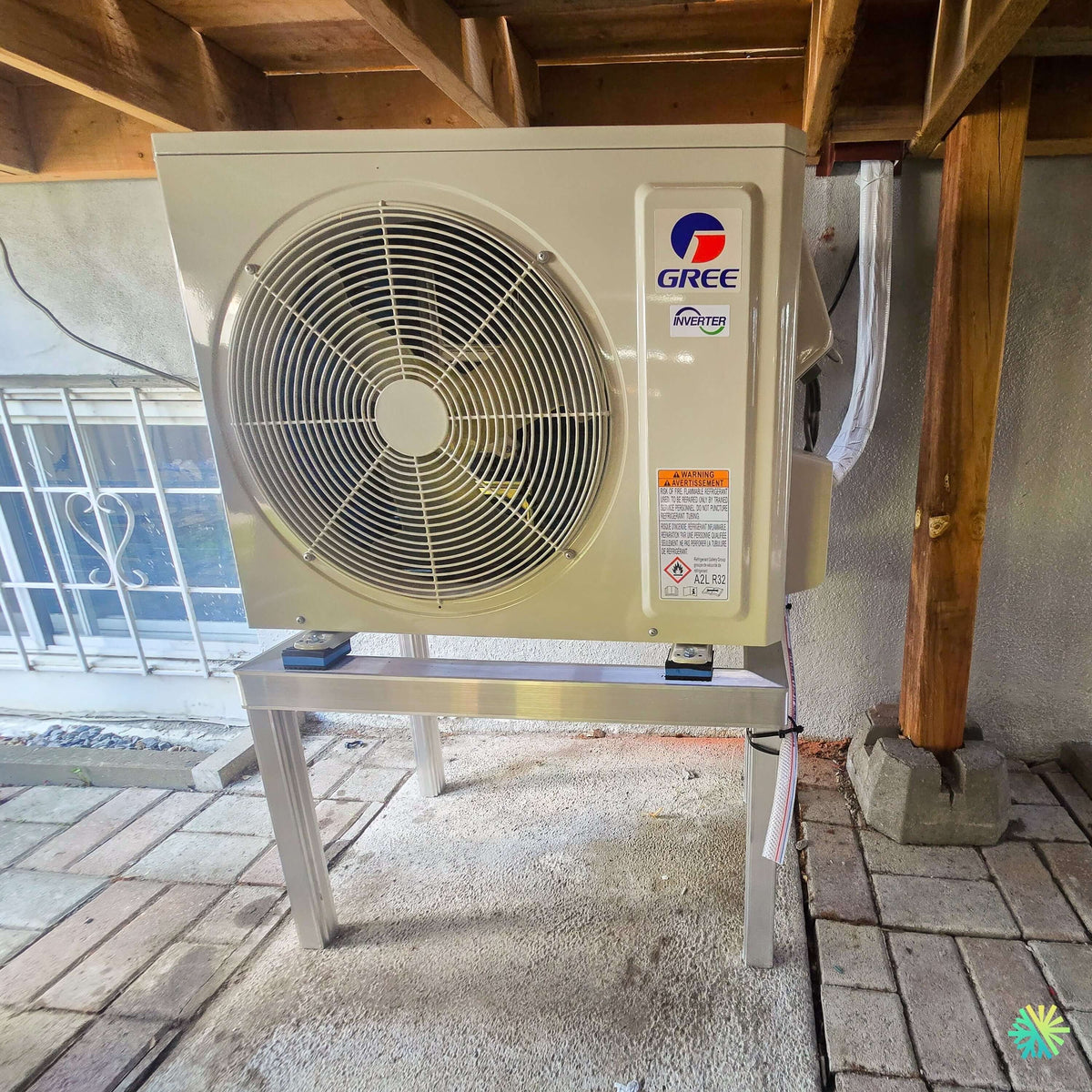
The project photo shows a central element of this achievement: the outdoor GREE unit was installed on a raised metal support, perfectly clear of the ground, under a deck or a wooden structure. The condenser rests on a stable base, above a paving stone and concrete surface, with carefully considered clearance from the foundation wall, posts, beams, and refrigeration lines. This configuration required a high level of precision, as an under-structure installation leaves no room for improvisation.
The client wanted a solution capable of improving the comfort of two indoor zones, without installing two separate outdoor units. The choice of a GREE FREE MATCH R32 was therefore a coherent option: a single outdoor condenser, two independent indoor units, modulating operation, and discreet integration into an everyday used space.
Why the GREE FREE MATCH R32 system was perfectly suited for this project
The GREE FREE MATCH R32 range is designed to meet the needs of residential multi-zone installations. In this DoubleZone configuration, the system allows 2 wall-mounted units to be connected to a single outdoor unit. For a homeowner, this represents a tangible advantage: each zone can be controlled separately, which improves comfort while avoiding the proliferation of visible outdoor equipment.
In a Senneville home, temperature differences between rooms can be significant. A glazed area, a room further away from the main heating system, an upper floor, a sun-exposed bedroom, or an office located in a less ventilated section can have very different needs. A DoubleZone heat pump allows these needs to be addressed with more finesse than a single-zone unit.
This type of system is particularly interesting for:
- single-family homes with multiple living areas;
- residences with renovated or extended sections;
- rooms located on different levels;
- spaces where a central solution would be too intrusive;
- owners who want to limit the number of outdoor units;
- customers looking for an efficient heating and cooling solution.
The R32 technology, visible on the outdoor unit's label, is also an important element of this project. This refrigerant is used in several new generations of modern HVAC systems. It provides good performance while being part of a market evolution towards more efficient equipment better suited to current expectations.
Outdoor installation under a deck: a challenge that requires experience
Installing a heat pump under a wooden structure can be advantageous, but only if clearances and ventilation are respected. The covered space partially protects the unit from direct precipitation, but this protection must not become a constraint for air circulation. A condenser must draw in and expel air efficiently; if it is placed too close to a wall, post, or obstacle, its performance may decrease.
In this installation in Senneville, our team carefully evaluated:
- the distance between the unit and the foundation wall;
- the available space in front of the fan;
- the height under the wooden beams;
- the proximity of structural posts;
- the passage of refrigeration lines;
- future access for HVAC maintenance;
- the stability of the metal support;
- vibration management;
- protection of connections.
The raised support is not just an aesthetic detail. It protects the unit from moisture, leaf accumulation, small accumulations of wind-driven snow, and ground-related stresses. In the photo, the unit is clearly visible installed above the paving stone level, with solid metal feet and anti-vibration pads. This method helps to extend the lifespan of the appliance and reduce noise transmitted to the surrounding structure.
Clean integration into a confined technical space
Even when space seems sufficient, the installation of a multi-zone system requires very rigorous organization. Unlike a standard wall-mounted installation, a DoubleZone heat pump requires the management of multiple refrigeration lines, communication cables, power supply, and condensation drains associated with the indoor units.
In this project, the lines were neatly grouped along the foundation wall, then protected to maintain a clean finish. The objective was to preserve the use of the space under the deck while maintaining accessible technical installation. This point is essential: an installation that is too cramped or poorly organized can complicate future repairs, increase intervention time, and reduce the overall quality of the project.
At AirGreen, we always consider that a successful HVAC installation must be beautiful, functional, and durable. The client doesn't just see the appliance on the day of installation; they will live with this installation for many years. This is why the cleanliness of the routing, the alignment of the conduits, the quality of the supports, the watertightness of the penetrations, and access to the connections are treated with as much attention as the system's commissioning.
The choice of support: stability, ventilation, and protection
The metal support visible in the photo plays a major role. It keeps the outdoor unit at a comfortable height, reduces contact with ground moisture, and facilitates cleaning around the appliance. In an under-deck area, this elevation also helps maintain better clearance around the condenser.
A good support must meet several criteria:
- Be stable despite normal compressor and fan vibrations.
- Resist moisture and temperature variations.
- Offer sufficient clearance under the unit.
- Allow maintenance access to important components.
- Integrate cleanly into the existing environment.
- Limit noise transmission to adjacent surfaces.
In this project, installation on a support was preferable to direct ground placement. The paving stones and concrete under the structure did not offer the same advantage as a raised technical base, especially for a multi-zone system intended for both heating and cooling. The GREE outdoor unit is therefore better protected, better ventilated, and easier to inspect.
Customized comfort for two zones of the house
One of the great advantages of a DoubleZone GREE FREE MATCH R32 heat pump is the ability to control two zones independently. This flexibility addresses a very common problem in homes: comfort is not uniform everywhere. A single general temperature is not always suitable for all rooms.
In this project in Senneville, the client wanted a solution that would allow them to adjust comfort according to the actual use of the spaces. The two indoor units can operate according to different needs, while being connected to the same outdoor condenser. This avoids constant compromises between rooms that are too hot and those that remain too cool.
Tangible daily benefits
A well-designed multi-zone installation provides immediately noticeable advantages:
- better comfort distribution;
- efficient air conditioning during warm periods;
- effective auxiliary heating for much of the cold season;
- discreet operation;
- independent zone control;
- reduction of visible outdoor appliances;
- integration adapted to the house's architecture.
For homeowners comparing a wall-mounted heat pump, a wall-mounted air conditioner, a central system, or several single-zone units, the DoubleZone solution often represents an excellent balance. It avoids overly invasive installation while offering more complete coverage than a single indoor unit.
Technical steps that ensure performance
The performance of a heat pump does not depend solely on the brand or model. It largely depends on the quality of the installation. For this project, our team followed the essential steps of a professional commissioning:
- validation of the outdoor location;
- support fastening;
- outdoor unit installation;
- passage of refrigeration lines;
- connection of lines to both circuits;
- mechanical protection of lines;
- compliant electrical connection;
- vacuuming;
- leakage check;
- system startup;
- testing of both zones;
- explanation of operation to the client.
Vacuuming is a particularly important step. It removes air and moisture from the refrigeration lines before commissioning. A neglected installation at this stage can lead to performance, reliability, and durability issues. At AirGreen, this technical rigor is part of our working method on every project, whether in Montreal, Laval, Longueuil, on the North Shore or on the South Shore.
Mistakes to avoid during under-structure installation
An under-deck installation can be very successful, but it must respect certain rules. We sometimes encounter systems installed too close to a wall, squeezed between posts, or placed in a space where the hot air expelled by the unit immediately returns to the condenser. This type of error harms the system's efficiency and can reduce its lifespan.
Here are the most common mistakes to avoid:
Installing the unit in an overly enclosed space
A condenser needs to breathe. Even under an open structure, the actual air circulation must be checked, not just the available floor space.
Neglecting access for maintenance
A technician must be able to access the panels, connections, fan, and main components. An overly cramped unit becomes expensive to maintain.
Placing the unit directly on the ground
Moisture, debris, blown snow, and ground variations can impair the stability and durability of the installation.
Poorly managing conduits
Refrigeration lines must be protected, well insulated, and installed with adequate bends. Poorly placed lines can be exposed to shocks or damage.
Forgetting vibrations
A condenser produces normal vibrations. Appropriate supports and mounts must be used to prevent transmission to wooden structures or adjacent surfaces.
HVAC maintenance: an essential element for maintaining performance
A multi-zone heat pump must be regularly maintained. Since two zones depend on the same outdoor condenser, outdoor unit maintenance is particularly important. Under a deck, it is necessary to monitor the accumulation of dust, leaves, cobwebs, wood debris, or wind-borne dirt.
We recommend that owners periodically check:
- the cleanliness of the outdoor fan;
- the absence of obstruction in front of the unit;
- the condition of the indoor unit filters;
- the normal flow of drains;
- the condition of line insulation;
- unusual noises;
- the stability of the support.
Good HVAC maintenance helps maintain efficiency, reduce the risk of breakdowns, and extend the system's lifespan. AirGreen offers this service throughout Greater Montreal, including Montreal, Laval, Longueuil, the North Shore, the South Shore, and the West Island, including Senneville.
Subsidies and eligibility: a check to be made before the final choice
Available subsidies for heat pumps can influence the actual cost of a project. However, eligibility always depends on the exact model, the combination of units, the criteria of the current program, and the documentation provided. For a multi-zone system like the GREE FREE MATCH R32, it is important to validate the precise configuration before promising an amount.
At AirGreen, we help clients understand the applicable criteria and prepare the necessary information when the system is eligible. This step avoids unpleasant surprises and allows for a fairer comparison of bids. The lowest price is not always the best choice if the installation does not meet technical requirements or if post-installation support is limited.
Why AirGreen was the right choice for this project in Senneville
This installation perfectly illustrates our way of working. We don't just aim to install a device quickly. We analyze the location, building constraints, actual use of indoor areas, durability of connections, and future maintenance. In a space with a wooden structure, this approach is essential.
The result is a clean, stable, and consistent HVAC installation with the property's environment. The outdoor unit is elevated, clearances are respected, pipes are well organized, and the system can serve two zones without cluttering the yard with multiple condensers.
Our clients choose AirGreen because they want a complete solution: equipment selection, professional installation, technical advice, subsidy support, after-sales service, and maintenance. This expertise is particularly useful for multi-zone projects, where every decision made at the time of installation directly influences future comfort.
A project that combines efficiency, discretion, and intelligent installation
In Senneville, this GREE FREE MATCH R32 DualZone heat pump meets a specific need: to offer independent comfort in two zones, with a single outdoor unit well integrated under an existing structure. The project demonstrates the importance of thoughtful installation, especially when technical space is shared with architectural elements such as a terrace, wooden posts, a foundation, and outdoor landscaping.
For the client, the benefits are clear: better comfort, zone control, modern R32 equipment, discreet outdoor installation, and durable elevated support. For AirGreen, this project represents exactly what we want to offer with every installation: an HVAC solution adapted to the building, designed to operate efficiently for many years.
The job tools
Two quick checks with real numbers: what heat costs, and what your current heaters add up to in BTU/h.
Conversion: 1 W = 3.412 BTU/h. An indication, not a load calculation: baseboards and furnaces are often stronger than the real need, and they can stay as backup. AirGreen confirms the capacity on site.
How the job unfolds
The main steps of this kind of job at AirGreen. Every house has its quirks: the estimate brings them out.
We look at the room, the outside wall, the line route and where the outdoor unit will go. That is where the capacity gets chosen.
Model, capacity and price, in writing. We also check whether the model qualifies for assistance programs.
Floors and furniture protected, wall plate position marked level, wall opening located.
A single opening, with the slope the drain needs to flow outside.
Set on a stand raised above the snow, with the clearances the manufacturer requires.
Connected, insulated and protected. The opening is then sealed against water, cold air and insects.
A dedicated circuit and an accessible disconnect near the outdoor unit.
Leak test, vacuum, then start-up and a check of heating and cooling.
Remote, modes, filters: we show you the essentials before we leave.
- The on-site estimateWe look at the room, the outside wall, the line route and where the outdoor unit will go. That is where the capacity gets chosen.
- The quoteModel, capacity and price, in writing. We also check whether the model qualifies for assistance programs.
- Getting readyFloors and furniture protected, wall plate position marked level, wall opening located.
- The wall openingA single opening, with the slope the drain needs to flow outside.
- The outdoor unitSet on a stand raised above the snow, with the clearances the manufacturer requires.
- Lines, cable and drainConnected, insulated and protected. The opening is then sealed against water, cold air and insects.
- The electrical workA dedicated circuit and an accessible disconnect near the outdoor unit.
- Tests and start-upLeak test, vacuum, then start-up and a check of heating and cooling.
- The walkthroughRemote, modes, filters: we show you the essentials before we leave.
What we check on a job like this one
Each number is a point we check on site. Switch between summer and winter to watch air and heat move.
In summer, the outdoor unit rejects the house's heat outside.
Generic illustration of this type of installation, not a survey of this job site. Tap a number.
Mounted level on a wall plate, high enough for the air to reach the whole room, with enough space around it to slide the filters out easily.
The refrigerant lines, the communication cable and the drain go through the wall in a single opening, sealed against water, cold air and insects.
Two insulated copper pipes connect the two units. Outside, a line cover can protect them from sun, knocks and weather.
A shut-off switch near the outdoor unit isolates it safely for service. It must stay accessible at all times.
The compressor and the fan. In heating mode it captures heat from the outdoor air, even in winter, and moves it inside.
On the ground or on the wall, it keeps the unit above accumulated snow. The unit stays clear and defrost water can drain away.
The fan needs to blow freely. Storage, a fence or a wall too close, and efficiency drops while noise goes up.
Is your home ready?
Check what applies at your place. A "no" is not a refusal: it is what we sort out during the estimate.
Good habits, once the unit is in place
Six simple habits that keep the unit going. Your list stays on this device.
What to do, season by season
Three habits per season for this unit. They take a few minutes and prevent many calls.
- Clean the indoor unit's filters.
- Clear leaves and debris left on the outdoor unit by winter.
- Test cooling before the first hot days.
- Clean the filters more often when the unit runs a lot.
- Keep plants away from the outdoor unit.
- Check that no water drips from the indoor unit.
- Rake the leaves around the outdoor unit.
- Test heating before the first cold days.
- Book periodic maintenance before winter.
- Keep snow away from the stand and the front of the unit.
- Let the unit defrost: it is normal.
- Never hit the ice on the fins; call us if the unit stays iced up.
The right pages, at the right time
Four statements: true or false?
It all comes down to details you have just seen.
1. In heating mode, the outdoor unit can produce water.
During defrost cycles. That water must drain away without forming ice.
2. You pick the capacity with a simple square-footage rule.
Windows, insulation, orientation and how the room is used all count. Capacity is chosen on site.
3. A multi-zone connects several indoor heads to a single condenser.
One head per room, all on the same condenser. Each room keeps its own temperature.
4. The disconnect can sit behind the patio furniture.
It must stay accessible: it is what shuts the unit off for service.
0 / 4 right answers
What people ask us about this kind of work
Does a wall-mounted heat pump heat in winter?
Wall-mounted or multi-zone: how do I choose?
Where does the outdoor unit go?
Are there grants?
Do I need a permit?
How cold can it heat?
How much can I save?
How is the LogisVert assistance calculated?
Is it noisy?
The outdoor unit is covered in ice: is that normal?
Does AirGreen hold the required licences?
Is the estimate free?
No question matches. Write to us: we answer.
More jobs to see, near you
By town, by equipment or by region: browse more than 4,700 published projects.
Each dot: a town where AirGreen has published projects. The glowing dot: this job.
An on-site estimate, the right capacity, the right equipment.
The on-site estimate is free and the quote follows within 24 hours.
Text and photo: a real AirGreen Climatisation & Chauffage job. The diagrams are generic illustrations of the type of installation, not a survey of this job site. Sources of the added figures: airgreen.ca product pages (NEEP / AHRI performance), Hydro-Québec (Heat pumps page, LogisVert, read on 13 October 2026), Régie de l’énergie (rate D as of 1 April 2026).