
Installation of a GREE All Match Slim Duct R32 ducted heat pump in Bois-des-Filion – custom ducts, discreet comfort, and optimized air distribution
In Bois-des-Filion, AirGreen installs a GREE ducted heat pump with custom ducts for discreet, uniform comfort tailored to homes on the North Shore.
In summer, the outdoor unit rejects the house's heat outside.
Generic illustration of this type of installation, not a survey of this job site. Tap a number.
It captures or rejects heat outside. It sits on a level base, above the snow, with free space all around.
The insulated refrigerant lines enter the house through a sealed opening and run to the indoor coil.
A shut-off switch near the outdoor unit isolates it safely for service.
Sitting on the indoor module, it moves heat between the house air and the refrigerant.
Electric furnace or air handler: its fan pushes air through the ducts. The electric backup takes over in extreme cold.
Supply ducts bring air to the rooms; returns bring it back to the unit. Their condition matters as much as the unit's.
It protects the coil and the fan. A dirty filter cuts airflow, so it gets checked regularly.
It runs the heat pump and the backup heat. It must be compatible with the installed system.
A GREE ducted system designed to disappear into the home, but not in comfort
In Bois-des-Filion, on the North Shore, our AirGreen team completed an HVAC installation that perfectly sums up what more and more homeowners are looking for: the comfort of an efficient heat pump, without the visible appearance of a traditional wall air conditioner in the main rooms. The project involved integrating a GREE ducted system, also called ducted conduit, Slim Duct, or ductable, with air distribution through custom-made and adjusted ducts.
The core of this installation is based on a very different approach from a classic wall unit. Instead of installing a visible indoor unit in the living room, kitchen, or hallway, the ducted system is hidden in a technical space, a false ceiling, an attic, or an area designated for mechanical equipment. The air is then distributed to several outlets through a network of ducts. In this project, special attention was given to the fabrication of metal transitions, the positioning of outlets, and balancing the airflow.
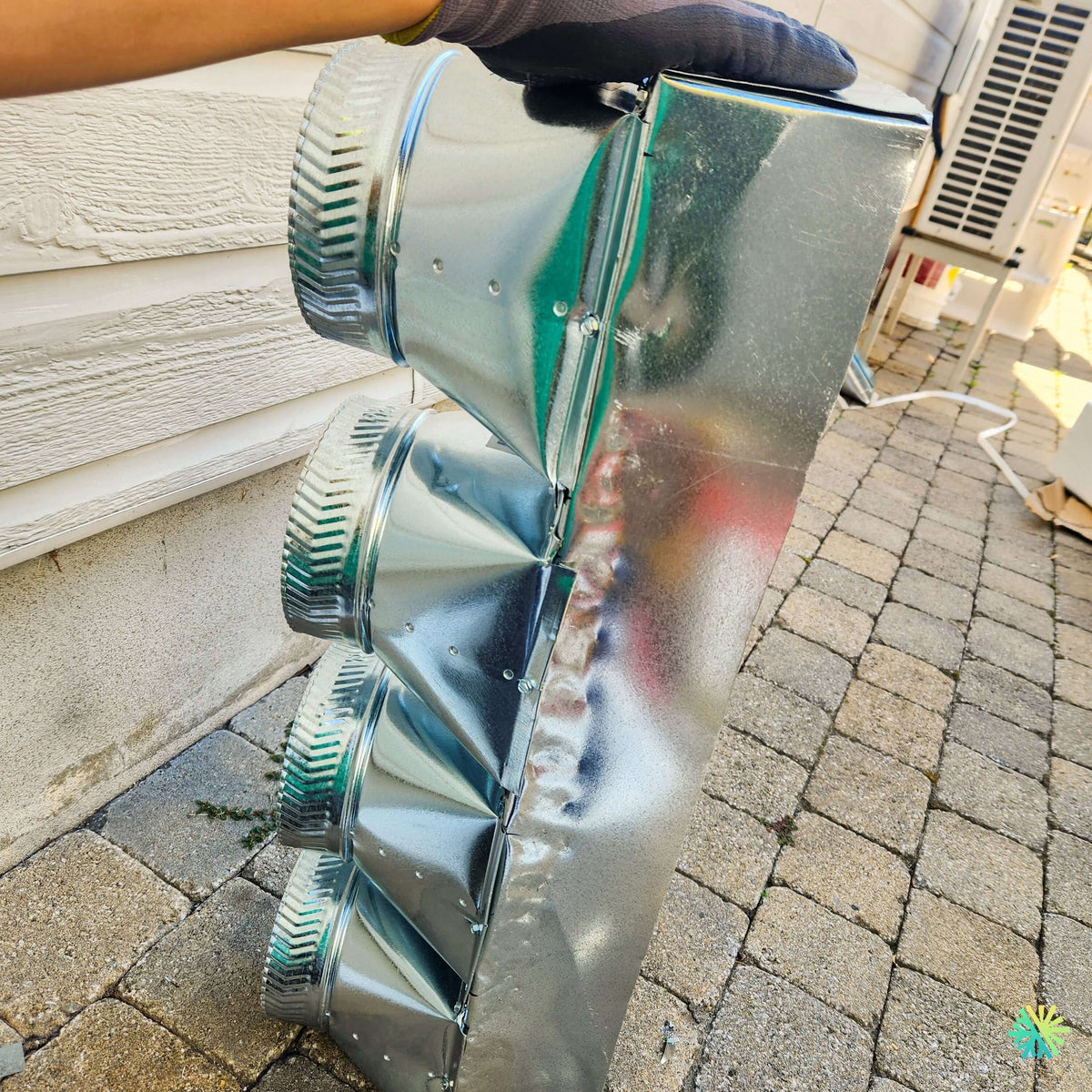
The metal piece visible during the site preparation perfectly illustrates this often invisible step for the end customer: a galvanized sheet metal plenum with several circular connections, designed to distribute air to different zones. This type of component is not just an accessory. It is an essential part that directly influences comfort, noise level, static pressure, and the actual performance of the system.
At AirGreen, we know that a GREE ducted heat pump can offer excellent performance, but only if the installation is considered as a whole: indoor unit, outdoor unit, ducts, pressure losses, insulation, drainage, service location, and wall control. This is precisely what guided this project in Bois-des-Filion.
The client's need: a discreet, clean, and uniform solution
The client wanted to improve the comfort of their home without multiplying visible wall units. Like many homeowners on the North Shore, they were looking for a solution capable of air conditioning and heating certain zones more uniformly while maintaining a clean interior appearance. In a house where architecture, ceilings, and interior layout sometimes limit options, the GREE ducted system becomes a very interesting solution.
Before proposing the installation, we evaluated several elements:
- the layout of the rooms to be served;
- the available space to run the ducts;
- the required static pressure level;
- the distance between the indoor unit and the supply vents;
- the positioning of the outdoor unit;
- the feasibility of condensate drainage;
- future access for HVAC maintenance;
- electrical and refrigeration constraints.
This analysis is essential. A poorly sized or poorly ducted ducted unit can become noisy, underperforming, or difficult to maintain. Conversely, a well-designed installation delivers a very clean result: stable temperature, better air distribution, and very few visible elements inside.
Why the GREE choice was relevant for this installation
For this project in Bois-des-Filion, the GREE All Match Slim Duct R32 range stood out as a coherent option thanks to its integration flexibility and format suited for discreet installations. The ducted GREE systems offered by AirGreen cover several capacities, including 9,000 BTU, 12,000 BTU, 18,000 BTU, 24,000 BTU, 30,000 BTU, and 36,000 BTU, allowing the selection of a power truly adapted to the building rather than forcing a unit that is too small or too large.
In the case of a ducted system, the number of BTUs should never be chosen solely based on the area. You must consider insulation, sun exposure, the number of floors, ceiling height, heat loss, the zones to be covered, and the duct network. A house in Bois-des-Filion with large windows, for example, can have a very different thermal behavior from a more compact bungalow located in Laval or a condo in Montreal.
The GREE ducted models available at AirGreen also stand out for several important technical advantages:
- discreet indoor format for installation in ceiling, false ceiling, attic, or technical space;
- compatibility with short or more elaborate duct networks, depending on the model's static pressure;
- low static pressure and high static pressure options depending on needs;
- inverter technology to adjust operation according to actual demand;
- some models designed to provide reliable heating down to very cold temperatures, depending on the configuration;
- availability of models with refrigerant R32, an increasingly used option in recent installations;
- possibility of integration into residential projects, multi-family housing, and some small businesses.
As a GREE Elite dealer, AirGreen also benefits from specialized access to technical training, original parts, and installation procedures specific to ducted systems. This aspect is very important because a ducted installation requires more advanced expertise than a simple wall-mounted installation.
The crucial role of the plenum and custom ducts
On this site, the fabrication and adjustment of the distribution network represented a key part of the work. The metal plenum prepared for installation had several circular outlets, allowing air to be distributed to different sections of the house. Each outlet had to be positioned precisely to avoid unnecessary turbulence, pressure losses, and flow rate differences between rooms.
A ducted system does not work properly if the ducts are improvised. The most common mistakes we observe when correcting installations done elsewhere are as follows:
- ducts too long for the static pressure capacity of the unit;
- plenums too small, causing noise and poor distribution;
- too abrupt metal transitions;
- lack of adequate insulation around ducts;
- poorly placed supply vents;
- insufficient air return;
- too restricted service access;
- poorly planned condensate drainage.
In Bois-des-Filion, our team worked with a precision mindset: preparing metal components, validating alignments, planning fastenings, limiting air restrictions, and ensuring a clean integration. The goal was not just to “fit” the system into the available space, but to create a durable and stable installation.
An installation that requires more than just equipment: calculation, coordination, and finishing
Installing a GREE ducted system requires close coordination between several disciplines. You have to think like a refrigeration technician, a sheet metal worker, a ventilation technician, and an HVAC installer. The indoor unit must be well supported, level, accessible, and installed according to required clearances. The ducts must be securely fastened. Refrigeration connections must be made according to standards, with pressurization, leak testing, and proper vacuuming. Drainage must be reliable, especially when the unit is installed in a ceiling or enclosed space.
In this installation, we paid special attention to noise reduction. A good ducted system should be unnoticeable. For this, the airflow must be controlled. A high-performance unit can become unpleasant if air is forced through ducts that are too narrow. That is why static pressure, duct diameter, run length, and the quality of metal transitions were carefully checked.
The exterior finish was also planned to preserve the appearance of the house. As with our projects in Montreal, Laval, Longueuil, on the North Shore and on the South Shore, we favor a clean layout for piping, cables, and accessories, with particular attention to protection, supports, and durability.
What a homeowner needs to know before choosing a GREE ducted heat pump
A Slim Duct system can be an excellent solution, but it is not suitable for all projects in the same way. At AirGreen, we take the time to explain the advantages, limitations, and success conditions before recommending this type of installation.
Ducted or wall-mounted: two very different approaches
The wall air conditioner or the wall heat pump remains an effective and quick solution for many homes. The unit is visible, accessible, and generally simpler to install. The ducted system, on the other hand, aims for a more discreet integration. The ventilation grilles are visible, but the indoor unit is hidden.
The ducted system becomes particularly interesting when the client wants to:
- avoid a wall unit in a central room;
- distribute air to several nearby zones;
- maintain a cleaner interior aesthetic;
- improve comfort in connected spaces;
- replace or improve an old duct system;
- integrate HVAC into a larger renovation.
However, a higher installation budget than a standard wall unit must be planned, as the ductwork, integration, and balancing work is more complex. It’s an investment that must be justified by the house configuration and the client’s expectations.
Subsidies: an essential validation before installation
Many customers ask us if a GREE ducted heat pump can qualify for a subsidy, especially under programs like Hydro-Québec’s LogisVert. The answer always depends on the exact combination of the indoor unit, outdoor unit, capacity, energy certification, and the applicable AHRI file.
That’s why AirGreen verifies technical information before finalizing an offer. When a model is eligible, we clearly indicate the available details and necessary documents. The customer receives a complete invoice after installation, which simplifies their process. We always remind that a subsidy should not be assumed without verifying the exact model, as two devices from the same brand can have different statuses depending on their combination.
Mistakes to avoid with a ducted system
In Bois-des-Filion, this installation was successful because it was planned in advance. Here are the mistakes a homeowner should avoid before choosing a ducted system:
Choosing capacity based only on the number of rooms
An 18,000 BTU or 24,000 BTU system is not automatically suitable just because there are two or three rooms to serve. The calculation must include the actual heat load, duct distance, and the required airflow for each zone.
Neglecting the air return
Air blowing is important, but air return is just as crucial. Without proper return, the system can strain, become noisy, or lose efficiency.
Installing ducts without considering static pressure
Ducts must be compatible with the unit’s capacity to push air. This is one of the most important points in a ducted installation.
Forgetting maintenance access
A hidden unit should never become inaccessible. It must be possible to clean, inspect, maintain, and repair the equipment. Future HVAC maintenance must be planned from the day of installation.
Underestimating the importance of finishing
The client rarely sees the indoor unit, but feels every day the quality of the work: noise, comfort, stability, cleanliness of vents, humidity control, and temperature consistency.
The AirGreen experience with ducted systems
Our experience with HVAC projects in Greater Montreal allows us to compare several types of installations: simple wall units, multi-zone, central units, low-pressure ducted, high-pressure ducted, and integrated systems in renovations. This field experience helps us recommend the right solution according to the house, rather than systematically proposing the same type of device.
In Montreal, we have often worked in buildings where space is limited and ducts must pass through very specific areas. In Laval, many houses allow for more flexible integration in the basement or attic. In Longueuil and on the South Shore, we frequently see projects where the client wants to modernize comfort without completely transforming the interior. On the North Shore, such as in Bois-des-Filion, Blainville, Terrebonne, or Boisbriand, houses often offer good opportunities to integrate a ducted system when the structure allows.
In this project, the client particularly appreciated the cleanliness of the preparatory work and the clarity of the explanations. We took the time to show how the air would be distributed, why the ducts needed to be properly sized, and how service access would be preserved. This type of exchange avoids unpleasant surprises and allows the client to understand what they are really paying for: not just a machine, but a complete, thoughtful, and durable installation.
A discreet comfort that changes the use of the house
After installation, the main goal was to achieve a more even temperature without visible equipment in the targeted rooms. A good ducted system feels different from a wall unit: the air is less concentrated in one spot, the distribution can be gentler, and the visual integration is more understated.
For homeowners who value interior design, this is a major advantage. Ventilation outlets can be positioned discreetly, and the indoor unit remains hidden. For families, this also means less visible equipment to handle, fewer obstacles on the walls, and comfort that better integrates into daily life.
Why entrust this type of installation to AirGreen
A ducted installation should not be entrusted to a team that treats this type of project like a standard wall-mounted installation. You need to understand the ducts, static pressure, acoustics, drainage, clearances, and manufacturer requirements. At AirGreen, we combine refrigeration expertise with a practical on-site design approach.
Our clients choose AirGreen for several concrete reasons:
- clear and detailed estimates;
- recommendations adapted to the building;
- experienced technicians;
- clean and compliant installations;
- support for models eligible for subsidies;
- structured after-sales service;
- $5,000,000 liability insurance;
- knowledge of the realities of Montreal, Laval, Longueuil, the North Shore, and the South Shore.
In Bois-des-Filion, this installation of a GREE All Match Slim Duct R32 ducted heat pump clearly demonstrates our way of working: analyze before installing, fabricate the right fittings, protect the system’s performance, and deliver a clean result. Discreet comfort is never a matter of chance. It relies on precise technical choices, rigorous installation, and a true understanding of the building.
For homeowners considering a ducted solution, this project is an excellent example of what to look for: a well-chosen system, well-planned ducts, a team that masters the details, and a finish that respects both the performance and appearance of the home.
How it goes, from the first call to the end
The main steps of this kind of job at AirGreen. Every house has its quirks: the estimate brings them out.
We look at the ducts, the current indoor module, the electrical panel and the planned spot for the outdoor unit.
The equipment combination, capacity and price, in writing. We check whether the combination qualifies for assistance programs.
Access protected, old unit disconnected and removed when it is being replaced.
Electric furnace or air handler, with its coil, connected to the supply and return ducts.
On a level base, raised above the snow, with free space all around.
Insulated, they enter through a sealed opening and run to the indoor coil.
Dedicated circuits, accessible disconnect, a thermostat that works with the heat pump and the backup heat.
Leak test, vacuum, start-up, airflow check and a test of both modes.
Filter, thermostat, backup heat in extreme cold: what to know before winter.
- The on-site estimateWe look at the ducts, the current indoor module, the electrical panel and the planned spot for the outdoor unit.
- The quoteThe equipment combination, capacity and price, in writing. We check whether the combination qualifies for assistance programs.
- Getting readyAccess protected, old unit disconnected and removed when it is being replaced.
- The indoor moduleElectric furnace or air handler, with its coil, connected to the supply and return ducts.
- The outdoor unitOn a level base, raised above the snow, with free space all around.
- The refrigerant linesInsulated, they enter through a sealed opening and run to the indoor coil.
- Electrical and thermostatDedicated circuits, accessible disconnect, a thermostat that works with the heat pump and the backup heat.
- Tests and start-upLeak test, vacuum, start-up, airflow check and a test of both modes.
- The walkthroughFilter, thermostat, backup heat in extreme cold: what to know before winter.
And at your place?
Two quick checks with real numbers: what heat costs, and what your current heaters add up to in BTU/h.
Conversion: 1 W = 3.412 BTU/h. An indication, not a load calculation: baseboards and furnaces are often stronger than the real need, and they can stay as backup. AirGreen confirms the capacity on site.
What to do, season by season
Three habits per season for this unit. They take a few minutes and prevent many calls.
- Check the indoor module's filter.
- Clear winter debris from the outdoor unit.
- Test cooling before the heat arrives.
- Check the filter more often in peak season.
- Keep registers and returns clear.
- Watch condensate drainage near the coil.
- Change or clean the filter.
- Test heating and backup heat before the cold.
- Book periodic maintenance.
- Clear snow around the outdoor unit.
- Store nothing in front of the indoor module.
- Note any unusual noise or smell and call us.
Which type of equipment for your project?
Pick what looks like your need.
Four mistakes we do not make
Flip each card to see what we do instead.
What people ask us about this kind of work
Can I keep my current ducts?
What happens in extreme cold?
Furnace, air handler, ducted: what is the difference?
Are there grants?
Do I need a permit?
How much can I save?
How is the LogisVert assistance calculated?
Will my current thermostat work?
Central or wall units: which one?
Does AirGreen hold the required licences?
Is the estimate free?
No question matches. Write to us: we answer.
Useful pages for what comes next
More jobs to see, near you
By town, by equipment or by region: browse more than 4,700 published projects.
Each dot: a town where AirGreen has published projects. The glowing dot: this job.
Tell us about your house. We come and see it for free.
The on-site estimate is free and the quote follows within 24 hours.
Text and photo: a real AirGreen Climatisation & Chauffage job. The diagrams are generic illustrations of the type of installation, not a survey of this job site. Sources of the added figures: airgreen.ca product pages (NEEP / AHRI performance), Hydro-Québec (Heat pumps page, LogisVert, read on 13 October 2026), Régie de l’énergie (rate D as of 1 April 2026).