
Installation of a Fujitsu AIRSTAGE Altair 500 wall-mounted heat pump in Sainte-Brigide-d'Iberville: a rooftop installation designed for stability, clearance, and serviceability
AirGreen installs a Fujitsu AIRSTAGE Altair 500 R-32 in Sainte-Brigide-d'Iberville on an elevated support with vibration isolators, a solution suited to the requirements of a rooftop HVAC installation.
In summer, the outdoor unit rejects the house's heat outside.
Generic illustration of this type of installation, not a survey of this job site. Tap a number.
Mounted level on a wall plate, high enough for the air to reach the whole room, with enough space around it to slide the filters out easily.
The refrigerant lines, the communication cable and the drain go through the wall in a single opening, sealed against water, cold air and insects.
Two insulated copper pipes connect the two units. Outside, a line cover can protect them from sun, knocks and weather.
A shut-off switch near the outdoor unit isolates it safely for service. It must stay accessible at all times.
The compressor and the fan. In heating mode it captures heat from the outdoor air, even in winter, and moves it inside.
On the ground or on the wall, it keeps the unit above accumulated snow. The unit stays clear and defrost water can drain away.
The fan needs to blow freely. Storage, a fence or a wall too close, and efficiency drops while noise goes up.
A distinctive outdoor configuration that shows why the support and location matter just as much as the heat pump itself
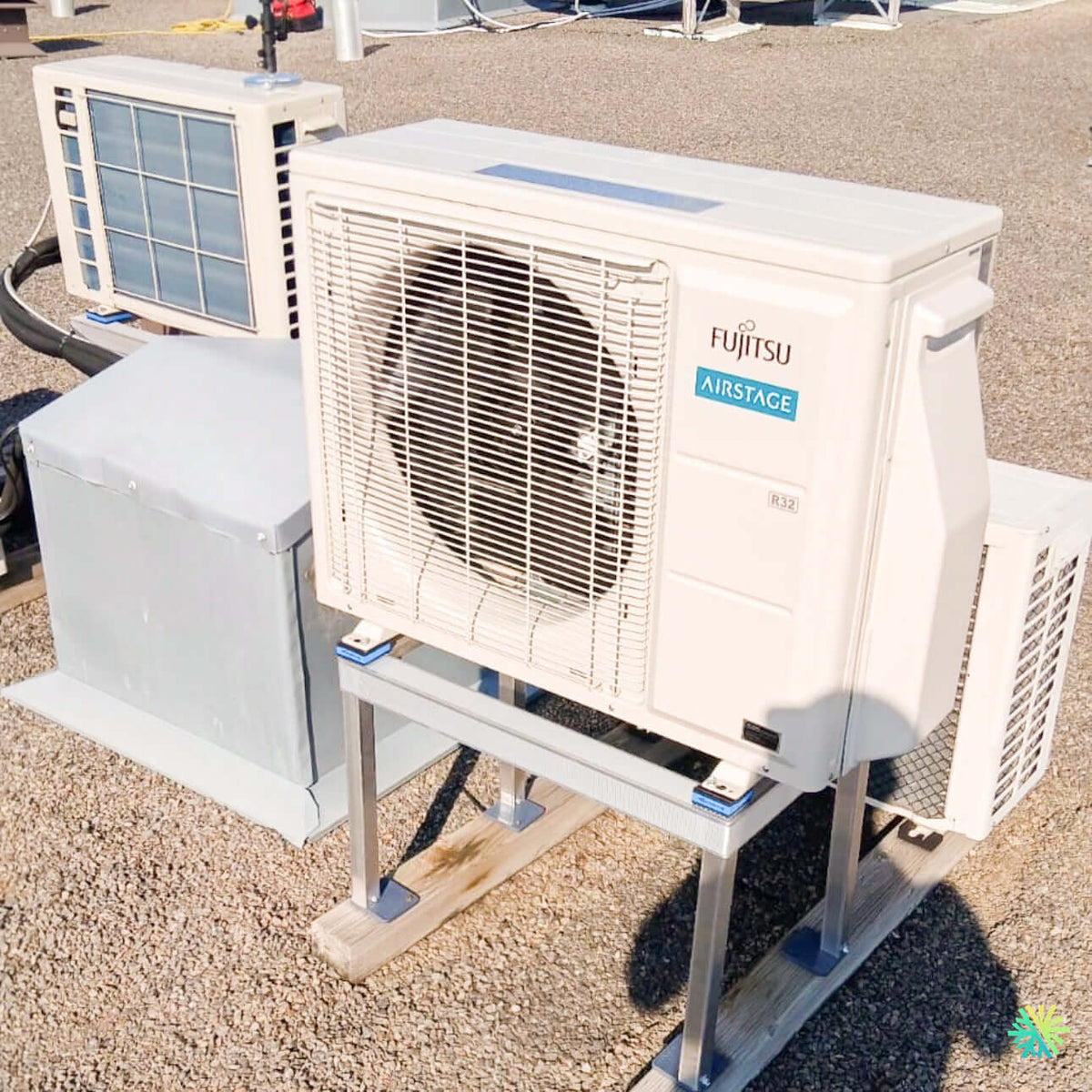
At Sainte-Brigide-d'Iberville, we completed an installation of a Fujitsu AIRSTAGE Altair 500 wall-mounted heat pump in a configuration that immediately stands out: the outdoor unit is installed on an elevated metal support, directly on a gravel-covered roof surface, among several other mechanical systems.
This type of project requires a different approach from a standard residential installation at ground level. Here, the challenge is not simply to secure a condenser against a foundation. We must consider the roof structure, support stability, vibrations, clearance beneath the unit, access for maintenance, nearby equipment, and the routing of the refrigerant piping.
The photo of this installation in Sainte-Brigide-d'Iberville clearly shows several important details: the Fujitsu AIRSTAGE Altair 500 with R-32 rests on an independent metal structure, which is itself supported by wooden crossbeams. Blue anti-vibration isolators are visible beneath the heat pump’s feet. The unit is therefore isolated from its support structure while remaining high enough to maintain proper clearance beneath the condenser.
This project clearly illustrates AirGreen’s philosophy: a durable HVAC installation begins well before the machine is started.
Why install a heat pump on an elevated support on a roof?
A heat pump installed on a roof is subject to particular constraints.
Unlike a unit installed on the ground alongside a house, it may be more exposed to wind, precipitation, rapid temperature fluctuations, and winter accumulation. The installer must also prevent a heavy or vibrating appliance from unnecessarily transmitting its movements to the building structure.
For this installation, we therefore chose a configuration with:
- Rigid, elevated metal support;
- Spaced bases to distribute the loads;
- Wooden crossbeams beneath the support;
- Anti-vibration pads beneath the Fujitsu unit;
- Clearance beneath the heat pump;
- Visible access at the front and sides of the unit.
This type of mounting allows us to better control the unit’s final position and limit direct contact points with the roof.
The clearance beneath the condenser is also particularly useful in winter. A heat pump produces water during its defrost cycles. This water must be able to move away from the unit rather than gradually forming a mass of ice around its base.
An already crowded mechanical environment
The photo shows that this heat pump is not alone on the roof.
Several other outdoor units can be seen around the Altair 500, along with a large metal enclosure in the immediate vicinity. This requires more careful planning of the positioning.
When installing a heat pump on a roof, we must always avoid placing a new unit where it could:
- draw in air discharged directly by another unit;
- obstruct access to existing equipment;
- prevent access to a service panel;
- complicate a future repair;
- reduce the clearances required around the condenser;
- create a conflict with the ducts or cables already present on the roof.
The goal is therefore not simply to “find a place.” Each unit must have its own operating space.
The Fujitsu AIRSTAGE Altair 500: an R-32 single-zone range
The Fujitsu AIRSTAGE Altair 500 is part of Fujitsu's H single-zone series. The technical documentation provided for this range covers six capacities: 09KPAS1, 12KPAS1, 18KPAS1, 24KPAS1, 30KPAS1, and 36KPAS1.
The series uses R-32 refrigerant, a detail that can also be seen on the front panel of the photographed outdoor unit.
Fujitsu indicates that R-32 has a global warming potential of 675, compared with 2,088 for R-410A, representing a stated reduction of 68% in GWP. The manufacturer also states that systems operating with R-32 may require less refrigerant charge while maintaining the desired heating performance.
A range of capacities to meet different needs
According to the Altair 500 technical data sheet, the nominal cooling capacities are as follows:
- 9,000 BTU/h for the 09KPAS1;
- 12,000 BTU/h for the 12KPAS1;
- 18,000 BTU/h for the 18KPAS1;
- 22,000 BTU/h for the 24KPAS1;
- 30,000 BTU/h for the 30KPAS1;
- 33,000 BTU/h for the 36KPAS1.
In heating mode, the stated nominal capacities increase to 10,000, 14,000, 18,000, 24,000, 30,000, and 34,000 BTU/h, respectively.
The photo alone cannot reliably confirm which of these capacities was installed on this Sainte-Brigide-d'Iberville project. We always prefer to rely on the nameplate or exact model number rather than the apparent dimensions of the condenser.
This is particularly important in this range, since some outdoor units have very similar dimensions despite having different performance levels and technical requirements.
Why proper sizing remains essential
A homeowner comparing several heat pumps is often tempted to associate higher capacity with greater comfort.
In reality, a wall-mounted heat pump must be sized according to the building’s needs.
An oversized unit may cool quickly without running long enough to provide proper dehumidification. An undersized unit may run continuously during certain peak periods and fail to provide the desired capacity reserve.
At AirGreen, we therefore analyze several factors before recommending a capacity:
- area of the zones to be treated;
- insulation level;
- solar orientation;
- window configuration;
- ceiling height;
- heat loss;
- room layout;
- actual use of the building.
This logic applies just as much to a home in Sainte-Brigide-d'Iberville as to a project in Montreal, Laval, Longueuil, on the North Shore, or on the South Shore.
Energy efficiency ratings that vary by model
Fujitsu documentation indicates a SEER2 of up to 26.0 for the 9,000 BTU model. The 12,000 BTU model is listed at 24.0, the 18,000 BTU model at 22.0, the 24,000 BTU model at 21.5, the 30,000 BTU model at 22.0, and the 36,000 BTU model at 21.0.
These data show one important thing: even within the same product family, performance varies according to capacity.
It is therefore preferable to evaluate a specific model rather than discussing the Altair 500 range as though all capacities had exactly the same performance.
The technical data sheet also indicates different ENERGY STAR ratings depending on capacity, including certain models designated ENERGY STAR, Cold Climate, or Maximum Efficiency.
Heating down to -15 °C according to the technical data sheet
The Altair 500 series has a listed heating operating range of -15 °C to 24 °C for the six capacities listed in the documentation.
This feature makes it possible to use the heat pump as a heating source for a significant part of the cold season.
Nevertheless, it remains essential to consider the building as a whole.
A given heat pump will not necessarily produce all the heat required by every home when the outdoor temperature drops sharply. Available capacity, heat loss, and the presence of a backup system must always be assessed together.
Inverter technology at the heart of its operation
The Altair 500 uses an Inverter compressor.
Instead of operating solely according to an on-off logic, the system can adjust its capacity according to demand.
This modulation offers several advantages in everyday use:
- more stable indoor temperature;
- less abrupt starts;
- capacity better suited to partial loads;
- consumption that may be reduced when demand is low;
- better comfort during transitional periods.
Fujitsu documentation also indicates that the outdoor unit can provide up to 16% more heat than the labelled nominal capacity depending on operating conditions.
The technical details that give this Sainte-Brigide-d'Iberville installation its full meaning
Vibration isolators that are particularly relevant on a roof
The small blue isolators visible beneath the condenser may seem like a minor detail.
On a roof, however, they take on particular importance.
The compressor and outdoor fan naturally produce slight vibrations. If these are transmitted directly to a metal structure and then to the building, they can sometimes become noticeable indoors.
The isolators therefore create a mechanical separation between the appliance and its support.
This type of detail is precisely what we aim to anticipate during our AirGreen installations.
A freestanding structure rather than an appliance placed directly on the roof
The support visible in the photo consists of a metal structure on four legs. These legs rest on two wooden beams placed on the roof.
This arrangement offers several practical advantages.
It first distributes the loads. It also keeps the heat pump away from gravel and the roof surface. Finally, it makes the system more accessible for future inspections.
When an outdoor unit is installed too low, it becomes more difficult to inspect its base, clean around the condenser, or service certain components.
Piping dimensions vary according to capacity
One of the most important aspects of the Altair 500 series concerns the refrigerant piping dimensions.
The technical specifications state:
- 09KPAS1 and 12KPAS1: 1/4 in. liquid and 3/8 in. gas;
- 18KPAS1 and 24KPAS1: 1/4 in. liquid and 1/2 in. gas;
- 30KPAS1 and 36KPAS1: 3/8 in. liquid and 5/8 in. gas.
This means that replacing a heat pump must always include an inspection of the existing piping.
It is not enough for the lines to already be in place. They must be compatible with the exact model selected.
Practical piping lengths for complex installations
The Altair 500 range offers different line lengths depending on capacity.
The 9,000 and 12,000 BTU models allow up to 66 ft of piping. The 18,000 and 24,000 BTU models go up to 98 ft, while the 30,000 and 36,000 BTU models can reach 164 ft.
On a project where the outdoor unit is positioned on the roof, this flexibility can be particularly useful.
The distance between the condenser and the indoor unit is sometimes greater than in a standard wall-mounted installation. The route must therefore be planned before securing the equipment.
The electrical power supply also depends on capacity
The entire range operates at 208 to 230 V, 60 Hz, single-phase, but circuit-breaker requirements vary.
The documentation states:
- 15 A for the 9,000, 12,000, and 18,000 BTU models;
- 20 A for the 24,000 BTU model;
- 30 A for the 30,000 and 36,000 BTU models.
During an HVAC installation, we must therefore verify the available power supply before finalizing the system selection.
An older unit on a roof does not automatically guarantee that the electrical circuit is suitable for the new model.
Quiet indoor operation
The Fujitsu specifications list particularly low indoor sound levels on certain models.
The 9,000 and 12,000 BTU models can operate as quietly as 19 dB(A) in quiet mode. The 18,000 BTU model is rated at 26 dB(A), the 24,000 BTU model at 31 dB(A), and the 30,000 and 36,000 BTU models at 32 dB(A).
For a wall-mounted heat pump installed in a bedroom, office, or living room, this specification has a major impact on everyday comfort.
The indoor fan also offers six speeds plus automatic mode, allowing the airflow to be adjusted to demand.
ProCore, Hydro Fin, and coil durability
Fujitsu highlights highly corrosion-resistant copper ProCore coils, as well as a Hydro Fin coil designed to improve corrosion resistance.
On a roof, where an outdoor unit is more exposed to precipitation and wind, coil quality becomes particularly important.
This obviously does not eliminate the need for regular maintenance.
An outdoor unit must remain clear and clean. Debris, leaves, or buildup around the coil can reduce airflow and impair performance.
A platform compatible with multiple control options
The Altair 500 documentation lists several control accessories.
The system can be used with a compatible Wi-Fi adapter for the AIRSTAGE Mobile app, as well as with various wired controllers and BACnet- or Modbus-compatible interfaces.
For a residential owner, Wi-Fi can primarily enable remote monitoring and adjustment.
In a commercial setting or a building with multiple mechanical systems, more advanced interfaces may become useful for integrating the system into centralized management.
Future accessibility: a frequently overlooked detail
The photo from Sainte-Brigide-d'Iberville shows another advantage of this installation: the front of the unit remains unobstructed.
This point is crucial.
A heat pump may eventually need to be inspected, cleaned, or repaired. A technician may need access to the connections, electrical panel, fan, or other components.
Installing a unit in a location where future servicing becomes nearly impossible is a costly mistake.
At AirGreen, we therefore try to consider the installation from two different perspectives: the day it is commissioned and the years of service that follow.
The mistakes we avoid on this type of project
A rooftop installation may seem simple once completed. In reality, several mistakes must be avoided:
Placing the unit directly on an unstable surface
This can lead to vibrations, movement, and premature deterioration of the base.
Neglecting the clearance beneath the condenser
Defrost water must have enough space to drain away.
Installing the unit too close to another unit
This can disrupt airflow and complicate service operations.
Forgetting about future access
A condenser surrounded by equipment becomes more costly and time-consuming to maintain.
Reusing piping without confirming its dimensions
The diameters vary according to the Altair 500's capacity.
Assuming that the old electrical circuit is suitable
The required circuit breaker can range from 15 A to 30 A depending on the model.
An installation that reflects our way of working
This Fujitsu AIRSTAGE Altair 500 wall-mounted heat pump installation in Sainte-Brigide-d'Iberville shows that a good HVAC project is not based solely on the name printed on the condenser.
Here, we have an R-32 unit, an inverter platform, a single-zone system, an installation on an elevated support, vibration isolators, and carefully considered positioning among other equipment already present on the roof.
It is precisely this attention to the building's real constraints that makes it possible to achieve a clean, accessible, and durable installation.
Whether we are working in Sainte-Brigide-d'Iberville, Montréal, Laval, Longueuil, on the North Shore or on the South Shore, our priority remains the same: choosing the right equipment, complying with the manufacturer's technical requirements, and adapting the installation to the building's actual environment.
An efficient heat pump deserves an installation that matches its capabilities.
How it goes, from the first call to the end
The main steps of this kind of job at AirGreen. Every house has its quirks: the estimate brings them out.
We look at the room, the outside wall, the line route and where the outdoor unit will go. That is where the capacity gets chosen.
Model, capacity and price, in writing. We also check whether the model qualifies for assistance programs.
Floors and furniture protected, wall plate position marked level, wall opening located.
A single opening, with the slope the drain needs to flow outside.
Set on a stand raised above the snow, with the clearances the manufacturer requires.
Connected, insulated and protected. The opening is then sealed against water, cold air and insects.
A dedicated circuit and an accessible disconnect near the outdoor unit.
Leak test, vacuum, then start-up and a check of heating and cooling.
Remote, modes, filters: we show you the essentials before we leave.
- The on-site estimateWe look at the room, the outside wall, the line route and where the outdoor unit will go. That is where the capacity gets chosen.
- The quoteModel, capacity and price, in writing. We also check whether the model qualifies for assistance programs.
- Getting readyFloors and furniture protected, wall plate position marked level, wall opening located.
- The wall openingA single opening, with the slope the drain needs to flow outside.
- The outdoor unitSet on a stand raised above the snow, with the clearances the manufacturer requires.
- Lines, cable and drainConnected, insulated and protected. The opening is then sealed against water, cold air and insects.
- The electrical workA dedicated circuit and an accessible disconnect near the outdoor unit.
- Tests and start-upLeak test, vacuum, then start-up and a check of heating and cooling.
- The walkthroughRemote, modes, filters: we show you the essentials before we leave.
And at your place?
Two quick checks with real numbers: what heat costs, and what your current heaters add up to in BTU/h.
Conversion: 1 W = 3.412 BTU/h. An indication, not a load calculation: baseboards and furnaces are often stronger than the real need, and they can stay as backup. AirGreen confirms the capacity on site.
What to do, season by season
Three habits per season for this unit. They take a few minutes and prevent many calls.
- Clean the indoor unit's filters.
- Clear leaves and debris left on the outdoor unit by winter.
- Test cooling before the first hot days.
- Clean the filters more often when the unit runs a lot.
- Keep plants away from the outdoor unit.
- Check that no water drips from the indoor unit.
- Rake the leaves around the outdoor unit.
- Test heating before the first cold days.
- Book periodic maintenance before winter.
- Keep snow away from the stand and the front of the unit.
- Let the unit defrost: it is normal.
- Never hit the ice on the fins; call us if the unit stays iced up.
Which type of equipment for your project?
Pick what looks like your need.
Four mistakes we do not make
Flip each card to see what we do instead.
What people ask us about this kind of work
Does a wall-mounted heat pump heat in winter?
Wall-mounted or multi-zone: how do I choose?
Where does the outdoor unit go?
Are there grants?
Do I need a permit?
How cold can it heat?
How much can I save?
How is the LogisVert assistance calculated?
Is it noisy?
The outdoor unit is covered in ice: is that normal?
Does AirGreen hold the required licences?
Is the estimate free?
No question matches. Write to us: we answer.
Useful pages for what comes next
More jobs to see, near you
By town, by equipment or by region: browse more than 4,700 published projects.
Each dot: a town where AirGreen has published projects. The glowing dot: this job.
Tell us about your house. We come and see it for free.
The on-site estimate is free and the quote follows within 24 hours.
Text and photo: a real AirGreen Climatisation & Chauffage job. The diagrams are generic illustrations of the type of installation, not a survey of this job site. Sources of the added figures: airgreen.ca product pages (NEEP / AHRI performance), Hydro-Québec (Heat pumps page, LogisVert, read on 13 October 2026), Régie de l’énergie (rate D as of 1 April 2026).