
Installation of a MIDEA 28 triple-zone heat pump in Saint-Jean-sur-Richelieu on the South Shore
Installation of a MIDEA 28 triple-zone heat pump in Saint-Jean-sur-Richelieu: elevated outdoor unit, careful layout, management of three zones, and technical details of an HVAC project adapted to Quebec’s climate.
Take a tour of the installation
Each number is a point we check on site. Switch between summer and winter to watch air and heat move.
In summer, the outdoor unit rejects the house's heat outside.
Generic illustration of this type of installation, not a survey of this job site. Tap a number.
Mounted level on a wall plate, high enough for the air to reach the whole room, with enough space around it to slide the filters out easily.
The refrigerant lines, the communication cable and the drain go through the wall in a single opening, sealed against water, cold air and insects.
Two insulated copper pipes connect the two units. Outside, a line cover can protect them from sun, knocks and weather.
A shut-off switch near the outdoor unit isolates it safely for service. It must stay accessible at all times.
The compressor and the fan. In heating mode it captures heat from the outdoor air, even in winter, and moves it inside.
On the ground or on the wall, it keeps the unit above accumulated snow. The unit stays clear and defrost water can drain away.
The fan needs to blow freely. Storage, a fence or a wall too close, and efficiency drops while noise goes up.
A MIDEA 28 installed on a raised support: the outdoor detail that protects the entire system
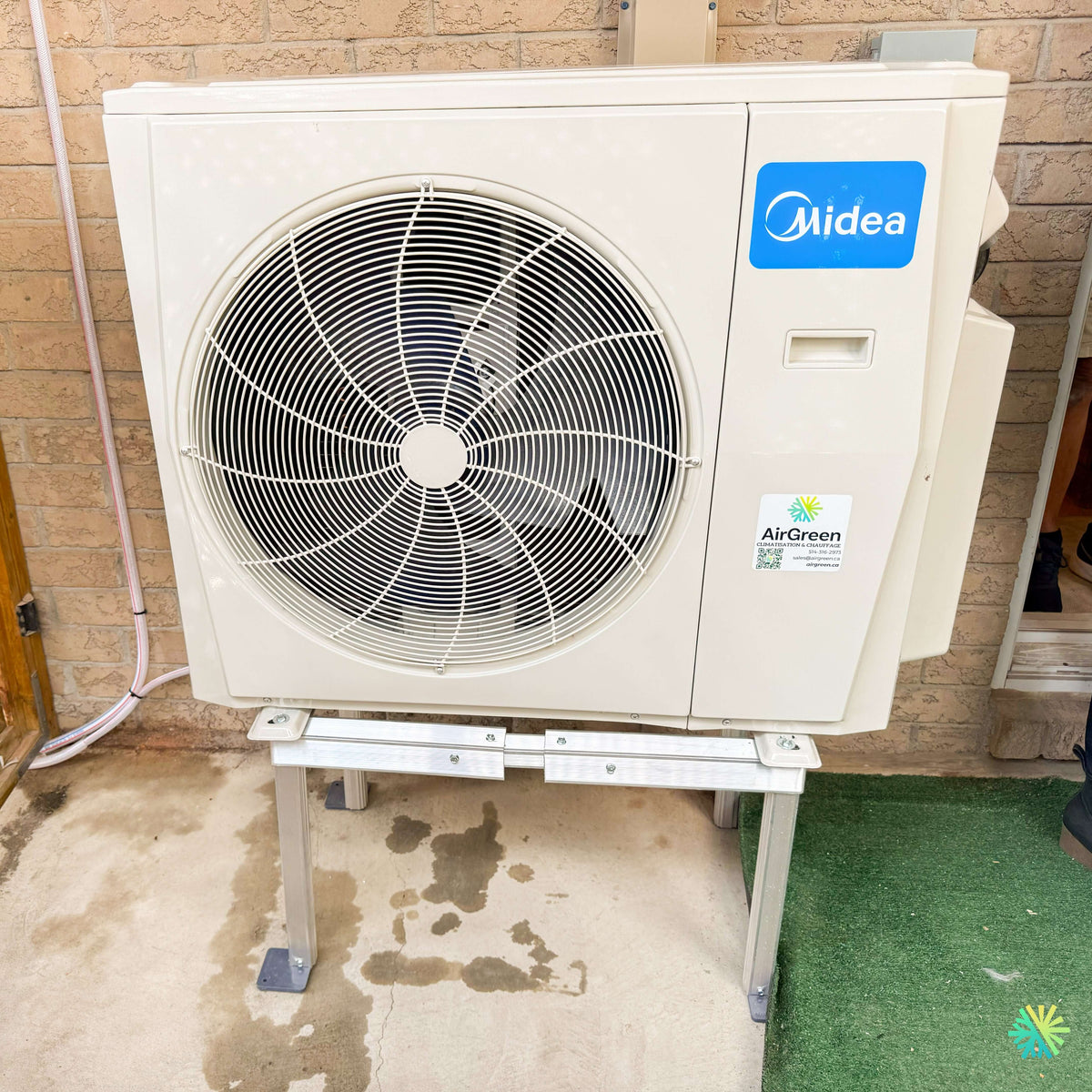
On this installation completed in Saint-Jean-sur-Richelieu, the detail that immediately catches our attention is not only the Midea outdoor unit: it is above all the way we integrated it into its surroundings. The MIDEA 28 three-zone heat pump is installed on a raised metal support, in front of a brick wall, in an outdoor space where every inch counts between the walkway, the neighboring door, and the concrete surface.
The project photograph shows a clean and easily accessible installation. The outdoor unit rests on a four-legged metal structure, with two crossbars that firmly support the condenser. It is therefore not placed directly on the concrete. The refrigerant lines enter from the left side of the installation, while the multi-zone unit's connection section remains accessible on the right side. The AirGreen sticker visible on the casing marks the completion of a project in which the system choice and its outdoor placement were treated as a whole.
This project particularly illustrates a reality of anHVAC installation on the South Shore : a high-performance heat pump must also be installed in a location that takes snow, drainage, maintenance, clearance around the equipment, and the property's actual architecture into account.
Why a three-zone heat pump was relevant in Saint-Jean-sur-Richelieu
A multi-zone heat pump makes it possible to connect multiple indoor units to a single outdoor unit. Midea describes this principle precisely in its documentation: one outdoor unit can power multiple indoor units, each of which can be controlled and adjusted according to the desired temperature in the room concerned.
For a three-zone project, this architecture therefore makes it possible to condition three distinct spaces without installing three separate outdoor condensers.
This becomes particularly interesting in a home where needs differ between, for example:
- a living room highly exposed to sunlight;
- a bedroom used primarily at night;
- a floor, an office, or another room whose heating and cooling load varies throughout the day.
The homeowner can therefore manage comfort by zone instead of trying to circulate air from a single wall-mounted unit through several closed rooms.
Midea also emphasizes that individual control makes it possible to heat or cool only the spaces in use, rather than systematically treating the entire home the same way.
A single outdoor unit for three zones: an advantage particularly visible in this photo
The outdoor location shown here immediately illustrates one of the benefits of a triple-zone configuration.
There is a door immediately nearby, a concrete walkway, and a strip of exterior paving at ground level. Installing several separate condensers in this area would quickly have occupied much more space.
With the MIDEA 28 triple-zone, we can combine the heating and cooling needs of several indoor zones around a single condenser.
The manufacturer also presents the reduction in occupied outdoor space as one of the direct advantages of its multi-zone system: several indoor units can share a single outdoor unit, reducing both the space required and the number of units producing noise outside.
In the projects we carry out in Saint-Jean-sur-Richelieu, Longueuil, Montreal, Laval, on the South Shore and the North Shore, this aspect often becomes decisive when properties have a narrow side space, a landscaped yard, or an access route that absolutely must be preserved.
Why we elevated the outdoor unit
The photograph clearly shows that the Midea condenser does not rest directly on the slab.
We used an elevated metal support which keeps the unit well above ground level. In Quebec’s climate, this decision is far from being purely aesthetic.
A heat pump also operates during the winter. Its outdoor unit must therefore continue exchanging air even when it snows and when ice or water may accumulate near the building.
An elevated installation helps in particular to:
- keep the unit above some of the accumulated snow;
- leave more space beneath the condenser;
- facilitate the drainage of water produced during defrost cycles;
- reduce direct contact between the unit’s base and a damp outdoor surface;
- maintain better accessibility for certain service HVAC service and maintenance.
The photo clearly shows that the entire lower portion of the heat pump remains unobstructed. The support rests on several feet distributed across the concrete and positions the condenser at a practical height rather than leaving it at ground level.
Water beneath a heat pump in heating mode does not necessarily indicate a problem
One visible detail in the photograph also deserves an explanation: water marks appear on the concrete beneath the support.
When a heat pump operates in heating mode during cold weatherFrost may form on the outdoor coil. The system then periodically runs a defrost cycle. The water produced by this defrosting must be able to drain freely beneath the unit.
This is one of the reasons why we place so much importance on the condenser’s height and the area directly beneath it.
Installing a heat pump too close to the ground can become problematic when snow, ice, and successive defrost cycles progressively reduce the available space beneath the unit.
The support visible in this project in Saint-Jean-sur-Richelieu instead allows an open area to be maintained beneath the unit.
MIDEA 28: a multi-zone platform designed to modulate its capacity
The principle of a multi-zone system is not simply to run three indoor units simultaneously at full power.
Inverter technology allows the heat pump to vary the operation of the compressor and motors according to demand. Midea specifies that when all rooms do not require full capacity or when the room temperature changes, the system can operate at partial load and reduce energy consumption.
For us, this is a particularly important characteristic when sizing a three-zone heat pump.
The three served spaces do not necessarily require their maximum capacity at the same time. A bedroom may be lightly used during the day while a main room receives more sunlight. In the evening, the demand profile may change completely.
That is why selecting a multi-zone system should never be limited to mechanically adding up the BTUs listed on the indoor units.
What Midea's tables indicate for a three-zone configuration
The product line's technical documentation presents several possible combinations.
For the Extreme Heat system, Midea identifies, among others, a configuration three zones using the outdoor unit MO3HX-H18B-2A with three 6,000 BTU All Easy Pro units. This combination has the AHRI reference 215471457.
For this reference configuration, the specification sheet indicates:
- power supply: 208/230 V, single-phase, 60 Hz;
- indicated nominal capacity: 19,000 BTU/h in cooling and 20,000 BTU/h in heating;
- SEER2 of 25;
- EER2 of 15;
- heating seasonal performance rating indicated at 10,4;
- published maximum outdoor airflow of 2,131 CFM;
- outdoor sound level indicated at 62 dB(A).
These data correspond to the reference combination specified by Midea. For a real-world project, we always verify the exact indoor and outdoor unit numbers rather than assuming that a product name alone is sufficient to determine certified performance.
One essential point: head capacity and condenser capacity are not the same thing
Midea documentation contains a particularly important note for any homeowner comparing multi-zone systems.
The manufacturer states that if the total nominal capacity of the indoor units exceeds that of the outdoor unit, the capacity actually available to each one may be reduced, particularly in heating mode.
That is exactly why a good multi-zone heat pump installation begins with an analysis of each room’s needs.
Installing a larger head in each zone does not automatically improve comfort.
Oversizing can instead lead to an unbalanced installation in which the indoor capacities were selected without taking into account:
- actual load of each room;
- available condenser capacity;
- manufacturer-approved combinations;
- sun exposure;
- windows and doors;
- insulation;
- air volume;
- actual room usage.
At AirGreen, we consider the three zones to be a single, coherent HVAC system.
Multi-zone connections: greater precision behind a visually simple result
A triple-zone outdoor unit has several circuits intended for the indoor units.
In the photograph, the connection area is located on the side of the condenser. Once the installation is complete, the overall setup appears relatively simple. However, a multi-zone system requires particularly methodical organization of the refrigerant lines and wiring.
Each head must be correctly paired with the corresponding circuit.
Midea has integrated a technology called into its platform SynchroConnectAccording to the documentation, the system can diagnose the status of the connections and synchronize the refrigerant and electrical lines in certain situations, which facilitates the connection and commissioning process.
For our technicians, this feature provides additional assistance, but it never replaces basic best practices: identifying the circuits, making the connections correctly, carrying out leak-tightness checks, and properly evacuating the system before startup.
This Saint-Jean-sur-Richelieu project shows why the outdoor location matters just as much as the BTUs
The heat pump must remain accessible after the installer leaves
A common mistake is to look only for the most discreet place to hide the condenser.
Yet a heat pump must be able to be inspected and maintained throughout its service life.
In this installation, the service side remains accessible, and the outdoor unit is not enclosed in a decorative structure. The fan face is also completely unobstructed.
This is important: the large fan visible in the photo must be able to move air freely through the heat exchanger.
Placing an object, fence, or structure too close to the air outlet can disrupt the unit’s operation. Aesthetic integration must therefore always remain compatible with technical requirements.
A brick wall also requires a clean installation of the lines
The outdoor unit is located directly in front of a brick facade.
On the left side of the photo, you can see the path of the lines descending toward the heat pump. When working on a masonry facade, we aim to maintain an orderly route while avoiding unnecessary passages.
The goal is not merely to obtain a clean final photo. Refrigerant lines must be mechanically protected and installed so they can accommodate building movement without creating weak points.
A poorly executed installation may have hanging lines, excessively exposed sections, or improperly positioned penetrations.
In this project, the piping is grouped along the side of the unit, leaving the condenser’s front completely clear.
An indoor range much more flexible than a simple wall-mounted head
Even when a project is presented as a three-zone heat pump, the three indoor units do not necessarily have to be identical.
The Midea brochure shows a range that includes wall-mounted units, consoles, cassettes, ducted units, and air-handling units. The manufacturer describes a residential range comprising several formats intended for different space configurations.
This flexibility is very useful when a home has, for example, two bedrooms compatible with wall-mounted units but a third zone where the architecture requires a different solution.
This is also what distinguishes a true multi-zone HVAC design Multi-zone HVAC of simply repeating three identical units.
Grants: the AHRI number must be verified before announcing an amount
Homeowners in Saint-Jean-sur-Richelieu and the South Shore frequently look for a heat pump while taking into account the financial assistance programs available in Quebec.
With a multi-zone system, particular care is required.
Eligibility must not be determined solely from the Midea logo or the name MIDEA 28. The exact equipment combination and its reference AHRI must be verified.
The Midea brochure indicates, for example, the reference 215471457 for its Extreme Heat three-zone All Easy Pro 6K × 3 combination.
However, the amount of financial assistance applicable to this specific installation is not indicated in the brochure provided. We must therefore verify the combination actually installed and the current program criteria before confirming eligibility or an amount to the homeowner.
This is a step we recommend before signing a project, not after installation.
Mistakes to avoid when installing a three-zone system
After numerous projects heat pumps in Montreal, Laval, Longueuil, the North Shore, and the South Shore, certain mistakes come up regularly when we examine existing installations or proposed projects.
Installing the condenser directly in a snow accumulation area
A location that is acceptable in July can become problematic in January. The outdoor installation must be designed for Quebec's winter conditions.
Selecting three indoor units based only on floor area
Floor area is important, but it is not enough. A heavily glazed room, a second floor, or a south-facing zone may have completely different needs from a bedroom of the same size.
Ignoring Midea combination tables
The models and capacities must be compatible with the outdoor unit. Midea documentation includes detailed combination tables specifically for its multi-zone systems.
Confusing installed BTUs with BTUs available simultaneously
A multi-zone heat pump redistributes its capacity according to demand. The sum of the rated capacities of the indoor units does not necessarily correspond to the same simultaneous capacity supplied by the outdoor unit.
Placing the outdoor unit without considering future servicing
The valves, panels, and connections must remain accessible. In the photo of our installation in Saint-Jean-sur-Richelieu, the technical side of the unit remains clear despite the relatively compact space.
An outdoor installation designed to last in Quebec
The final result of this project seems simple: a Midea condenser neatly installed in front of a brick wall.
But the photograph summarizes several important decisions.
We have a raised outdoor unit, an unobstructed ventilation face, a sturdy independent support, grouped connections, and maintained service clearance around the machine. The condenser serves a triple-zone, making it possible to obtain several comfort zones without multiplying the outdoor units.
This is precisely the approach we favor at AirGreen.
We are not only looking to make a heat pump work on the day of installation. We seek to anticipate what will happen when the snow arrives, when the system performs its defrost cycles, when a technician needs to access the connections, and when the owner uses the different zones every day.
For a MIDEA 28 triple-zone heat pump in Saint-Jean-sur-Richelieu, the system choice, the indoor unit configuration, and the installation of the outdoor condenser must all be part of the same consideration.
This project shows that a detail as concrete as the height of the outdoor support can be just as important in the long term as an efficiency rating listed in a technical brochure.
The big day, step by step
The main steps of this kind of job at AirGreen. Every house has its quirks: the estimate brings them out.
We look at the room, the outside wall, the line route and where the outdoor unit will go. That is where the capacity gets chosen.
Model, capacity and price, in writing. We also check whether the model qualifies for assistance programs.
Floors and furniture protected, wall plate position marked level, wall opening located.
A single opening, with the slope the drain needs to flow outside.
Set on a stand raised above the snow, with the clearances the manufacturer requires.
Connected, insulated and protected. The opening is then sealed against water, cold air and insects.
A dedicated circuit and an accessible disconnect near the outdoor unit.
Leak test, vacuum, then start-up and a check of heating and cooling.
Remote, modes, filters: we show you the essentials before we leave.
- The on-site estimateWe look at the room, the outside wall, the line route and where the outdoor unit will go. That is where the capacity gets chosen.
- The quoteModel, capacity and price, in writing. We also check whether the model qualifies for assistance programs.
- Getting readyFloors and furniture protected, wall plate position marked level, wall opening located.
- The wall openingA single opening, with the slope the drain needs to flow outside.
- The outdoor unitSet on a stand raised above the snow, with the clearances the manufacturer requires.
- Lines, cable and drainConnected, insulated and protected. The opening is then sealed against water, cold air and insects.
- The electrical workA dedicated circuit and an accessible disconnect near the outdoor unit.
- Tests and start-upLeak test, vacuum, then start-up and a check of heating and cooling.
- The walkthroughRemote, modes, filters: we show you the essentials before we leave.
What would it look like at your place?
Two quick checks with real numbers: what heat costs, and what your current heaters add up to in BTU/h.
Conversion: 1 W = 3.412 BTU/h. An indication, not a load calculation: baseboards and furnaces are often stronger than the real need, and they can stay as backup. AirGreen confirms the capacity on site.
Four mistakes we do not make
Flip each card to see what we do instead.
Your own project, step by step
What to do, season by season
Three habits per season for this unit. They take a few minutes and prevent many calls.
- Clean the indoor unit's filters.
- Clear leaves and debris left on the outdoor unit by winter.
- Test cooling before the first hot days.
- Clean the filters more often when the unit runs a lot.
- Keep plants away from the outdoor unit.
- Check that no water drips from the indoor unit.
- Rake the leaves around the outdoor unit.
- Test heating before the first cold days.
- Book periodic maintenance before winter.
- Keep snow away from the stand and the front of the unit.
- Let the unit defrost: it is normal.
- Never hit the ice on the fins; call us if the unit stays iced up.
Is your home ready?
Check what applies at your place. A "no" is not a refusal: it is what we sort out during the estimate.
Four statements: true or false?
It all comes down to details you have just seen.
1. In heating mode, the outdoor unit can produce water.
During defrost cycles. That water must drain away without forming ice.
2. You pick the capacity with a simple square-footage rule.
Windows, insulation, orientation and how the room is used all count. Capacity is chosen on site.
3. A multi-zone connects several indoor heads to a single condenser.
One head per room, all on the same condenser. Each room keeps its own temperature.
4. The disconnect can sit behind the patio furniture.
It must stay accessible: it is what shuts the unit off for service.
0 / 4 right answers
What people ask us about this kind of work
Does a wall-mounted heat pump heat in winter?
Wall-mounted or multi-zone: how do I choose?
Where does the outdoor unit go?
Are there grants?
Do I need a permit?
How cold can it heat?
How much can I save?
How is the LogisVert assistance calculated?
Is it noisy?
The outdoor unit is covered in ice: is that normal?
Does AirGreen hold the required licences?
Is the estimate free?
No question matches. Write to us: we answer.
More jobs to see, near you
By town, by equipment or by region: browse more than 4,700 published projects.
Each dot: a town where AirGreen has published projects. The glowing dot: this job.
Every house has its constraints. We see them before we install.
The on-site estimate is free and the quote follows within 24 hours.
Text and photo: a real AirGreen Climatisation & Chauffage job. The diagrams are generic illustrations of the type of installation, not a survey of this job site. Sources of the added figures: airgreen.ca product pages (NEEP / AHRI performance), Hydro-Québec (Heat pumps page, LogisVert, read on 13 October 2026), Régie de l’énergie (rate D as of 1 April 2026).