
Installation of a Fujitsu AIRSTAGE Altair 500 R-32 wall-mounted heat pump in Contrecœur on the South Shore
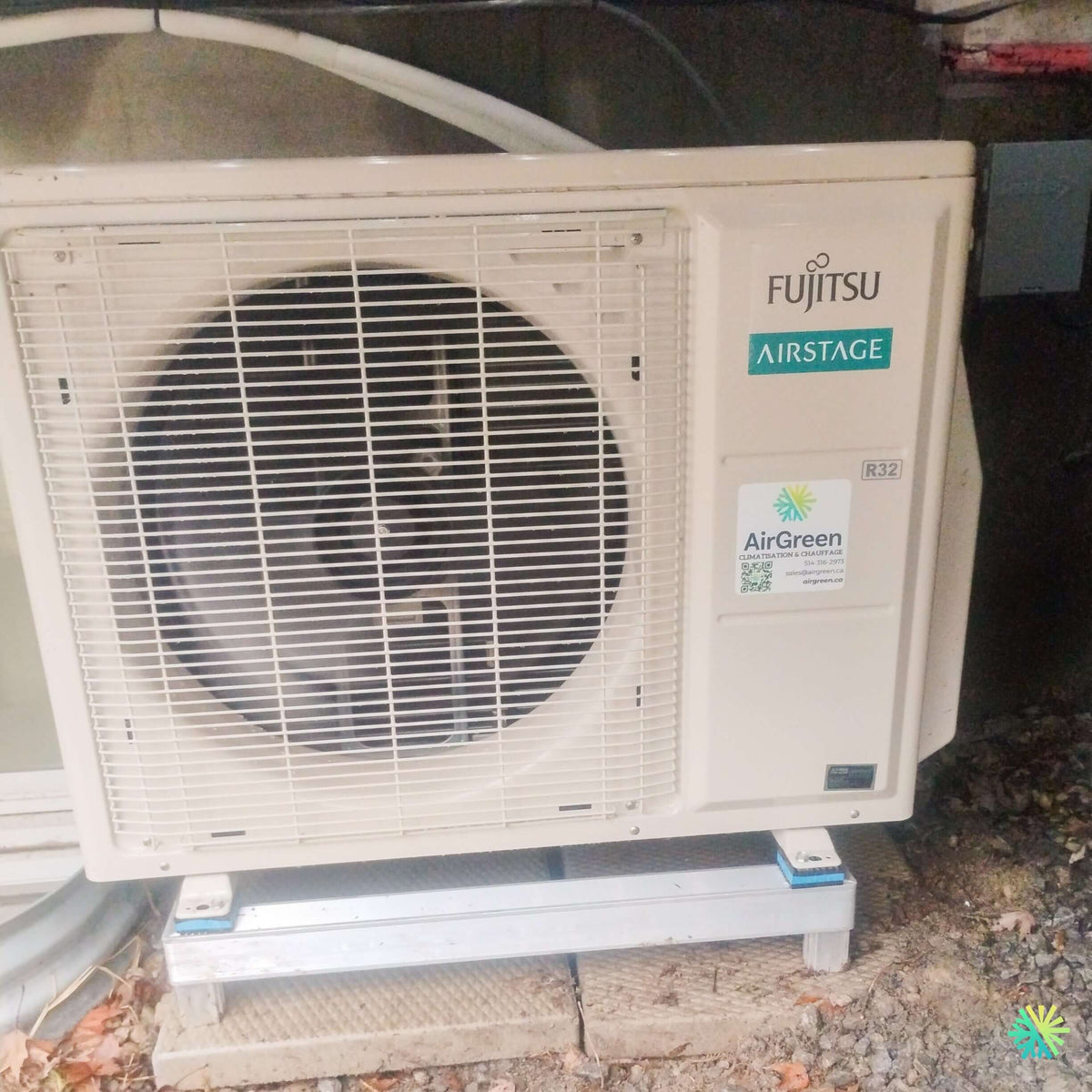
In Contrecœur, AirGreen installs a Fujitsu AIRSTAGE Altair 500 R-32 on a stable, elevated outdoor stand—a terrain-adapted solution that promotes drainage, airflow, and accessibility to the heat pump.
- City
- Region
- Equipment
- Brand
- Challenges
- Published
The job on one screen
The article, chapter by chapter
In Contrecœur, an outdoor installation designed to keep the heat pump stable, unobstructed, and accessible despite a low-lying space
In this installation carried out in Contrecœur, the site photo illustrates an aspect of the work that homeowners see less often when shopping for a heat pump: the care given to the outdoor unit, its support, and its immediate surroundings.
We installed a Fujitsu AIRSTAGE Altair 500 wall-mounted heat pump, a single-zone system using R-32 refrigerant. In the photo, the outdoor unit is installed on an independent metal support, positioned above a solid base in the immediate vicinity of the building. Isolation components are visible beneath the unit’s feet, while the front fan remains completely unobstructed.
This configuration was particularly appropriate here. The ground around the unit is uneven, with soil, stones, and visible plant debris. Placing the outdoor unit directly in this environment would have been a much less suitable long-term approach. We therefore opted for a structured installation in which the heat pump remains stabilized, elevated, and accessible.
The Fujitsu AIRSTAGE logo, the R32 designation, and our AirGreen identification are clearly visible on the outdoor housing. The Altair 500 series is available in several capacities and combines Inverter technology, heating, cooling, and multiple efficiency levels depending on the selected combination. Fujitsu documentation lists the 09KPAS1, 12KPAS1, 18KPAS1, 24KPAS1, 30KPAS1, and 36KPAS1 models.
Why the outdoor support is an essential part of this Contrecœur installation
The compressor is one of the heaviest and most heavily used components of a wall-mounted heat pump. When operating, it naturally produces slight vibrations. It must also withstand years of heating, cooling, and defrosting cycles.
That is why we never consider its support a mere accessory.
In our installation in Contrecœur, the outdoor unit is mounted on a horizontal metal structure resting on feet. The photo also shows small components placed beneath the heat pump’s mounting points. Their purpose is to create a clean interface between the unit’s feet and the support while helping limit the direct transmission of vibrations.
A proper base should, among other things, allow you to:
- to keep the machine stable and level;
- to reduce movement caused by vibrations;
- to prevent direct contact with soft or uneven ground;
- to maintain space beneath the appliance;
- to facilitate water drainage;
- to keep the unit more accessible for future service;
- to keep the fan and heat exchanger away from immediate accumulations of soil and debris.
On a job like this, this preparation work is not spectacular, but it directly contributes to the quality of the HVAC installation.
Ground conditions that require a different approach than a simple ground-level slab
The photo shows a reality we often encounter in Contrecœur, Longueuil, and several areas of the South Shore: the space available around homes is not always perfectly level.
To the right of the outdoor unit, the ground consists of soil and small stones. To the left, the foundation and building components limit the available space. We therefore need to install the heat pump in a way that prevents local ground settlement or accumulated debris from compromising the equipment’s base.
In this project, the metal support creates a separate structure between the heat pump and the surrounding ground. The outdoor unit therefore does not rely solely on the natural surface directly beneath it.
This point becomes even more important during the transitional seasons. In Quebec, the ground can be wet, frozen, snow-covered, and then waterlogged within a few weeks. An improperly supported outdoor unit can eventually become unlevel or develop mechanical stresses that could have been avoided during installation.
Air circulation in front of the fan: a priority clearly visible in the photo
Another important aspect of this installation is the open space in front of the outdoor unit’s large fan.
A heat pump operates by exchanging heat with the outdoor air. In cooling mode, it rejects the heat removed from the home outdoors. In heating mode, it captures thermal energy from the outdoor air and transfers it indoors.
In both cases, air must be able to circulate.
That is why we avoid positioning the front of the unit directly facing a nearby obstacle, a buildup of materials, or dense vegetation.
The Contrecœur photo shows that the front of the Fujitsu unit remains completely open, allowing the fan to operate without immediate obstruction.
This is an important detail because reducing airflow around an outdoor unit can affect its heat-exchange capacity and unnecessarily increase operating stress.
Fujitsu Altair 500: six sizes in one family
The Fujitsu AIRSTAGE Altair 500 series covers a range of residential needs.
According to the manufacturer's specifications, the nominal cooling capacities are:
- 9,000 BTU/h for the 09KPAS1;
- 12,000 BTU/h for the 12KPAS1;
- 18,000 BTU/h for the 18KPAS1;
- 22,000 BTU/h for the 24KPAS1;
- 30,000 BTU/h for the 30KPAS1;
- 33,000 BTU/h for the 36KPAS1.
In heating, the stated nominal capacities are respectively 10,000, 14,000, 18,000, 24,000, 30,000, and 34,000 BTU/h.
The exact capacity of the system installed in this photo in Contrecœur is not legible on the label. We therefore prefer not to arbitrarily assign a BTU rating to the unit based on its external dimensions.
This is also the method we use when preparing a project for a client.
We determine requirements based on the building: floor area, insulation, orientation, windows, number of floors, movement between rooms, how the area is used, and the heating strategy.
A modulation range that matters just as much as nominal capacity
The capacity listed on a heat pump does not explain all of its actual operation.
Inverter technology allows the system to adjust its performance to demand. The Fujitsu specifications also show relatively wide minimum-to-maximum ranges.
For example, the 12KPAS1 can modulate in cooling from approximately 3,100 to 13,600 BTU/h, while its stated heating range extends from 2,700 to 17,000 BTU/h. The 18KPAS1, meanwhile, reaches up to 20,000 BTU/h in cooling and 24,000 BTU/h in heating within its modulation range.
This ability to adjust operation helps prevent a unit from constantly operating in a start-stop cycle.
In a properly sized home, this promotes a more consistent temperature and generally quieter operation.
Different energy efficiency depending on the Altair 500 model
The Fujitsu specifications assign the Altair 500 series SEER2 values ranging from 21.0 to 26.0 BTU/hW, depending on capacity.
For example:
- 09KPAS1 : SEER2 of 26.0;
- 12KPAS1 : 24,0;
- 18KPAS1 : 22,0;
- 24KPAS1 : 21,5;
- 30KPAS1 : 22,0;
- 36KPAS1 : 21,0.
These differences explain why we always verify the exact system configuration before presenting performance figures to a homeowner.
Buying “a Fujitsu Altair 500” does not automatically mean achieving the same performance with every capacity.
Heating down to -15 °C: understanding the system’s exact purpose
The Altair 500 series is rated for a heating operating range down to -15 °C. Fujitsu indicates a range of -15 °C to 24 °C for the various models in the family.
This information should be taken seriously when selecting equipment in Contrecœur or elsewhere on the South Shore.
Not all Fujitsu heat pumps have exactly the same purpose. Some of the brand’s platforms are intended for use at even lower winter temperatures.
The Altair 500 must therefore be selected according to its intended role: summer cooling, heating for a large part of the cold season, reducing the use of another system, or combining multiple heating sources.
At AirGreen, we prefer to explain this distinction clearly rather than present all wall-mounted heat pumps as if they were interchangeable.
A compact outdoor unit that remains relatively discreet
The photo of our installation also shows why the format of an outdoor unit can be important.
The Fujitsu unit fits into a relatively limited space between the building and the adjacent landscaped area. The casing remains compact, and the front fan occupies most of the facade, allowing the available space to be used efficiently.
Depending on the model, Altair 500 outdoor units have different dimensions. The smaller capacities use groups that are significantly more compact than the 30,000 and 36,000 BTU models. Fujitsu also lists weights ranging from approximately 51 lb to 117 lb for the outdoor units, depending on capacity.
The support must obviously be selected and installed according to the machine’s actual weight.
Behind this Fujitsu R-32 in Contrecœur: piping, defrosting, electrical work, and maintenance
R-32 is clearly identified on the outdoor unit casing
The inscription R32 appears directly on the photographed unit.
This generation of Fujitsu systems therefore uses a refrigerant different from the R-410A commonly found in many earlier installations.
In its documentation, Fujitsu gives the R-32 a global warming potential of 675, compared with 2,088 for R-410A, corresponding to a claimed reduction of 68%. The manufacturer also points out that R-32 systems can use less refrigerant while maintaining the desired performance.
For the customer, this change does not affect everyday ease of use. For the installer, however, it means working with the equipment, methods, and precautions appropriate for the system in question.
Defrosting explains why we want to keep space beneath the unit
When the heat pump operates in cold, damp weather, frost may form on the outdoor heat exchanger.
The system then periodically runs a defrost cycle.
During this process, water is produced around and beneath the outdoor unit. This is one of the main reasons why the Contrecœur photo is useful: it clearly shows open space beneath the unit thanks to the support.
Poor management of this water can eventually create ice buildup on the ground. That is why we consider drainage when selecting the location.
The presence of soil and uneven materials around this unit further emphasized the value of a raised, structured installation.
Pipe diameters vary according to capacity
For a heat pump replacement, this detail is decisive.
The pipe diameters recommended by Fujitsu for the Altair 500 are:
- 09KPAS1 and 12KPAS1: 1/4 in. liquid and 3/8 in. gas;
- 18KPAS1 and 24KPAS1: 1/4 in. liquid and 1/2 in. gas;
- 30KPAS1 and 36KPAS1: 3/8 in. liquid and 5/8 in. gas.
We therefore cannot assume that an existing refrigerant line will be suitable simply because it was used with an older wall-mounted heat pump.
Before reusing them, we must check the dimensions, condition, configuration, and compatibility with the selected model.
Line runs of up to 66, 98, or 164 feet
The range offers some flexibility when the outdoor unit needs to be located away from the indoor unit.
According to the technical specifications:
- 09 and 12 models: up to 20 m / 66 ft;
- 18 and 24 models: up to 30 m / 98 ft;
- 30 and 36 models: up to 50 m / 164 ft.
This option is particularly useful when the property’s architecture requires a specific outdoor location.
We regularly encounter this type of situation in Montréal, Laval, Longueuil, on the North Shore and South Shore: a patio, low window, pedestrian passage, nearby neighbors, garage access, or yard layout.
However, the ideal approach remains the one that combines technical efficiency, line protection, and a clean finish.
A power supply that varies by model
All Altair 500 models mentioned in the specifications use a 208–230 V, 60 Hz, single-phase power supply, but the electrical protection varies.
Fujitsu states:
- 15 A for the 09, 12, and 18 models;
- 20 A for the 24 model;
- 30 A for the 30 and 36 models.
We therefore verify the exact unit before determining the required circuit.
Automatically keeping an old circuit breaker or old cable because a heat pump was already installed in the same location can result in an installation that is incompatible with the new equipment’s specifications.
Up to 19 dB(A) indoors on certain capacities
The outdoor unit draws attention in the photo, but everyday comfort obviously also depends on the indoor unit.
Fujitsu indicates that the 09KPAS1 and 12KPAS1 indoor units can reach 19 dB(A) in cooling mode with quiet operation. Larger units have higher minimum values, proportional to their airflow.
This difference is another reason not to unnecessarily oversize a heat pump.
A unit must provide sufficient capacity for the area it serves without moving more air than necessary during much of its operation.
ProCore coils and Hydro Fin fins
The Altair 500 documentation also indicates the use of ProCore copper coils in the indoor unit, as well as Hydro Fin fins designed to improve corrosion resistance. Fujitsu also mentions washable filters and a backlit wireless remote control supplied with the unit.
These features contribute to the system’s overall design, but they do not eliminate the need for maintenance.
Over the seasons, we recommend monitoring:
- the cleanliness of the filters;
- the indoor heat exchanger;
- the fan;
- the condensate drain;
- the outdoor heat exchanger;
- leaves and debris around the compressor;
- the condition of the mounting surface and fastening points.
The Contrecœur photo also makes it immediately clear why outdoor maintenance is important: leaves and natural materials can gradually accumulate around a unit located near the ground.
What to avoid around an outdoor unit like this
A successful installation can lose some of its benefits if the area around the unit is not properly maintained afterward.
We especially recommend avoiding:
- stacking objects in front of the fan;
- to allow leaves to accumulate against the heat exchanger;
- to create a compact snowbank against the unit;
- to move or modify the support without verification;
- to allow vegetation to grow directly around the unit;
- to block access to the service panels;
- to direct continuous water runoff toward the unit;
A few minutes of periodic inspection can often help maintain a much more favorable environment around the heat pump.
ENERGY STAR and potential financial assistance: the exact model is essential
The Altair 500 technical data sheet lists different ENERGY STAR ratings depending on capacity and also identifies cold-climate ratings for certain references.
To determine eligibility for financial assistance or a rebate, however, we must verify the exact combination of indoor and outdoor models, as well as the conditions of the program applicable at the time of the project.
The trade name “Altair 500” alone is not enough to confirm an amount.
This model-by-model verification helps avoid expectations based on information that may not apply to the complete system actually installed.
An AirGreen installation that first addresses the site's actual constraints
This project in Contrecoeur neatly summarizes our approach.
The homeowner needed a wall-mounted heating and air conditioning solution, but our work did not end with choosing the Fujitsu system.
We also had to create the conditions needed for the equipment to operate properly in this precise location: uneven ground, a unit installed close to the building, the need to keep the façade clear, and the importance of maintaining space beneath the unit.
The metal support visible in the photo, the insulation pads beneath the feet, and the positioning of the outdoor unit show an installation designed around the site's actual environment.
At AirGreen, we carry out Fujitsu heat pump installations in Contrecoeur, Varennes, Verchères, Boucherville, Longueuil, and throughout the South Shore, as well as in Montreal, Laval, and on the North Shore.
A heat pump can have excellent technical specifications. To truly benefit from them, it must also be properly sized, connected, supported, and commissioned.
This Fujitsu AIRSTAGE Altair 500 R-32 in Contrecoeur provides a concrete example: a recent system installed on a base adapted to the terrain and positioned to preserve its operation and accessibility for years to come.
The job tools
Two quick checks with real numbers: what heat costs, and what your current heaters add up to in BTU/h.
Conversion: 1 W = 3.412 BTU/h. An indication, not a load calculation: baseboards and furnaces are often stronger than the real need, and they can stay as backup. AirGreen confirms the capacity on site.
How the job unfolds
The main steps of this kind of job at AirGreen. Every house has its quirks: the estimate brings them out.
We look at the room, the outside wall, the line route and where the outdoor unit will go. That is where the capacity gets chosen.
Model, capacity and price, in writing. We also check whether the model qualifies for assistance programs.
Floors and furniture protected, wall plate position marked level, wall opening located.
A single opening, with the slope the drain needs to flow outside.
Set on a stand raised above the snow, with the clearances the manufacturer requires.
Connected, insulated and protected. The opening is then sealed against water, cold air and insects.
A dedicated circuit and an accessible disconnect near the outdoor unit.
Leak test, vacuum, then start-up and a check of heating and cooling.
Remote, modes, filters: we show you the essentials before we leave.
- The on-site estimateWe look at the room, the outside wall, the line route and where the outdoor unit will go. That is where the capacity gets chosen.
- The quoteModel, capacity and price, in writing. We also check whether the model qualifies for assistance programs.
- Getting readyFloors and furniture protected, wall plate position marked level, wall opening located.
- The wall openingA single opening, with the slope the drain needs to flow outside.
- The outdoor unitSet on a stand raised above the snow, with the clearances the manufacturer requires.
- Lines, cable and drainConnected, insulated and protected. The opening is then sealed against water, cold air and insects.
- The electrical workA dedicated circuit and an accessible disconnect near the outdoor unit.
- Tests and start-upLeak test, vacuum, then start-up and a check of heating and cooling.
- The walkthroughRemote, modes, filters: we show you the essentials before we leave.
What we check on a job like this one
Each number is a point we check on site. Switch between summer and winter to watch air and heat move.
In summer, the outdoor unit rejects the house's heat outside.
Generic illustration of this type of installation, not a survey of this job site. Tap a number.
Mounted level on a wall plate, high enough for the air to reach the whole room, with enough space around it to slide the filters out easily.
The refrigerant lines, the communication cable and the drain go through the wall in a single opening, sealed against water, cold air and insects.
Two insulated copper pipes connect the two units. Outside, a line cover can protect them from sun, knocks and weather.
A shut-off switch near the outdoor unit isolates it safely for service. It must stay accessible at all times.
The compressor and the fan. In heating mode it captures heat from the outdoor air, even in winter, and moves it inside.
On the ground or on the wall, it keeps the unit above accumulated snow. The unit stays clear and defrost water can drain away.
The fan needs to blow freely. Storage, a fence or a wall too close, and efficiency drops while noise goes up.
Is your home ready?
Check what applies at your place. A "no" is not a refusal: it is what we sort out during the estimate.
Good habits, once the unit is in place
Six simple habits that keep the unit going. Your list stays on this device.
What to do, season by season
Three habits per season for this unit. They take a few minutes and prevent many calls.
- Clean the indoor unit's filters.
- Clear leaves and debris left on the outdoor unit by winter.
- Test cooling before the first hot days.
- Clean the filters more often when the unit runs a lot.
- Keep plants away from the outdoor unit.
- Check that no water drips from the indoor unit.
- Rake the leaves around the outdoor unit.
- Test heating before the first cold days.
- Book periodic maintenance before winter.
- Keep snow away from the stand and the front of the unit.
- Let the unit defrost: it is normal.
- Never hit the ice on the fins; call us if the unit stays iced up.
The right pages, at the right time
Four statements: true or false?
It all comes down to details you have just seen.
1. In heating mode, the outdoor unit can produce water.
During defrost cycles. That water must drain away without forming ice.
2. You pick the capacity with a simple square-footage rule.
Windows, insulation, orientation and how the room is used all count. Capacity is chosen on site.
3. A multi-zone connects several indoor heads to a single condenser.
One head per room, all on the same condenser. Each room keeps its own temperature.
4. The disconnect can sit behind the patio furniture.
It must stay accessible: it is what shuts the unit off for service.
0 / 4 right answers
What people ask us about this kind of work
Does a wall-mounted heat pump heat in winter?
Wall-mounted or multi-zone: how do I choose?
Where does the outdoor unit go?
Are there grants?
Do I need a permit?
How cold can it heat?
How much can I save?
How is the LogisVert assistance calculated?
Is it noisy?
The outdoor unit is covered in ice: is that normal?
Does AirGreen hold the required licences?
Is the estimate free?
No question matches. Write to us: we answer.
More jobs to see, near you
By town, by equipment or by region: browse more than 4,700 published projects.
Each dot: a town where AirGreen has published projects. The glowing dot: this job.
An on-site estimate, the right capacity, the right equipment.
The on-site estimate is free and the quote follows within 24 hours.
Text and photo: a real AirGreen Climatisation & Chauffage job. The diagrams are generic illustrations of the type of installation, not a survey of this job site. Sources of the added figures: airgreen.ca product pages (NEEP / AHRI performance), Hydro-Québec (Heat pumps page, LogisVert, read on 13 October 2026), Régie de l’énergie (rate D as of 1 April 2026).