
Installation of a MIDEA MIDEA35 wall-mounted heat pump in Varennes on Montreal’s South Shore
In Varennes, AirGreen installs a MIDEA35 wall-mounted heat pump near the ceiling with precise integration, careful clearance, and an HVAC solution adapted to heating and cooling in Quebec’s climate.
Take a tour of the installation
Each number is a point we check on site. Switch between summer and winter to watch air and heat move.
In summer, the outdoor unit rejects the house's heat outside.
Generic illustration of this type of installation, not a survey of this job site. Tap a number.
Mounted level on a wall plate, high enough for the air to reach the whole room, with enough space around it to slide the filters out easily.
The refrigerant lines, the communication cable and the drain go through the wall in a single opening, sealed against water, cold air and insects.
Two insulated copper pipes connect the two units. Outside, a line cover can protect them from sun, knocks and weather.
A shut-off switch near the outdoor unit isolates it safely for service. It must stay accessible at all times.
The compressor and the fan. In heating mode it captures heat from the outdoor air, even in winter, and moves it inside.
On the ground or on the wall, it keeps the unit above accumulated snow. The unit stays clear and defrost water can drain away.
The fan needs to blow freely. Storage, a fence or a wall too close, and efficiency drops while noise goes up.
In Varennes, a high installation where a few centimetres mattered just as much as the heat pump’s performance
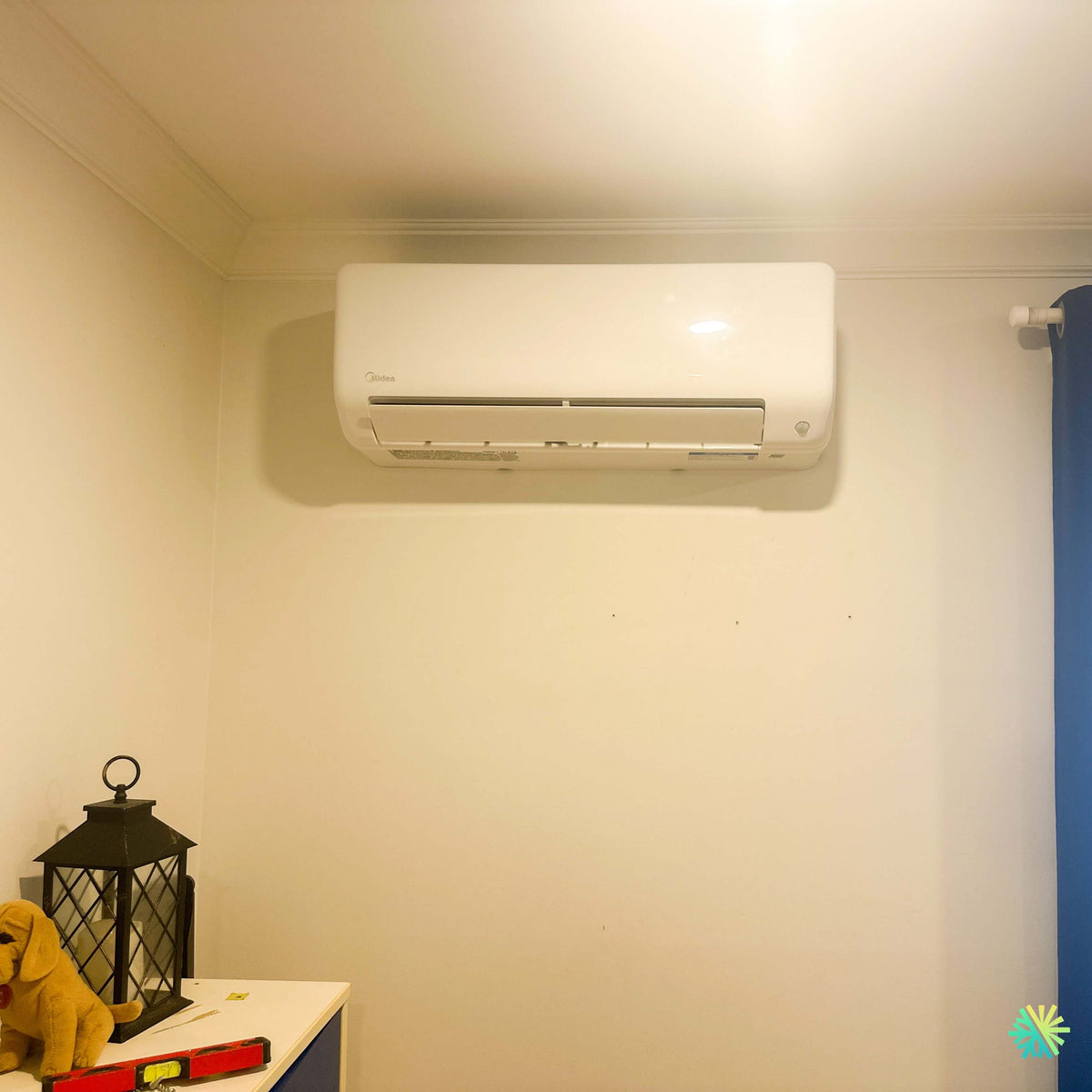
In this residence de Varennes, we installed a MIDEA35 wall-mounted heat pump in a room where the wall configuration required a particularly precise approach. The photograph taken at the end of the work clearly shows the situation: the indoor unit is positioned very high, close to the ceiling mouldings, on a free section of wall located right next to a window fitted with a dark curtain.
At first glance, such a streamlined installation may seem simple. However, when we need to position a wall-mounted heat pump in the upper section of a wall, several technical details immediately become important: the clearance required above the unit, future access to the filters, circulation of the intake air, complete opening of the lower flap, proximity to the mouldings, the route of the refrigerant lines, and condensate drainage.
In this Varennes installation, our objective was therefore twofold: make effective use of the available wall space while maintaining a visually discreet and technically coherent installation.
The white front of the MIDEA35 The white front of the unit blends particularly well into the light-coloured wall. No decorative conduit crosses the portion of the wall visible in the photo, and the high position leaves all the lower space available for arranging the room. The unit also does not interfere with the rod and curtain on the right.
This is the kind of detail that distinguishes an installation designed for the home from one where the first available spot is simply chosen.
Why did we choose such a high position on this wall?
A wall-mounted heat pump should normally be installed high enough to promote good air distribution, but it is not enough to place it as close to the ceiling as possible.
The unit must be able to properly draw air from the room through its upper section. We must also preserve the space needed to open the unit during HVAC maintenance, remove and clean the filters, access the heat exchanger, and, if necessary, carry out a more thorough cleaning.
In this Varennes room, several visible elements influenced our decision:
- the decorative mouldings at the junction of the wall and ceiling;
- the window and its curtain on the right;
- the space occupied by the furniture beneath the unit;
- the need to maintain a clear air projection toward the room;
- the importance of not unnecessarily cluttering the wall with the installation components.
We therefore positioned the head to achieve a clean integration while respecting the unit’s functional requirements.
A heat pump installed near the ceiling must always be able to breathe
This is a frequently underestimated point.
The air that will be heated or cooled must first enter the unit. On a wall-mounted heat pump, air intake occurs primarily in the upper section. An installation too close to the ceiling or trim can hinder airflow and considerably complicate maintenance.
In the photograph of our installation in Varennes, we can clearly see that the unit is close to the ceiling but remains below the trim line. This positioning maintains a harmonious visual finish without making the heat pump look attached to the ceiling.
We check this type of detail before permanently securing the wall plate. Moving a head a few centimetres after drilling the wall, installing the drain, and routing the lines is obviously much more complicated than determining its position correctly from the outset.
The curtain’s proximity: a detail that should not be overlooked
Another interesting aspect of this installation is the curtain located to the right of the heat pump.
Lightweight fabrics can move when they are directly in an airflow. They can also reduce the clearance around a unit when the installation is too close.
We therefore left a clear gap between the wall-mounted head and the curtain.
This choice keeps the side of the unit clear while preventing fabric from moving in front of an important airflow area.
In projects involving anHVAC installation in Montreal, Laval, Longueuil, on the North Shore, and on the South Shore, we systematically assess the immediate surroundings of the unit: curtains, cabinet doors, bookcases, televisions, upper cabinets, and other objects can all influence the best location.
Why the MIDEA35 is particularly well suited to this type of residential installation
The MIDEA35 belongs to MIDEA’s premium wall-mounted series. The range presented by the manufacturer includes configurations of 9,000, 12,000, and 18,000 BTU/h in cooling, with respective nominal heating capacities of 12,000, 12,000, and 20,000 BTU/h.
One particularly relevant feature for Quebec is its heating operating range: the three MIDEA35 configurations listed in the documentation are designed to operate down to -30 °C.
For a property in Varennes, where the heat pump will be called upon both during humid July days and throughout the cold periods of January and February, this is not a minor detail.
We are not looking only for an air conditioner for the summer. A wall-mounted heat pump for cold climates must be selected by considering its heating performance when the outdoor temperature drops sharply.
Three MIDEA35 capacities, three different efficiency profiles
The series makes it possible to adapt the selection to the building’s actual load.
MIDEA documentation provides the following data:
| MIDEA35 | Cooling capacity | Rated heating | SEER2 | HSPF2 IV | AHRI |
|---|---|---|---|---|---|
| MSESU-H09B-2A / MO1SS-H09B-2A | 9,000 BTU/h | 12,000 BTU/h | 33,3 | 22,0 | 215471386 |
| MSESU-H12B-2A / MO1SS-H12B-2A | 12,000 BTU/h | 12,000 BTU/h | 29,4 | 14,5 | 215471387 |
| MSESU-H18B-2A / MO1SS-H18B-2A | 18,000 BTU/h | 20,000 BTU/h | 25,6 | 16,2 | 215471388 |
These data show why we never reduce an entire product line to a single efficiency figure. Performance depends on the exact combination of the indoor and outdoor units.
The photograph of this installation does not allow us to read the nameplate or determine with certainty the installed BTU capacity. We therefore deliberately avoid assigning it a precise output without a visible model number.
This is an important practice in HVAC : we prefer verifiable technical information to an estimate based solely on the appearance of a unit.
Variable speed: why comfort is not just about reaching 22 °C
One of the major advantages of a modern heat pump such as the MIDEA35 is its ability to modulate its operation.
According to MIDEA, variable-speed technology allows the compressor to adapt its operation to changing temperature needs rather than operating only through repeated on-and-off cycles. This modulation helps reduce temperature fluctuations in the room.
In everyday life, this feature is important.
A properly sized heat pump does not necessarily need to operate constantly at full capacity. Once the room is close to the requested temperature, the system can reduce its output and maintain indoor conditions more steadily.
This is also one of the reasons why oversizing a wall-mounted heat pump is not a strategy we recommend simply “to make sure there are enough BTUs.”
Excessive capacity can alter operating cycles and reduce summer dehumidification quality. The choice should be based on the building, its heat loss, floor area, insulation, orientation, and room layout.
A quiet wall-mounted unit, an essential criterion in a small room
The photograph suggests a space where the indoor unit is relatively close to the occupied area. In this kind of setting, fan noise may be more significant than in a large open space.
Depending on the model, the MIDEA35 can achieve very low indoor sound levels. The 9,000 and 12,000 BTU/h versions are rated at 19 dB(A) in silent mode, while the 18,000 BTU/h version can go as low as 16 dB(A) according to the manufacturer's test conditions.
These figures do not mean that the heat pump will always produce this sound level: when a room needs to be cooled or heated quickly, the fan naturally increases its speed.
The value of a modulating unit is precisely its ability to spend much of its time operating at lower levels once indoor conditions have stabilized.
The small circular element visible on the right of the unit is not decorative
In the photo of this installation in Varennes, we can distinguish a characteristic round element from the series at the far right of the front panel.
The range MIDEA35 offers a smart sensor, as well as a humidity sensor and various comfort control functions. The MIDEA brochure indicates that the smart sensor can take room occupancy into account and that, when no presence is detected for an extended period, the unit can reduce its operating frequency to limit consumption.
This is a particularly interesting feature in rooms that are not used continuously.
Much more precise airflow adjustment than simply choosing “low, medium, or high”
MIDEA provides up to 100 air volume adjustment levels on this family of systems, allowing much finer fan modulation. The manufacturer also provides control through the SmartHome app and Wi-Fi, depending on the selected configuration.
In a high-mounted installation like the one in Varennes, airflow adjustment is particularly useful.
We want to be able to direct the air into the occupied zone without creating an unpleasant draft. The heat pump includes horizontal and vertical oscillation, as well as the Follow Me, silent mode, night mode, ECO mode, and 8°C heating.
The Follow Me function can change how the temperature is controlled
The temperature measured directly near a heat pump located high on a wall may differ from the temperature felt lower down in the room.
This is simply a consequence of the natural stratification of air, particularly when heating.
The feature “Follow Me” uses the temperature sensor built into the remote control to allow the system to adjust its operation according to the temperature measured where the remote is located.
When used properly, this feature can therefore be useful in a room where the unit is mounted very high.
Maintenance was considered from the outset when selecting the location
We attach great importance to a detail that homeowners may not notice until several months after installation: can the unit really be properly serviced?
The filters of a wall-mounted heat pump must remain accessible. After several years, more thorough cleaning of the evaporator, drain pan and blower wheel may also become necessary.
MIDEA has included a removable blower wheel, designed to facilitate thorough cleaning and access to the inside of the unit.
This is a practical advantage, but only if the installer has not placed the unit in a location that makes opening it nearly impossible.
In this Varennes project, the proximity of the trim was therefore taken into account from the outset to maintain a clean installation without overlooking future service work.
Behind this discreet installation: the HVAC checks that determine long-term reliability
Once the casing is closed, much of the installer's work becomes invisible.
Yet it is precisely behind the wall, in the connections, lines, drain and electrical circuit, that several of the most important elements for the lifespan of a MIDEA35 heat pump.
Pipe diameters vary according to capacity
We place particular emphasis on this point when replacing a unit.
The versions 9,000 and 12,000 BTU/h version of the MIDEA35 uses 1/4 in. and 3/8 in. lines, while the 18,000 BTU/h uses 3/8 in. and 5/8 in.. The documentation specifies a maximum length of 82 ft for the 9,000 and 12,000 BTU versions and up to 164 ft for the 18,000 BTU version.
It is therefore risky to order a heat pump assuming that the old lines can necessarily be reused.
We check:
- the diameter of both lines;
- their length;
- their physical condition;
- the height difference between the units;
- compatibility with the new refrigerant;
- the condition and quality of the connections;
- the condensate drain route.
This check is even more important when part of the circuit is concealed in a finished wall.
A MIDEA35 operates with R-454B
The series uses R-454B refrigerant, classified as A2L. MIDEA also indicates a leak-detection device associated with A2L systems in this range.
For the homeowner, the heat pump is normally operated using its remote control or smart controls.
For the team carrying out theHVAC installation, while the type of refrigerant affects several aspects of the work procedure. The tools, commissioning methods, and precautions must correspond to the installed equipment.
We therefore always make sure to precisely identify the indoor-outdoor combination before the work begins.
Electrical requirements also vary.
The 9,000 BTU and 12,000 BTU versions of the MIDEA35 have a specified minimum ampacity of 16 A with maximum protection of 20 A. For the 18,000 BTU model, the minimum ampacity is 24.9 A and the maximum protection is 25 A. The power supply specified for the series is 208/230 V single-phase, 60 Hz.
This illustrates why we never determine a circuit breaker solely according to the approximate BTU value or the previously installed unit.
The exact model takes precedence.
MIDEA35 and LogisVert: verify the exact combination before announcing a rebate
The question of theLogisVert financial incentive is particularly important for homeowners in Varennes and on the South Shore.
Hydro-Québec currently indicates an incentive of $120 per 1,000 BTU/h of heating capacity at -8 °C for an eligible certified heat pump ENERGY STAR – cold climatewhen all program conditions are met. The amount is determined according to the installation date.
For installations completed since November 26, 2025, Hydro-Québec specifies that units must be ENERGY STAR certified to be eligible, and that a cold-climate heat pump receives the prescribed rate of $120 per 1,000 BTU/h at -8 °C when it meets all the criteria.
For example, the MIDEA35 combination of 12,000 BTU, AHRI 215471387provides a heating capacity of 11,000 BTU/h at -8 °C and a listed incentive of 1 320 $. The combination of 18,000 BTU, AHRI 215471388provides 19,300 BTU/h at -8 °C and corresponds to 2 316 $ according to the data currently published.
However, we must make one essential clarification: The photo of this installation in Varennes does not make it possible to identify the unit’s exact capacity with certainty.We therefore cannot assign one of these precise amounts to this installation based solely on the image.
For each file, we verify the AHRI number and the applicable list. actual installation date, with Hydro-Québec itself indicating that the search must be performed using the exact equipment combination.
A successful finish is one that does not monopolize the wall
The final photograph of this project in Varennes clearly illustrates an idea that we regularly apply.
A wall-mounted heat pump is a technical unit that will remain visible every day for many years. It must therefore be positioned as a functional element of the home, rather than as an obstacle around which the room will later have to be arranged.
Here, we preserved almost all of the wall space available below the unit. The furniture remains usable, the window and its curtain remain independent of the unit, and the MIDEA35 fits naturally into the upper part of the room.
The white color of the unit and the wall also helps make the installation much more discreet.
The errors this type of project helps avoid
During an installation comparable to Varennes, Boucherville, Longueuil, or elsewhere on the South Shoreseveral errors can be avoided with proper planning:
- installing the indoor unit so high that opening its panel becomes difficult;
- partially blocking the upper intake with trim;
- placing the unit too close to a curtain;
- directing the airflow straight toward the area where occupants sit or lie down;
- selecting the BTU capacity based solely on floor area;
- reusing old piping without verifying the required diameters;
- neglecting the condensate drain slope;
- choosing the circuit breaker before verifying the exact model;
- announcing a LogisVert amount without confirming the AHRI number;
- forgetting that the unit will eventually need to be cleaned and serviced.
These details are not as spectacular as a SEER2 rating displayed in a brochure, but they directly determine the quality of an installation.
A unit designed for year-round heating, cooling, and comfort control
The MIDEA35 offers more than simply switching between heating and cooling modes.
Among the functions documented by MIDEA are, in particular, ECO mode, Turbo, sleep mode, fan control, timer, Follow Me, automatic cleaning, silent mode, 8°C heating, horizontal and vertical swing, and humidity control.
Heating to 8°C can be useful, for example, when a home remains unoccupied for a period during the winter. MIDEA indicates that this function maintains a minimum temperature to reduce the risk of freezing during an extended absence.
The remote control also allows you to select different fan speeds, the cooling, heating, dehumidification and fan modes, as well as the ECO/GEAR and BOOST functions.
The warranty is also part of comparing a heat pump
MIDEA’s Quebec brochure indicates, for the residential sector, a limited 12-year warranty on the compressor, 12 years on parts and 10 years on labor, subject, of course, to the terms and conditions applicable to the product and its registration.
When a homeowner compares several wall-mounted heat pumps, we recommend not looking only at the purchase price.
You should also compare:
- energy efficiency;
- low-temperature capacities;
- the modulation range;
- the sound level;
- maintenance options;
- the piping requirements;
- the applicable warranties;
- eligibility for financial assistance programs;
- the availability of after-sales service.
A heat pump installation in Varennes is an investment intended to last for several years. The system’s true value is therefore measured over its service life, not simply by the amount shown at the bottom of the estimate.
What this Varennes installation illustrates about the way we work at AirGreen
This installation intentionally appears simple once completed.
That is precisely what we are looking for.
The MIDEA35 indoor unit is straight, visually balanced on the wall, clear of the curtain and positioned below the moulding without encroaching on the room. The space below remains available, and no visible element gives the impression of an improvised installation.
Behind this result, however, we had to consider the location, air circulation, future maintenance, connection routing, drainage and the technical requirements specific to the MIDEA35 series.
This is the same method we apply to our wall-mounted heat pumps in Montreal, Laval, Longueuil, Varennes, Boucherville, on the North Shore and throughout the South Shore.
We are not simply looking for a place where the unit can fit. We are looking for the location where it will be able to function properly, remain accessible, distribute its air efficiently and integrate neatly into the home.
For this installation in Varennes, the available wall did not need to be visually modified to accommodate the system. The MIDEA35 occupies only the area it needs and allows the rest of the room to retain its function.
It is a discreet finish, but a technically thoughtful one — exactly the kind of result that still matters several years after our team has left.
The unit on this job, in figures
The range as published on airgreen.ca: pick a size to see its capacity in deep cold.
| Size | Heating at −8 °C | Heating at −15 °C | Coldest certified point | COP at −15 °C | SEER | HSPF | Indicative LogisVert aid |
|---|---|---|---|---|---|---|---|
| Midea Série 35 9 000 | 11,000 | 13,500 | −30 °C: 7,500 | 2.0 | 33.3 | 14.6 | – |
| Midea Série 35 12 000 | 11,000 | 13,500 | −30 °C: 7,500 | 2.0 | 29.4 | 12.7 | $1,320 |
| Midea Série 35 18 000 | 19,300 | 22,600 | −30 °C: 11,900 | 2.34 | 25.6 | 16.2 | $2,316 |
According to NEEP, its certified maximum capacity at −30 °C (−22 °F) is 7,500 BTU/h, 83% of its nominal 9,000 BTU size.
At 8 °C, its certified maximum capacity reaches 17,200 BTU/h, 91% more than its nominal 9,000 BTU size.
According to NEEP, its certified heating capacity at −15 °C (5 °F) is 13,500 BTU/h, 150% of its nominal 9,000 BTU size. Its COP there is 2.00.
According to NEEP, its certified maximum capacity at −30 °C (−22 °F) is 7,500 BTU/h, 62% of its nominal 12,000 BTU size.
At 8 °C, its certified maximum capacity reaches 17,200 BTU/h, 43% more than its nominal 12,000 BTU size.
According to NEEP, its certified heating capacity at −15 °C (5 °F) is 13,500 BTU/h, 112% of its nominal 12,000 BTU size. Its COP there is 2.00.
According to NEEP, its COP at −15 °C is 2.34: the highest of the Série 35 line, which ranges from 2.00 to 2.00 at that temperature.
According to NEEP, its certified maximum capacity at −30 °C (−22 °F) is 11,900 BTU/h, 66% of its nominal 18,000 BTU size.
At 8 °C, its certified maximum capacity reaches 29,700 BTU/h, 65% more than its nominal 18,000 BTU size.
Data read live from the airgreen.ca page of each size (NEEP / AHRI certified performance). When the title names the installed size, it is highlighted; otherwise the whole range is shown. The aid shown is today’s, using Hydro-Québec’s rule ($120 per 1,000 BTU/h at −8 °C); amounts quoted in the article date from its publication. Only Hydro-Québec confirms the assistance granted.A dash in the aid column: amount to be confirmed for this model.
The big day, step by step
The main steps of this kind of job at AirGreen. Every house has its quirks: the estimate brings them out.
We look at the room, the outside wall, the line route and where the outdoor unit will go. That is where the capacity gets chosen.
Model, capacity and price, in writing. We also check whether the model qualifies for assistance programs.
Floors and furniture protected, wall plate position marked level, wall opening located.
A single opening, with the slope the drain needs to flow outside.
Set on a stand raised above the snow, with the clearances the manufacturer requires.
Connected, insulated and protected. The opening is then sealed against water, cold air and insects.
A dedicated circuit and an accessible disconnect near the outdoor unit.
Leak test, vacuum, then start-up and a check of heating and cooling.
Remote, modes, filters: we show you the essentials before we leave.
- The on-site estimateWe look at the room, the outside wall, the line route and where the outdoor unit will go. That is where the capacity gets chosen.
- The quoteModel, capacity and price, in writing. We also check whether the model qualifies for assistance programs.
- Getting readyFloors and furniture protected, wall plate position marked level, wall opening located.
- The wall openingA single opening, with the slope the drain needs to flow outside.
- The outdoor unitSet on a stand raised above the snow, with the clearances the manufacturer requires.
- Lines, cable and drainConnected, insulated and protected. The opening is then sealed against water, cold air and insects.
- The electrical workA dedicated circuit and an accessible disconnect near the outdoor unit.
- Tests and start-upLeak test, vacuum, then start-up and a check of heating and cooling.
- The walkthroughRemote, modes, filters: we show you the essentials before we leave.
What would it look like at your place?
Two quick checks with real numbers: what heat costs, and what your current heaters add up to in BTU/h.
Baseboards and electric furnaces turn 1 kWh of electricity into 1 kWh of heat. A heat pump delivers more: that is its COP. At Hydro-Québec’s rate D (11.142¢/kWh above 40 kWh a day, since 1 April 2026):
Hydro-Québec: a heat pump can be up to three times more efficient than baseboards for heating in the colder months.
Estimate per kWh of heat, at the chosen temperature, using the certified COP from the product page. Taxes, access charge and backup heat not included.
Conversion: 1 W = 3.412 BTU/h. An indication, not a load calculation: baseboards and furnaces are often stronger than the real need, and they can stay as backup. AirGreen confirms the capacity on site.
Four mistakes we do not make
Flip each card to see what we do instead.
Your own project, step by step
What to do, season by season
Three habits per season for this unit. They take a few minutes and prevent many calls.
- Clean the indoor unit's filters.
- Clear leaves and debris left on the outdoor unit by winter.
- Test cooling before the first hot days.
- Clean the filters more often when the unit runs a lot.
- Keep plants away from the outdoor unit.
- Check that no water drips from the indoor unit.
- Rake the leaves around the outdoor unit.
- Test heating before the first cold days.
- Book periodic maintenance before winter.
- Keep snow away from the stand and the front of the unit.
- Let the unit defrost: it is normal.
- Never hit the ice on the fins; call us if the unit stays iced up.
Is your home ready?
Check what applies at your place. A "no" is not a refusal: it is what we sort out during the estimate.
Four statements: true or false?
It all comes down to details you have just seen.
1. In heating mode, the outdoor unit can produce water.
During defrost cycles. That water must drain away without forming ice.
2. You pick the capacity with a simple square-footage rule.
Windows, insulation, orientation and how the room is used all count. Capacity is chosen on site.
3. A multi-zone connects several indoor heads to a single condenser.
One head per room, all on the same condenser. Each room keeps its own temperature.
4. The disconnect can sit behind the patio furniture.
It must stay accessible: it is what shuts the unit off for service.
0 / 4 right answers
What people ask us about this kind of work
Does a wall-mounted heat pump heat in winter?
Wall-mounted or multi-zone: how do I choose?
Where does the outdoor unit go?
Are there grants?
Do I need a permit?
How cold can it heat?
How much can I save?
How is the LogisVert assistance calculated?
Is it noisy?
The outdoor unit is covered in ice: is that normal?
Does AirGreen hold the required licences?
Is the estimate free?
No question matches. Write to us: we answer.
More jobs to see, near you
By town, by equipment or by region: browse more than 4,700 published projects.
Each dot: a town where AirGreen has published projects. The glowing dot: this job.
Every house has its constraints. We see them before we install.
The on-site estimate is free and the quote follows within 24 hours.
Text and photo: a real AirGreen Climatisation & Chauffage job. The diagrams are generic illustrations of the type of installation, not a survey of this job site. Sources of the added figures: airgreen.ca product pages (NEEP / AHRI performance), Hydro-Québec (Heat pumps page, LogisVert, read on 13 October 2026), Régie de l’énergie (rate D as of 1 April 2026).