
Installation of a Fujitsu AIRSTAGE ORION XLTH wall-mounted heat pump in Dorval, in the West Island of Montreal
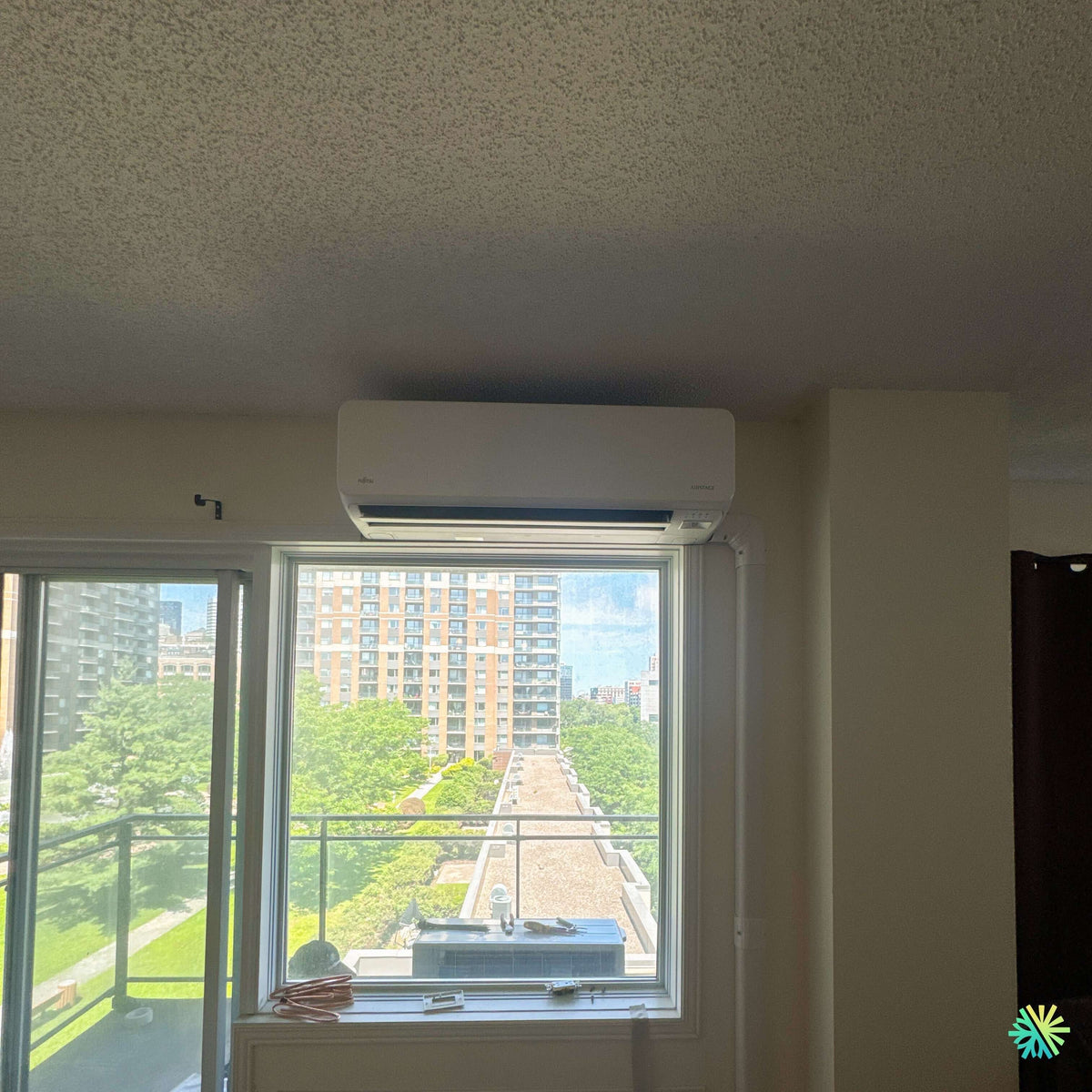
AirGreen installation of a Fujitsu AIRSTAGE ORION XLTH wall-mounted heat pump in Dorval: unit perfectly integrated above a large window, neat piping, Inverter technology, R-32, and heating down to -26 °C.
Take a tour of the installation
Each number is a point we check on site. Switch between summer and winter to watch air and heat move.
In summer, the outdoor unit rejects the house's heat outside.
Generic illustration of this type of installation, not a survey of this job site. Tap a number.
Mounted level on a wall plate, high enough for the air to reach the whole room, with enough space around it to slide the filters out easily.
The refrigerant lines, the communication cable and the drain go through the wall in a single opening, sealed against water, cold air and insects.
Two insulated copper pipes connect the two units. Outside, a line cover can protect them from sun, knocks and weather.
A shut-off switch near the outdoor unit isolates it safely for service. It must stay accessible at all times.
The compressor and the fan. In heating mode it captures heat from the outdoor air, even in winter, and moves it inside.
On the ground or on the wall, it keeps the unit above accumulated snow. The unit stays clear and defrost water can drain away.
The fan needs to blow freely. Storage, a fence or a wall too close, and efficiency drops while noise goes up.
A Dorval installation where the positioning of the wall-mounted unit made all the difference
For this project in Dorval, our AirGreen team had to integrate a Fujitsu AIRSTAGE ORION XLTH wall-mounted heat pump into a space where every positioning detail mattered. The installation photo clearly illustrates the challenge: large windows occupy almost the entire exterior wall, while an opening to the balcony is immediately to the left and a return wall limits the available space on the right.
Rather than choosing a location simply because it was easy to access, we installed the indoor unit directly above the large window, making use of a section of wall that would otherwise have been of little use. This configuration keeps the side walls available for furniture while giving the heat pump an unobstructed position for distributing air throughout the room.
The result is particularly clean: the wall-mounted unit remains visually discreet despite its central position, and the refrigerant lines are grouped in a vertical line set cover installed to the right of the window. In an apartment or condo in Dorval, where indoor space is often more limited than in a detached house, this type of planning makes a significant difference.
Why install a heat pump above a window?
Installing a wall-mounted heat pump above a window requires more precision than installing one on a large, completely unobstructed wall.
Before mounting the unit, we must check, among other things:
- the actual height available between the window frame and the ceiling;
- the required clearances around the unit;
- the wall structure and the strength of the mounting;
- the possible route for the refrigerant piping;
- the condensate drain routing;
- future accessibility for HVAC maintenance;
- the direction of the airflow to promote even distribution throughout the room.
In the photo, the heat pump is positioned very close to the ceiling while maintaining the clearance required for proper operation. The available width was also used intelligently to visually center the unit in relation to the window.
This type of finish does not depend solely on the quality of the heat pump selected. An excellent machine installed in an unsuitable location can result in less effective air circulation, complicate drainage, or make maintenance unnecessarily difficult. At AirGreen, we therefore consider the location of the indoor unit to be an integral part of HVAC system sizing and installation design.
A Neat Finish for Lines in a Highly Visible Space
Another important element of this installation in Dorval is the routing of the lines.
The lines exit the indoor unit on the right side and are then concealed in a white line cover that runs vertically down the wall. This solution protects and groups the components while maintaining a finish that matches the room’s walls and white trim.
In many wall-mounted heat pump installations in Montreal, Dorval, Laval, Longueuil, the North Shore, or the South Shore, the difference between an installation that looks improvised and a professional installation is often visible in these details.
We specifically aim to avoid:
- pipes left unnecessarily visible;
- diagonal line covers;
- excessive detours;
- a drain with insufficient slope;
- lines that make it difficult to open a window or door;
- a finish that draws more attention than the heat pump itself.
In this case, the selected vertical route keeps the installation compact and orderly.
The Fujitsu AIRSTAGE ORION XLTH: a series designed for cold climates
The Fujitsu AIRSTAGE ORION XLTH belongs to the H series of single-zone wall-mounted systems designed to provide both cooling and heating.
The Fujitsu documentation provided for this installation indicates a heating operating capacity down to -26 °C (-15 °F). The range includes several capacities, with 9,000, 12,000, 15,000, 18,000, and 24,000 BTU nominal-class systems depending on the selected combination. The technical sheet specifically lists the following systems: ASUH09KZAS/AOUH09KZAH1, ASUH12KZAS/AOUH12KZAH1, ASUH15KZAS/AOUH15KZAH1, ASUH18KZAS/AOUH18KZAH1, and ASUH24KZAS/AOUH24KZAH1.
However, the exact capacity of the unit shown in the photo cannot be confirmed solely from its exterior appearance. This is important: two visually similar wall-mounted units may have different capacities and electrical characteristics. To accurately identify an existing installation, always refer to the nameplate or model numbers.
Inverter technology: better than simple on-off operation
The Inverter technology used by the Fujitsu ORION XLTH allows the compressor to continuously adjust its output according to actual demand.
A conventional heat pump operating primarily through on-off cycling must repeat start-up and shutdown cycles to maintain the temperature. An inverter unit can instead slow down as a room approaches its target temperature and increase its output when demand becomes greater.
In a home like the one shown in this Dorval installation, with a large glazed area exposed to changes in outdoor temperature, this modulation is particularly relevant.
A large window can create:
- significant solar gains during certain periods of the summer;
- greater heat losses during cold periods;
- rapid changes in load depending on the time of day.
The system can then gradually adjust its operation instead of treating every change as a maximum-demand request.
Performance that varies according to the selected capacity
The Fujitsu technical sheet clearly shows why a heat pump should not be evaluated solely based on the series name.
For the five ORION XLTH capacities shown, the TRÈS2 values, corresponding to seasonal cooling efficiency, are respectively 33.1, 30.5, 27.5, 25.5, and 24.0 BTU/hW for the 9K, 12K, 15K, 18K, and 24K models.
The specification sheet also lists Region V CPSC2 values ranging from 10.7 to 9.4, depending on capacity.
In other words, automatically choosing the largest heat pump available is not a good strategy. A unit should be selected according to the home’s actual heating needs, rather than the assumption that a higher BTU rating is always better.
An oversized system may be less suited to the room’s actual load, while an undersized unit will have to work much harder during extreme conditions.
Impressive heating capacity when temperatures drop
The ORION XLTH series documentation also provides detailed data on capacity retention in cold weather.
Depending on the selected capacity, Fujitsu indicates maximum performance at -15 °C, -21 °C, and -26 °C. Some configurations can still provide a maximum capacity greater than their rated capacity even when the outdoor temperature is well below freezing.
This is precisely the type of specification we analyze when recommending a heat pump for the climate of Montreal and the West Island.
However, the advertised “operates down to -26 °C” value should never be the only comparison criterion. You should also consider the actual amount of heat available at low temperatures, seasonal efficiency, the building’s needs, and whether or not another heating source is present.
R-32 and the new generation of Fujitsu heat pumps
This generation of Fujitsu ORION XLTH uses R-32 refrigerant.
In its documentation, Fujitsu indicates a global warming potential of 675 for R-32, compared with 2,088 for R-410A, representing an announced reduction of 68%. The documentation also specifies that R-32 systems may require less refrigerant while maintaining their heating performance.
For a homeowner comparing different options for wall-mounted heat pumps in Dorval or Montreal, the refrigerant type is now one of the technical specifications worth checking for the exact model being offered.
Particularly quiet indoor operation
Noise is often an important concern when a wall-mounted unit is located in a living room, bedroom, or open living space.
Depending on capacity, the Fujitsu series presented in the technical sheet offers several fan speeds, plus automatic mode. On the most compact models in the range, indoor sound levels can drop to 23 dB(A) in quiet mode.
The installation visible in Dorval also benefits from an additional advantage: the unit is mounted high and away from the area directly occupied by residents. Airflow can therefore be distributed from the top of the room rather than being blown directly at occupant level.
Built-in Wi-Fi and comfort management
The series documentation also indicates built-in Wi-Fi connectivity, enabling remote monitoring and control through the AIRSTAGE mobile environment.
For many homeowners, this feature quickly becomes practical: it allows them to change a setpoint before returning home or adjust operation without being directly in front of the remote control.
Fujitsu also offers several optional control and interface options, including wired controllers as well as BACnet- and Modbus-compatible solutions for certain more advanced applications.
Dimensions that explain the importance of measuring before installation
The photo from this project particularly clearly illustrates the importance of physical dimensions.
The 9K, 12K, and 15K indoor units listed in the documentation measure approximately 980 mm wide, 280 mm high, and 240 mm deep. The 18K and 24K versions are larger, with a listed width of 1,150 mm.
In a room where the unit is to be installed above a window, these additional 170 mm can completely change the project’s feasibility.
That is why we take measurements before confirming the location. We must consider not only the unit’s total width, but also the space required for the mounting plate, access to the connections, clearance from the ceiling, and the routing of the lines.
This Dorval project shows what distinguishes a truly planned HVAC installation
The heat pump must do more than simply fit on the wall
A common mistake is to consider the installation successful as soon as the unit “fits” in the available space.
For us, this is only the beginning.
A professional installation must also take air circulation, drainage, the refrigerant line route, noise, aesthetics, and future maintenance into account.
For this project, choosing the space above the window preserves much of the available wall space while positioning the Fujitsu AIRSTAGE ORION XLTH in a logical location for air distribution.
Drainage must be planned before drilling
The drain is a relatively inconspicuous part of a heat pump installation, but poor planning can cause significant problems.
In cooling and dehumidification mode, the indoor unit produces condensation. This water must be drained properly.
When gravity drainage is possible, we generally prioritize a continuous, controlled slope. An installation around a large window therefore requires determining the drain route before definitively choosing the line-set exit point.
This preparatory work prevents the unnecessary addition of a condensate pump or multiple line-set cover sections after installation.
Check the piping for the exact model
Fujitsu documentation also shows that pipe diameters vary according to capacity.
The 9K and 12K models use a 1/4-inch liquid and 3/8-inch gas combination, while the 15K switches to 1/4-inch and 1/2-inch. The 18K and 24K models, meanwhile, use 3/8-inch and 5/8-inch.
This is an excellent example of a technical detail that must never be determined simply by looking at the indoor unit cabinet.
When replacing a heat pump, we therefore inspect the existing lines before deciding that they can be kept. The diameter, condition of the copper, compatibility with the new equipment, and the manufacturer’s requirements must all be taken into account.
What about rebates?
The Fujitsu specification sheet classifies the units presented as ENERGY STAR, including classifications related to cold climates. This may be relevant when a homeowner is looking for a heat pump eligible for a financial assistance program.
However, actual eligibility and the applicable amount must always be verified using the exact combination of indoor and outdoor units, the applicable AHRI number, and the program rules in effect at the time of the project. We therefore avoid promising an amount based solely on the name “ORION XLTH.”
This is particularly important because several capacities can belong to the same series while having distinct performance ratings and technical references.
What we take away from this AirGreen installation in Dorval
This project demonstrates that a successful wall-mounted heat pump installation depends on more than simply choosing a recognized brand.
Here, the extensive window area greatly reduced the number of possible locations. We used the space above the window, maintained a balanced layout in the room, and carefully grouped the lines along the right side.
Choosing a Fujitsu AIRSTAGE ORION XLTH, with Inverter technology, heating for cold climates down to -26 °C, R-32 refrigerant, and Wi-Fi control options, completes an installation designed for the types of conditions encountered in Greater Montreal.
At AirGreen, we carry out this type of HVAC installation in Dorval, Montreal, Laval, Longueuil, the North Shore and the South Shore, adapting each project to the building’s actual configuration rather than imposing the same solution everywhere.
A precise visit and assessment make it possible to determine the capacity actually required, the best location for the indoor unit, the position of the outdoor unit, the route of the lines, and the electrical requirements before work begins.
This preparation is what makes it possible to achieve a visually clean installation and, above all, a heat pump capable of operating as designed during Montreal’s humid summers and cold periods.
The big day, step by step
The main steps of this kind of job at AirGreen. Every house has its quirks: the estimate brings them out.
We look at the room, the outside wall, the line route and where the outdoor unit will go. That is where the capacity gets chosen.
Model, capacity and price, in writing. We also check whether the model qualifies for assistance programs.
Floors and furniture protected, wall plate position marked level, wall opening located.
A single opening, with the slope the drain needs to flow outside.
Set on a stand raised above the snow, with the clearances the manufacturer requires.
Connected, insulated and protected. The opening is then sealed against water, cold air and insects.
A dedicated circuit and an accessible disconnect near the outdoor unit.
Leak test, vacuum, then start-up and a check of heating and cooling.
Remote, modes, filters: we show you the essentials before we leave.
- The on-site estimateWe look at the room, the outside wall, the line route and where the outdoor unit will go. That is where the capacity gets chosen.
- The quoteModel, capacity and price, in writing. We also check whether the model qualifies for assistance programs.
- Getting readyFloors and furniture protected, wall plate position marked level, wall opening located.
- The wall openingA single opening, with the slope the drain needs to flow outside.
- The outdoor unitSet on a stand raised above the snow, with the clearances the manufacturer requires.
- Lines, cable and drainConnected, insulated and protected. The opening is then sealed against water, cold air and insects.
- The electrical workA dedicated circuit and an accessible disconnect near the outdoor unit.
- Tests and start-upLeak test, vacuum, then start-up and a check of heating and cooling.
- The walkthroughRemote, modes, filters: we show you the essentials before we leave.
What would it look like at your place?
Two quick checks with real numbers: what heat costs, and what your current heaters add up to in BTU/h.
Conversion: 1 W = 3.412 BTU/h. An indication, not a load calculation: baseboards and furnaces are often stronger than the real need, and they can stay as backup. AirGreen confirms the capacity on site.
Four mistakes we do not make
Flip each card to see what we do instead.
Your own project, step by step
What to do, season by season
Three habits per season for this unit. They take a few minutes and prevent many calls.
- Clean the indoor unit's filters.
- Clear leaves and debris left on the outdoor unit by winter.
- Test cooling before the first hot days.
- Clean the filters more often when the unit runs a lot.
- Keep plants away from the outdoor unit.
- Check that no water drips from the indoor unit.
- Rake the leaves around the outdoor unit.
- Test heating before the first cold days.
- Book periodic maintenance before winter.
- Keep snow away from the stand and the front of the unit.
- Let the unit defrost: it is normal.
- Never hit the ice on the fins; call us if the unit stays iced up.
Is your home ready?
Check what applies at your place. A "no" is not a refusal: it is what we sort out during the estimate.
Four statements: true or false?
It all comes down to details you have just seen.
1. In heating mode, the outdoor unit can produce water.
During defrost cycles. That water must drain away without forming ice.
2. You pick the capacity with a simple square-footage rule.
Windows, insulation, orientation and how the room is used all count. Capacity is chosen on site.
3. A multi-zone connects several indoor heads to a single condenser.
One head per room, all on the same condenser. Each room keeps its own temperature.
4. The disconnect can sit behind the patio furniture.
It must stay accessible: it is what shuts the unit off for service.
0 / 4 right answers
What people ask us about this kind of work
Does a wall-mounted heat pump heat in winter?
Wall-mounted or multi-zone: how do I choose?
Where does the outdoor unit go?
Are there grants?
Do I need a permit?
How cold can it heat?
How much can I save?
How is the LogisVert assistance calculated?
Is it noisy?
The outdoor unit is covered in ice: is that normal?
Does AirGreen hold the required licences?
Is the estimate free?
No question matches. Write to us: we answer.
More jobs to see, near you
By town, by equipment or by region: browse more than 4,700 published projects.
Each dot: a town where AirGreen has published projects. The glowing dot: this job.
Every house has its constraints. We see them before we install.
The on-site estimate is free and the quote follows within 24 hours.
Text and photo: a real AirGreen Climatisation & Chauffage job. The diagrams are generic illustrations of the type of installation, not a survey of this job site. Sources of the added figures: airgreen.ca product pages (NEEP / AHRI performance), Hydro-Québec (Heat pumps page, LogisVert, read on 13 October 2026), Régie de l’énergie (rate D as of 1 April 2026).