
Installation of a Samsung WindFree™ MaxHeat wall-mounted heat pump in Deux-Montagnes, on Montreal’s North Shore
In Deux-Montagnes, AirGreen installs a Samsung WindFree MaxHeat in a restricted space above a large window, with precise clearance, discreet lines, controlled drainage, and complete commissioning.
Take a tour of the installation
Each number is a point we check on site. Switch between summer and winter to watch air and heat move.
In summer, the outdoor unit rejects the house's heat outside.
Generic illustration of this type of installation, not a survey of this job site. Tap a number.
Mounted level on a wall plate, high enough for the air to reach the whole room, with enough space around it to slide the filters out easily.
The refrigerant lines, the communication cable and the drain go through the wall in a single opening, sealed against water, cold air and insects.
Two insulated copper pipes connect the two units. Outside, a line cover can protect them from sun, knocks and weather.
A shut-off switch near the outdoor unit isolates it safely for service. It must stay accessible at all times.
The compressor and the fan. In heating mode it captures heat from the outdoor air, even in winter, and moves it inside.
On the ground or on the wall, it keeps the unit above accumulated snow. The unit stays clear and defrost water can drain away.
The fan needs to blow freely. Storage, a fence or a wall too close, and efficiency drops while noise goes up.
A unit integrated into a narrow strip of wall above a large window
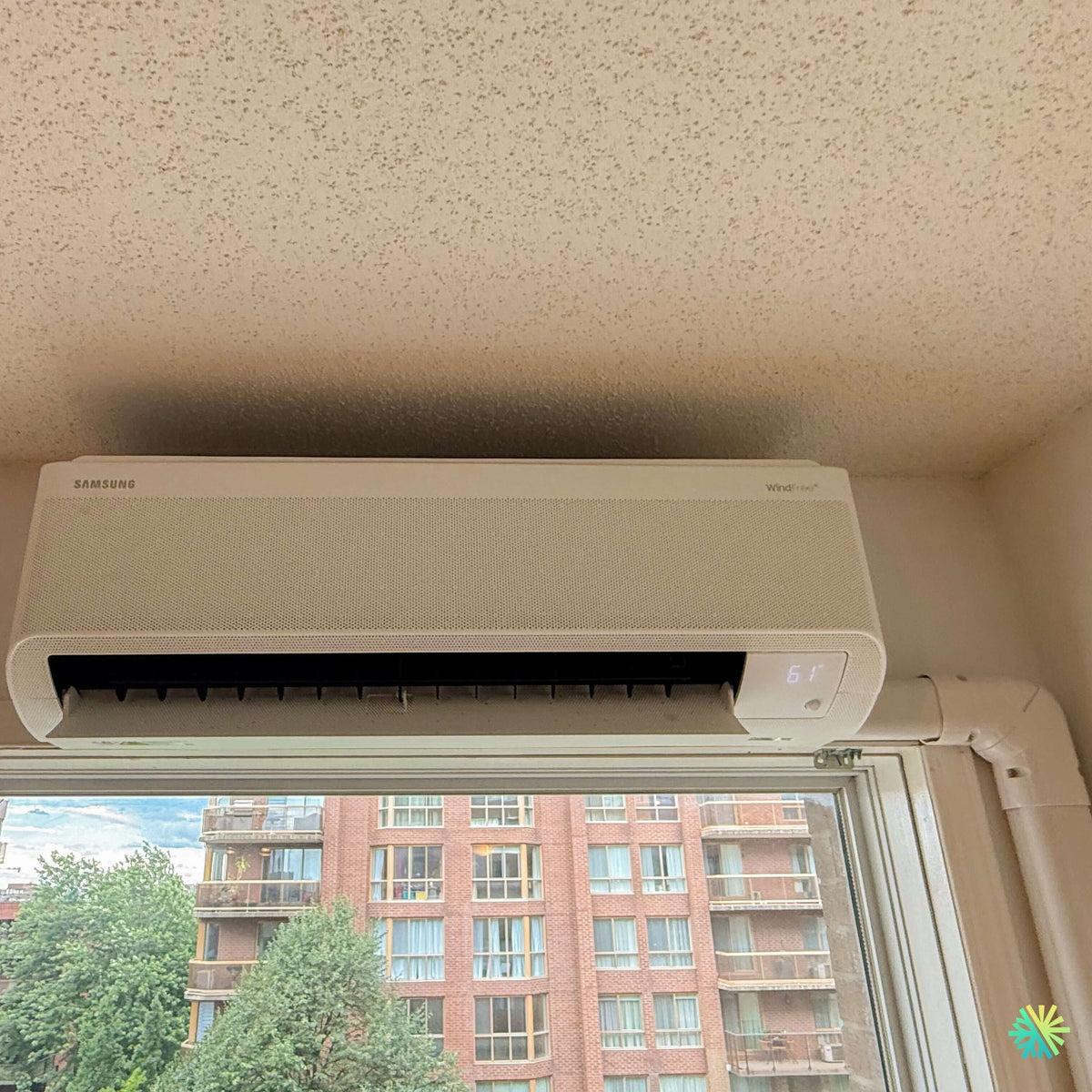
This wall-mounted heat pump installation in Deux-Montagnes stands out because of a very specific challenge: the indoor unit had to be installed between a large window and a textured ceiling, in a strip of wall offering very little room for maneuver.
In this type of configuration, the choice of location is not based solely on appearance. We must preserve air intake through the top of the unit, allow the front panel to open, maintain access to the filters, and route the lines without interfering with the window’s operation.
The photograph taken during commissioning clearly shows the result achieved. The Samsung WindFree™ MaxHeat is positioned above the glazing, near the right corner of the room. Its main louver is open, and the display shows a setpoint of 61 °F, or approximately 16 °C, used to maintain an active cooling demand during the checks.
On the right, the lines are concealed in a white line-set cover that changes direction near the unit before running down along the wall. This compact finish groups the connections together while following the room’s architectural lines.
A position that had to meet three constraints simultaneously
Installing the unit above a window requires several questions to be resolved before the first hole is drilled. For this Deux-Montagnes project, three constraints dominated the planning.
The limited clearance below the ceiling
The heat pump had to be installed high enough not to unnecessarily cover the window, but it could not be pressed against the ceiling.
Room air is drawn in mainly through the top of the indoor unit. Inadequate clearance can therefore complicate air circulation, filter removal, and panel opening during future HVAC maintenance.
We measured the actual available space while taking into account:
- the height of the casing;
- the recommended clearance above the unit;
- the opening of the front panel;
- the thickness of the textured ceiling;
- the access needed to detach the unit from its mounting plate;
- alignment with the window’s upper frame.
The ceiling had a textured finish that also needed to be protected. A unit handled too close to this surface could leave marks, detach part of the finish, or make future service work difficult.
The proximity of the side wall
The presence of the right-hand wall limited the space available for connecting the pipes. We had to retain enough room to install the line-set cover, make the bend, and allow reasonable access to the side of the unit.
A wall-mounted unit should not be chosen solely based on its BTU rating. Its physical dimensions matter just as much when installation takes place in a corner, above a door, or between a window and a ceiling.
A few centimeters can determine whether it will be possible to:
- remove the panel;
- inspect the connections;
- clean the unit properly;
- remove the unit without damaging the wall;
- carry out a future replacement without rebuilding the finish.
Alignment with the window
A large window creates a highly visible horizontal line. When a heat pump is installed directly above it, the slightest tilt becomes obvious.
We therefore positioned the mounting plate precisely so that the unit would remain visually straight in relation to the frame. However, this alignment also had to be compatible with condensate drainage and the routing of the connections.
A successful installation is not simply “centered.” It must be:
- solid;
- level;
- accessible;
- properly drained;
- suited to the air distribution;
- consistent with the interior layout.
A compact line-set cover that follows the corner of the room
The pipes of a wall-mounted heat pump are not limited to a single line. The route may include insulated refrigerant lines, the communication cable, the power supply depending on the configuration, and the condensate drain.
On this installation, the white line-set cover exits the right side of the unit, makes a bend near the corner, and runs vertically downward. This route limits the amount of visible piping above the window.
We paid particular attention to the finish of the connections between the sections. A poorly installed line-set cover can have open gaps, warped covers, or irregular changes in direction. These flaws are particularly visible in a bright room where the system is located directly above a window.
The selected route offers several advantages:
- it keeps the main wall largely clear;
- it protects the pipe insulation;
- it reduces the installation’s visual impact;
- it facilitates a later inspection;
- it allows the drain route to be controlled;
- it naturally follows the corner of the room.
A drainage slope to plan before securing the unit
In air conditioning, the indoor evaporator becomes cold and removes some of the moisture contained in the air. This water is collected in the condensate pan and then discharged through the drain.
The narrow space above the window made drainage especially important. The pipe had to leave the unit without creating an upward section that would trap water in the pan.
A back-pitched or pinched drain can cause:
- slow drainage;
- gurgling noises;
- a leak under the unit;
- water marks around the window;
- odors coming from the drain pan;
- an accumulation of damp dust;
- damage to the paint or frame.
During commissioning, we do not simply observe the line-set cover. We verify that the water actually drains and that no leaks appear around the unit.
A large window that affects cooling requirements
The glazing visible beneath the unit occupies a significant portion of the wall. Such an area can affect the room’s heating and cooling requirements depending on its orientation, window quality, and exposure to sunlight.
In summer, exposed glazing can transmit a significant amount of heat into the room. In winter, it can represent a greater area of heat loss than insulated walls.
Positioning the heat pump above this area allows it to treat the zone near the window quickly. The louver can initially direct air into the room, after which the system can reduce direct airflow as the temperature approaches the setpoint.
However, the required capacity should never be determined solely by the number of windows. We also consider:
- the area and volume of the zone;
- the number of exterior walls;
- the building’s orientation;
- the floor of the dwelling;
- insulation quality;
- ceiling height;
- air infiltration;
- the layout of the rooms;
- occupancy habits;
- the heat already present.
Why a 61 °F setpoint appears in the photo
The display of 61 °F does not necessarily represent the recommended temperature for everyday use. This low setpoint keeps the cooling demand active while the system is being checked.
During this step, we check in particular:
- the indoor unit’s start-up;
- the outdoor unit’s response;
- compressor modulation;
- the movement of the main louver;
- the airflow;
- the return-air temperature;
- the supply-air temperature;
- condensate drainage;
- the response to the remote control;
- the absence of vibrations or unusual noises.
Setting a heat pump continuously to 61 °F does not necessarily cool a room faster. The setpoint mainly asks the system to continue operating longer. For everyday use, a more moderate temperature generally provides a better balance between comfort, dehumidification, and energy consumption.
The microperforated front panel at the heart of WindFree comfort
The white front panel of the unit is covered with numerous microperforations. These allow the system to distribute conditioned air with movement that is much less noticeable when WindFree mode is activated.
The heat pump may initially use its main louver to bring the room quickly closer to the requested temperature. It can then distribute air through the microperforations to maintain the setpoint without continuously producing a direct cold draft.
Samsung states that the air velocity in WindFree mode remains below 0.15 meters per second, a level defined as practically still air according to the reference cited by the manufacturer.
This feature is particularly useful when the indoor unit is located:
- near a sofa;
- facing a workstation;
- in a bedroom;
- above a traffic area;
- in a room where occupants remain seated for long periods.
However, WindFree mode does not compensate for a poor location. The initial airflow range, existing obstacles, and communication with adjacent rooms must always be assessed before installation.
Performance, sizing, and financial assistance for a Samsung WindFree MaxHeat in Deux-Montagnes
Features that vary according to the installed capacity
The Samsung WindFree MaxHeat lineup is available in several capacities. The indoor photograph alone cannot reliably confirm the exact number of BTUs in the installed system. Some sizes use indoor cabinets with similar dimensions.
To properly identify a heat pump, we always verify:
- the complete indoor unit model;
- the complete outdoor unit model;
- the AHRI-certified combination;
- rated capacity;
- low-temperature heating capacity;
- the SEER2 and HSPF2 values.
According to Samsung’s current data, the lineup is available in capacities ranging from 9,000 to 24,000 BTU. The 12,000 BTU rated combination notably shows a SEER2 of 24.0 and an HSPF2 of 10.5, while results differ for the 9,000, 15,000, 18,000, and 24,000 BTU capacities. The lineup is designed to provide heating down to approximately -30 °C.
Samsung also states that the MaxHeat can maintain its advertised heating capacity at -15 °C and includes a bottom-pan heater to support defrosting and water drainage.
These data explain why two heat pumps with a comparable rated capacity can deliver different results during winter on the North Shore.
Sizing should not be reduced to a square-footage rule.
An approximate rule based on floor area can serve as a starting point, but it does not replace a complete assessment.
In Deux-Montagnes, the same floor area may require a different capacity depending on whether the dwelling is located:
- on the ground floor or top floor;
- above a garage;
- in a newer or older building;
- facing south or north;
- in a sheltered area or one exposed to wind;
- with standard or very high ceilings;
- with open rooms or multiple closed doors.
An oversized unit can reach its setpoint too quickly, cycle off more often, and control humidity less effectively. An undersized unit may run continuously without fully meeting needs during the hottest or coldest periods.
At AirGreen, we seek a capacity that allows the variable-speed compressor to modulate regularly. This modulation helps maintain a stable temperature and limit abrupt fluctuations.
The indoor unit’s location affects actual comfort
Even a properly sized heat pump can deliver disappointing results if air does not circulate toward occupied areas.
Before confirming the location, we examine:
- the direction of the initial airflow;
- tall furniture;
- partitions;
- doors;
- the distance to adjacent rooms;
- occupant positioning;
- heat sources;
- curtains and blinds;
- maintenance options.
In this project, the wall above the window makes it possible to preserve the living space and the side walls available for furnishing. The unit can project air toward the center of the room before switching to gentler air distribution.
A heat pump potentially eligible for LogisVert
A Samsung WindFree MaxHeat may be eligible for Hydro-Québec’s LogisVert program when the exact combination meets the applicable criteria and appears on the list in effect at the time of installation.
The regular assistance granted for an ENERGY STAR certified cold-climate heat pump is calculated according to its recognized heating capacity at -8 °C, at a rate of $120 per 1,000 BTU/h. The amount must therefore not be calculated solely from the nominal capacity indicated in the commercial name.
For certain eligible multi-unit residential buildings, the bonus brings the total rate to $220 per 1,000 BTU/h at -8 °C. This enhanced measure applies to eligible installations completed on or after June 15, 2026, and requires compliance with additional conditions relating in particular to the building and its location.
The exact amount must be confirmed with:
- the AHRI number;
- the indoor and outdoor models;
- the recognized capacity at -8 °C;
- the installation date;
- the building type;
- the applicable eligibility list.
This verification prevents announcing a rebate based on an incorrect equipment match.
Mistakes to avoid in a similar installation
Choosing the unit before measuring the vertical space
A unit installed too high can compromise air intake or access to the filters. The physical dimensions must be confirmed before ordering.
Installing the unit directly against the ceiling
Visual proximity must not come at the expense of the required clearance. You must also plan for the possibility of removing the unit from its mounting plate.
Neglecting the drain route
A perfectly straight line-set cover can conceal a reverse slope. Drainage must be tested during commissioning.
Directing the airflow toward a permanently occupied area
WindFree mode reduces perceptible airflow, but the initial positioning remains essential for comfort.
Confusing the setpoint temperature with the cooling speed
An extremely low setpoint does not change the unit's capacity. It simply extends the demand.
Determining the BTU capacity by looking only at the indoor cabinet
Several capacities may use a similar chassis. The nameplates and AHRI combination remain the reliable references.
Plan for maintenance from the day of installation
The proximity of the ceiling makes maintenance planning particularly important. The panel must be able to open, and the filters must remain accessible without damaging the textured finish.
Routine maintenance includes, among other things:
- inspection and cleaning of the filters;
- dust removal from the air intake area;
- inspection of the microperforations;
- inspection of the motorized louver;
- visual inspection of the drain;
- inspection of the outdoor unit;
- periodic cleaning of the evaporator and fan.
A WindFree front panel obstructed by dust can gradually lose diffusion quality. Cleaning must therefore be carried out using a suitable method, without spraying products directly onto the electronic components.
An installation adapted to the constraints of a North Shore home
This HVAC installation in Deux-Montagnes shows that a limited space can deliver an excellent result when the dimensions, drainage, and technical access are assessed before the work begins.
We integrated the heat pump above the window while preserving:
- functional clearance beneath the ceiling;
- access to the filters;
- air distribution toward the room;
- a compact piping route;
- a finish that follows the corner of the wall;
- verifiable drainage;
- an installation suited to the available space.
At AirGreen, we install wall-mounted heat pumps, air conditioners, and complete heating, ventilation, and air conditioning systems in Deux-Montagnes, Montréal, Laval, Longueuil, the North Shore, and the South Shore. Each project is planned according to the actual building rather than based on a standard solution applied without verification.
The big day, step by step
The main steps of this kind of job at AirGreen. Every house has its quirks: the estimate brings them out.
We look at the room, the outside wall, the line route and where the outdoor unit will go. That is where the capacity gets chosen.
Model, capacity and price, in writing. We also check whether the model qualifies for assistance programs.
Floors and furniture protected, wall plate position marked level, wall opening located.
A single opening, with the slope the drain needs to flow outside.
Set on a stand raised above the snow, with the clearances the manufacturer requires.
Connected, insulated and protected. The opening is then sealed against water, cold air and insects.
A dedicated circuit and an accessible disconnect near the outdoor unit.
Leak test, vacuum, then start-up and a check of heating and cooling.
Remote, modes, filters: we show you the essentials before we leave.
- The on-site estimateWe look at the room, the outside wall, the line route and where the outdoor unit will go. That is where the capacity gets chosen.
- The quoteModel, capacity and price, in writing. We also check whether the model qualifies for assistance programs.
- Getting readyFloors and furniture protected, wall plate position marked level, wall opening located.
- The wall openingA single opening, with the slope the drain needs to flow outside.
- The outdoor unitSet on a stand raised above the snow, with the clearances the manufacturer requires.
- Lines, cable and drainConnected, insulated and protected. The opening is then sealed against water, cold air and insects.
- The electrical workA dedicated circuit and an accessible disconnect near the outdoor unit.
- Tests and start-upLeak test, vacuum, then start-up and a check of heating and cooling.
- The walkthroughRemote, modes, filters: we show you the essentials before we leave.
What would it look like at your place?
Two quick checks with real numbers: what heat costs, and what your current heaters add up to in BTU/h.
Conversion: 1 W = 3.412 BTU/h. An indication, not a load calculation: baseboards and furnaces are often stronger than the real need, and they can stay as backup. AirGreen confirms the capacity on site.
Four mistakes we do not make
Flip each card to see what we do instead.
Your own project, step by step
What to do, season by season
Three habits per season for this unit. They take a few minutes and prevent many calls.
- Clean the indoor unit's filters.
- Clear leaves and debris left on the outdoor unit by winter.
- Test cooling before the first hot days.
- Clean the filters more often when the unit runs a lot.
- Keep plants away from the outdoor unit.
- Check that no water drips from the indoor unit.
- Rake the leaves around the outdoor unit.
- Test heating before the first cold days.
- Book periodic maintenance before winter.
- Keep snow away from the stand and the front of the unit.
- Let the unit defrost: it is normal.
- Never hit the ice on the fins; call us if the unit stays iced up.
Is your home ready?
Check what applies at your place. A "no" is not a refusal: it is what we sort out during the estimate.
Four statements: true or false?
It all comes down to details you have just seen.
1. In heating mode, the outdoor unit can produce water.
During defrost cycles. That water must drain away without forming ice.
2. You pick the capacity with a simple square-footage rule.
Windows, insulation, orientation and how the room is used all count. Capacity is chosen on site.
3. A multi-zone connects several indoor heads to a single condenser.
One head per room, all on the same condenser. Each room keeps its own temperature.
4. The disconnect can sit behind the patio furniture.
It must stay accessible: it is what shuts the unit off for service.
0 / 4 right answers
What people ask us about this kind of work
Does a wall-mounted heat pump heat in winter?
Wall-mounted or multi-zone: how do I choose?
Where does the outdoor unit go?
Are there grants?
Do I need a permit?
How cold can it heat?
How much can I save?
How is the LogisVert assistance calculated?
Is it noisy?
The outdoor unit is covered in ice: is that normal?
Does AirGreen hold the required licences?
Is the estimate free?
No question matches. Write to us: we answer.
More jobs to see, near you
By town, by equipment or by region: browse more than 4,700 published projects.
Each dot: a town where AirGreen has published projects. The glowing dot: this job.
Every house has its constraints. We see them before we install.
The on-site estimate is free and the quote follows within 24 hours.
Text and photo: a real AirGreen Climatisation & Chauffage job. The diagrams are generic illustrations of the type of installation, not a survey of this job site. Sources of the added figures: airgreen.ca product pages (NEEP / AHRI performance), Hydro-Québec (Heat pumps page, LogisVert, read on 13 October 2026), Régie de l’énergie (rate D as of 1 April 2026).