
Installation of a MIDEA 28 triple-zone heat pump in Clarenceville, in Montérégie
Installation of a MIDEA 28 triple-zone heat pump in Clarenceville: 18,000 BTU compressor, three independent zones, elevated wall mounting, and HVAC installation adapted to Quebec’s climate.
Take a tour of the installation
Each number is a point we check on site. Switch between summer and winter to watch air and heat move.
In summer, the outdoor unit rejects the house's heat outside.
Generic illustration of this type of installation, not a survey of this job site. Tap a number.
Mounted level on a wall plate, high enough for the air to reach the whole room, with enough space around it to slide the filters out easily.
The refrigerant lines, the communication cable and the drain go through the wall in a single opening, sealed against water, cold air and insects.
Two insulated copper pipes connect the two units. Outside, a line cover can protect them from sun, knocks and weather.
A shut-off switch near the outdoor unit isolates it safely for service. It must stay accessible at all times.
The compressor and the fan. In heating mode it captures heat from the outdoor air, even in winter, and moves it inside.
On the ground or on the wall, it keeps the unit above accumulated snow. The unit stays clear and defrost water can drain away.
The fan needs to blow freely. Storage, a fence or a wall too close, and efficiency drops while noise goes up.
Three comfort zones, one compressor: a MIDEA 28 installation tailored to a home in Clarenceville
In Clarenceville, this installation project led us to work with a particularly interesting configuration for homeowners who want to improve both the heating and cooling of several rooms without multiplying the number of outdoor units. We installed a MIDEA 28 three-zone heat pump, a solution that allows three indoor units to be powered by a single outdoor compressor.
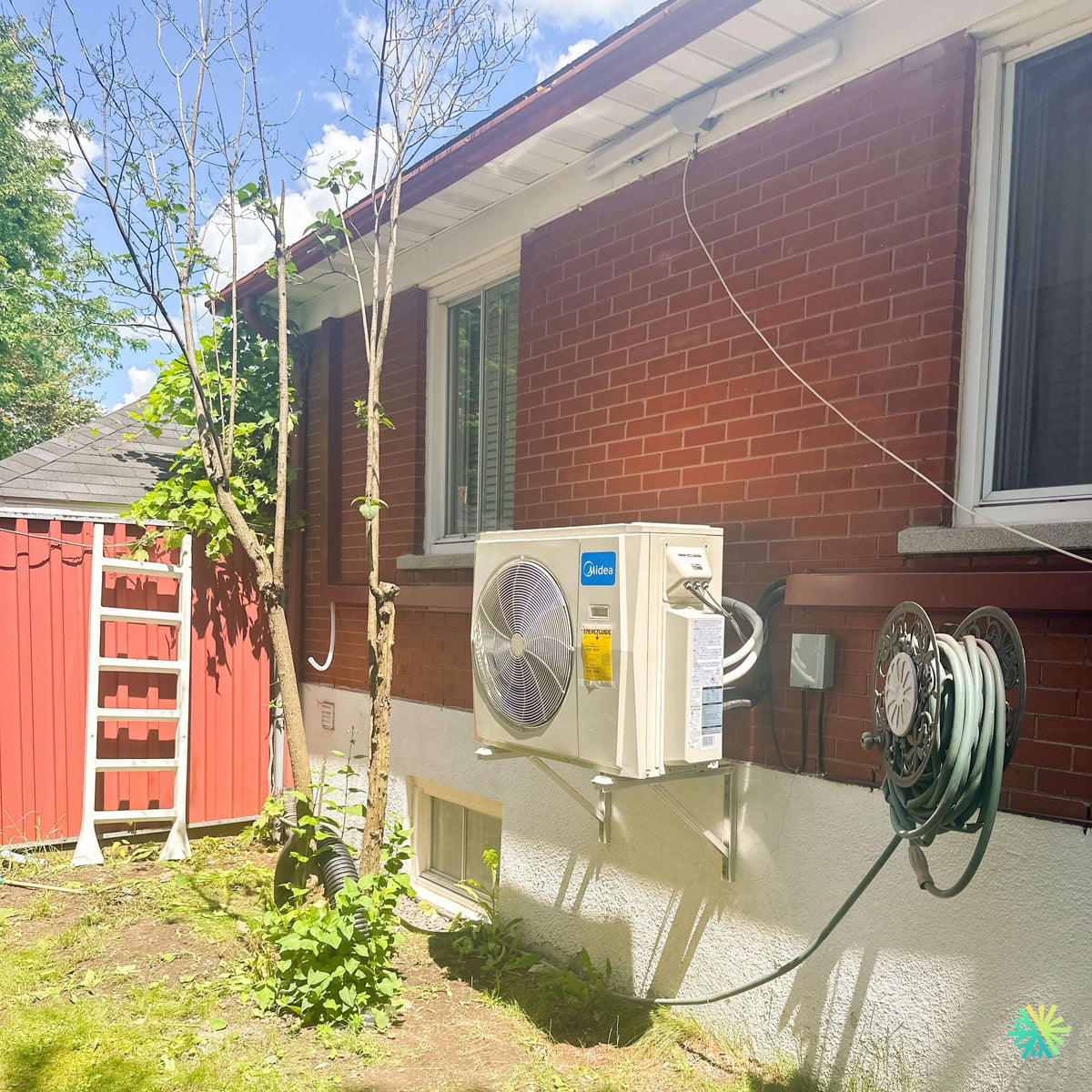
The photo of this installation clearly illustrates a reality we regularly encounter in HVAC in Quebec : the equipment must be selected based on its performance, but its location must also take into account the existing architecture, windows, foundation, available clearance, access for maintenance, winter snow accumulation, and the route of the refrigerant lines.
Here, the MIDEA outdoor unit was installed beside a brick house, above the foundation, in a yard where several features reduced the usable space: a basement window, vegetation, a nearby tree, and outdoor accessories attached to the building. Our goal was therefore to carry out a three-zone heat pump installation compact, accessible, and suited to four-season use.
Why a three-zone heat pump made sense for this property
A multi-zone heat pump connects several indoor units to a single outdoor unit. In the MIDEA technical documentation provided for this installation, the principle is clearly defined: each indoor unit serves its own space and can receive a temperature setting suited to the room concerned.
For a home with, for example, a main living area and two bedrooms, this design offers great flexibility. The owner does not have to maintain exactly the same temperature everywhere.
It becomes possible to:
- maintain more heating in a frequently occupied room;
- reduce demand in an unoccupied bedroom during the day;
- quickly cool a sun-exposed zone;
- avoid installing three separate compressors around the building;
- control the three spaces much more precisely than with a single oversized wall-mounted unit.
MIDEA’s documentation also highlights the benefit of operating only the zones that need it rather than systematically conditioning the entire house.
However, it is important to understand one key nuance: multi-zone heat pump does not correspond to three completely independent systems. The temperatures can be set separately, but units connected to the same compressor normally operate in the same main mode, either heating or cooling.
The 18,000 BTU MIDEA 28 TripleZone: the technical data that really matters
The configuration MIDEA 28 TripleZone paired with the outdoor compressor MO3HX-H18B-2A has a nominal capacity of 18,000 BTU/h. The system is designed to supply up to three zones, and the reference configuration in MIDEA documentation combines three 6,000 BTU All Easy Pro indoor units with the MO3HX-H18B-2A compressor, under number AHRI 215471457.
For this model, the main specifications include:
- outdoor compressor: MO3HX-H18B-2A;
- nominal capacity: 18,000 BTU/h;
- up to three zones;
- R-454B refrigerant;
- heating operation designed for temperatures reaching approximately -30°C;
- SEER2: 25.0;
- EER2: 15.0;
- HSPF2: 10.4;
- certification ENERGY STAR®;
- certification ENERGY STAR® cold climate;
- AHRI: 215471457;
- power supply 208/230 V, single-phase, 60 Hz;
- announced outdoor sound level of approximately 62 dB(A);
- approximate outdoor dimensions of approximately 37.25 x 16.13 x 31.88 in.;
- MCA of 16 A and maximum overcurrent protection of 20 A for this model.
The MIDEA 28 data sheet provided by AirGreen also confirms the R-454B refrigerant, low-temperature operation, AHRI 215471457, and the main efficiency ratings for this configuration.
These figures are particularly useful when comparing a heat pump solely on its purchase price. Two 18,000 BTU systems do not necessarily deliver the same performance in January or have the same annual energy consumption. The SEER2, the HSPF2, low-temperature capacities and certification for the complete combination must be included in the analysis.
A wall-mounted installation that directly addresses the constraints visible at the site
One of the most important elements of this installation in Clarenceville is the outdoor bracket.
We installed the compressor on a metal structure attached to the wallrather than placing it directly near the ground. In the photo, the unit is clearly raised above the foundation and basement window.
This choice offers several advantages in a climate like Quebec’s.
Keep the unit above the snow
A heat pump must be able to freely draw in and exhaust air even in the middle of winter. An installation that is too low may become surrounded by snow after a few storms or after the snowblower passes.
By raising the compressor, we reduce the risk of the unit’s base being blocked by a significant accumulation.
This obviously does not relieve the owner of the need to clear snow around the heat pump, but it provides a much more useful safety margin.
Keep clear space in front of the fan
In this installation, the large front fan faces the yard. It is not pointed directly at a wall or enclosed in a narrow space.
This is essential. An outdoor heat pump must be able to move a considerable amount of air. An obstacle placed too close to the fan can promote air recirculation, reduce efficiency, and complicate operation in cold weather.
Avoid blocking the basement window
The unit is positioned high enough that it is not simply placed in front of the basement window.
In a project involving a heat pump in Montreal, Laval, Longueuil, on the North Shore or the South Shorethis kind of detail may seem secondary when preparing the quote. On site, however, it directly affects the final result.
A good location must respect the building before even taking the heat pump's aesthetics into account.
Vibration-damping supports: a small detail that matters on a masonry wall
In the photo, we can also see the contact points between the heat pump and its metal support.
When a compressor is mounted on a wall bracket, we pay particular attention to vibrations. A modern inverter unit modulates its speed and often operates at low speed for long periods. A rigid mechanical installation can nevertheless transmit certain vibrations to the structure.
The support, anchors, and vibration-damping components must therefore be installed correctly.
This attention is particularly relevant when the outdoor unit is located near:
- a bedroom;
- a living room;
- a window;
- a lightweight structure;
- or a wall that could easily transmit vibrations indoors.
A triple-zone installation requires more precision than a single-zone system
The outdoor compressor is only part of the work. A triple-zone heat pump involves three circuits to the indoor spaces.
This means more refrigerant piping, more communication wiring, and three condensate drains to plan according to the home's configuration.
Each route must be assessed before drilling.
At AirGreen, we pay particular attention to:
- the actual length of each refrigerant line;
- the elevation difference between the compressor and the indoor units;
- the location of the building penetrations;
- pipe insulation;
- the exterior protection of the lines;
- the slopes required for condensate drains;
- future access for maintenance;
- the electrical configuration;
- vacuuming down the system and performing a leak check before startup.
On a multi-zone system, a connection error between a refrigerant line and its corresponding wiring can also be much more difficult to diagnose than with a simple wall-mounted unit.
MIDEA incorporates a technology called SynchroConnectAccording to the manufacturer’s documentation, the system can diagnose mismatches between the electrical connections and the refrigerant circuits and help synchronize them during commissioning.
This feature does not replace a rigorous installation. Rather, it provides additional protection during the commissioning of a system with multiple circuits.
Sizing three zones does not mean adding BTUs at random.
This is probably one of the most common mistakes homeowners make when comparing multi-zone heat pumps.
An 18,000 BTU compressor can accommodate different combinations of indoor units, but that does not mean each head will always deliver its maximum rated capacity simultaneously.
MIDEA itself specifies in its combination table that when the total rated capacity of the indoor units exceeds the capacity of the outdoor compressor, the capacity actually available to each unit may be reduced, a phenomenon that is particularly noticeable in heating mode.
That is exactly why we do not size a system solely based on the building’s total area.
We also consider:
- the area of each zone;
- the number of exterior walls;
- windows;
- solar orientation;
- insulation;
- ceiling height;
- air circulation between rooms;
- how each space is used;
- low-temperature heating needs.
A closed 120 sq. ft. bedroom does not have the same needs as a 600 sq. ft. open-plan kitchen and living room, even though both are part of the same building.
This Clarenceville project illustrates what a good multi-zone installation needs to account for from the outset.
One MIDEA 28 triple-zone It is interesting because it concentrates three comfort zones on a single outdoor platform. But the final quality depends just as much on the installation as on the unit itself.
At this Clarenceville job site, the visible result reflects several important technical decisions: an elevated compressor, unobstructed access to the fan side, access to the service side, positioning compatible with the basement window, and connections grouped near the building.
The electrical circuit must be checked before installation.
The photo also shows the outdoor electrical disconnect located near the compressor.
For the configuration MO3HX-H18B-2A, the technical data indicates a 208/230 V power supply and electrical specifications that must be respected when selecting the circuit and its protection. Never choose the circuit breaker simply because an old heat pump already occupied the same location.
When replacing a unit, we check:
- the voltage;
- the gauge of the existing wiring;
- the minimum ampacity required by the manufacturer;
- the maximum permitted protection;
- the condition of the outdoor disconnect;
- the available space in the electrical panel.
This verification helps avoid a frustrating situation in which the new unit is mechanically installed but cannot be properly commissioned.
LogisVert: check the AHRI number rather than relying solely on the MIDEA 28 name
The LogisVert rebate is another important consideration for homeowners evaluating a heat pump in Quebec.
Since November 26, 2025, Hydro-Québec has indicated, among other things, that installed heat pumps must be ENERGY STAR® certified to qualify for financial assistance. Hydro-Québec also recommends conducting the search using the AHRI number, since eligibility and amounts may vary depending on the installed combination, the work date, and the applicant’s situation.
For the MIDEA 28 presented here, the important reference number to remember for the 18,000 BTU ductless triple-zone configuration is AHRI 215471457.
We always prefer to validate the application using the LogisVert list in effect at the time of installation rather than quoting an amount based on an outdated schedule. Hydro-Québec also specifies that an application should generally be submitted within nine months following installation.
The mistakes we seek to avoid in a triple-zone installation
A multi-zone installation requires more planning than it may appear to once completed.
Among the problems we systematically seek to prevent:
- a compressor installed too close to the ground, where snow can block airflow;
- improper sizing of the indoor units, creating short cycles or uncomfortable areas;
- an improperly matched total indoor-unit capacity to the outdoor compressor;
- unnecessarily long refrigerant lines, which complicate the work and can affect performance;
- improperly positioned drains, which can cause leaks or damage indoors;
- insufficient service access around the outdoor unit;
- poor vibration management on a wall bracket;
- an unverified power supply before the installers arrive;
- a poor understanding of multi-zone operation, particularly regarding the heating or cooling mode shared by the system.
A clean installation therefore involves more than properly aligning the compressor on its bracket. The decisions hidden behind the machine are often the ones that determine the system's reliability after several winters.
Why this MIDEA 28 is relevant well beyond Clarenceville
The context of this Clarenceville home differs from that of a duplex in Montreal, a bungalow in Laval, a two-story home in Longueuil or a property located on the North Shore or the South Shore. Yet the challenges are often similar.
Homeowners generally seek:
- multiple temperature zones without installing several compressors;
- efficient heating during Quebec winters;
- precise cooling in summer;
- controlled electricity consumption;
- a compact outdoor installation;
- equipment eligible, whenever possible, for financial assistance programs;
- a system that can be properly maintained for many years.
The MIDEA 28 is particularly well suited to projects where three separate spaces need to be served by a single outdoor unit.
At AirGreen, the equipment is selected after analyzing the building
We install heat pumps, multi-zone systems, and other HVAC in Montreal, Laval, Longueuil, on the North Shore and South Shore, as well as in several municipalities across the greater region.
Our approach to a triple-zone system begins with understanding the building: the rooms to be served, distances, the electrical panel, possible indoor-unit locations, drains, and the compressor's actual location.
This MIDEA 28 installation in Clarenceville shows why this step is important.
The compressor ultimately occupies a relatively small portion of the exterior wall. Yet behind this result are the selection of the three zones, sizing, bracket positioning, line routing, electrical coordination, evacuation, operational testing, and verification of each indoor unit.
It is this attention to detail that transforms a triple-zone heat pump into a true home comfort system.
For a MIDEA 28 heat pump, a new HVAC installation or replacement of an existing system at Montreal, Laval, Longueuil, on the North Shore or South Shorewe can analyze the property, determine the appropriate capacities for each area, and prepare an installation suited both to the building and to the manufacturer's technical requirements.
The big day, step by step
The main steps of this kind of job at AirGreen. Every house has its quirks: the estimate brings them out.
We look at the room, the outside wall, the line route and where the outdoor unit will go. That is where the capacity gets chosen.
Model, capacity and price, in writing. We also check whether the model qualifies for assistance programs.
Floors and furniture protected, wall plate position marked level, wall opening located.
A single opening, with the slope the drain needs to flow outside.
Set on a stand raised above the snow, with the clearances the manufacturer requires.
Connected, insulated and protected. The opening is then sealed against water, cold air and insects.
A dedicated circuit and an accessible disconnect near the outdoor unit.
Leak test, vacuum, then start-up and a check of heating and cooling.
Remote, modes, filters: we show you the essentials before we leave.
- The on-site estimateWe look at the room, the outside wall, the line route and where the outdoor unit will go. That is where the capacity gets chosen.
- The quoteModel, capacity and price, in writing. We also check whether the model qualifies for assistance programs.
- Getting readyFloors and furniture protected, wall plate position marked level, wall opening located.
- The wall openingA single opening, with the slope the drain needs to flow outside.
- The outdoor unitSet on a stand raised above the snow, with the clearances the manufacturer requires.
- Lines, cable and drainConnected, insulated and protected. The opening is then sealed against water, cold air and insects.
- The electrical workA dedicated circuit and an accessible disconnect near the outdoor unit.
- Tests and start-upLeak test, vacuum, then start-up and a check of heating and cooling.
- The walkthroughRemote, modes, filters: we show you the essentials before we leave.
What would it look like at your place?
Two quick checks with real numbers: what heat costs, and what your current heaters add up to in BTU/h.
Conversion: 1 W = 3.412 BTU/h. An indication, not a load calculation: baseboards and furnaces are often stronger than the real need, and they can stay as backup. AirGreen confirms the capacity on site.
Four mistakes we do not make
Flip each card to see what we do instead.
Your own project, step by step
What to do, season by season
Three habits per season for this unit. They take a few minutes and prevent many calls.
- Clean the indoor unit's filters.
- Clear leaves and debris left on the outdoor unit by winter.
- Test cooling before the first hot days.
- Clean the filters more often when the unit runs a lot.
- Keep plants away from the outdoor unit.
- Check that no water drips from the indoor unit.
- Rake the leaves around the outdoor unit.
- Test heating before the first cold days.
- Book periodic maintenance before winter.
- Keep snow away from the stand and the front of the unit.
- Let the unit defrost: it is normal.
- Never hit the ice on the fins; call us if the unit stays iced up.
Is your home ready?
Check what applies at your place. A "no" is not a refusal: it is what we sort out during the estimate.
Four statements: true or false?
It all comes down to details you have just seen.
1. In heating mode, the outdoor unit can produce water.
During defrost cycles. That water must drain away without forming ice.
2. You pick the capacity with a simple square-footage rule.
Windows, insulation, orientation and how the room is used all count. Capacity is chosen on site.
3. A multi-zone connects several indoor heads to a single condenser.
One head per room, all on the same condenser. Each room keeps its own temperature.
4. The disconnect can sit behind the patio furniture.
It must stay accessible: it is what shuts the unit off for service.
0 / 4 right answers
What people ask us about this kind of work
Does a wall-mounted heat pump heat in winter?
Wall-mounted or multi-zone: how do I choose?
Where does the outdoor unit go?
Are there grants?
Do I need a permit?
How cold can it heat?
How much can I save?
How is the LogisVert assistance calculated?
Is it noisy?
The outdoor unit is covered in ice: is that normal?
Does AirGreen hold the required licences?
Is the estimate free?
No question matches. Write to us: we answer.
More jobs to see, near you
By town, by equipment or by region: browse more than 4,700 published projects.
Each dot: a town where AirGreen has published projects. The glowing dot: this job.
Every house has its constraints. We see them before we install.
The on-site estimate is free and the quote follows within 24 hours.
Text and photo: a real AirGreen Climatisation & Chauffage job. The diagrams are generic illustrations of the type of installation, not a survey of this job site. Sources of the added figures: airgreen.ca product pages (NEEP / AHRI performance), Hydro-Québec (Heat pumps page, LogisVert, read on 13 October 2026), Régie de l’énergie (rate D as of 1 April 2026).