
Installation of a Broan-NuTone V160H80RT air exchanger (AI series, Virtuo technology) in Les Cèdres, in Vaudreuil-Soulanges
An already occupied mechanical room and a network of ducts to work around: here’s how we installed a Broan-NuTone V160H80RT AI Series air exchanger in Les Cèdres. Virtuo auto-balancing, 82% recovery efficiency, MERV 8 filtration, and airflow set to 105 CFM.
Take a tour of the installation
Each number is a point we check on site. Switch between summer and winter to watch air and heat move.
Generic illustration of this type of installation, not a survey of this job site. Tap a number.
It removes stale air and brings in fresh air. The two airflows cross in the core without mixing.
It recovers part of the heat from the outgoing air to temper the incoming air. Depending on the model, it also manages humidity.
An outdoor hood, kept away from the exhaust so the house does not pull back the air it just removed.
Humid, stale air leaves through its own hood, fitted with a damper.
The ducts that connect to the outside are insulated to prevent condensation inside the house.
Stale air is drawn from humid rooms and fresh air is sent to living areas. The airflows are balanced.
It sets the mode and speed. You use it more when the house is humid or full of people.
Depending on the model and the season, the core produces condensation, removed through a drain with its loop.
Three square meters of mechanical-room space, an existing duct network, and a unit that had to fit between the two
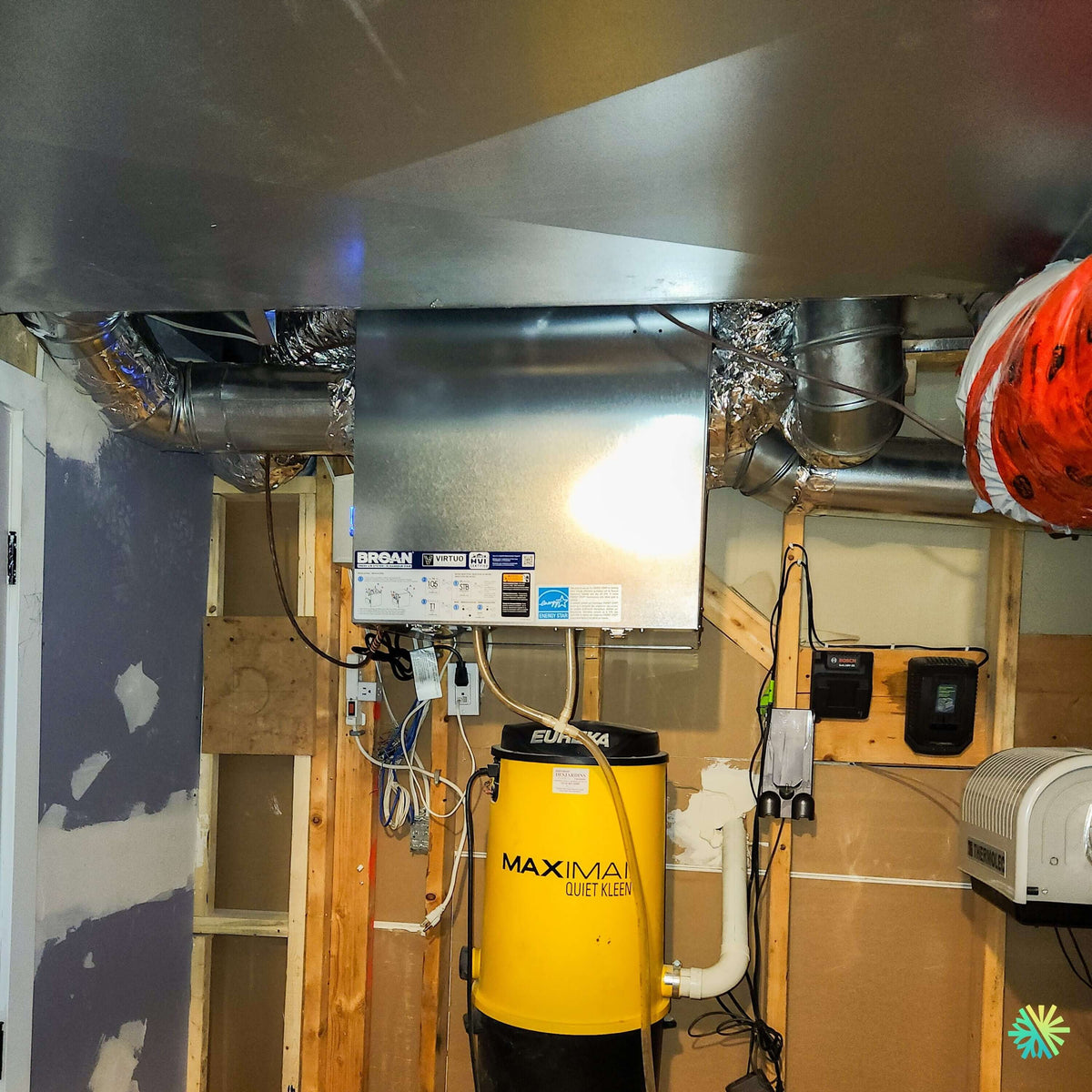
The project entrusted to us in Les Cèdres was nothing like a new-construction project where everything is drawn up on paper before anything is drilled. We arrived in an already occupied corner of the basement: a wall-mounted central vacuum, a Thermolec electric coil installed on the existing network, a tool-charger panel, a half-finished partition, and a rectangular plenum running across the ceiling from one wall to the other. The space available for an air exchanger was limited to a rectangle of wall above the vacuum.
It was in this context that we installed a Broan-NuTone V160H80RT, a heat-recovery ventilator from the AI series equipped with Virtuo technology, connected to the existing duct network rather than to a completely dedicated network. The result fits in a single photo, but it rests on a series of decisions that deserve to be explained, because they are exactly the questions homeowners in Vaudreuil-Soulanges ask us when requesting a quote.
Why Les Cèdres has its own rules
The residential housing stock in Les Cèdres has changed considerably over the past twenty years. Row houses and properties along the channel have been joined by entire developments of bungalows and cottages built to significantly stricter airtightness requirements. These homes heat well. They ventilate poorly because their envelopes no longer allow air to enter accidentally.
We therefore see two types of customers in the area, and they do not need the same thing:
- The newer home, often equipped with a complete central duct network and sometimes an original ventilation unit that has reached the end of its service life. The work involves replacing and correcting it.
- The 1980s-to-2000 home renovated in stages, whose envelope was tightened without the ventilation system keeping pace. That was the case here.
In both situations, having a functional duct network radically changes the cost and duration of the project. It is the first factor we assess during the technical visit.
The AI series and Virtuo technology: what self-balancing really changes
The Broan-NuTone AI series is based on a principle that has changed the way we work: the unit electronically measures its own airflow and adjusts itself.
In practical terms, the installer selects the target airflow on the unit’s built-in LCD screen, within a range of 35 to 159 CFM for this model. The HRV then checks the intake and exhaust airflow and adjusts the speed of its two motors until balance is achieved. Motorized dampers replace mechanical backdraft dampers. The system then continues to compensate during operation as the filters become loaded and outdoor conditions vary.
What auto-balancing does, and what it does not do
This needs to be clear, because the argument is often poorly marketed.
What Virtuo solves: the gap between supply and exhaust airflow, drift over time caused by dirty filters, and human error when reading instruments.
What Virtuo does not solve: a duct that is too long, a crushed flex duct, a poorly positioned exterior hood, a fresh-air intake located one meter from the dryer exhaust, or a target airflow that was miscalculated from the outset. If the system imposes a pressure drop the unit cannot overcome, auto-balancing will simply reach equilibrium at an airflow below the target—and the homeowner will notice nothing unless they open the display.
In other words, the technology shifts the value of the work. It does not eliminate it. It concentrates that value in network layout, sizing, and commissioning. That is precisely where the difference between two bids that look similar on paper is determined.
Specifications of the Broan-NuTone V160H80RT
- Type: heat recovery ventilator (HRV), AI series
- Adjustable airflow: 35 to 159 CFM, selected on the display
- Sensible recovery efficiency (SRE): 82% at 0°C and 67% at -25°C
- Fan efficiency: approximately 2.3 CFM/watt
- Motors: electronically commutated PMSM (ECM)
- Filtration : MERV 8
- Connections: four 6-inch ports on top of the unit
- Dimensions: 21.5 × 21 × 16.3 in. (approximately 54.6 × 53.3 × 41.4 cm)
- Weight: 35 lb (approximately 15.9 kg)
- Power supply: 120 V, 60 Hz, 2.4 A, 163 W, 6-foot cord
- Defrost: by recirculation
- Cabinet: corrosion-resistant galvanized steel, one-piece molded expanded polystyrene insulation
- Certifications: HVI, cUL/UL certification, and ENERGY STAR certification
- Warranty : 10 years on the core
- Installation: suspended by chains or wall-mounted on universal brackets, both included
Translating 82% into real-world air
Claimed efficiency remains an abstraction until it is translated into a perceptible temperature.
On a January night at -25 °C, with the house maintained at 21 °C, the temperature difference to overcome is 46 degrees. At 67% ERS under these conditions, fresh air enters the house at approximately 6 °C instead of -25 °C, without any electric heating element or burner being used. The heating system absorbs the remainder of the difference, and it is marginal.
At 0 °C, a temperature that represents a much larger portion of our heating season than the extremes, the unit recovers 82 % of the outgoing air. That is the figure that affects the annual bill, not the figure for the three coldest nights of the year.
The connection: dedicated, simplified, or integrated into the existing system
Broan recognizes several installation configurations, and the choice is not merely cosmetic.
The fully dedicated system is the most effective: the air exchanger draws stale air directly from wet rooms (bathrooms, kitchen, basement) and supplies fresh air to living areas and bedrooms, independently of the heating system. This is the preferred configuration in homes heated with hot water, electric baseboards, or radiant floors.
The configuration integrated into the forced-air system, selected here, connects the unit to the existing central duct network. It considerably reduces work in finished ceilings, which was the client's objective. However, it comes with one non-negotiable condition: the central system's fan must operate continuously at low speed or be interlocked with the HRV; otherwise, fresh air remains trapped in the ducts instead of being distributed. We always explain this before proposing this approach, because a client who shuts off continuous circulation to save money cancels out part of the benefit of the investment.
The work process
- Clearance survey and verification. A wall-mounted installation was chosen instead of chain suspension: the ceiling was occupied by the main plenum, and the wall mount provides full front access to the door for filter and core maintenance.
- Installation of the universal brackets and unit. Leveling checked in both axes. An HRV installed crookedly drains poorly.
- Connection of the four 6-inch ducts. Transitions made with rigid galvanized ductwork and adjustable elbows; insulated flexible-duct sections kept short and taut, with the vapor barrier closed and sealed with aluminum tape at every joint.
- Exterior penetrations. Two separate hoods, with the required separation distance maintained between the fresh-air intake and stale-air exhaust; the intake is located away from the dryer vent and parking area.
- Dual drain. Both of the unit's condensate outlets were connected using the supplied push-fit hoses, with a continuous slope and a water test before closing everything up.
- Power supply. Connection to a nearby dedicated 120 V outlet, with a 6-foot cord and no extension cord.
- Wall control wiring to the main floor, away from power cables to prevent induction.
- Commissioning. Selecting the target airflow on the LCD screen, running the auto-balancing sequence, then verifying the measured airflow rates displayed by the unit. The setpoint selected for this home was established at 105 CFM for continuous ventilation.
Coexisting with the rest of the mechanical room
This project illustrates a reality that generic articles leave out: an air exchanger almost never ends up in an empty room.
- The central vacuum located directly beneath the unit requires clearance for emptying the canister. The elevated wall-mounted installation preserves this clearance.
- The electric coil installed in the ductwork requires fresh air to be introduced upstream, never directly downstream of a heat source, to avoid distorting the safety readings.
- The wall penetrations were sealed because a mechanical room under negative pressure draws air through every available leak.
- Access to the service door was preserved across its full width. A unit that cannot be opened is a unit that will never be serviced.
The mistakes we correct most often in Les Cèdres
- Relying on auto-balancing to compensate for a poor duct system. The unit will reach balance, but at a reduced airflow rate.
- Connecting the fresh air intake to the return without interlocking the central fan. Fresh air then circulates only when the heating or air conditioning is running.
- Installing the two exterior hoods side by side. Exhaust air is drawn back in, and the unit recycles its own moisture.
- Omitting the trap or drain slope. Condensate stagnates, freezes around the perimeter, or allows drain odours to travel back up.
- Leaving a three-metre slack flexible duct where one metre of rigid duct would have been enough. Every tight bend reduces airflow, and therefore efficiency and electricity consumption.
- Never reopen the screen after commissioning. The unit displays its actual airflow rates: this is the first free diagnostic tool available to the owner.
V160H80RT Maintenance
- Every 3 months: check and clean or replace the MERV 8 filters. During pollen season or after renovation work, shorten the interval.
- Every 6 months: remove the core, vacuum it, rinse it with warm soapy water, and let it dry completely.
- Every 12 months: inspect the exterior hoods for leaves, lint, frost, and insects; confirm that both drains flow properly; and reread the airflow rates shown on the display.
- Continuously: lower the humidity setting as the outdoor temperature drops to prevent condensation from returning to the windows.
HVAC maintenance for the air exchanger naturally fits into the annual visit for the heat pump or central system, avoiding a second service call.
Regulations, Novoclimat, and financial assistance
Residential mechanical ventilation in Quebec is governed by the Construction Code and CSA F326, which establishes the required total capacity according to the number and type of rooms. New homes certified under Novoclimat require balanced ventilation: the HRV is the usual solution.
Financially, an air exchanger is rarely subsidized as standalone equipment. It is generally covered as part of a comprehensive energy assessment, in which the building envelope's airtightness and ventilation are analyzed together. Current programs change regularly: we verify them with each client when preparing the quote, rather than announcing an amount that may no longer exist when the contract is signed.
Have your Broan-NuTone air exchanger installed with AirGreen
We design, install, and maintain residential ventilation systems in Les Cèdres, Coteau-du-Lac, Vaudreuil-Dorion, Saint-Lazare, Pointe-des-Cascades, Saint-Zotique, the West Island, as well as Montreal, Laval, Longueuil, the North Shore, and the South Shore.
Our method never changes. We measure before making recommendations: conditioned floor area, number and type of rooms, existing ductwork, combustion appliances, and actual clearances in the mechanical room. We install with materials built to last: rigid ductwork wherever possible, short and taut flexible ductwork elsewhere, aluminum sealing, and connected, tested drains. We document the commissioning, including measured airflow rates, so the next technician knows exactly where the system was set and why.
For an assessment of your HVAC installation needs or a quote for a Broan-NuTone air exchanger, contact our team. We come to your location, take measurements, and explain what you are buying before you buy it.
The big day, step by step
The main steps of this kind of job at AirGreen. Every house has its quirks: the estimate brings them out.
We locate the wall for the two outdoor hoods, the unit's spot, service access and the drain.
The unit, its location and the price, in writing.
Hung or set level, with clear access to the filters and the core.
Fresh air intake and exhaust, kept apart and sealed.
The ones connected to the outside are insulated to prevent condensation inside the house.
Connected with its loop, when the unit needs one.
Installed where you will see it and use it.
Incoming and outgoing airflows are adjusted so the house is neither pressurized nor depressurized.
Speeds, filters, core: how to use it through the seasons.
- The on-site estimateWe locate the wall for the two outdoor hoods, the unit's spot, service access and the drain.
- The quoteThe unit, its location and the price, in writing.
- The unitHung or set level, with clear access to the filters and the core.
- The outdoor hoodsFresh air intake and exhaust, kept apart and sealed.
- The ductsThe ones connected to the outside are insulated to prevent condensation inside the house.
- The drainConnected with its loop, when the unit needs one.
- The wall controlInstalled where you will see it and use it.
- BalancingIncoming and outgoing airflows are adjusted so the house is neither pressurized nor depressurized.
- The walkthroughSpeeds, filters, core: how to use it through the seasons.
Four mistakes we do not make
Flip each card to see what we do instead.
Your own project, step by step
What to do, season by season
Three habits per season for this unit. They take a few minutes and prevent many calls.
- Clean the filters and core as the manufacturer specifies.
- Check the outdoor hoods: nests, debris, dampers.
- Lower the speed if the outdoor air gets humid.
- Adjust the speed to the humidity in the house.
- Check that the drain flows.
- Keep the outdoor hoods clear.
- Clean the filters before the closed-house season.
- Check the exhaust damper.
- Book a full cleaning if the unit has not had one in a long time.
- Clear snow from both outdoor hoods.
- Raise the speed if condensation appears on windows.
- Let the unit run: with the house closed, humidity builds up.
Is your home ready?
Check what applies at your place. A "no" is not a refusal: it is what we sort out during the estimate.
Four statements: true or false?
It all comes down to details you have just seen.
1. In an air exchanger, fresh air and stale air mix.
The two airflows cross in the core without mixing.
2. The two outdoor hoods must be kept apart.
Otherwise the exchanger pulls back the air it just removed.
3. An air exchanger can help with condensation on windows.
It renews the air and helps keep humidity in the right range.
4. An exchanger never needs maintenance.
Filters and core get dirty and need regular cleaning.
0 / 4 right answers
What people ask us about this kind of work
What does an air exchanger do?
Does fresh air cool the house in winter?
What speed should it run at?
Does an exchanger need cleaning?
What are the signs of poor ventilation?
HRV or ERV: what is the difference?
Should it run in winter?
Does AirGreen hold the required licences?
Is the estimate free?
No question matches. Write to us: we answer.
More jobs to see, near you
By town, by equipment or by region: browse more than 4,700 published projects.
Each dot: a town where AirGreen has published projects. The glowing dot: this job.
Every house has its constraints. We see them before we install.
The on-site estimate is free and the quote follows within 24 hours.
Text and photo: a real AirGreen Climatisation & Chauffage job. The diagrams are generic illustrations of the type of installation, not a survey of this job site. Sources of the added figures: airgreen.ca product pages (NEEP / AHRI performance), Hydro-Québec (Heat pumps page, LogisVert, read on 13 October 2026), Régie de l’énergie (rate D as of 1 April 2026).